 Translate




Meeting materials
Attend the meeting
Free language assistance services are available for this meeting. Contact WES at 503-742-4567 (48-hour notice needed).
Agenda
Facilitator: Greg DiLoreto, WES Advisory Committee Chair
| Time | Topic | Action |
|---|---|---|
6:00 pm 2 minutes | Call to Order Chair, Greg DiLoreto | Roll Call |
6:02 pm 7 minutes | Welcome & Updates Greg Geist, Director | Inform |
6:09 pm 5 minutes | Approve March Minutes Chair, Greg DiLoreto | Approval |
6:14 pm 6 minutes | Public Comment Each public member who would like to speak will have 3 min. The meeting adjourn time may vary depending on public comments. | Comment |
6:20 pm 45 minutes | Budget Presentation Presented by Erin Blue, Finance Manager | Inform |
7:05 pm 20 minutes | Customer Assistance Program Presented by Erin Blue, Finance Manager | Motion |
7:25 pm 5 minutes | WES Advisory Committee Report-outs Chair, Greg DiLoreto | Share |
| Adjourn |
Minutes
Approval of previous meeting's minutes: Yes
Attendees:
Members in attendance: Rita Baker, Christopher Bowker, Christina Brow, Carol Bryck, Greg DiLoreto, Jeff Dodd, Anthony Fields, David James, Brian Johnson, William Gifford, David Golobay, Larry Linstrom, Denyse McGriff, Michael Milch, Kathryn Miller, Marchelle Pahlosky, Colleen Rockwell, Neil Schulman
Quorum was established.
Members not in attendance: Adam Khosroabadi
Meeting called to order at 6:00pm by Chair DiLoreto.
Agenda items with timestamps from video linked above:
- 00:01:41 Director Updates – Presenter: Greg Geist, Director (Inform)
- 00:11:20 Public Comment – Facilitator: Greg DiLoreto, Chair (Comment)
- No Public Comments
- 00:11:33 Budget Presentation – Presenter: Erin Blue, Finance Manager (Inform)
- Erin presented an overview of the FY26-27 Budget.
- 01:09:00 Customer Assistance Program – Presenter: Erin Blue, Finance Manager (Motion)
- Erin presented updates to the Customer Assistance Program which included three separate motions detailed below.
- 01:29:48 Approve March Minutes – Facilitator: Greg DiLoreto, Chair (Consensus Approval)
- Minutes were approved.
- 01:30:58 WES Advisory Committee Report-Outs & Discussion (Share)
Motions:
- WES Advisory Committee recommends that the WES Board approve medication of the Income-Qualified Bill Discount (IQBD) percentage from 50% to 40% as part of the proposed updates to WES' Customer Assistance Program.
First to motion: William Gifford, seconded by Denyse McGriff.
Members in attendance: Rita Baker (Y), Christopher Bowker (Y) , Christina Brow (Y), Carol Bryck (Y), Greg DiLoreto (Y), Jeff Dodd (Y), Anthony Fields (Y), David James (Y), Brian Johnson (Y), William Gifford (Y), David Golobay (Y), Larry Linstrom (Y), Denyse McGriff (Y), Michael Milch (Y), Kathryn Miller (Y), Marchelle Pahlosky (Y), Colleen Rockwell (Y), Neil Schulman (Y)
all in favor/0 opposed/0 abstention. Motion to Appoint Carries. - WES Advisory Committee recommends that the WES Board approve amendments to the Good Neighbor IGAs to add financial assistance for wastewater services as an eligible use of funds.
First to motion: William Gifford, seconded by Marchelle Pahlosky.
Members in attendance: Rita Baker (Y), Christopher Bowker (Y) , Christina Brow (Y), Carol Bryck (Y), Greg DiLoreto (Y), Jeff Dodd (Y), Anthony Fields (Y), David James (Y), Brian Johnson (Y), William Gifford (Y), David Golobay (Y), Larry Linstrom (Y), Denyse McGriff (Y), Michael Milch (Y), Kathryn Miller (Y), Marchelle Pahlosky (Y), Colleen Rockwell (Y), Neil Schulman (Y)
all in favor/0 opposed/0 abstention. Motion to Appoint Carries. - WES Advisory Committee recommends that the WES Board approve amendments to the WES' City Partner IGAs to allow pass-through of WES' IQBD and update other related/outdated terms.
First to motion: William Gifford, seconded by Denyse McGriff.
Members in attendance: Rita Baker (Y), Christopher Bowker (Y) , Christina Brow (Y), Carol Bryck (Y), Greg DiLoreto (Y), Jeff Dodd (Y), Anthony Fields (Y), David James (Y), Brian Johnson (Y), William Gifford (Y), David Golobay (Y), Larry Linstrom (Y), Denyse McGriff (Y), Michael Milch (Y), Kathryn Miller (Y), Marchelle Pahlosky (Y), Colleen Rockwell (Y), Neil Schulman (Y)
all in favor/0 opposed/0 abstention. Motion to Appoint Carries.
Announcements: None
Meeting adjourned at 7:33pm by Chair DiLoreto
Respectfully submitted by:
Chris Koontz
Memorandum
TO: WES Advisory Committee
FROM: Erin Blue, Finance Manager
Ron Wierenga, Deputy Director
DATE: May 14, 2026
SUBJECT: Customer Assistance Program Update
BACKGROUND
Clackamas Water Environment Services’ (WES) current Customer Assistance Program (CAP) offers multiple types of assistance, including payment plans and an income-qualified bill discount (IQBD). The IQBD is the most significant component of WES’ CAP and currently provides a 50% discount on the wastewater portion of the bill for eligible households.
There are approximately 650 households enrolled in WES’ IQBD, including 250 in the Rate Zone 2 service area who are billed directly by WES, and approximately 400 in the Rate Zone 1 service area who are billed by WES partner cities (Gladstone, Oregon City, and West Linn). Compared to an estimated 6-12% of Clackamas County households that may be eligible for utility assistance1, current enrollment in WES’ IQBD is low, representing less than 1% of households served. The most significant limitation of WES’ IQBD has been restricted eligibility. The current discount is available only to directly billed customers, effectively excluding renters and multi-family households; and WES’ existing agreements with partner cities do not consistently provide for pass-through of the discount.
In response to these challenges, WES staff have been working over the past year to update the CAP as one of WES’ strategic plan initiatives. Proposed updates were reviewed with the WES Advisory Committee (WESAC) at the September 2025 meeting, with feedback from the committee incorporated into a subsequent update presented to WES’ Board at a December 2025 policy session. At that session, the Board provided direction to move forward with the revised program. Since that time, staff have taken steps towards implementation, including updating terms in WES' rules, developing amendments to the intergovernmental agreements (IGAs) with our city partners, and exploring a pilot program to include WES' discount on electricity bills for renters and multi-family households. As the target date for implementation approaches, staff are also evaluating anticipated enrollment, funding capacity, and the financial impact of the revised program.
This memo outlines updates to the IQBD component of WES’ CAP, including enrollment projections, estimated financial impact, and funding sources. The memo also proposes refinements to the IQBD to maximize community impact with available funding.
PROGRAM UPDATES AND ENROLLMENT PROJECTIONS
Proposed updates to WES’ IQBD are intended to broaden access to assistance and improve consistency across WES’ service area. Updates include extending the discount to the surface water portion of the bill, amending IGAs to ensure pass-through of WES’ IQBD to customers enrolled in all city partner wastewater assistance programs, and broadening eligibility to include renters and multi-family households.
As a result of these changes, WES is anticipating a significant increase in enrollment. The City of Milwaukie does not pass through their IQBD to WES and currently has 150 households receiving wastewater assistance, all of whom will become eligible for pass-through of WES’ IQBD. Early conversations regarding a pilot program to include WES’ discount on electricity bills indicate there are approximately 800 renters and multi-family households that would be eligible.
FINANCIAL IMPACT AND AVAILABLE FUNDING
To determine whether available resources can meet this increase in enrollment, staff evaluated current funding levels and the anticipated financial impact of the revised program.
The annual cost of WES’ IQBD under current enrollment is approximately $160 thousand, or $0.15 per equivalent dwelling unit (EDU) per month. Expanding enrollment to include households in Milwaukie and eligible renter and multi-family households, along with extending the discount to the surface water portion of the bill, is projected to increase the annual program cost to approximately $526 thousand, or $0.49 per EDU per month.
WES’ current IQBD is funded entirely through sanitary sewer rate revenues. Under the proposed CAP structure, funding would be expanded to include both sanitary sewer and surface water rate revenues, as well as non-rate revenues. WES anticipates non-rate revenues, which consist primarily of late fees, will generate approximately $150 thousand annually that can be directed toward the IQBD. To minimize the impact on ratepayers, the updated CAP limits the rate-funded portion to 0.5% of budgeted sanitary sewer and surface water rate revenues. For FY 2026-27, rate-funded sources will generate approximately $280 thousand. These combined funding sources of $430 thousand will allow enrollment to roughly double to approximately 1,300 households. While that increase will move WES’ program toward a level of utilization that more closely reflects the community’s need, it will likely not be sufficient to meet anticipated demand.
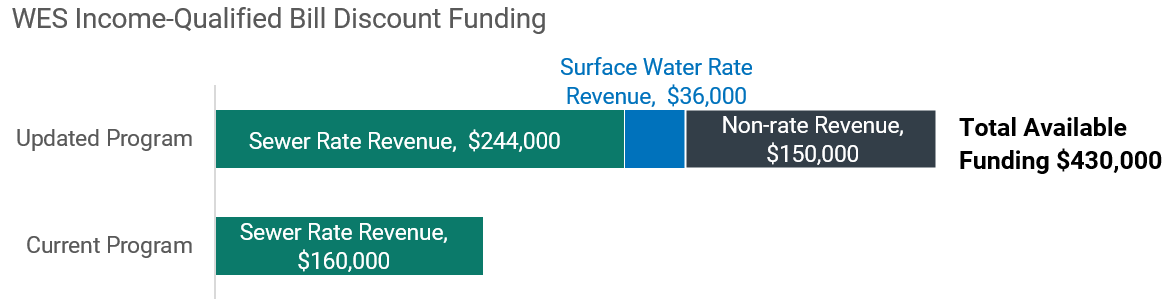
WES Income-Qualified Bill Discount Funding:
- Updated Program
- Sewer Rate Revenue: $244,000
- Surface Water Rate Revenue: $36,000
- Non-rate Revenue: $150,000
- Total Available Funding: $430,000
- Current Program
- Sewer Rate Revenue: $160,000
PROPOSED DISCOUNT CHANGE
The goal of the IQBD is to improve the affordability of wastewater and surface water services for low-income households. WES evaluates affordability using the EPA’s Lowest Quintile Residential Indicator (LQRI), which compares the annual cost of wastewater services to the annual income of the lowest earning 20% of households. Under this framework, annual wastewater costs between 1% and 2% of household income are considered mid impact and costs below 1% are considered low impact.
WES’ existing 50% IQBD was not originally established using this affordability framework. Because current enrollment is relatively low, WES has an opportunity to refine the discount structure before implementation of the expanded program while minimizing the number of households impacted by the change. In evaluating potential revisions, staff considered the balance between maintaining a higher discount level for existing participants and extending assistance to a larger number of households across the service area. Based on the estimated level of community need and available funding, staff are proposing to reduce the IQBD from 50% to 40%.
A 40% discount would continue to shift WES’ LQRI from a mid-impact rating to a low-impact rating while also enabling assistance to be extended to an additional 300 households without increasing funding.
For customers directly billed by WES, the reduction in the discount percentage will be partially offset by extending the discount to the surface water portion of the bill. The net impact on these households (including FY 2026-27’s proposed rate increase) will be $2.37 per month, or 6.4%. The impact on customers served through WES’ city partners would be more noticeable as those households would not receive an offset from the surface water portion of the discount. As a result, the approximately 400 income-qualified households served by partner cities would experience a net increase of approximately $4.00 per month in the WES wastewater treatment portion of their bill (including FY 2026-27’s proposed rate increase).
To mitigate this impact, staff are proposing to phase in the 40% IQBD for the three cities currently receiving WES’ pass-through, with the reduced discount taking effect in fiscal year 2027-28 rather than 2026-27. This phase-in will give partner cities time to inform their customers and make adjustments, and because enrollment in WES’ updated program will increase gradually, the phase-in can be accommodated with existing program funding.
GOOD NEIGHBOR FUND PROPOSAL
Staff are also proposing that WES’ city partners receiving Good Neighbor program funds (Gladstone, Milwaukie, and Oregon City) have the option to direct a portion of those funds toward their wastewater customer assistance programs. If the cities so chose, Good Neighbor funding could potentially allow the cities to retain the current 50% discount percentage on the WES portion of the bill for their enrolled households, offsetting the impact of the proposed reduction. This proposal aligns with the approved purpose in the IGAs to “Create opportunities for collaboration and leverage resources between the City and WES relating to another purpose approved by the Parties.” To implement the change, staff would propose an amendment to the Good Neighbor IGAs to add providing financial assistance for wastewater services to income-qualified residents within the City as a new eligible use of Good Neighbor funds.
NEXT STEPS
The Advisory Committee’s recommendation will be shared with the WES Board. Staff will then take steps to implement the recommendation, including potentially revising the discount amount and working with the cities to amend the Good Neighbor IGAs and City partner IGAs.
STAFF RECOMMENDATION
Staff requests a recommendation from the Advisory Committee supporting:
- Modification of the IQBD discount percentage from 50% to 40%; and
- Amendment of the Good Neighbor IGAs to add financial assistance for wastewater services as an eligible use of funds; and
- Amendment of the City partner IGAs to allow pass-through of WES’ IQBD and update other relevant/outdated terms.
EB/RW
1 Estimated range of eligible households in Clackamas County is derived from percent of households in WES’ service area enrolled in in Portland General Electric’s IQBD (~6%) and the estimated households eligible for energy assistance in Clackamas County developed by Oregon’s Low-Income Heating and Energy Assistance Program (12%).