Septic and Onsite Wastewater Systems

Septic and Onsite Wastewater Systems

Septic Fees

Service or itemFee Amount
Site Evaluations 
Single Family Dwelling - per lot$1,571
Commercial Facility or Community System - first 1,000 gallons$1,571
Commercial Facility or Community System - each additional 500 gallons$230
Construction Permits 
Standard system$1,700
Pressure Distribution$2,000
Alternative Treatment Technology$2,000
Redundant System$1,700
Steep Slope$1,700
Tile Dewatering$2,300
Seepage Trench$1,700
Gray Water Disposal Sump or other Nonwater-Carried System$930
Capping Fill$2,000
Sand Filter$2,300
Saprolite$1,700
Commercial Holding Tank$1,700
Pump System (in addition to permit fee)$100
Commercial Plan Review$750
Permit Renewal - No Field Visit$300
Permit Renewal - Field Visit$700
Residential Repair 
Minor Repair Residential$500
Major Repair Residential$900
Major Repair Residential - non- Standard system$1,150
Commercial Repair 
Minor Repair Commercial$600
Major Repair Commercial$1,300
Commercial Repair Review fee (601-2,500 GPD) in addition to repair permits$400
Alteration Permits 
Minor Alteration$600
Major Alteration$1,000
Major Alteration Residential - non-standard system$1,250
Commercial Major Alteration Review (>600 GPD) in addition to alteration permit$400
Authorization Notice 
Authorization Notice without field visit$350
Authorization Notice with field visit$850
Additional Services 
Compliance recovery feeEqual to permit fee
Existing System Report (no water, requires staff site visit)$900
Existing System Report (no site visit)$120
Pumper Truck Inspection - First truck$300
Pumper Truck Inspection - additional truck$130
Annual/Biennial Inspection of Alternative System$675
Annual Report Evaluation for a Holding Tank$123
Annual Report Evaluation, O&M Systems$123
Plot Plan Check (Building permits)$250
Reinspection Fee/Additional Field Visit$130/hour
Oregon DEQ Surcharge$117 Charged on permits above as required by ORS.

General Transportation & Development Fees

Service or itemFee Amount
Fee Appendix A - Annual CPI Adjustment

[Applies to all DTD Division Fees, unless otherwise noted.]
Annual adjustment; change in Consumer Price Index for the Western United States (CPI) up to 3%.

- Fee ≤$10: EXEMPT from annual CPI adjustment
- Fee $10.01-$50: Round DOWN to nearest $0.25
- Fee >$50.01: Round DOWN to nearest $1
Research/Consultation fee$123/hour - 1 hour minimum
Paper copies 
8 1/2" x 11" or 14"$2/page
11" x 17"$2.50/page
18" x 24"$3.50/page
Large Format$0.75/sq ft ($5 minimum)
Bank Managed Service FeeActual cost
Returned check fee$25.50
Sidebar Heading
Related Information
New Format?
Off

2025 Annual Operations & Maintenance (O&M) Reporting Instructions

For septic systems with a reporting requirement, an Annual Operation and Maintenance Report and related fee is required each year a septic system is in operation, regardless of whether the structure is occupied. Maintenance providers or property owners must submit an annual report to the Clackamas County Septic Program and pay the annual report fee. Prior to submitting an annual report, the maintenance provider or property owner must follow these steps:

  1. Verify the reporting requirement prior to submittal.
    The $126.69 annual fee is due for each report submitted, even if a system does not require annual reporting.
  2. Verify the septic permit number.
    Use the records lookup guidance on our website to confirm the correct septic permit number associated with the address. If the permit number in your records is not found, attempt to search by address and/or taxlot. If you’re unable to locate the permit number, email septicinfo@clackamas.us to confirm the correct permit number prior to submitting your report.
  3. Verify your Department of Environmental Quality (DEQ) maintenance provider certification status on DEQ’s website.
    Submit a copy of your certification if DEQ does not reflect a recent renewal.
  4. Use the current DEQ-approved Annual Operation and Maintenance Report Form for reporting.
  5. Verify the completeness and accuracy of the report for each property. 
    eports requiring staff to validate data or make corrections are subject to a 1-hour minimum, $123 per hour fee.
  6. Submit your report(s).
    Important info:
    1. Do not send a payment; staff will reach out for payment after validating reports.
    2. Submit by email (septicinfo@clackamas.us) or mail (Clackamas County, ATTN: Septic Program, 150 Beavercreek Rd., Oregon City, OR 97045):
      1. Provide a contact name, email and phone number with your submittal.
      2. If submitting multiple reports at one time, bundle no more than 25 reports with the same system status (i.e., operational or failing, as described below).

Operational example

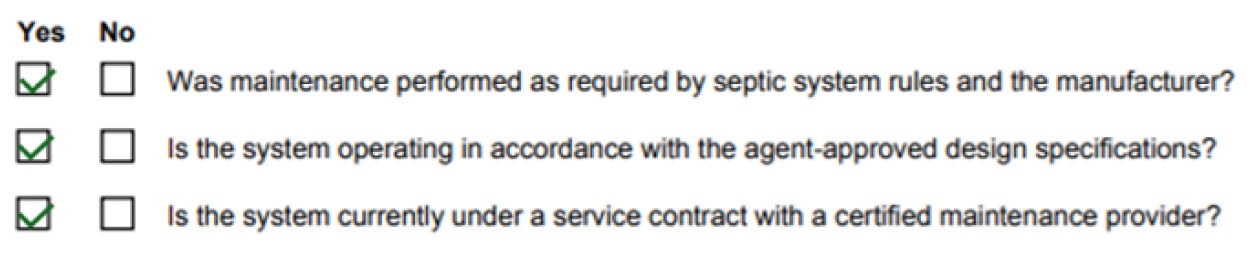
If all three system status questions are answered yes: 

  • Was maintenance performed as required by septic system rules and the manufacturer?
  • Is the system operating in accordance with the agent-approved design specifications?
  • Is the system currently under a service contract with a certified maintenance provider?

then the system is operational and you may bundle up to 25 operational system reports together in a single submission.

Example of an operational form. The questions ‘Was maintenance performed as required by septic system rules and the manufacturer?’, ‘Is the system operating in accordance with the agent-approved design specifications?’, and ‘Is the system currently under a service contract with a certified maintenance provider?’ are all checked Yes.

Failing example

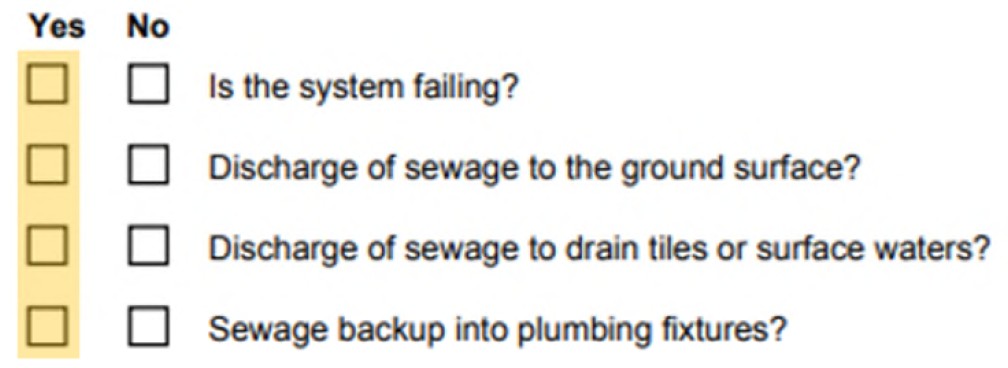
If any of the following questions are answered yes:

  • Is the system failing?
  • Discharge of sewage to the ground surface?
  • Discharge of sewage to drain tiles or surface waters?
  • Sewage backup into plumbing fixtures?

then the system requires additional review. Do not bundle failing system reports with operational system reports; you may bundle up to 25 failing system reports together in a single submission.

Example of a failing form. The questions 'Is the system failing?', 'Discharge of sewage to the ground surface?', 'Discharge of sewage to drain tiles or surface waters?', and 'Sewage backup into plumbing fixtures?' are highlighted.

Sidebar Heading
Related Information
New Format?
Off

Adding a personal use bathroom to a detached shop or garage

A personal use shop generally does not require the drainfield to be enlarged, as the net flow to the system will not increase (you are either using the bathroom in the home or in the shop). 

There are four main options for connecting your shop bathroom to an existing septic tank currently serving the home: 

  1. Simply connect to the existing septic tank that serves the home. If the shop is located where there is sufficient fall to the existing septic tank (as determined by the Plumbing Code), you may be able to simply connect a pipe from the shop to the existing septic tank, without the need for installing a pump or additional tanks. This will require a Plumbing permit.
  2. Install a septic tank at the shop, and connect directly to the existing drainfield serving the house. This requires a minimum amount of fall between the outlet of the tank at the shop and the existing drainfield. See OAR 340-071-0220(11) for required amount of fall. This will require a Plumbing permit to connect the shop to the septic tank, and a Septic permit to install a new tank and new effluent sewer pipe to the drainfield.
  3. Install a dosing septic tank and pump near the shop. This is one option if there isn’t sufficient fall between the shop and the existing septic tank or drainfield. This option requires a new tank with a pump to be installed at the shop, so that only effluent (liquid) is pumped to the existing septic tank that serves the house. This is the most common option we see when someone wants to add a bathroom to their shop, and is unable to gravity feed sewage directly to the existing septic tank. This will require a Plumbing permit to connect the shop to the septic tank, and a Septic permit for installation of the new tank and effluent pump.
  4. Install a sewage ejector pump in the shop. This is another option if there isn’t sufficient fall between the shop and the existing septic tank. This type of pump turns the sewage into a slurry for transport to a receiving tank. Per DEQ rules (OAR 340-071-0220(3)(d)), a multi-compartment tank is required if you plan to use a sewage ejector pump. As most homes have been installed with a single compartment septic tank, this option will most likely require the existing septic tank be replaced with a multi-compartment tank, or the installation of an additional tank in series with the existing tank. The pump and any connection to a septic tank will require a Plumbing permit, and the installation/addition/replacement of a septic tank requires a Septic permit.
Sidebar Heading
Related Information
New Format?
Off

Septic Projects and Document Requirements

Review the most common septic projects and their document requirements below. We are here to help you. Contact us about your specific project at septicinfo@clackamas.us.


Authorization Notice

Projects that increase flow to an existing system, connect a new structure to an existing system, or change the use of the existing system. Example: adding a bedroom, reconnecting a replacement dwelling to an existing septic system or adding an RV or motor home to an existing system.

  1. ESER (Existing System Evaluation Report) date must be less than 1 year ago
  2. LUCS (Land Use Compatibility Statement) must be approved by planning
  3. Complete Site Plan
  4. Apply in Development Direct within the septic module
  5. Note: You will need to fill out a Notice Authorizing Representative Form if the applicant is not the owner of the property.

For Temporary Care Dwellings an Authorization Notice is required within 30 days of Land Use approval and every five years that the temporary care dwelling is connected to the existing system. If it is an RV and not connected to the existing system, an Authorization Notice is still required.

Existing System Verification (ESV)

A qualified septic professional locates system components to ensure a project proposal will meet setback requirements. This document becomes the septic record for the property. An ESV can also be submitted as an as-built record for the property without a proposed project, allowing the septic inspection reports to be used at time of sale.

  1. Complete an ESV (Existing System Verification) or ESER (Existing System Evaluation Report).
  2. Apply in Development Direct within the septic module

Site Evaluation

Determines if an area is approvable for a septic system and is the required first step when starting with an undeveloped piece of land. It may also be required for replacement/alteration of an existing drainfield if a site evaluation is not on record.

  1. Dig your test pits.
  2. Complete Site Plan
  3. Apply in Development Direct within the septic module
  4. Note: You will need to fill out a Notice Authorizing Representative Form if the applicant is not the owner of the property.

Existing System Repair Evaluation

Existing system repair evaluations determine if an area is approvable for a replacement septic system.

  1. Dig your test pits.
  2. Complete Site Plan
  3. Apply in Development Direct within the septic module
  4. Note: You will need to fill out a Notice Authorizing Representative Form if the applicant is not the owner of the property.

Septic Permit

For new septic system; usually for a new structure. 

  1. Complete Site Plan including relative elevations.
  2. Gather Material Spec Sheets from the distributor/manufacturer of the
    • Tank
    • Box
    • Drainfield
  3. If a pump will be used, include pump specs, calculations and the pump curve from distributor/manufacturer.
  4. If a Sand Filter (checklist), ATT, or Pressure distribution (checklist) septic system will be installed, include the operations and maintenance service contract. If you are installing an ATT, include the spec sheet.
  5. LUCS (Land Use Compatibility Statement) approved by the Planning Department.
  6. Apply in Development Direct within the septic module.
  7. Note: You will need to fill out a Notice Authorizing Representative Form if the applicant is not the owner of the property.

Minor Repair Permit

For repair or replacement of a tank and/or box.

  1. Complete Site Plan including relative elevations.
  2. Material Spec Sheets (obtained from distributor or manufacturer) for the tank and/or box you propose to install
  3. If a pump will be used, include pump specs, calculations and the pump curve from distributor/manufacturer.
  4. Apply in Development Direct within the septic module.
  5. Note: You will need to fill out a Notice Authorizing Representative Form if the applicant is not the owner of the property.

Major Repair Permit

To repair or replace all or part of the drainfield., and/or treatment system, when the system is failing .

  1. Complete Site Plan including relative elevations.
  2. Material Spec Sheets from the distributor/manufacturer of the
    • Tank
    • Box
    • Drainfield
  3. If a pump will be used, include pump specs, calculations and the pump curve from distributor/manufacturer.
  4. If a Sand Filter (checklist), ATT, or Pressure distribution (checklist) septic system will be installed, include the operations and maintenance service contract. If you are installing an ATT, include the spec sheet.
  5. Apply in Development Direct within the septic module.
  6. Note: You will need to fill out a Notice Authorizing Representative Form if the applicant is not the owner of the property.

Minor Alteration Permit

To add a new tank to the existing septic system or alter an existing tank. This is commonly done when adding a tank at an accessory structure and connecting to the existing system.  

  1. Complete Site Plan, iincluding relative elevations.
  2. Material Spec Sheets (obtained from distributor or manufacturer) for the tank and/or box you propose to install
  3. If a pump will be used, include pump specs, calculations and the pump curve from distributor/manufacturer.
  4. LUCS (Land Use Compatibility Statement) approved by the Planning Department.
  5. Apply in Development Direct within the septic module.
  6. Note: You will need to fill out a Notice Authorizing Representative Form if the applicant is not the owner of the property.

Major Alteration Permit

Septic construction permit to alter the existing drainfield, or treatment system.

  1. Complete Site Plan including relative elevations.
  2. Gather Material Spec Sheets from the distributor/manufacturer of the
    • Tank
    • Box
    • Drainfield
  3. If a pump will be used, include pump specs, calculations and the pump curve from distributor/manufacturer.
  4. If a Sand Filter (checklist), ATT, or Pressure distribution (checklist) septic system will be installed, include the operations and maintenance service contract. If you are installing an ATT, include the spec sheet.
  5. LUCS (Land Use Compatibility Statement) approved by the Planning Department.
  6. Apply in Development Direct within the septic module.
  7. Note: You will need to fill out a Notice Authorizing Representative Form if the applicant is not the owner of the property.

Inspection Paperwork

After a septic permit has been issued, install the septic system as approved by the septic department, but DO NOT BACKFILL any part of the system.

  • Submit completed inspection paperwork via the septic module of Development Direct, choosing the "inspection paperwork uploads" dropdown
     

Operation and Maintenance

All owners of septic systems are required to maintain their septic system, which primarily involves pumping the septic tank. Certain types of systems require an ongoing maintenance contract with a DEQ certified provider and annual reporting to Clackamas County Septic. These systems include most Sand Filters, Recirculating Gravel Filters, and Pressurized Distribution systems, and all Alternative Treatment Technology systems (ATTs). Additional guidance on septic system maintenance can be found on the EPA webpage.

Contact septicinfo@clackamas.us if you are unsure whether your system requires a maintenance contract and annual reporting.

Pumper Truck Inspections

Clackamas County Septic performs septage, sewage, pump truck and pump trailer inspections. Oregon DEQ requires inspections for a newly purchased vehicle and/or at time of renewal of a DEQ Pumper or DEQ Pumper/Installer license. Oregon DEQ completes all other steps for sewage disposal service licensing.

Pumper Truck Inspections can be done at our Red Soils campus or your facility, if it is within Clackamas County. Pumper Truck Inspection dates are based on your inspection location and staff availability. Inspections can only be setup with a rough time estimate and the inspection will be done within the route of inspections for the day, with priority given to septic system inspections.

Customers pay a travel fee and pump truck inspection fee and a travel fee is based on location and travel time. Travel time roundtrip is 1 hour minimum. Please review the Septic Program Fee schedule for the current travel fee.

Apply in Development Direct then email septicinfo@clackamas.us to schedule the inspection. Include your septic permit number, preferred inspection date, inspection location, contact name and phone number.

Other project documents:

  • Certification of Existing System Decommissioning
    Used when abandoning a septic tank that is being replaced, or when the property is connected to public sewer
  • Easement Forms –
    Septic easements are needed any time a septic system and the structure it serves are on different legal lots of record. Same owner easements must be signed by a Clackamas County Soil Scientist prior to recording, or they are not valid. Clackamas County Septic review of different owner easements is always recommended but not required by DEQ.
  • Sewer Availability Worksheet
    Used when submitting a septic permit application in the vicinity of public sewer
  • Statement of Use
    Used when submitting a septic application for commercial and agricultural use. This is not needed for residential use.
Sidebar Heading
Related Information
New Format?
On

Stakeout Procedure

Purpose

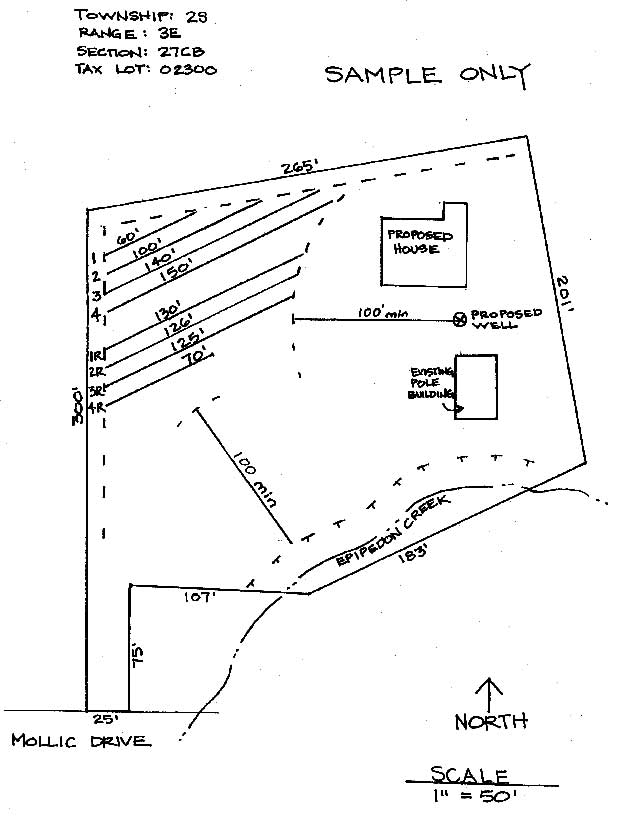
Stakeout sample

To determine if sufficient space exists on a lot with limited area for the proposed development, and ensure all septic components meet required setbacks.

Procedure

  1. Clear tall brush in area of stakeout, approximately 10,000 sq ft (100'x100' or equivalent). Do not remove topsoil or otherwise grade the area. If the area is covered with brambles, clear a path to any features requiring a setback (ex: escarpment, stream, or well).
  2. Use a transit or laser (not a builders level) to mark points about 25 ft apart on the leach line. Make sure the line is at the same elevation (or within the allowed trench depth variation) throughout its length. Mark the points with stakes tall enough to be visible above any remaining brush. Color-code each line using alternating colors for each leach line. Alternatively, you can spray paint or drape string between stakes of each line. Do this for both the original and replacement drainfields.
  3. Stake the other septic components, such as the septic tank, and sand filter if required, as well as the house, accessory buildings, drive, and any other proposed development. If you do not know the actual house you can draw a general envelope of the area where the house could fit. Check with the Planning Section to ensure that all building envelopes meet their requirements for setback to the property lines.
  4. Accurately record the elevation at the beginning and end of each leach line, as well as the line lengths and color in a chart. Draw all the septic components and other developments on an accurate, to scale plot plan and submit it to the Soils Section for review. Provide a north arrow, and roads on your lot frontage. Draw in all features that require a setback, and the distance from the feature to the closest septic component.
Sample Chart
  Line # Color Beginning elevation Ending elevation Length (ft)
Original area 1 Red 0.64 0.64 58
  2 White 2.87 3.00 75
  3 Red 5.89 5.90 125
  4 White 7.03 7.38 125
  5 Red 8.90 9.02 92
Repair area 1 White 2.57 3.00 92
  2 Red 5.00 5.02 112.5
  3 White 6.49 6.63 112.5
  4 Red 7.80 8.10 112.5
Septic tank   Orange      
House   Blue      
Drive   Yellow      

* Check site evaluation for maximum trench depth variation

New Format?
On

Authorization Notice

Do I need an Authorization Notice?

An Authorization Notice is required when you propose to reconnect to an existing septic system, when there is an increase in flow, when there is a change in use (from residential to daycare, for example), or when a temporary dwelling is needed for hardship reasons*.

Application

To apply for an Authorization Notice, submit an Existing System Evaluation Report (ESER) from a DEQ certified provider. If no previous records are available you will also need to provide a Record Drawing and Installed Materials List from a licensed septic installer or consultant.

System components may need to be uncovered for soils staff review if:

  • If the maintenance inspection report is in dispute by the county or property owner.
  • If there are no records on the system and the materials in the system are not consistent with a system installed prior to 1974
  • The new proposal (foundations or partition, for example) appears to conflict with minimum required setbacks to septic components (5 ft to the tank and 10 ft to the drainfield).

Evaluation Results

Based on the Inspection Report, we may require that the septic components be moved, replaced or supplemented. Any septic system construction will depend on the analysis of the test pits and other site conditions. Other than maintenance (pumping the tank or removing roots from any components) all work on the septic system must be done under a permit.

Altering the septic components

Minor changes to a septic system can be done under an alteration permit. If more than 50% of the drainfield is affected or if there is an increase in flow greater than 300 gallons per day or 50% of the system capacity (whichever is less), a site evaluation, rather than an authorization notice, is required and new construction permit, rather than an alteration permit will be required.

Repairs to the existing system

If system components are found to be in need of repair or replacement, a septic repair permit will be required. Test pits may be required for repairs to drainfield components.

Clackamas County Septic and Onsite Wastewater
150 Beavercreek Road
Oregon City, OR 97045

*Medical hardship Authorization Notices are required every 5 years as per OAR 340-071-0205

New Format?
On

Same Owner Easement Release Instructions

The Same Owner Easement form used by all field offices to site a system or a portion thereof onto adjacent property under the same ownership may establish an agreement and covenant between the Grantor and the State of Oregon through the Department of Environmental Quality.

Such an easement can not be released except through an action by the Department. The Regional Division Administrator must sign the easement release form. Before the Regional Division Administrator will sign the form, all documents related to releasing the easement must be in order, and must be passed through a short chain of review within the Department.

What documents must be assembled?

  1. One copy of the original (and current) easement;
  2. Written statement from the Legal Entity (e.g., City, County or Sanitary District) assuring the sewer connection has been made. If other than a sewer connection the property owner must provide a written statement describing why the easement is no longer needed;
  3. The completed original easement release form.

Where are these documents to be sent?

The property owner is to send the documents to the Agent in the appropriate County within the region. The documents will be reviewed, and verification that the easement should be vacated will be made. The Agent will forward the documents with a written statement that the easement should be vacated to the appropriate DEQ regional lead staff listed below. Once the DEQ regional lead staff person is satisfied that all is in order, they will forward all documents and a summary report to their manager or Regional Division Administrator for approval. Once the Regional Division Administrator signs the easement release form, all documents will be returned to the DEQ regional lead staff person. The DEQ regional lead staff person will return the original easement release form to the Agent and make copies of these documents for the Department file record. The Agent will return the original easement release form to the property owner and make a copy for their file record. The property owner now needs to complete the process by recording it at the county recorder's office and sending a copy of the recorded document back to the onsite office that holds the property file.

DEQ onsite program regional lead staff contacts

Western Oregon (North) Gary Artman
artman.gary@deq.state.or.us
503-687-7426
Western Oregon (Mid) Randy Trox
trox.randall@deq.state.or.us
503-687-7338
Western Oregon (South) Chuck Costanzo
costanzo.chuck@deq.state.or.u
503-471-2850 x224
Eastern Oregon Bob Baggett
baggett.robert@deq.state.or.us
503-388-6146 x230
New Format?
On