 Translate




Garbage and Recycling
Garbage and Recycling
Sign up for our Newsletter
Subscribe to our newsletter for tips on saving money, reducing waste, and keeping your customers happy.
Recycling Modernization Act
A modern makeover for Oregon’s recycling system
The Plastic Pollution and Recycling Modernization Act (RMA) will update Oregon’s outdated recycling system by building on local community programs and leveraging the resources of producers to create an innovative system that works for everyone. The Oregon legislature passed the Recycling Modernization Act (Senate Bill 582) during the 2021 legislative session. The new law became effective Jan. 1, 2022 and recycling program changes will start in July 2025.
What is RMA?
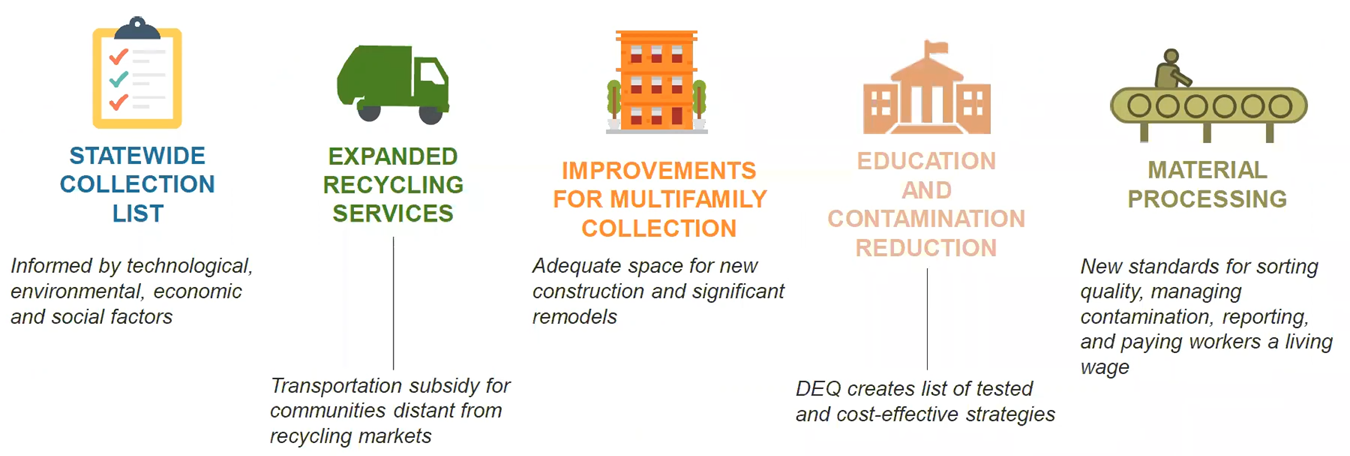
Source: DEQ’s Recycling Modernization Act Overview, Sept. 9, 2021
Oregon’s Plastic Pollution and Recycling Modernization Act (RMA) is a statewide law created to make recycling more efficient, environmentally responsible, and consistent across all Oregon communities. It also encourages smarter packaging design to reduce waste. Many initial improvements will take place behind the scenes, like upgrading recycling facilities, creating better tracking systems to renew public confidence in the system, and eventually leading to all communities in Oregon having the opportunity to recycle the same items from the convenience of their home and work.
Starting July 1, 2025, Oregon’s recycling system began its largest upgrade in decades. Consumers will no longer bear the full burden of recycling; brands, like Amazon and Proctor & Gamble, will be held financially accountable for the environmental impacts of their packaging, paper, and food serviceware products sold in the state which will allow for investments in our recycling infrastructure. While some changes will start right away, others may not take effect until 2027 or later.
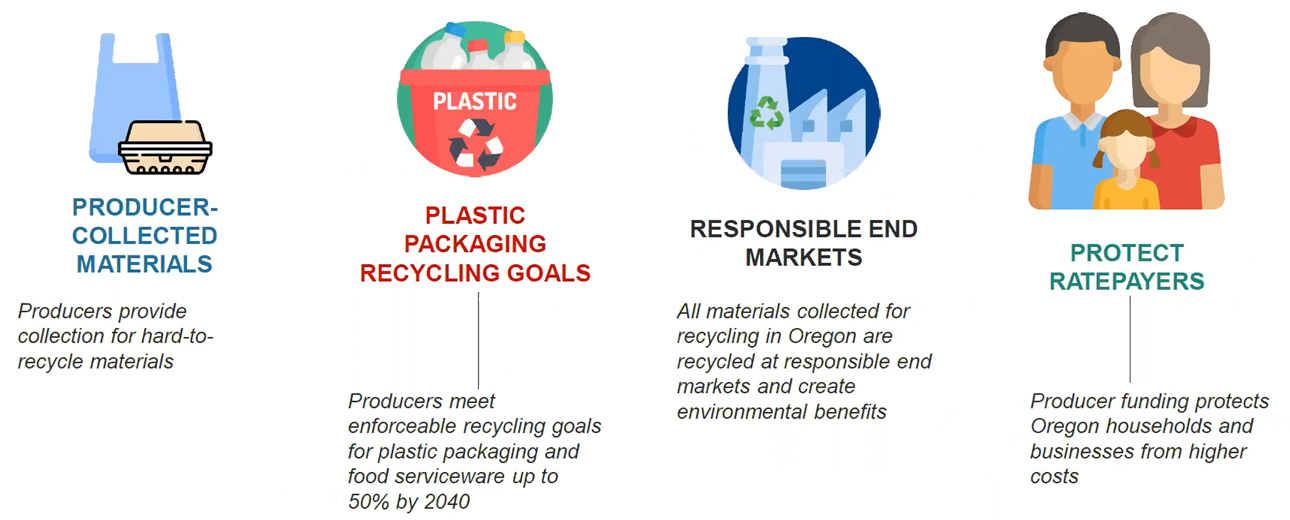
Source: DEQ’s Recycling Modernization Act Overview, Sept. 9, 2021
Oregon’s Recycling Modernization Act
- Expands recycling access: All Oregonians will be able to recycle at home and work.
- Creates a statewide collection list: The same items can be recycled across the state.
- Invests in recycling facilities: Modernizes sorting facilities for efficiency and reliability.
- Supports responsible end markets: Ensures recycled items are reused locally, domestically, or abroad.
- Reduces contamination: Educates the public to keep trash out of recycling bins.
- Adds RecycleOn Centers: 30+ new centers are expected to open across the Portland metropolitan area by the end of 2027 which will provide free, convenient drop-off recycling for items not accepted curbside (e.g. plastic bags and stretchy plastic, loose plastic lids and caps, shredded paper and more).

Brands and producers will share the responsibility for recycling costs through the Circular Action Alliance (CAA), the state-approved producer responsibility organization. They will manage statewide program implementation and provide information on the statewide webpage. For those areas of the state with robust recycling (like Clackamas, Multnomah, and Washington Counties), much will remain the same, including our local recycling, glass, yard debris, and garbage webpages, guides, and information.
What Clackamas County Residents Need to Know
Clackamas County already has curbside recycling at home and work, so many current practices will remain the same. However, beginning July 1, 2025, expect these minor changes:
Changes to the Recycling List
- Plastic caps screwed onto plastic bottles, jars, and jugs are now accepted (loose caps and lids should go in the garbage, unless dropped off at a RecycleOn Center)
- Pizza boxes with grease (but no leftover food) are now accepted
- Shredded paper will no longer go in curbside bins (shredded paper in paper bags can be taken to a RecycleOn Center for recycling)
- Plastic bottles, jugs, and tubs must be 2 inches by 2 inches or larger (previous minimum was 6 oz.); clamshells (tubs with hinged lids) are still not allowed
- Scrap metal cannot be more than 10 lbs. nor 10 inches (previously 30 lbs./30 in.)
Future Changes
- Expanded recycling options on Mt. Hood, including a RecycleOn Center located at the Clackamas County Garbage and Recycling Transfer Station.
- Additional RecycleOn Centers or events for items not accepted in recycle bins at home and work. (Stay in the loop with the latest Oregon RecycleOn News)
- Expanded efforts to reduce contamination in recycling bins
- More items added to the recycling list over time
Other Oregon Extended Producer Responsibility (EPR) Programs
Oregon’s Recycling Modernization Act is part of a larger statewide trend holding producers responsible for their products’ end-of-life impacts. Other programs include:
- BottleDrop: Oregon beverage container recycling
- PaintCare: Paints and stains
- Oregon E-Cycles: TVs, computers, laptops, printers, and electronics
- Bye Bye Mattress: Mattresses and box springs
- Med Take-Back Oregon: unused prescription medications
Tips for Clackamas County Residents
Check out the links below for more information about recycling right and Oregon’s Recycling Modernization Act.
- Follow the current Clackamas County Recycle Guide (available in seven languages) to avoid putting items in your recycling bin that can jam equipment, harm workers, and make it harder to recycle the good stuff.
- DEQ’s Plastic Pollution & Recycling Modernization Act
- Visit the RecycleOn Center website to explore what’s accepted (in multiple languages) and find nearby recycling centers using the interactive map.
New Format?
Off
Food Waste Prevention
Prevent wasted food, repurpose and redistribute, and then dispose to conserve water, energy, and resources.
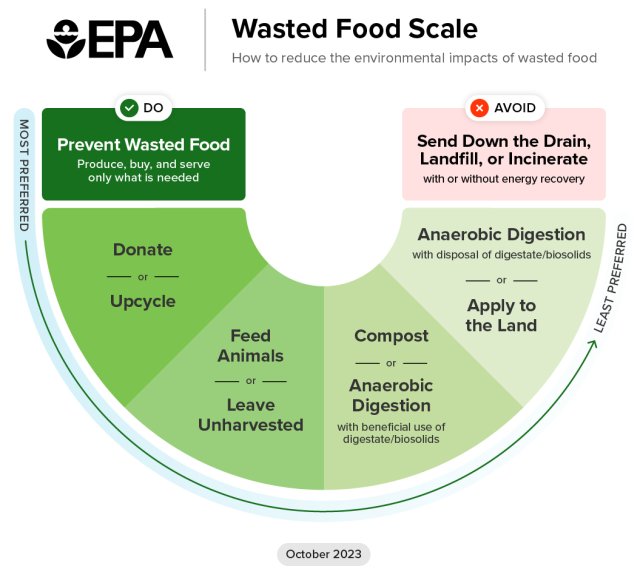 Food is a big part of our daily lives and is important for our health and wellbeing. It's also a major part of the economy, through farming, processing, transporting, storing, and managing food, but the way we produce and use food can negatively affect the environment and society. By making the most of our food—especially by preventing food waste—we can get more benefits and create less harm.
Impacts of Food
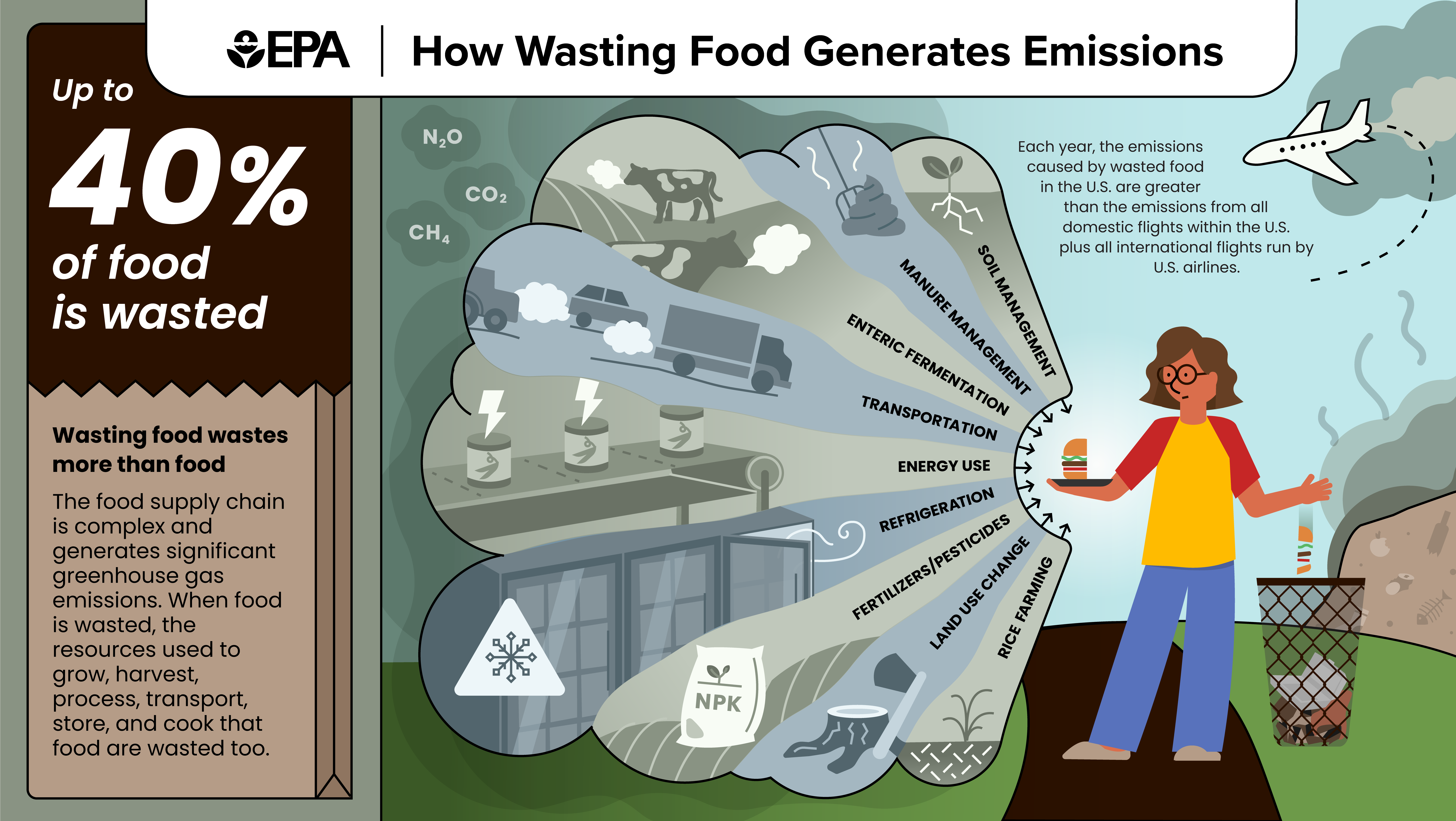 Environmentally, food is one of the most significant materials in our system. It's estimated that 40% of all food produced or imported in the US is never consumed. Annually, 5.9 trillion gallons of freshwater and 140 million acres of agriculture land are wasted on food that is never consumed. Food in landfills also account for 58% of greenhouse gas emissions, and in Oregon, represent 16% of material in our landfills (Oregon DEQ). The impacts of food waste add up and it doesn't only impact our environment, it also wastes labor, energy, resources, and money along the way.
Prevent Wasted Food
Preventing food waste is one of the most impactful ways you can reduce environmental impacts and save money. Did you know that each year, the average family of four spends over $2,900 on food that never gets consumed?
Below are a few steps you/your household could consider to start making small changes to how you shop, store, and think about making your food last longer. Start small, add as you can, and find a plan that works for your situation – any little bit helps.
1. Shop with Meals in Mind
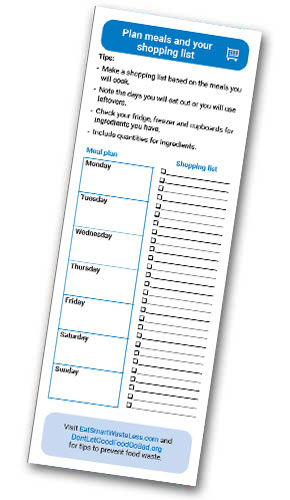 Plan your meals
- Keep a list of meals that your household enjoys.
- Make a meal plan each week. Take into account the days when you will eat out or eat up leftovers instead of cooking.
- Keep track of your meals and lists. AnyList, BigOven, Cozi, Cooklist, Mealime, Prepear, and Samsung Food and offer free versions of their apps to track recipes and create shopping lists.
- Note: the county does not endorse nor particularly support any of these apps or websites.
- Utilize The Guest-imator when planning for larger events or holidays to determine how much food to prepare.
Shop at home first
- Make a shopping list based on your meal plan. Include quantities to make sure you buy just what you need.
- Check the fridge, freezer and cupboards for ingredients you already have before you buy more.
- Download this simple meal planner and shopping list (PDF).
Stick to your plan
- Hungry? Eat a snack before shopping to avoid impulse purchases.
- Buy only what you need. Pre-packaged produce or 2-for-1 deals can lead to over-buying and wasted food. Shop the loose produce area and dry goods bulk section to get the exact amount you need.
- If you eat fresh foods often, try shopping a little more frequently, but buy less each trip. This way your food is always fresh.
- Buy fruit with varying ripeness so eating can be staggered.
- When choosing produce, imperfect fruits and veggies are often perfectly delicious. When choosing bananas, go for the often-ignored singles and doubles.
2. Prepare Now to Eat Later
Prep right from the store
- As soon as you return from the store, wash, chop, peel, cook or portion ingredients for your weekly meals and snacks. Alternatively, choose a specific day each week for food prep.
- Some items, like berries and cabbage, should not be washed until they are ready to eat.
- If portioning canned goods, transfer food to suitable containers with lids. Do not store food in opened metal cans.
Freeze food for later
- Freeze food such as bread, sliced fruit, cut-up vegetables and meat in meal-size portions if you don't plan to use them within a few days.
- If you've made too much or if leftovers are not going to be eaten in time, freeze them in a freezer-safe container for use later when you need a quick meal.
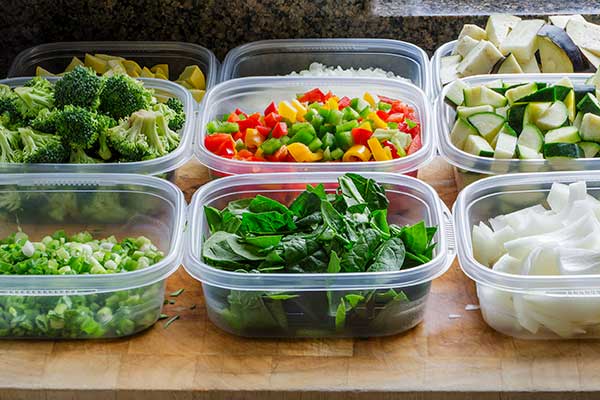 Use containers and labels
- Store prepped food in clear containers and place near the front of the refrigerator so they are visible and easy to identify.
- Freezer bags or containers with a good seal can be used to avoid freezer burn.
- Label and date food containers and bags when storing.
- Keep labels (PDF) or masking tape and a pen nearby to make labeling as convenient as possible.
3. Keep it Fresh
- Fruits and vegetables each have their own storage requirements for the longest life. Find food storage tips using the following resources:
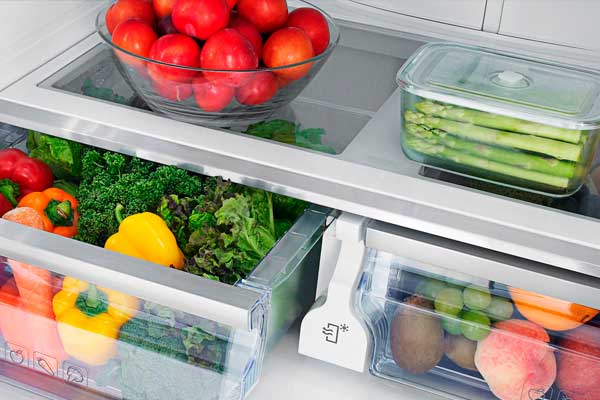 Put fruits that need to ripen such as peaches, plums, avocados and tomatoes in a bowl on the counter until ripe. Once ripe, move produce to the refrigerator.
- Unsure if your food is still okay to eat? Find out at Eat or Toss.
Keep it separated
- Be careful when storing apples, pears, tomatoes and bananas with other fruit — they emit ethylene, a gas that accelerates ripening. Check fruit regularly. Separate very ripe fruit, such as apples and bananas, from your other produce.
- When cooking meals with multiple ingredients like vegetables, proteins and grains, consider storing them separately. This offers more flexibility when making new meals from those leftovers.
 Additional tips
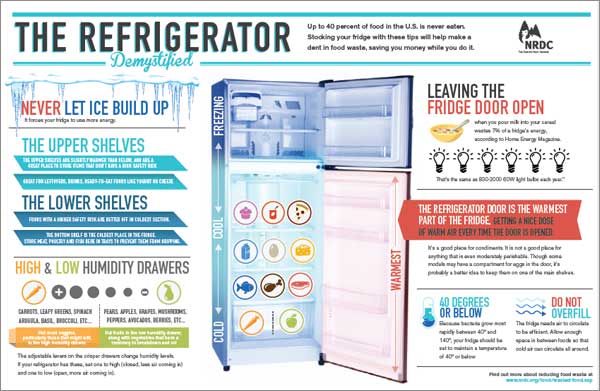
Most refrigerators have specific design elements to maximize the lifespan of your food. Understand your refrigerator's design (PDF from the Natural Resources Defense Council) and see where and how you should be storing your food.
4. Eat What You Buy
Keep track of leftovers
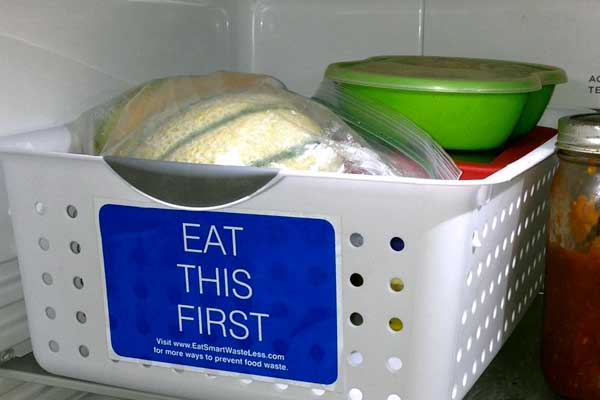 First In, First Out (FIFO) is a useful way that many restaurants and grocery stores use to organize food - and you can use this system at home! Move food that's soonest to spoil to the front of the shelf or put it in an "Eat this first" bin. Move recently purchased items towards the back.
- Make leftovers a part of your weekly meal plan by designating one day a week for 'eating down the fridge' or 'leftover lollapalooza'.
- If possible, reheat leftovers in the way they were originally prepared. A toaster oven can help make pizza, breads, fried foods, grilled meats, and seafood much more appetizing than the microwave can.
Get creative
 Think of leftovers as ingredients. Make casseroles, burritos, wraps, frittatas, stews, smoothies and more from leftovers and extra ingredients. Find ideas for leftovers at the Food Hero website.
- Puree cooked veggies and a can of tomato sauce for a nutrient dense pasta sauce or puree with a can of broth for soup.
- Learn cooking skills together and challenge family members to transform 'need to use up' food items into a meal.
- Utilize various preservation techniques, such as dehydrating, canning, freezing, pickling, and infusing to save food from being wasted.
Don't be confused by the date labels
- Get to know what date labels mean so you aren't throwing good food in the trash. "Sell-by", "use-by" and "best by" all means different things and none of these identify when food has 'gone bad' or could be dangerous.
- Practice safe food handling habits, store food properly, and learn when and how to use your senses and good judgment to determine if food needs to be tossed.
- Food shelf life estimates are helpful guides. However, they are just estimates so always use your best judgment.
5. Measure Wasted Food
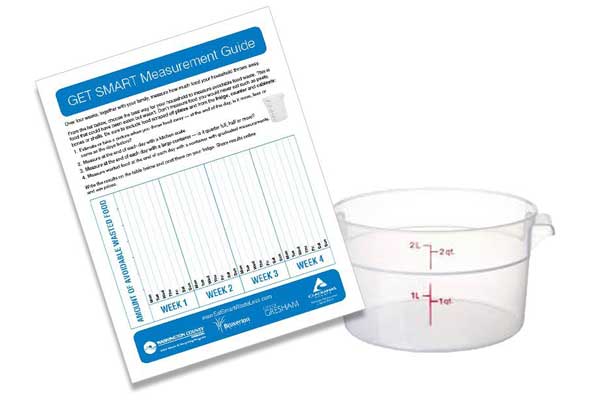 Consider measuring the food your household throws away. Identify food that was once edible – not peelings, cores or eggshells. Be sure to include food scraped off plates and tossed from the fridge, counter and cabinets. For any duration, choose a measurement method that works best for you from the options below:
- Take a picture or make an estimate, is it more, less or the same as the week before?
- Weigh it. Using a kitchen scale, weigh wasted food on a regular basis and write it down.
- Track the volume. Using a large container, estimate how full is it — quarter full, half or more. Or use a container with graduated measurements.
- Write the results on the Measurement Guide (PDF) and share with those in your household. Remember to note the reason the food was wasted so you can identify opportunities for improvement.
Start by making changes in the way you shop for, prepare, and store your food. Small actions can make a big difference!
Request free physical resources for preventing wasted food by emailing wasteinfo@clackamas.us.
Rescue and Donate Food
- Save good food from going to waste! Pickup surplus food from nearby stores and restaurants through Too Good To Go.
- Start or donate to a Little Free Pantry in your neighborhood.
- Donate surplus to local food pantries or Gleaners of Clackamas County.
Compost
When it comes to peels, shells, bones, and coffee grounds, (and more), disposal is inevitable. Use various at-home composting methods (compost tumblers, stationary compost bins, worm bins, etc.) to decompose your food scraps. Find more information and tips on home composting through Metro or OSU Extension Service's Master Gardener program.
Residents within the city limits of Lake Oswego, Milwaukie, and Wilsonville can include food waste in their yard waste bins. Including food waste in your yard waste bin outside those city limits may result in a fee from your garbage and recycling company.
Learn more on our Recycle Guide page.
More Resources
New Format?
On
Choose to Reuse
A Guide for Businesses to Switch to Reusable Serviceware
New Oregon laws make it easier than ever for restaurants, food carts, and grocery stores to use reusable dishware and accept customers' cups and to-go containers. Learn how to choose reusables: It's good for your business, your customers, and your bottom line.
Why Choose Reusable Serviceware?
Save Money
Restaurants and grocery stores that make the switch to reusable dishware, cups, and cutlery can reduce their purchasing and garbage costs, saving money every month.
For example, coffee shops can save thousands of dollars per year. Read about how one coffee shop saw a savings of over $6,800 per year by switching to reusables.
Reduce Waste
Reusables can be washed and sanitized thousands of times. That means thousands fewer single-use items in the trash.
Customer sSatisfaction
Switching to reusable serviceware can enhance your image, demonstrate your commitment to being environmentally friendly, and offer a better customer experience.
More than ever, customers want to support businesses that go above and beyond in their sustainability efforts. Offering and promoting reusables is a simple, tangible way to show customers you care about reducing waste.
Check out the Choose to Reuse Fact Sheet (PDF from Metro) for tips and tools.
Oregon's New Bring Your Own (BYO) Law
A new way to cut waste and costs
Thanks to Oregon's new law, customers can now bring their own containers to participating restaurants, food carts, grocery stores and other retail food establishments when purchasing food, grabbing to-go orders, or packing up leftovers. While this isn't a requirement of businesses, encouraging customers to bring their own containers saves money, reduces waste, and makes sustainability-minded customers happy.
Last year, 41% of Portland's Nossa Familia Coffee customers brought their own cups or dined in, keeping 52,364 single-use cups out of landfills!
Encourage Customers to BYO
Let customers know you accept reusable containers by posting a BYO sign in a visible place.
- Restaurant BYO cups and containers sign (PDF from Metro)
- Retail BYOP cups and containers sign (PDF from Metro)
Guidelines for Businesses
These easy-to-follow guides will help you safely accept customers' reusable containers while following public health codes.
1. Read the Rules
2. Create a Standard Operating Procedure (SOP)
- Download the SOP template (PDF from Metro)
- Fill out the SOP
- Keep a copy of the SOP on-site
3. Train Staff
- Walk through the SOP together
- Print a "How-to" sign for Staff (PDF from Metro)
Find more details at:
- Oregon Health Authority fact sheet for restaurants (PDF from OHA)
- Oregon Department of Agriculture fact sheet for retail and grocery stores (PDF from OHA)
Additional Resources
New Format?
On
Repair Fair - Oregon City
Small appliances, small electronics, clean clothes and textiles.
Learn more regional repair calendar
Room to be announced
Repair Fair - Gladstone
Small appliances, small electronics, clean clothes and textiles.
Proper Battery Disposal Keeps Our Community Safe
Household batteries that end up in the trash or recycling cart can spark fires in trucks and facilities. By disposing of batteries the right way, you help protect workers, neighbors, and the environment.
Battery Drop-Off
You can properly dispose of household batteries for free at:
Metro South Household Hazardous Waste Facility
2001 Washington St., Oregon City
For more locations, call 503-234-3000 or use Metro's What Goes Where tool.
Multifamily residents (those living in apartments, condos, etc.) do not yet have curbside battery collection. Clackamas County is working with local collectors to develop a safe option.
Have friends or family with a glass bin? Ask to use theirs and be sure to follow the instructions below.
Curbside Battery Collection (Single-Family Homes)
Battery recycling is now part of regular residential garbage and recycling service for all single-family homes in Clackamas County. Discarded batteries can spark and cause fires when not handled properly, creating dangerous situations for garbage and recycling truck drivers, processing facilities, and our communities. Follow these three important steps below to safely recycle/dispose of batteries in your glass bin.
Batteries Accepted
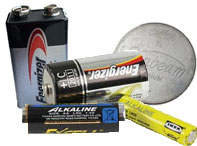
AAA, AA, C, D, button-cell & coin, 6- & 9-volt batteries
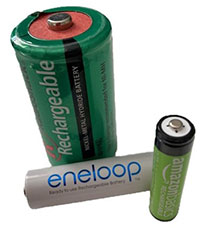
Rechargeable and single-use batteries
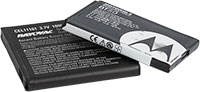
Batteries that can be easily removed (e.g. from old cell phones, cameras, etc.)
Batteries NOT Accepted
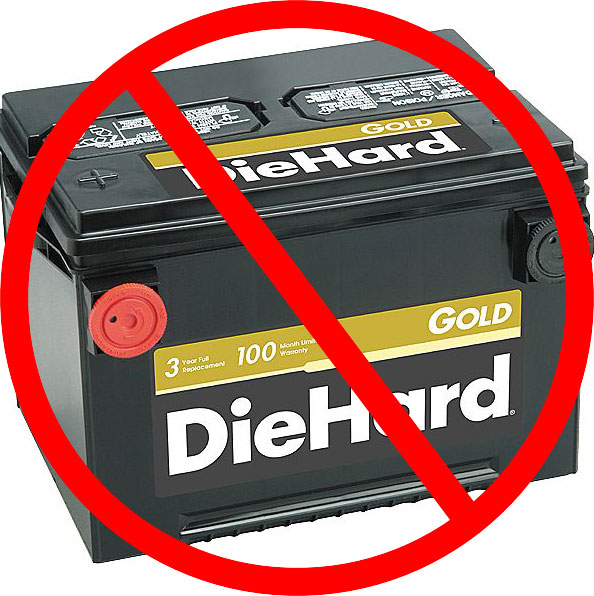
Batteries that do not fit in a 1 qt. zip-seal bag
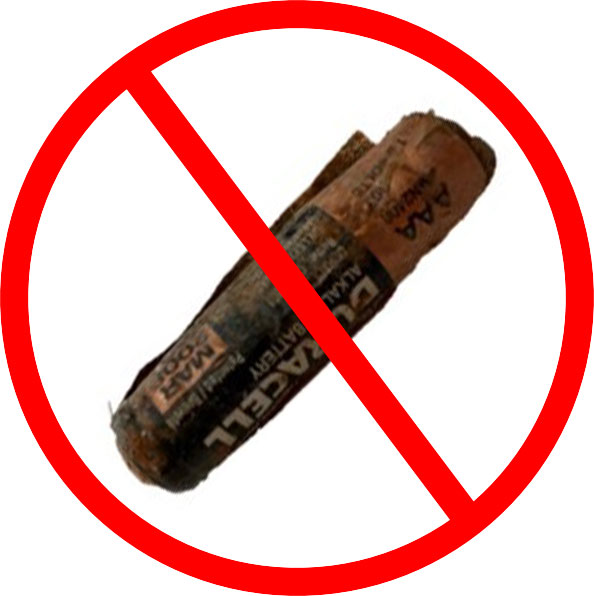
Damaged, corroded, or bulging batteries
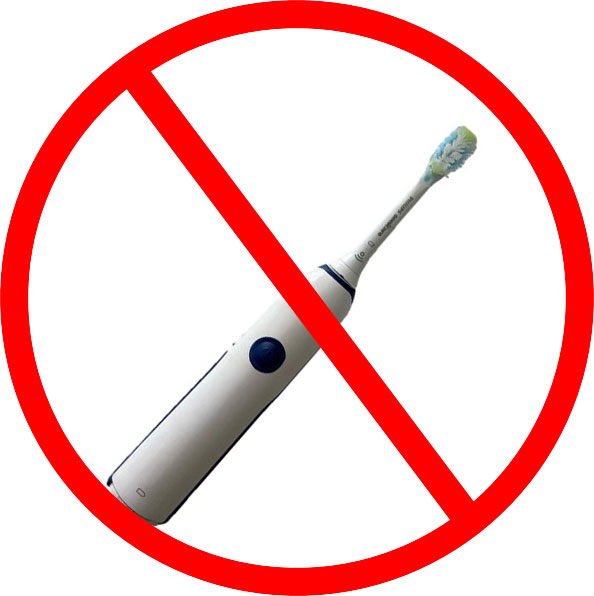
Embedded or built-in batteries - those that are not easily removable from their products (e.g. electric toothbrush, wireless headphones, Bluetooth speakers, fitness watches/bands, vape pens, etc.)
How to Prepare Batteries for Pickup
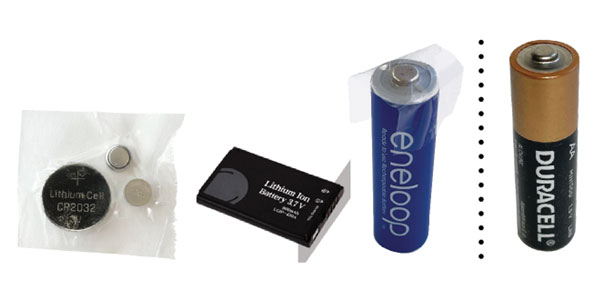
1. Tape ends of all batteries, except alkaline, with clear tape
- Can't tell what type of battery it is? Tape it.
- For coin/button cell batteries, wrap tape around the entire battery. If you have multiple hearing aid or other coin/button cell batteries, save time by laying out a long strip of packing tape, place the batteries on the tape—be sure not to let them touch each other—and then place another long strip of tape on top.
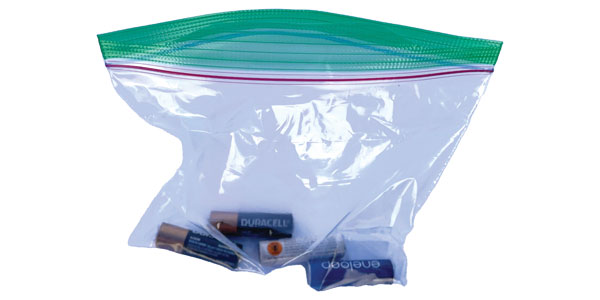
2. Bag all batteries in a 1 qt. zip-seal clear plastic bag
- Zip-seal clear plastic bags smaller than 1 qt. are accepted.
- Bags larger than 1 qt. are not allowed.
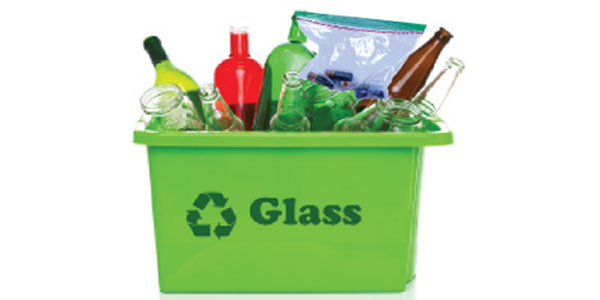
3. Set on top of glass in the glass bin
- Set out on your regular garbage day. (Note: It is best practice to set your glass bin out only when it is at least half-full.)
- Limit of a single 1 qt. bag per pickup.
- Missing a glass bin? Contact your garbage and recycling company.
Safety Tips
Damaged (or corroded, bulging, leaking) batteries must be taken to a household hazardous waste facility. Never put damaged batteries in the trash or curbside battery recycling program.
- Place damaged batteries in a small plastic bag with absorbent, nonflammable materials, such as kitty litter, sand, or dry rice. For extra safety, place this bag into a metal can, like an old soup can.
- Take to a Household Hazardous Waste Facility for safe disposal (Call 503-234-3000 Monday-Friday, 8:30am – 5pm, for phone assistance).
Never remove embedded or built-in rechargeable batteries. If a battery doesn't come out easily, take the whole device to a drop-off facility. Call Metro's Recycling Information Center at 503-234-3000 on Monday-Friday, 8:30 a.m. to 5 p.m. or search What Goes Where for recycling options.
Why Proper Disposal Matters
- Prevent fires: Battery-caused fires in garbage trucks and facilities are increasing and endanger workers and communities.
- Avoid toxic exposure: Batteries contain chemicals harmful to people, animals, and the environment.
- Support recycling: Metals and materials from batteries can be turned into new batteries, stainless steel, and asphalt.
Frequently Asked Questions
Can the batteries be placed in an open container like a coffee can?
No. The batteries need to be in a 1-quart clear sealed plastic bag for the safety of our recycling collectors.
I have one recycling cart, not a specific glass bin. Do I put my batteries in my cart?
No. Properly prepared batteries should only be placed with your glass in your glass bin. It is important for batteries to be collected separately to reduce the risk of fire.
If you don't have a glass bin, you can place your bag of batteries and glass in a plastic crate or bucket next to your recycling cart for pickup. Please call your collector to have a glass bin delivered to you.
Glass should not be placed in your recycling cart as it reduces the value of materials when it breaks in the recycling truck and gets mixed in with the other materials. If you don't know your collector, check our Garbage and Recycling Companies page.
Can the rechargeable batteries from vape pens be recycled?
If the battery cartridge is replaceable, it can be included with the ends taped. Never remove embedded or built-in rechargeable batteries. Some rechargeable batteries are not designed or intended to be removed. Check the manufacturer instructions for disposal. For additional questions for rechargeable batteries, contact Metro's Recycling Information Center at 503-234-3000 or use the Find a Recycler tool.
Can I recycle my corroding batteries?
Take your corroding, bulging or leaking batteries to a hazardous waste collection facility. Take lead acid batteries (automobile or motorcycle) to a battery shop.
My batteries weren't picked up, what should I do now?
Make certain the batteries are in a clear sealed bag and prepared properly. Sometimes there can be issues when new initiatives begin. If your batteries aren't being picked-up please call your collector. If you don't know your collector, check our Garbage and Recycling Companies page.
What if I live in an apartment, condo, or mobile home community and don't have my own glass bin?
This program is designed for single-family recycling at this time. You can take batteries to a household hazardous waste facility, battery store or home improvement store. Find details at Metro's Recycling Information Center at 503-234-3000 or use Metro's What Goes Where tool to learn where you can drop off batteries and other materials for reuse and recycling.
Battery PSAs
These Public Service Announcements (PSAs) are short videos that educate the public about the importance of disposing of batteries properly and help spread awareness so we can keep our communities safe.
Help Keep Everyone Safe - Dispose of Your Batteries Right
Ayude a mantener a todos seguros - Recicle sus pilas correctamente (video en español)
Recycle Your Batteries Properly - Help Keep Everyone Safe
Recicle sus pilas correctamente - Ayude a mantener a todos seguros (video en español)
Reduce Fires - Dispose of Batteries Properly
Reduzca los incendios - Recicle sus pilas correctamente (video en español)
3 easy steps to recycle batteries curbside
Recicle pilas en casas unifamiliares con 3 sencillos pasos (video en español)
More Ways to Get Help
- Recycle Guides: Available in seven languages
- What Goes Where: Search recycling, reuse, and disposal options for hundreds of items
- Metro Recycling Information Center: 503-234-3000
- Recycle or Not (Instagram):@recycleornot / @ReciclarONo
- Recycle or Not game: Test your recycling knowledge (en español: juege ReciclarONo)
New Format?
Off