 Translate




Free language assistance services are available for this meeting. Contact Cameron Ruen at cruen@clackamas.us (48-hour notice needed).
Agenda
Meeting objectives:
- Meet and learn about what everyone brings to this effort
- Share what a Transportation System Plan is and how it will get updated
- Understand PAC Role
- Discuss Vision and Goals
- Collect feedback on how we can make this process better for you and engage community members
| Time | Agenda Topic |
|---|---|
| 5:30 pm | Arrival and dinner, mapping activity
|
| 6:00 pm | Welcome and Group introductions |
| 6:25 pm | Transportation System Plan (TSP) Overview |
| 6:45 pm | PAC Responsibilities |
| 7:00 pm | Overview of Public Engagement |
| 7:10 pm | Vision and Goals
|
| 7:35 pm | Other technical work |
| 7:45 pm | Learning from you and others |
| 7:55 pm | Next steps
|
Summary
PAC Member Attendance
- Ulla Brunette, East County —Attended
- Devin Edwards, East County —Not in Attendance
- Santa Avila, Southwest —Not in Attendance
- Warren Holzem, Southwest —Attended
- Sahara Defrees, Northwest —Attended
- Robert Bittle, Northwest —Attended
- Iryna Semenyuk, CRC East—Attended
- Nicole Riehl, CRC East —Attended
- Jay Panagos, CRC West —Attended
- Vasiliy Safin, CRC West —Attended
- Troy Love, CRC West —Attended
- Franklin Ouchida, Greater McLoughlin —Attended
- Vanessa Dane-Slagle , Greater McLoughlin —Attended
- Scott Davis, Greater McLoughlin —Attended
- Nataliia Makohon, Clackamas County – FolkTime —Attended
- Jay Tomlinson, Clackamas County – Unite Oregon —Not in Attendance
- Daryl Woods, Clackamas County – Freight Representative—Attended
- Paul Savas, Clackamas County Commissioner—Attended
- Tammy Stevens, Clackamas County Planning Commissioner—Attended
Staff Attendance
- Anthony De Simone,Clackamas County (Transportation Planner II)
- Cameron Ruen ,Clackamas County (Communications)
- Esme Schornstein ,JLA Public Involvement (Project Coordinator)
- Jeff Owen,Clackamas County (Principal Transportation Planner)
- Karen Buehrig ,Clackamas County (Long Range Planning Manager)
- Kristen Kibler ,JLA Public Involvement (Principal + Senior Strategist)
- Leah Fisher ,Clackamas County (Public Health Division)
- Marc Butorac,Kittelson & Associates (Principal Engineer)
- Mike Bezner ,Clackamas County (Assistant Dir. Of Transportation)
Welcome & Introductions
Clackamas County and consultant staff introductions, followed by roundtable PAC member introductions. During introductions, PAC members were asked to share more about their interest in participating on the committee.
- 6 people mentioned safety concerns
- Specifically, around Government Camp
- Specifically in Oak Grove, where walking and biking feels unsafe
- Desire for increased freight safety
- Desire to make non-car transportation safer (and easier)
- 4 people mentioned increased accessibility of the transportation system
- Desire to make the transportation system less stressful – mental health focus
- Desire to create more vibrant communities through transportation accessibility
- Increase ADA accessibility
- 3 people mentioned affordability concerns
- Including the high economic impacts of having a car on people with lower incomes
- Concern about the financial costs of car accidents
- 2 people shared an interest in beautification and vibrancy of the transportation system
- 2 people mentioned public health concerns
- Promoting better mental health through a less stressful transportation system
- Concerns about the physical and mental health impacts of car accidents
- Desire to encourage non-vehicular transportation for folks
- Desire for more focus on youth transportation users
- Economic aspect of freight impacts in the county’s transportation system.
- Desire to grow the transportation system before increasing housing.
- Connectivity concerns
- Interest in greenways, for safety, diversity, and equality reasons.
- Desire to have a transportation system that serves the community.
- Personal and familial ties to the region
Transportation System Plan (TSP) Overview
Anthony De Simone (Clackamas County) provided an overview of the county’s transportation system, including inventory statistics of transportation assets, and described video content to aid PAC members in their understanding of the project.
Transportation System Plan (TSP) – 2045 Update
Marc Butorac (Kittelson & Associates) explained what a TSP is and provided context regarding the last update in 2013 along with the county’s transportation needs. It was noted that prior to 2013, the county had addressed urban and rural needs in separate documents. The TSP focuses on unincorporated areas of the entire county and coordinates with the cities that have their own plans.
He broke down the TSP process, including public engagement. There was conversation regarding how the Geographic Subarea Workshops differ from the PAC. It was noted that predicting county population growth is one of the biggest preparation factors for the 2045 TSP update.
At this point, the following question was posed to the PAC members:
Before we get to schedule and engagement, do you have any questions about what’s in a TSP? The list below summarizes the questions for this topic.
- Is there any coordination between cities for their TSP?
- Yes, and it depends on the context, region, and situation. Various city staff are also participating in the Technical Advisory Committee (TAC) to aid in coordination.
- Are there any roads that will change who owns and manages them during this time?
- Yes, there may be jurisdictional transfers still to come, in addition to some that have already taken place.
- Will this address the county’s Drive to Zero?
- The countywide initiative, Drive to Zero, is connected to the Transportation Safety Action Plan (TSAP) which is underway; the TSP is coordinated with the TSAP.
- Is there a strategy behind project prioritization?
- Projects will be reviewed using evaluation criteria, which are partly analytic and subjective. The evaluation criteria will be shaped from the goals that will be discussed today. In addition, the draft prioritization will be shared further for public feedback to come.
The TSP Update Schedule was shared, along with the flow process for how the PAC and other groups and broader community are engaged.
PAC Responsibilities
Kristen Kibler (JLA Public Involvement) shared the PAC member roles and responsibilities. There was emphasis on Clackamas County (and consultant) roles versus member roles, as well as responsibilities for all. It was noted that the PAC meetings are always open to the public. Five minutes will be reserved for public comment.
There was space for members to share their questions, concerns, and/or suggestions regarding meeting structure and member roles and responsibilities. The only comment was a desire to have the public open houses be like those for the Sunrise Corridor Community Vision Project. Kristen then mentioned that there is an opportunity for PAC members to serve as liaisons to help engage people at upcoming public events.
Overview of Public Engagement
Anthony De Simone (Clackamas County) shared the county’s guiding principles for the TSP public engagement process and updated the group on new state guidelines.
One of the main State of Oregon requirements was for the county to create a Community Profile document. This document compiles demographic information that is a part of the county’s foundational approach for outreach opportunities. He shared population graphics and statistics for incorporated vs unincorporated areas in the county.
The county held some early engagement to prepare for starting the TSP process. Place-It Workshops helped gather some initial interest in the TSP process and better understand community values around transportation. These were play-based, non-technical, community meetings.
Kristen Kibler shared the upcoming public engagement overview for this TSP update. She posed the following question to the committee:
Do you have any specific ideas for reaching communities across the county?
It was noted that project staff are willing to create specialty invites to PAC members to share if they have contacts with organizations. The following is a list of PAC member ideas to reach various communities across the county:
- CPOs and Hamlets
- Community Facebook Group - especially in rural areas, these groups can be popular. Largely speaking, social media is a good tool. (Damascus has active SM)
- Bike Milwaukie bike rides. These events occur on the third Saturday of each month, and the following Monday there is a Happy Hour with guest speakers.
- Granges
- Chamber of Commerce and rotary clubs – they have a big reach
- Disability groups
- Disaster preparation groups
- Construction boards for AGC and Anuka
- Clackamas Community College
- Farmer’s Markets (for example: Old Time Fair in West Linn)
- Ukrainian Foundation CBOs – they are happy to share this on their social pages, and they have their annual festival in the summer.
- Ukrainian American Community Magazine
It was stated that Anthony De Simone will be the main point of contact for PAC members.
Vision & Goals
Jeff Owen shared the vision and goals from the current TSP and that the county believes they are still relevant for this update.
Discussion + Small Group Topic: what do these goals mean to you and are we missing anything?
Kristen broke the PAC members into groups of three and organized the discussion question:
What do these goals mean to you? (and is anything missing?) Groups talked about this question for about 15 minutes and then presented their conversation points.
Some groups shared ideas for clarifications/improvements to the goals. These items are listed below:
Group 1: Ulla, Vanessa, Tammy
- Liked the vision and goals, and that safety was a top priority.
- Thought that there was an economic aspect missing from the goals. Consider adding tourism to “Local Businesses and Jobs” especially near Mt Hood.
Group 2: Scott, Nataliia, Daryl
- Affordability for people who move about – for example, personal vehicles are not an affordable option for many people. Possibility of incorporating individual financial concerns into the goals.
- Incorporate increased navigability and better wayfinding into the goals.
Group 3: Franklin, Warren, Sahara
- Concerns that the idea of “reducing disparities” may be too broad. This can mean different things to different people.
- How do we decide what we value and who defines the items within the goals?
- Incorporate the reliability of the public transportation system.
- Safety can mean different things to different people – how is it defined? Safety could refer to curb ramps or reducing collisions, lighting for different modes of travel, etc. Be specific about safety.
- What is a key destination and who defines it?
- Goals are good but need to be more specific with the language.
Group 4: Iryna, Nicole, Robert
- Goals are great but need to re-work language in the statements.
- How do we incorporate public transportation into the goals? What factors cause ridership decline? Safety and cleanliness concerns were mentioned.
Group 5: Jay P, Vasiliy, Troy
- Fiscal responsibility – question of how will we pay for infrastructure/programs?
- Include the prioritization of urban needs vs rural needs – how should we go about this and differentiate between the two?
In addition to the goal-specific comments, several groups presented other conversation points of note. These items are listed below:
Group 1:
- No additional comments.
Group 2:
- Improve public communications, specifically what makes up the system and what transportation options are available, i.e. some PAC did not know that the county had an operational ferry.
Group 3:
- Emphasis on training – how to use elements of the system, better TriMet training, how to be a safe driver, etc.
- Clackamas County has grown a lot – need to understand motivation for people who are using public transportation. For example, are most public transit users commuters or recreational users, etc.
Group 4:
- Population growth, especially in rural areas, is increasing, but transportation infrastructure is staying the same. How do we directly talk about this and figure out a solution? Address growth in advance.
Group 5:
- Look at where specific types of investments go so that they have the most impact. For example, are ADA facilities in very rural areas having the biggest impact – consider reallocating/focusing these resources in areas for most impact.
Other Technical Work
Anthony DeSimone (Clackamas County) shared additional technical work that is currently happening that will be impactful for this TSP update:
- Complying with state and federal guidelines
- Reviewing existing conditions and modeling future conditions
- Reviewing and incorporating other plans
- Evaluating projects
- Evaluating costs (cost estimation)
The committee members will see work on project objectives and evaluation criteria over the next 3 meetings.
Next Steps
Kristen Kibler (JLA Public Involvement) shared the next PAC Meeting #2 is currently being proposed to be held virtually on December 18. All PAC members were asked if they were able to make that date, or if they had any objections; no hands were raised. One member is unable to attend. Confirmation that PAC Meeting #2 will be held virtually on December 18 from 6-8pm.
PAC Meeting #2 will cover existing conditions, safety deficiencies, and transportation needs (which is the combination of deficiencies and gaps) for all travel modes. There will be an interactive map activity for PAC members to share gaps and deficiencies within the current transportation system. Clarification of the definition of the following terms:
- Gaps: something that does not currently exist
- Deficiencies: something that does exist, but is not up to standards
Further information for Meeting #2 will be sent out via email to members prior to the meeting.
There was a request from the PAC to receive a copy of the 2013 TSP along with additional information about which 2013 TSP projects were not constructed and why. The 2013 TSP is available online.
Additional Information (separate from PAC meeting group discussion)
Written Comments collected during the meeting from PAC members on ideas/connections for engagement
The following is transcribed from the green “Notes” form that was passed out to PAC members along with the meeting evaluation form. The following was listed:
- Hamlets/CBOs, FB groups/social media, granges
- I’m involved in Ukrainian community through Ukrainian Foundation which is a non-profit CBO, we have different platforms on social media and website which could be useful for information sharing. Ukrainian American magazine Kahoh, which is published bi-monthly. The points for its distribution include stores, churches, and libraries.
- North Clackamas Chamber of Commerce, Rotary Clubs of Clackamas + others, Oregon Trucking Association – located in Oak Grove.
- Facebook Community Groups (Boring, Damascus), Boring Community Planning Organization – first Tuesday of each month at 7pm at Boring Grange.
- Oak Grove Community Council (Community Planning Organization), Parent-Teacher Organization.
- Clackamas Community College Campuses – students, faculty, staff.
- Gladstone Community Festival (1st week of August), Associated General Contractors (AGC), Northwest Underground Contractors Association (NWUCA), Oregon Association of Concrete (OACI).
Comments/input provided by Individual PAC members unable to attend meeting
Santa Avila was unable to attend but met with staff to learn about the process and share feedback.
Summary of the check-in discussion
Consider communicating alternative routes in cases of emergencies; Molalla has different bodies of water that could impede travel/flow of traffic. This also happened during the 2020 fires. Aligns with Safety & Health goal.
Bus routes in Molalla are limited, there’s no centralized location for people to move around; facilitate connectivity. There are few public transportation options to travel north and even less to travel south (Salem), none of which are cost or time efficient. For example, community members that would want to travel to Woodburn but do not have a vehicle, would need to access public transportation to Canby first and make a transportation connection there making it cost and time inefficient.
Santa reflected on how Molalla and nearby towns and cities are growing - the community is in need of more travel lanes not just routes.
Question from Santa: Does the 20-year plan consider the growing population? If so, how?
Reflecting back at comments of limited travel options as well as time efficiency and affordability. Rural area like Molalla is very dependent on folks owning an auto, Santa mentions how she and others relay on community members for traveling needs. Most of the community needs to travel outside of Molalla to access culturally specific food and produce as well as activities. Aligns with Local Business/ Jobs goal.
Inequity- notable inequality Hospital accessibility, no visible clear routes to ones (blue H) signs. Aligns with Reduce Disparities and Health & Safety goal.
Discussion Question: What do these goals mean to you?
Santa reflected on her feedback as we reviewed the PAC material, and she mentions most of the goals listed align with her feedback. Santa shared that in her experience, Ubers don’t want to come to Molalla or take a long time. She and other community members in Molalla are dependent on self-transportation, family or community members. Because of this she has noticed having the need to cancel appointments and or opt for virtual appointments. Limited travel options can and does affect quality of life and overall well-being for folks in Molalla in various ways- physical health, mental health emergency preparedness etc. She’s hoping achieving these goals significantly improves the quality of life of folks in Molalla and that rural areas like hers are significantly considered in the planning process as she sometimes feels areas closer to the metro area lives continue to receive accommodations that help their well-being while rural areas are often overlooked in the aspect of improving quality of life.
Materials
Kittelson Technical Memorandum
Vision
The draft vision for the Transportation System Plan is:
Building on the foundation of our existing assets, we envision a well-maintained and designed transportation system that:
- provides safety, mobility, accessibility and connectivity for people, goods and services;
- is tailored to our distinct geographies; and
- supports future needs and land use plans.
Goals
The Transportation System Plan includes six goals that are a more refined expression of the vision. Goals are intended to guide the implementation of the vision. The draft goals are:
- Safety and Health: Promote a transportation system that supports and improves our safety, health, and security.
- Fiscally Responsible: Promote a fiscally responsible approach to protect and improve the existing transportation system and meet future needs.
- Local Business and Jobs: Plan the transportation system to promote a prosperous and adaptable economy and further the economic well-being of businesses and residents of the county.
- Reduce Disparities: Reduce disparities in safe and reliable transportation between communities and key destinations.
- Sustainable: Provide a transportation system that supports efficient use of resources and optimizes benefits to the environment, the economy and the community.
- Livable and Local: Tailor transportation solutions, including policies, programs, and infrastructure projects, to suit the unique needs of local communities.
Discussion Question: What do these goals mean to you?
The project team will capture feedback and then craft objectives that support these goals.
Public Advisory Committee (PAC) Roster
| Name | Geographic Subarea |
|---|---|
| Ulla Brunette | East County |
| Devin Edwards | East County |
| Santa Avila | Southwest |
| Warren Holzem | Southwest |
| Sahara Defrees | Northwest |
| Robert Bittle | Northwest |
| Iryna Semenyuk | CRC* East |
| Nicole Riehl | CRC* East |
| Jay Panagos | CRC* West |
| Vasiliy Safin | CRC* West |
| Troy Love | CRC* West |
| Franklin Ouchida | Greater McLoughlin / McLoughlin Mayor |
| Vanessa Dane-Slagle | Greater McLoughlin / McLoughlin Mayor |
| Scott Davis | Greater McLoughlin / McLoughlin Mayor |
| Nataliia Makohon | Countywide |
| Jay Tomlinson | Countywide |
| Daryl Woods | Countywide |
| Commissioner Paul Savas | Countywide |
| Planning Commissioner Tammy Stevens | Countywide |
| *CRC = Clackamas Regional Center / Centro regional de Clackamas | |
Subarea map
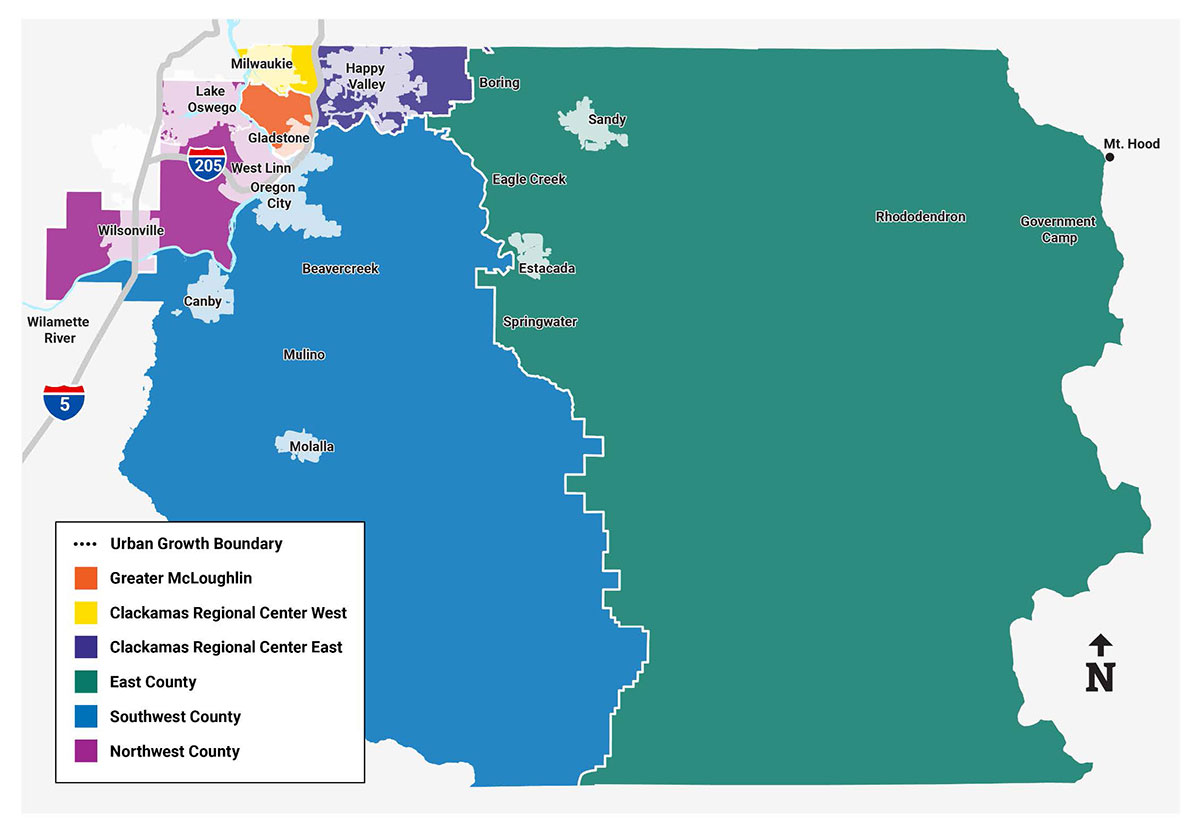
Clackamas County's Transportation System Plan (TSP) reflects all relevant national, state and regional transportation and planning requirements, and provides policies, guidelines and projects to meet transportation needs for residents, businesses and visitors in the unincorporated county for 20 years.
The 2045 TSP Update revisits this plan and helps us to consider the transportation changes that might be possible by 2045. This process involves a broad range of public involvement efforts including this event.
Learn more about the 2045 TSP Update.