Planning and Zoning

Planning and Zoning

ZDO 1009: Landscaping

1009.01 General Provisions

  1. Landscaping materials shall be selected and sited to produce a hardy and low-maintenance landscaped area with an emphasis on fast-growing plants.  Selection shall include consideration of soil type and depth, spacing, exposure to sun and wind, slope and contours of the subject property, building walls and overhangs, and compatibility with existing vegetation to be preserved.  Notwithstanding the requirement for hardiness, annuals are permitted as provided in Subsection 1009.01(B).
  2. A variety of plants, intermixed throughout landscaped areas, shall be provided, as follows:
    1. Evergreen and deciduous;
    2. Trees, shrubs, and groundcover;
    3. Plants of varying textures;
    4. Plants of varying widths and heights at maturity; and
    5. Plants with seasonal color interest (e.g., foliage, flowering perennials, annuals).
  3. The planting of invasive non-native or noxious vegetation shall be prohibited, and existing invasive non-native or noxious vegetation shall be removed.
  4. Landscaped areas shall not be used for other purposes, such as storage or display of automobiles, equipment, merchandise, or materials.
  5. Landscaping of the unimproved area between a lot line and the improved portion of an adjacent road right-of-way shall be required when there are no immediate plans to develop or otherwise disturb the unimproved area, and one or more of the following apply:
    1. The subject property is located inside the Portland Metropolitan Urban Growth Boundary;
    2. Landscaping is necessary to present an appearance consistent with the proposed development as viewed from the road;
    3. Landscaping is necessary to reduce dust, noise, erosion, or fire hazard; or
    4. The road is designated as a scenic road on Comprehensive Plan Map 5-1, Scenic Roads.
  6. Landscaping shall be used to highlight public entrances to buildings.  If—due to the depth of a front setback, a required walkway, or both—there is insufficient area to permit a typical, in-ground landscaping bed between a public entrance and a front lot line, this requirement may be met with trellises, hanging baskets, or planters, any of which shall include plants.
  7. Where feasible, landscaping shall be required adjacent to walkways and other areas intended for pedestrian use.
  8. H.  Existing significant plants, terrain, and other natural features shall be incorporated into the landscaping design and development if such features are required to be retained by other provisions of this Ordinance or if otherwise feasible.

1009.02 Minimum Area Standards

  1. Table 1009-1, Minimum Landscaped Area, establishes the minimum percentage of the area of the subject property that shall be landscaped. 
    1. The minimum landscaped area shall be calculated after subtracting any public dedications from the area of the subject property.
    2. Landscaping in adjacent rights-of-way shall not count toward compliance with the minimum landscaped area.
    3. Requirements for surface parking and loading area landscaping, screening and buffering, scenic roads landscaping, landscaping strips, and recreational areas and facilities set forth in Section 1009 apply regardless of whether compliance with those requirements results in landscaping a greater percentage of the subject property than is required by Table 1009-1.

Table 1009-1:  Minimum Landscaped Area

Zoning DistrictMinimum Landscaped Area
10 percent 
RTC
  • 15 percent outside Government Camp
  • 10 percent in Government Camp
SCMU
  • 15 percent for developments of triplexes, quadplexes, or multifamily dwellings, including mixed-use developments that include these uses
  • 10 percent for all other developments
BP, C-2, C-3, GI, LI, NC, RC, RI, VCS, VO15 percent
OA, OC, RCHDR20 percent
HDR, MR-1, MR-2, MRR, PMD, VA, VTH25 percent except 20 percent for townhouses in the MR-1 and MR-2 Districts
HR
  • 25 percent for conditional uses
  • 20 percent for townhouses if three or more dwelling units are attached in succession
FF-10, FU-10, R-2.5 through R-30, RA-1, RA-2, RR, RRFF-5, VR-4/5, and VR-5/725 percent for conditional uses
SHD40 percent
  1. A minimum of 75 percent of the minimum landscaped area required by Table 1009-1—excluding any area occupied by pedestrian amenities, active recreational areas, or edible gardens—shall be landscaped with native or drought-tolerant plants.
  2. Outdoor recreational areas required by Subsection 1009.08(A), as well as outdoor recreational areas in the MRR District, shall count toward the minimum landscaped area required by Table 1009-1, except that impervious surface area exceeding 25 percent of the outdoor recreational area shall be excluded.
  3. Edible gardens may comprise a maximum of 10 percent of the minimum landscaped area required by Table 1009-1.
  4. Green roofs may comprise a maximum of 25 percent of the minimum landscaped area required by Table 1009-1.
  5. Turf lawn may comprise a maximum of 10 percent of the minimum landscaped area required by Table 1009-1.  However, this limitation shall not apply to active recreational areas, provided that no other areas of the subject property are planted in turf lawn, and it shall not apply to cemeteries.
  6. Pedestrian amenities may comprise a maximum of one-third of the minimum landscaped area required by Table 1009-1.  However, no more than 15 percent of the minimum landscaped area required by Table 1009-1 and developed with pedestrian amenities shall have an impervious surface.
  7. Area occupied by walls, fences, or trellises constructed to comply with Subsections 1009.03 and 1009.04 shall count toward the minimum landscaped area required by Table 1009-1.
  8. In the PMD, MR-1, MR-2, and HDR Districts, the following may comprise a maximum of 20 percent of the minimum landscaped area required by Table 1009-1:  interior courtyards, atriums, solar greenhouses, solariums, roof gardens, indoor recreational areas, and other comparable amenities.
  9. In the RCHDR and SHD Districts, the minimum landscaped area required by Table 1009-1 shall be met with shared outdoor surface areas, including the following:  landscaping, courtyards, pedestrian plazas, areas dedicated for parks, onsite walkways and bikeways, recreational areas and facilities, yards, decks, terraces, patios, and roof gardens.  In addition, indoor recreational facilities identified in Subsection 1009.08(B), and over and above the minimum standard set forth in Subsection 1009.08(B), may be counted toward the minimum landscaped area required by Table 1009-1.Also, private outdoor areas may be counted toward meeting the minimum landscaped area required by Table 1009-1, as follows:
    1. A maximum of 25 percent of the minimum landscaped area required by Table 1009-1 may be comprised of usable private outdoor space, except that the 25-percent cap does not apply to usable private open space facing streets and accessory to residential development.
    2. When living areas face the street, usable balcony space may be applied toward achieving the minimum landscaped area required by Table 1009-1 on a 1:2 ratio (one square foot of credit for every two square feet of balcony space facing the street).  The balconies must have non-opaque sides and be designed to incorporate landscaping or other decorative features.
  10. Exceptions:  Notwithstanding Table 1009-1:
    1. If a commercial, industrial, or institutional development is lawfully nonconforming with regard to compliance with the minimum landscaped area standard, less than 5,000 square feet of building floor space may be added without bringing the subject property into full compliance with the standard, as follows:
      1. Additions of less than 1,000 square feet of building floor space do not require increased compliance with the minimum landscaped area standard.
      2. Additions of 1,000 to 1,999 square feet of building floor space require either an additional five percent of the subject property to be landscaped or compliance with Table 1009-1, whichever is less.
      3. Additions of 2,000 to 4,999 square feet of building floor space require either an additional 10 percent of the subject property to be landscaped or compliance with Table 1009-1, whichever is less.
      4. If a series of additions occur, the landscaped area shall increase until compliance with Table 1009-1 is reached.
    2. In the RTC District in Government Camp, the minimum landscaped area standard will be waived for lots or tracts with street frontage on Government Camp Loop from Wy'East Trail to Olive Street and on Little Trail from Olive Street to Church Street, if plaza space that complies with the following standards is provided:
      1. Plaza space shall be permanent space open to the public. 
      2. Plaza space shall be integrated into the development and be both accessible and visible from Government Camp Loop or Little Trail.
      3. A minimum of 100 square feet of plaza space shall be provided for developments of up to 1,999 square feet of building floor space, and a minimum of 150 square feet of plaza space shall be provided for developments of 2,000 square feet of building floor space or more.  This shall be developed as one contiguous space, except that developments of 5,000 square feet of building floor space or more may develop two separate plazas.
      4. Plaza space surface materials shall consist of textured concrete, concrete mixed with aggregate, rock, rock veneer, pavers, bricks, or wood.  Asphalt is prohibited. 
      5. A minimum of ten percent of the plaza space area shall be landscaped with planters or hardy native vegetation.
      6. A minimum of three permanent seating spaces shall be provided in the plaza space for developments of up to 1,999 square feet of floor space.  One additional permanent seating space shall be provided for each additional 1,000 square feet of floor space.  Seating spaces shall be constructed of textured concrete, rock, rock veneer, wood, or wrought iron.
      7. A minimum of one garbage receptacle shall be provided in each plaza, and all plaza space receptacles shall be clad in wood or stone.

1009.03 Surface Parking And Loading Area Landscaping

Surface parking and loading areas shall be landscaped as follows:

  1. Surface parking areas that include more than 15 parking spaces shall comply with the following landscaping requirements:
    1. Twenty-five square feet of landscaping per parking space, excluding perimeter parking spaces, shall be provided, except that the standard shall be reduced to 20 square feet for each parking space developed entirely with porous pavement.
    2. One landscape swale located between two rows of parking spaces, as shown in Figure 1009-1, is required for every six rows of parking spaces, unless all parking spaces are developed entirely with porous pavement.  Additional swales beyond the minimum requirement are allowed.
      1. For the purpose of Subsection 1009.03(A)(2), a "row" of parking spaces is one space deep, meaning that where two spaces abut at their ends, it is considered two "rows".  
         
      2. Parking spaces separated by pedestrian or vehicle crossings perpendicular to the row of parking spaces are considered to be part of a single row.  
         
      3. The first required swale shall be developed for the entire length of the longest row of parking spaces.
         
      4. Gaps in a required swale are permitted only to provide for pedestrian and vehicle crossings.
         
      5. The parking lot shall be graded to allow surface water to flow into a swale.  Curbs shall not separate parking spaces from the swale, and gaps between parking space tire stops are required to allow surface water to flow into a swale.
         
      6. Swales shall be a minimum of four feet wide.
         
      7. If the front portions of parking spaces are landscaped as allowed by Subsection 1015.02(A)(10), the landscaped portion of the parking space  shall be adjacent and in addition to the swale, as shown in Figure 1009-1.
         
      8. Turf lawn is prohibited in swales.

Figure 1009-1:  Parking Lot Swale
Diagram of parking lot swale

  1. Interior landscaping not developed as swales pursuant to Subsection 1009.03(A)(2) shall comply with the following standards:
    1. It shall be arranged in areas at the ends of rows of parking or between parking spaces within rows of parking. See Figure 1009-2.
    2. It may join perimeter landscaping as long as the interior landscape area extends at least four feet into the parking area from the perimeter landscape line. See Figure 1009-2.
    3. Landscaping that abuts, but does not extend into, the parking area may be included as interior landscaping if all of the following are met:
      1. The abutting landscaped area must be in addition to required perimeter landscaping;
      2. Only the first 10 feet of the abutting landscaped area, measured from the edge of the parking area, may be included as interior landscaping; and
      3. The landscaped area is not abutting and parallel to required perimeter landscaping. See Figure 1009-2.
    4. The interior length and width of landscaped areas shall be a minimum of four feet.
       

Figure 1009-2:  Interior Landscaping
Diagram of interior landscaping

  1. Interior landscaped areas, including swales, shall include a minimum of one tree located every eight interior parking spaces, or fraction thereof, except in the OA, VA, VCS, and VO Districts, where a minimum of one tree shall be located every six interior parking spaces.
    1. Where necessary to accommodate other design considerations, variable spacing of the trees required by Subsection 1009.03(A)(4) is allowed, but in no case shall there be less than one tree planted in every 12 parking spaces. 
    2. The species of trees required shall be determined on the basis of the growth habit and the need to provide maximum shading of surface parking areas. 
  2. Perimeter landscaping requirements for surface parking and loading areas adjacent to abutting lots or rights-of-way are as follows:
    1. A landscaping strip with a minimum width of five feet shall be provided adjacent to the perimeter of the surface parking or loading area, except:
      1. In the OA, VA, VCS, and VO Districts, the minimum width shall be 10 feet;
         
      2. In the BP and LI Districts, the minimum width shall be 15 feet abutting a front lot line; and
         
      3. In the GI District, the minimum width shall be 10 feet abutting a front lot line.
    2. The required landscaping strips shall comply with the following standards:
      1. Sufficient low shrubs shall be planted to form a continuous screen three feet high and 95 percent opaque, year-round; or a three-foot-high masonry wall or berm may be substituted for the shrubs.  When applied along front lot lines, the screen or wall is to be placed along the interior side of the landscaping strip and shall be 30 inches high instead of three feet high.
      2. In addition, one tree is required for every 30 linear feet of landscaping strip, or as otherwise required to provide a tree canopy over the landscaping strip.
      3. Ground cover plants must fully cover the remainder of the landscaped area.
    3. A perimeter landscape strip is not required for a surface parking or loading area adjacent to an abutting lot if one or more interior driveways connect the two lots and if the abutting lot also is developed with a surface parking or loading area adjacent to the shared lot line.
    4. Required walkways may cross perimeter landscaping strips.

1009.04 Screening And Buffering

  1. Screening shall be used to eliminate or reduce the visual impacts of the following:
    1. Service areas and facilities, such as loading areas and receptacles for solid waste or recyclable materials;
    2. Storage areas;
    3. Ground-mounted rainwater collection facilities with a storage capacity of more than 100 gallons;
    4. Parking lots within or adjacent to an Urban Low Density Residential, VR-5/7, VR-4/5, RA-1, RA-2, RR, RRFF-5, FF-10, FU-10, or HR District; and
    5. Any other area or use, as required by this Ordinance.
  2. Screening shall be accomplished by the use of sight-obscuring evergreen plantings, vegetated earth berms, masonry walls, sight-obscuring fences, proper siting of disruptive elements, building placement, or other design techniques.
  3. Screening shall be required to substantially block any view of material or equipment from any point located on a street or accessway adjacent to the subject property.  Screening from walkways is required only for receptacles for solid waste or recyclable materials.  A sight-obscuring fence at least six feet in height and up to a maximum of 10 feet in height shall be required around the material or equipment. 
  4. Buffering shall be used to mitigate adverse visual impacts, dust, noise, or pollution, and to provide for compatibility between dissimilar adjoining uses.  Special consideration shall be given to buffering between residential uses and commercial or industrial uses, and in visually sensitive areas. 
  5. Buffering shall be accomplished by one of the following: 
    1. A landscaping strip with a minimum width of 15 feet and planted with:
      1. A minimum of one row of deciduous and evergreen trees staggered and spaced a maximum of 30 feet apart;
      2. A perennial, evergreen planting with sufficient foliage to obscure vision and which will grow to form a continuous hedge a minimum of six feet in height within two years of planting; and
      3. Low-growing evergreen shrubs and evergreen ground cover covering the balance of the area;
    2. A berm with a minimum width of ten feet, a maximum slope of 40 percent on the side away from the area screened from view, and planted with:
      1. A perennial, evergreen planting with sufficient foliage to obscure vision and which will grow to form a continuous hedge within two years of planting.  The minimum combined height of the berm and planting shall be six feet; and 
      2. Low-growing evergreen shrubs and evergreen ground cover covering the balance of the area;
    3. A landscaping strip with a minimum width of five feet and including:
      1. A masonry wall or sight-obscuring fence a minimum of six feet in height.  The wall or fence is to be placed along the interior side of the landscaping strip;
      2. Evergreen vines, evergreen trees, or evergreen shrubs, any of which shall be spaced not more than five feet apart; and
      3. Low-growing evergreen shrubs and evergreen ground cover covering the balance of the area; or
    4. Another method that provides an adequate buffer considering the nature of the impacts to be mitigated.
  6. Required walkways shall be accommodated, even if such accommodation necessitates a gap in required screening or buffering.

1009.05 Scenic Roads

In the RA-1, RA-2, RRFF-5, FF-10, FU-10, MRR, and HR Districts, buildings in developments adjacent to roads designated as scenic roads on Comprehensive Plan Map 5-1, Scenic Roads, shall be set back a sufficient distance from the right-of-way to permit a landscaped or natural buffer zone.

1009.06 Landscaping Strips

  1. In the BP and LI Districts, a landscaping strip a minimum of 15 feet wide shall be provided abutting front lot lines.
     
  2. In the GI District, a landscaping strip a minimum of 10 feet wide shall be provided abutting front lot lines.
     
  3. In all other zoning districts, except SCMU, a landscaping strip a minimum of five feet wide shall be provided abutting front lot lines.  (See Subsection 1005.09(L) for additional SCMU landscaping requirements.)  
     
    1. This requirement will be waived or reduced in the NC, PMU, and VCS Districts, which are districts that have no minimum front setback standard, to the extent necessary to accommodate a building with a front setback of less than five feet.  
       
    2. If—due to the depth of a front setback and the need to accommodate a required walkway, required pedestrian amenities, or both—there is insufficient area to permit a five-foot-wide landscaping strip, the landscaping strip may be reduced in width or the landscaping requirement may be met with a linear arrangement of trellises, hanging baskets, or planters, any of which shall include plants.

1009.07 Fences And Walls

  1. Fences and walls shall be of a material, color, and design complementary to the development.
  2. In the BP and LI Districts, the minimum front setback for fences and walls is 15 feet.
  3. In the GI District, the minimum front setback for fences and walls is 10 feet. 

1009.08 Recreational Areas And Facilities

  1. An outdoor recreational area shall be provided in developments of duplexes, triplexes, quadplexes, or multifamily dwellings in the MR-1, MR-2, and HDR Districts, and in developments of triplexes, quadplexes, or multifamily dwellings, including mixed-use developments that include these uses, in the SCMU District, as follows:
     
    1. A minimum of 200 square feet of usable outdoor recreational space per dwelling unit shall be provided for studio, one- bedroom, and two-bedroom units.  The minimum shall be increased to 300 square feet per dwelling unit for units with three or more bedrooms.  However, in the SCMU District:
      1. The requirement shall apply only to the first 20 dwelling units per acre, or prorated equivalent thereof; and
      2. The amount of required outdoor recreational area may be reduced, to the minimum extent necessary, if—when combined with the minimum landscaping requirements of Subsections 1005.09(L), 1009.03, and 1009.04—full compliance would result in landscaping more than 15 percent of the lot.
         
    2. Outdoor recreational areas may be designed for passive or active recreation, including edible gardening.
    3. Outdoor recreational areas shall be designed for adequate surveillance opportunities.
    4. Outdoor recreational areas shall be conveniently located and accessible to all dwelling units.
  2. In the SHD and RCHDR Districts, a residential development shall provide at least one of the following recreational facilities for the first 60 dwelling units, or portion thereof, and at least one additional facility for every additional 120 dwelling units, or portion thereof. 
    1. An 800-square-foot or larger heated swimming pool;
    2. A minimum 1,000-square-foot exercise room with exercise equipment and mats;
    3. Two handball/racquetball courts;
    4. Whirlpool and sauna or steam bath rooms;
    5. Minimum 1,200-square-foot game room with pool and ping pong tables, folding tables and chairs, and kitchenette;
    6. An 800-square-foot shop equipped with hand tools, work benches, storage shelves, lockers, and ventilation;
    7. A 400-square-foot greenhouse with all-season solar exposure, equipped with benches, water, ventilation, summer shading materials, and storage areas for pots, tools, potting soil, fertilizers, etc;
    8. 3,000 square feet of hard-surface play area, such as a tennis court, basketball court, or roller-skating area;
    9. 4,200 square feet of soft surface play area with equipment provided for lawn games such as volleyball, badminton, croquet, and horseshoes; and
    10. Any other similar facility.

1009.09 Erosion Control

  1. Graded areas shall be re-vegetated with suitable plants to ensure erosion control.
  2. Netting shall be provided, where necessary, on sloped areas while ground cover is being established.

1009.10 Planting And Maintenance

  1. Impervious weed barriers (e.g, plastic sheeting) are prohibited. 
  2. Plants shall not cause a hazard.  Plants over walkways, sidewalks, pedestrian pathways, and seating areas shall be pruned to maintain a minimum of eight feet below the lowest hanging branches.  Plants over streets, bikeways, accessways, and other vehicular use areas shall be pruned to maintain a minimum of 15 feet below the lowest hanging branches.
  3. Plants shall be of a type that, at maturity, typically does not interfere with above- or below-ground utilities or paved surfaces.
  4. Plants shall be installed to current nursery industry standards.
  5. Plants shall be properly guyed and staked to current nursery industry standards as necessary.  Stakes and guys shall not interfere with vehicular or pedestrian traffic, shall be loosened as needed to prevent girdling of trunks, and shall be removed as soon as sufficient trunk strength develops, typically one year after planting.
  6. Landscaping materials shall be guaranteed for a period of one year from the date of installation.  The developer shall either submit a signed maintenance contract for the one-year period or provide a performance surety pursuant to Section 1311, Completion of Improvements, Sureties, and Maintenance, covering the landscape maintenance costs for the one-year period.
  7. Plants shall be suited to the conditions under which they will be growing.  As an example, plants to be grown in exposed, windy areas that will not be irrigated shall be sufficiently hardy to thrive under these conditions.  Plants shall have vigorous root systems, and be sound, healthy, and free from defects and diseases.
  8. When planted, deciduous trees shall be fully branched, have a minimum caliper of two inches, and have a minimum height of eight feet.
  9. When planted, evergreen trees shall be fully branched, have a minimum height of eight feet, and have only one leader.
  10. Shrubs shall be supplied in minimum one-gallon containers or eight-inch burlap balls with a minimum spread of 12 inches.
  11. Ground cover shall be planted a maximum of 30 inches on center with a maximum of 30 inches between rows.  Rows of plants shall be staggered.  Ground cover shall be supplied in minimum four-inch containers, except that the minimum shall be reduced to two and one-quarter inches or equivalent if the ground cover is planted a minimum of 18 inches on center.
  12. Plants shall be spaced so that ground coverage three years after planting is expected to be 90 percent, except where pedestrian amenities, rainwater collection systems, or outdoor recreational areas count as landscaping pursuant to Subsection 1009.02.  Areas under tree drip lines count as ground coverage.
  13. Irrigation of plants shall be required, except in wooded areas, wetlands, and in river and stream buffers.  The irrigation system shall be automatic, except that hose bibs and manually operated methods of irrigation may be permitted in small landscaped areas close to buildings.  Automatic irrigation systems are subject to the following standards:
    1. An automatic irrigation controller shall be required for irrigation scheduling.
    2. The system shall be designed to prevent runoff, low head drainage, overspray, or other similar conditions where irrigation water flows onto non-targeted areas, such as adjacent property, non-irrigated areas, hardscapes, roadways, or structures.
    3. In mulched planting areas, the use of low volume irrigation is required to maximize water infiltration into the root zone.
    4. Narrow or irregularly shaped areas, including turf lawn, less than eight feet in width in any direction shall be irrigated with subsurface or low volume irrigation.
    5. Overhead sprinkler irrigation is prohibited within two feet of any impervious surface unless:
      1. The landscaped area is adjacent to permeable surfacing and no runoff occurs; or
      2. The adjacent impervious surfaces are designed and constructed to drain entirely to landscaping; or
      3. The irrigation designer specifies an alternative design or technology that complies with Subsection 1009.10(M)(2).
  14. Appropriate methods of plant care and landscaping maintenance shall be provided by the property owner.  Pruning shall be done to current nursery industry standards.
  15. Plants shall be protected from damage due to heavy foot traffic or vehicular traffic by protective tree grates, pavers, or other suitable methods.

[Amended by Ord. ZDO-224, 5/31/11; Amended by Ord. ZDO-243, 9/9/13; Amended by Ord. ZDO-246, 3/1/14; Amended by Ord. ZDO-249, 10/13/14; Amended by Ord. ZDO-250, 10/13/14; Amended by Ord. ZDO-252, 6/1/15; Amended by Ord. ZDO-253, 6/1/15; Amended by Ord. ZDO-266, 5/23/18; Amended by Ord. ZDO-276, 10/1/20; Amended by Ord. ZDO-282, 7/1/22; Amended by Ord. ZDO-283, 9/5/23]

Sidebar Heading
Related Information
New Format?
Off

ZDO 1007: Roads and Connectivity

1007.01 General Provisions

  1. The location, alignment, design, grade, width, and capacity of all roads shall conform to Section 1007, Chapters 5 and 10 of the Comprehensive Plan, and the Clackamas County Roadway Standards.  Where conflicts occur between Section 1007, the Comprehensive Plan, and the Clackamas County Roadway Standards, the Comprehensive Plan shall control. 
  2. Right-of-way dedications and improvements shall be required of all new developments, including partitions, subdivisions, multifamily dwellings, duplexes, triplexes, quadplexes, townhouses, cottage clusters, detached single-family dwellings, and commercial, industrial, and institutional uses, consistent with Section 1007, Chapters 5 and 10 of the Comprehensive Plan, and the Clackamas County Roadway Standards.
  3. New developments shall have access points connecting with existingroads.
    1. Intersection spacing and access control shall be based on Subsection 3.08.110(E) of the Metro Code (Regional Transportation Functional Plan); Chapters 5 and 10 of the Comprehensive Plan; and the Clackamas County Roadway Standards. 
    2. For development on any portion of a contiguous site identified on Comprehensive Plan Map 5-6, Potentially Buildable Residential Sites > 5 Acres in UGB, the applicant shall provide a conceptual map of new streets for the entire site.  The map shall identify street connections to adjacent areas to promote a logical, direct, and connected system of streets; demonstrate opportunities to extend and connect new streets to existing streets, and provide direct public right-of-way routes.   Closed-end street designs shall be limited to circumstances in which barriers prevent full street extensions.  Closed-end streets shall not exceed 200 feet in length and shall serve no more than 25 dwelling units.  Subsequent development on the site shall conform to the conceptual street map, unless a new map is approved pursuant to Subsection 1007.01(C)(2). 
    3. Access control shall be implemented pursuant to Chapter 5 of the Comprehensive Plan and the Clackamas County Roadway Standards considering best spacing for pedestrian access, traffic safety, and similar factors.
    4. Approaches to public and county roads shall be designed to accommodate safe and efficient flow of traffic and turn control where necessary to minimize hazards for other vehicles, pedestrians, and bicyclists.
    5. Joint access and circulation drives utilizing reciprocal easements shall be utilized as deemed necessary by the Department of Transportation and Development.  In the NC District, joint street access for adjacent commercial developments shall be required.
    6. In the SCMU District, driveways shall be spaced no closer to one another than 35 feet, measured from the outer edge of the curb cut, unless compliance with this standard would preclude adequate access to the subject property as a result of existing off-site development or compliance with the Clackamas County Roadway Standards.
    7. In the VA District, no direct motor vehicle access is permitted on Sunnyside Road.
    8. Inside the Portland Metropolitan Urban Growth Boundary:
      1. The development shall have no more than the minimum number of driveways required by the Department of Transportation and Development on all arterial and collector streets. 
         
      2. For properties having more than one street frontage, driveways shall be located on the street with the lowest functional classification, if feasible. 
         
      3. Driveways shall be no wider than the minimum width allowed by the Clackamas County Roadway Standards.
         
      4. Driveways shall be located so as to maximize the number of allowed on-street parking spaces, the number of street trees, and optimum street tree spacing.
  4. Street alignments, intersections, and centerline deflection angles shall be designed according to the standards set forth in Chapters  5 and 10 of the Comprehensive Plan and the Clackamas County Roadway Standards.
  5. All roads shall be designed and constructed to adequately and safely accommodate vehicles, pedestrians, and bicycles according to Chapters 5 and 10 of the Comprehensive Plan and the Clackamas County Roadway Standards.  Development-related roadway adequacy and safety impacts to roadways shall be evaluated pursuant to the Clackamas County Roadway Standards and also to Oregon Department of Transportation standards for state highways.
  6. Roadways shall be designed to accommodate transit services where transit service is existing or planned and to provide for the separation of motor vehicles, bicycle, and pedestrian traffic, and other modes as appropriate.
  7. The needs of all modes of transportation shall be balanced to provide for safe and efficient flow of traffic.  Where practical, pedestrian crossing lengths shall be minimized and the road system shall be designed to provide frequent pedestrian connections.

1007.02 Public and Private Roadways

  1. All roadways shall be developed according to the classifications, guidelines, tables, figures, and maps in Chapters 5 and 10 of the Comprehensive Plan and the provisions of the Clackamas County Roadway Standards.
    1. Development along streets with specific design standards specified in Chapter 10 of the Comprehensive Plan shall improve those streets as shown in Chapter 10.
    2. Development along streets identified as Regional or Community Boulevards on Comprehensive Plan Map 5-5, Metro Regional Street Design Classifications, shall provide pedestrian, bicycle, transit, and visual amenities in the public right-of-way.  Such amenities may include, but are not limited to, the following:  street trees, landscaping, kiosks, outdoor lighting, outdoor seating, bike racks, bus shelters, other transit amenities, pedestrian spaces and access to the boulevard, landscaped medians, noise and pollution control measures, other environmentally sensitive uses, aesthetically designed lights, bridges, signs, and turn bays as appropriate rather than continuous turn lanes.
    3. Development adjacent to scenic roads identified on Comprehensive Plan Map 5-1, Scenic Roads, shall conform to the following design standards, as deemed appropriate by the Department of Transportation and Development:
      1. Road shoulders shall be improved to accommodate pedestrian and bicycle traffic; and
      2. Turnouts shall be provided at viewpoints or for recreational needs. 
    4. In centers, corridors, and station communities, as identified on Comprehensive Plan Map IV-8, Urban Growth Concept, roads shall be designed to minimize the length of street crossings and to maximize connectivity for pedestrians as deemed appropriate by the Department of Transportation and Development.  Other streetscape design elements in these areas include:
      1. On-street parking;
      2. Street trees;
      3. Street lighting;
      4. Pedestrian amenities; and
      5. Truck routes shall be specified for deliveries to local businesses.
    5. In centers, corridors, and station communities, as identified on Comprehensive Plan Map IV-8, on local streets within the Portland Metropolitan Urban Growth Boundary (UGB), and in unincorporated communities, when conflicts exist between the dimensional requirements for vehicles and those for pedestrians, pedestrians shall be afforded additional consideration in order to increase safety and walkability.  In industrial areas, the needs of vehicles shall take precedence.
    6. In the NC, OA, and VCS Districts, landscaping, crosswalks, additional lighting, signalization, or similar improvements may be required to create safe and inviting places for pedestrians to cross streets.
  2. The layout of new public and county roads shall provide for the continuation of roads within and between the development and adjoining developments when deemed necessary and feasible by the Department of Transportation and Development.
    1. When public access to adjoining property is required, this access shall be improved and dedicated to the County.
    2. Street stubs shall be provided to allow for future access to adjacent undeveloped property as deemed necessary by the Department of Transportation and Development. 
    3. These standards may be deviated from when safe and efficient alternate designs would better accommodate:
      1. Sustainable development features such as "Green Streets" as described in Metro's Green Streets: Innovative Solutions for Stormwater and Street Crossings (2002), which shall be allowed within the UGB and in unincorporated communities;
      2. Sustainable surface water management solutions such as low infiltration planters and basins, swales, ponds, rain gardens, trees, porous pavement, and minimal disruption to natural drainage systems;
      3. Preservation of existing significant trees and native vegetation;
      4. Preservation of natural terrain and other natural landscape features;
      5. Achievement of maximum solar benefit for new development through orientation and block sizing;
      6. Existing forest or agricultural uses;
      7. Existing development;
      8. Scenic qualities;
      9. Planned unit developments;
      10. Local access streets less than 200 feet in length which are not extendible; and
      11. Interior vehicular circulation for multifamily, commercial, institutional, and industrial developments.
  3. New county and public roads terminating in cul-de-sacs or other dead-end turnarounds are prohibited except where natural features (such as topography, streams, or wetlands), parks, dedicated open space, or existing development preclude road connections to adjacent properties, existing street stubs, or existing roads.
  4. Developments shall comply with the intersection sight distance and roadside clear zone standards of the Clackamas County Roadway Standards.  In addition:
    1. No planting, signing, or fencing shall be permitted which restricts motorists' vision; and
    2. Curbside parking may be restricted along streets with visibility problems for motorists, pedestrians, and/or bicyclists as deemed appropriate by the Department of Transportation and Development.
  5. New developments, subdivisions, and partitions may be required to dedicate land for right-of-way purposes and/or make road frontage improvements to existing rights-of-way, consistent with Section 1007, Chapters 5 and 10 of the Comprehensive Plan, and the Clackamas County Roadway Standards. 
  6. Road frontage improvements within the UGB and in Government Camp, Rhododendron, and Wemme/Welches shall include:
    1. Surfacing, curbing, or concrete gutters as specified in Section 1007, Chapters 5 and 10 of the Comprehensive Plan, and the Clackamas County Roadway Standards;
    2. Pedestrian, bikeway, accessway, and trail facilities as specified in Subsection 1007.04;
    3. Transit amenities as specified in Subsection 1007.05; and 
    4. Street trees as specified in Subsection 1007.06.

1007.03 Private Roads and Access Drives

  1. Private roads and access drives shall be developed according to classifications and guidelines listed in Section 1007, Comprehensive Plan Figures 5-1 through 5-3, Typical Roadway Cross Sections, Chapters 5 and 10 of the Comprehensive Plan, and the Clackamas County Roadway Standards, except:
    1. When easements or "flag-pole" strips are used to provide vehicular access to lots or parcels, the minimum width shall be 20 feet, unless a narrower width is approved by the Department of Transportation and Development and the applicable fire district's Fire Marshal; 
    2. Where the number of lots served exceeds three, a wider width may be required as deemed appropriate or necessary by the Department of Transportation and Development consistent with other provisions of Section 1007, the Comprehensive Plan, and the Clackamas County Roadway Standards;
    3. Access easements or "flag-pole" strips may be used for utility purposes in addition to vehicular access;
    4. The standards listed above may be deviated from when deemed appropriate by the Department of Transportation and Development to accommodate one-half streets or private common access drives and roads within developed urban areas providing access to not more than seven lots; and
    5. The intersection of private roads or access drives with a public or county road and intersections of two private roads or access drives shall comply with the sight distance and clear zone standards pursuant to Subsection 1007.02(D).

1007.04 Pedestrian and Bicycle Facilities

  1. General Standards:  Pedestrian and bicycle facilities shall be developed according to the classifications and guidelines listed in Section 1007, Comprehensive Plan Figures 5-1 through 5-3, Typical Roadway Cross Sections, Chapters 5 and 10 of the Comprehensive Plan, and the Clackamas County Roadway Standards.
  2. Pedestrian and Bicycle Facility Design:  Pedestrian and bicycle facilities shall be designed to:
    1. Minimize conflicts among automobiles, trucks, pedestrians, and bicyclists;  
    2. Provide safe, convenient, and an appropriate level of access to various parts of the development and to locations such as schools, employment centers, shopping areas, adjacent developments, recreation areas and open space, and transit corridors;  
    3. Allow for unobstructed movements and access for transportation of disadvantaged persons; and  
    4. Be consistent with Chapters 5 and 10 of the Comprehensive Plan; Comprehensive Plan Maps 5-2a, Planned Bikeway Network, Urban, 5-2b, Planned Bikeway Network, Rural, and 5-3, Essential Pedestrian Network; North Clackamas Parks and Recreation District's (NCPRD) Park and Recreation Master Plan; and Metro's Regional Trails and Greenways Map. 
  3. Requirements for Pedestrian and Bicycle Facility Construction:  Within the Portland Metropolitan Urban Growth Boundary (UGB), except if the subject property is in the AG/F, EFU, FF-10, RA-1, RA-2, RC, RI, RRFF-5, or TBR District, sidewalks, pedestrian pathways, and accessways shall be constructed as required in Subsection 1007.04 for subdivisions, partitions, multifamily dwellings, triplexes, quadplexes, cottage clusters, townhouses where three or more dwelling units are attached to one another, and commercial, industrial, or institutional developments, except that for structural additions to existing commercial, industrial, or institutional buildings, development of such facilities shall be required only if the addition exceeds 10 percent of the assessed value of the existing structure, or 999 square feet.
  4. Requirement for Sidewalk Construction: Within the UGB, except if the subject property is in the AG/F, EFU, FF-10, RA-1, RA-2, RC, RI, RRFF-5, or TBR District, sidewalks shall be constructed, as required in Subsection 1007.04(F), for duplexes, detached single-family dwellings, townhouses where two dwelling units are attached to one another, and manufactured dwellings outside a manufactured dwelling park.
  5. Sidewalks or Pedestrian Pathways in Unincorporated Communities:  In an unincorporated community, either a sidewalk or a pedestrian pathway shall be constructed on arterial or collector street frontage(s) of a lot upon which a subdivision, partition, multifamily dwelling, quadplex, triplex, townhouse where three or more dwelling units are attached to one another, or a commercial, industrial, or institutional development is proposed.
  6. Sidewalk Location:  Sidewalks required by Subsection 1007.04(C) or (D) shall be constructed on:
    1. Both sides of a new or reconstructed road, except that sidewalks may be constructed on only one side of the road if:
      1. The road is not a through road;
      2. The road is 350 feet or less in length and cannot be extended; or
      3. In consideration of the factors listed in Subsection 1007.02(B)(3);
    2. The street frontage(s) of a lot upon which a subdivision, partition, multifamily dwelling, triplex, quadplex, cottage cluster, townhouse where three or more dwelling units are attached to one another, or a commercial, industrial, or institutional development is proposed; and
    3. Local, connector, or collector road street frontage(s) of a lot upon which a duplex, a detached single-family dwelling, a townhouse where two dwelling units are attached to one another, or a manufactured dwelling is proposed. This requirement shall be imposed as a condition on the issuance of a conditional use permit, building permit, or manufactured dwelling placement permit, but:
      1. The requirement shall be waived for the replacement of a lawfully established dwelling, provided the number of dwelling units is not increased; and 
      2. The sidewalk requirement shall apply to no more than two street frontages for a single lot.
  7. Pedestrian Pathways:  Within the UGB, a pedestrian pathway may be constructed as an alternative to a sidewalk on a local, connector, or collector road when it is recommended by the Department of Transportation and Development; the surface water management regulatory authority approves the design; and at least one of the following criteria is met:
    1. The site has topographic or natural feature constraints that make standard sidewalk construction unusually problematic;
    2. No sidewalk exists adjacent to the site;
    3. Redevelopment potential along the road is limited; or
    4. The road is identified for a pedestrian pathway by the River Forest Neighborhood Plan adopted by the City of Lake Oswego.
  8. Sidewalk and Pedestrian Pathway Width:  Sidewalks and pedestrian pathways shall be constructed to the minimum widths shown in Table 1007-1, Minimum Sidewalk and Pedestrian Pathway Width, and be consistent with applicable requirements of Chapters 5 and 10 of the Comprehensive Plan.

Table 1007-1:  Minimum Sidewalk and Pedestrian Pathway Width

Street TypeResidential SidewalkCommercial or Institutional SidewalkIndustrial Sidewalk
Local5 feet7 feet5 feet
Connector5 feet7 feet5 feet
Collector5 feet8 feet5 feet
Arterial6 feet8 feet6 feet
  1. The entire required width of sidewalks and pedestrian pathways shall be unobstructed.
  2. Sidewalks and pedestrian pathways at transit stops shall be a minimum of eight feet wide for a distance of 20 feet centered on the transit shelter or transit stop sign.
  3. A sidewalk set back from the curb by at least five feet may be one foot narrower (but not less than five feet) than the standard listed above.  This five-foot separation strip shall be landscaped and shall be maintained by the adjacent property owner.  The landscape strip may contain fixed objects provided that sight distance and roadside clear zone standards are satisfied pursuant to the Clackamas County Roadway Standards.
  4. Uses located in the Light Industrial, General Industrial, or Business Park District and containing over 5,000 square feet of office space shall comply with the requirements for Commercial and Institutional uses.
  5. 5.     In Sunnyside Village, notwithstanding Table 1007-1 and Comprehensive Plan Figures X-SV-1, Sunnyside Village Plan Connector Street with Planting Strips and Bike Lanes and X-SV-2, Sunnyside Village Plan Connector Street with Planting Strips , a connector street requires nine-foot-wide sidewalks if commercial/retail is adjacent to the site. 
  6. Accessways:  Accessways shall comply with the following standards:
    1. Accessways shall be required where necessary to provide direct routes to destinations not otherwise provided by the road system and where topography permits.  Developments shall not be required to provide right-of-way for accessways off-site to meet this requirement.  If right-of-way is available off-site, the developer may be required to improve an accessway off-site up to 150 feet in length.
    2. Accessways shall provide safe, convenient access to facilities generating substantial pedestrian or bicycle trips, such as an existing or planned transit stop, school, park, place of worship, daycare center, library, commercial area, or community center.  Facilities such as these shall be accessible from dead-end streets, loops, or mid-block locations.  Where required, accessways shall be constructed at intervals of no more than 330 feet, unless they are prevented by barriers such as topography, railroads, freeways, pre-existing development, or environmental constraints such as streams and wetlands.
    3. An accessway shall include at least a 15-foot-wide right-of-way and an eight-foot-wide hard surface.  For safety, accessways should be as straight as practicable and visible from an adjacent use if practicable.  Removable bollards or other large objects may be used to bar motor vehicular access.
    4. So that they may be safely used at night, accessways shall be illuminated by street lights or luminaires on shorter poles.  Separate lighting shall not be required if existing lighting adequately illuminates the accessway. 
    5. Fences are not required, but the height of a fence along an accessway shall not exceed six feet.
    6. Ownership and maintenance responsibility for accessways shall be resolved during the development review and approval process.
  7. Accessways in Sunnyside Village:  The following standards apply in Sunnyside Village.  Where these standards conflict with Subsection 1007.04(I), Subsection 1007.04(J) shall take precedence.
    1. A system of interconnecting accessways shall be provided from subdivisions, quadplexes, and multifamily developments to commercial facilities and public amenities such as existing or planned transit stop or facility, school, park, place of worship, daycare facility, children's play area, outdoor activity areas, plazas, library, or similar facility and to a dead-end street, loop, or mid-block where the block is longer than 600 feet.
      1. An accessway shall include at least 15 feet of right-of-way and a 10-foot-wide paved surface.
      2. Accessways shall be illuminated so that they may be safely used at night.
      3. The maximum height of a fence along an accessway shall not exceed four feet.
      4. Bollards or other similar types of treatment may be required in order to prevent cars from entering the accessway.
      5. The designated east-west pedestrian accessway shall include a minimum 10-foot-wide concrete surface within a 10-foot-wide right-of-way, easement, or other legal form satisfactory to the County.  Planting areas adjacent to the easement with street trees should be provided along at least one side of this accessway.  However, alternatives to this standard may be considered through design review pursuant to Section 1102.  If the accessway is within a parking area, it shall be lined by parking lot trees planted at a maximum of 30 feet on center along both sides. 
  8. Bikeways:  Bikeways shall be required as follows:
    1. Shoulder bikeways, bike lanes, bike paths, or cycle tracks shall be included in the reconstruction or new construction of any street if a bikeway is indicated in Chapters 5 and 10 of the Comprehensive Plan and on Comprehensive Plan Map 5-2a or 5-2b; NCPRD's Park and Recreation Master Plan; or Metro's Regional Trails and Greenways Map. 
    2. Shoulder bikeways, bike lanes, bike paths, or cycle tracks shall be considered in the reconstruction or new construction of any other arterial or collector.
    3. Within urban growth boundaries, shoulder bikeways, bike lanes, bike paths, or cycle tracks shall be constructed from new public or private elementary, middle school, and high school facilities to off-site bikeways to provide continuous bicycle route connections within and between surrounding developments, unless precluded by existing development.
  9. Trails:  Trail dedications or easements shall be provided and developed as shown on Comprehensive Plan Map IX-1, Open Space Network & Recreation Needs; the Facilities Plan (Figure 4.3) in NCPRD's Park and Recreation Master Plan; and Metro's Regional Trails and Greenways Map. 
  10. Trails and Pedestrian Connections in Sunnyside Village:  The following standards apply in Sunnyside Village.  Where these standards conflict with other provisions in Section 1007, Subsection 1007.04(M) shall take precedence.
    1. An interconnecting system of trails and accessways throughout Sunnyside Village shall be provided.  The general trail locations are shown on Comprehensive Plan Map X-SV-1.  The location of the trails shall be set at the time a land use application is approved.  The locations of the trails are based on achieving connections to streets and/or pedestrian ways and protection of the significant features of the resource protection areas. 
    2. The trail system will generally occur along the creeks and resource protection areas.  The accessways and/or trail system will provide connections to parks, the elementary school, and to adjacent commercial and residential developments. 
    3. There also shall be an east-west accessway between 142nd Avenue and 152nd Drive, south of Sunnyside Road and north of Oregon Trail Drive.
    4. The trail system shall be designed to provide multiple access points for the public.  The trails shall be constructed by the developer. 
    5. All trails and accessways within the resource protection areas shall either be dedicated or an easement granted to NCPRD in conjunction with development.  These connections shall be maintained by and constructed to the standards established by NCPRD.
    6. The maintenance of all pedestrian connections and trails located outside the resource protection areas as identified on Comprehensive Plan Map X-SV-1 shall be the responsibility of the property owner. 
  11. Pedestrian and Bicycle Circulation:  The pedestrian and bicycle circulation connections shown on Comprehensive Plan Maps X-CRC-3, Clackamas Regional Center Area Design Plan Urban Design Elements, X-CRC-7, Clackamas Regional Center Area Design Plan Pedestrian and Bicycle Circulation Network, and X-CRC-7a, Clackamas Regional Center Area Design Plan Walkway Network, shall be provided.

1007.05 Transit amenities

All residential, commercial, institutional, and industrial developments on existing and planned transit routes shall be reviewed by Tri-Met or other appropriate transit provider to ensure appropriate design and integration of transit amenities into the development.  The design shall not be limited to streets, but shall ensure that pedestrian/bikeway facilities and other transit-supportive features such as shelters, bus pull-outs, park-and-ride spaces, and signing will be provided.  The designs shall comply with Tri-Met standards and specifications. 

1007.06 Street Trees

  1. Within the Portland Metropolitan Urban Growth Boundary, except in the AG/F, EFU, FF-10, FU-10, RA-1, RA-2, RC, RI, RRFF-5, and TBR Districts, street trees are required on all road frontage—except frontage on private roads or access drives—for subdivisions, partitions, multifamily dwellings, triplexes, townhouses where three or more dwelling units are attached to one another, and commercial, industrial, or institutional developments, except that for structural additions to existing commercial, industrial, or institutional buildings, street trees are required only if the addition exceeds 10 percent of the assessed value of the existing structure, or 999 square feet. Street trees shall comply with the following standards:
    1. Partial or complete exemptions from the requirement to plant street trees may be granted on a case-by-case basis.  Exemptions may be granted, for example, if the exemption is necessary to save existing significant trees which can be used as a substitute for street trees.
    2. Street trees to be planted shall be chosen from a County-approved list of street trees (if adopted), unless approval for planting of another species is given by the Department of Transportation and Development. 
    3. Location and planting of street trees may be influenced by such conditions as topography, steep terrain, soil conditions, existing trees and vegetation, preservation of desirable views, and solar access.
    4. Planting of street trees shall be coordinated with other uses which may occur within the street right-of-way, such as bikeways, pedestrian paths, storm drains, utilities, street lights, shelters, and bus stops.
    5. Street trees at maturity shall be of appropriate size and scale to complement the width of the street or median area.
  2. Street trees required for developments in the Clackamas Regional Center Area shall comply with the following standards: 
    1. Street trees are required along all streets, except for drive aisles in parking lots.
    2. When determining the location of street trees, consideration should be given to accommodating normal retail practices in front of buildings such as signage, outdoor display, loading areas, and pullout lanes.
    3. Street trees are required along private access streets under the following conditions:
      1. On both sides when the access point is a signalized intersection;
      2. On both sides when the street section has four or more lanes at the access point;
      3. On both sides when the private street is developed to comply with building orientation standards;
      4. On a minimum of one side when the street section has one or two lanes, and the street is not at a signalized intersection or is not used to meet the structure orientation standards of Subsections 1005.07(C) and 1005.08(B); and
      5. On a minimum of one side of the street when access is shared with adjacent property. Adjoining property shall be required to install trees on its side of the access street when the property is developed.
    4. In the Fuller Road Station Community, as identified on Comprehensive Plan Map X-CRC-1, street trees are required along both sides of all street types, and as shown in Comprehensive Plan Figure X-CRC-11, Clackamas Regional Center Area Design Plan Fuller Road Station Community, Type "E" Pedestrian/Bicycle Connection, for Type E pedestrian/bicycle connections.  Street trees shall be spaced from 25 to 40 feet on center, based on the selected tree species and any site constraints.  Street trees shall otherwise comply with the other provisions of Subsections 1007.06(A) and (B).
  3. In the Business Park District, street trees are required at 30- to 40-foot intervals along periphery and internal circulation roads, except where significant trees already exist.
  4. Street trees are required for developments in Sunnyside Village along both sides of all connector and local streets, and as set forth in Subsection 1007.09.  In addition: 
    1. One to two street trees are required per interior lot, and two to four for corner lots depending on the canopy of the tree species proposed.  If a small canopy (less than or equal to 25 feet in diameter at maturity) is proposed, then two per interior lot and four per corner lot are required.  If a larger canopy (greater than 25 feet in diameter at maturity) is proposed, then one per interior lot and two per corner lot are required. 
    2. As each portion of a project is developed, a specific species of street tree will be chosen for each street.  The developer may choose the species of street tree to be planted so long as the species is not known to cause sidewalks to buckle, does not have messy fruits or pods, is not prone to insects or having weak wood, and is not on the list of prohibited trees.  The County will have final approval regarding the type of street tree to be planted.
    3. Along connector streets or streets with a higher classification, metal grating, non-mortared brick, grasscrete, or similar material shall be installed at grade over the planting area around street trees, or raised planters shall be constructed to prevent soil compaction and damage to the trunk.  Landscape strips or tree wells are required along streets with a classification below connector status.

1007.07 Transportation Facilities Concurrency

  1. Subsection 1007.07 shall apply to the following development applications:  design review, subdivisions, partitions, and conditional uses.
  2. Approval of a development shall be granted only if the capacity of transportation facilities is adequate or will be made adequate in a timely manner.  The following shall be exempt from this requirement:
    1. Development that is located: 
      1. In the Light Industrial, General Industrial, or Business Park District; and
      2. North of the Clackamas River; and 
      3. West of Highway 224 (south of Highway 212) or 152nd Drive (north of Highway 212); and 
      4. South of Sunnyside Road (east of 82nd Avenue) or Harmony Road (west of 82nd Avenue) or Railroad Avenue (west of Harmony Road); and 
      5. East of Interstate 205 (south of Milwaukie Expressway) or the city limits of Milwaukie (north of the Milwaukie Expressway).
    2. Modification or replacement of an existing development (or a development that has a current land use approval even if such development has not yet been constructed) on the same property, provided that an increase in motor vehicle traffic does not result;
    3. Unmanned utility facilities, such as wireless telecommunication facilities, where no employees are present except to perform periodic servicing and maintenance;
    4. Mass transit facilities, such as light rail transit stations and park-and-ride lots;
    5. Home occupations to host events, which are approved pursuant to Section 806; and 
    6. Development in Government Camp that is otherwise consistent with the Comprehensive Plan land use plan designations and zoning for Government Camp.
  3. As used in Subsection 1007.07(B), adequate means a maximum volume-to-capacity ratio (v/c), or a minimum level of service (LOS), as established by Comprehensive Plan Tables 5-2a, Motor Vehicle Capacity Evaluation Standards for the Urban Area, and 5-2b, Motor Vehicle Capacity Evaluation Standards for the Rural Area. Notwithstanding the definitions of "urban" and "rural" in Chapter 5, Transportation System Plan, of the Comprehensive Plan, Highway 212 shall be evaluated under Table 5-2a, if the subject property is inside the Portland Metropolitan Urban Growth Boundary.
  4. For the purpose of calculating capacity as required by Subsections 1007.07(B) and (C), the following standards shall apply:
    1. The methods of calculating v/c and LOS are established by the Clackamas County Roadway Standards.
    2. The adequacy standards shall apply to all roadways and intersections within the impact area of the proposed development.  The impact area shall be identified pursuant to the Clackamas County Roadway Standards. 
  5. As used in Subsection 1007.07(B), timely means:
    1. For facilities under the jurisdiction of the County, necessary improvements are included in the Five-Year Capital Improvement Program, fully funded, and scheduled to be under construction within three years of the date land use approval is issued;
    2. For facilities under the jurisdiction of the State of Oregon, necessary improvements are included in the Statewide Transportation Improvement Program (STIP) and scheduled to be under construction within four years of the date land use approval is issued; 
    3. For facilities under the jurisdiction of a city or another county, necessary improvements are included in that jurisdiction's capital improvement plan, fully funded, and scheduled to be under construction within three years of the date land use approval is issued.
    4. Alternatively, timely means that necessary improvements will be constructed by the applicant or through another mechanism, such as a local improvement district.  Under this alternative: 
      1. Prior to issuance of a certificate of occupancy for a conditional use or a development subject to design review and prior to recording of the final plat for a subdivision or partition, the applicant shall do one of the following:
        1. Complete the necessary improvements; or
        2. For transportation facilities under the jurisdiction of the County, the applicant shall provide the county with a deposit, letter of credit, performance bond, or other surety satisfactory to county staff pursuant to Section 1311, Completion of Improvements, Sureties, and Maintenance.  For transportation facilities under the jurisdiction of the state, a city, or another county, the applicant shall comply with the respective jurisdiction's requirements for guaranteeing completion of necessary improvements.  This option is only available if the jurisdiction has a mechanism in place for providing such a guarantee. 
    5. For a phased development, the first phase shall satisfy Subsections 1007.07(E)(1) through (4) at the time of land use approval.  Subsequent phases shall be subject to the following: 
      1. At the time of land use approval, necessary improvements shall be identified and the phase for which they are necessary shall be specified. 
      2. Necessary improvements for a particular phase shall either: 
        1. Comply with Subsections 1007.07(E)(1) through (3) at the time of building permit approval, except that the improvements shall be scheduled to be under construction within three years of building permit approval rather than within three years of land use approval; or 
        2. Comply with Subsection 1007.07(E)(4), in which case the improvements shall be completed or guaranteed prior to issuance of a certificate of occupancy or recording of the final plat for the applicable phase.
  6. As used in Subsection 1007.07(E), necessary improvements are:
    1. Improvements identified in a transportation impact study as being required in order to comply with the adequacy standard identified in Subsection 1007.07(C). 
      1. A determination regarding whether submittal of a transportation impact study is required shall be made based on the Clackamas County Roadway Standards, which also establish the minimum standards to which a transportation impact study shall adhere.
      2. If a transportation impact study is not required, County traffic engineering or transportation planning staff shall identify necessary improvements or the applicant may opt to provide a transportation impact study.
  7. Notwithstanding Subsections 1007.07(D) and (F)(1)(a), motor vehicle capacity calculation methodology, impact area identification, and transportation impact study requirements are established by the ODOT Transportation Analysis Procedures Manual for roadways and intersections under the jurisidiction of the State of Oregon. 
  8. As an alternative to compliance with Subsection 1007.07(B), the applicant may make a voluntary substantial contribution to the transportation system.
    1. As used in this subsection, "substantial contribution" means construction of a roadway or intersection improvement that is all of the following:
      1. A complete project or a segment of a roadway identified in Comprehensive Plan Table 5-3a, 20-Year Capital Projects, 5-3b, Preferred Capital Projects, or 5-3c, Long-Term Capital Projects; the STIP; or the capital improvement plan (CIP) of a city or another county.
        1. For a segment of a roadway to qualify as a substantial contribution, the roadway shall be on or abutting the subject property; no less than the entire segment that is on or abutting the subject property shall be completed; and there shall be a reasonable expectation that the entire project—as identified in Comprehensive Plan Table 5-3a, 5-3b, or 5-3c; the STIP; or the CIP of a city or another county—will be completed within five years;
      2. Located within the impact area of the proposed development.  The impact area shall be established by the Clackamas County Roadway Standards;
      3. Estimated to have a minimum construction cost of $527,000 in year 2004 dollars.  The minimum construction cost shall on January 1st of each year following 2004 be adjusted to account for changes in the costs of acquiring and constructing transportation facilities.  The adjustment factor shall be based on the change in average market value of undeveloped land, except resource properties, in the County according to the records of the County Tax Assessor, and the change in construction costs according to the Engineering News Record (ENR) Northwest (Seattle, Washington) Construction Cost Index; and shall be determined as follows: 
        1. Change in Average Market Value X 0.50 + Change in Construction Cost Index X 0.50 = Minimum Construction Cost Adjustment Factor
        2. After the adjustment factor is applied to the previous year's minimum construction cost, the result shall be rounded to the nearest thousand. 
    2. Prior to issuance of a certificate of occupancy for a conditional use or a development subject to design review and prior to recording of the final plat for a subdivision or partition, the applicant shall do one of the following: 
      1. Complete the substantial contribution; or
      2. For transportation facilities under the jurisdiction of the County, the applicant shall provide the county with a deposit, letter of credit, performance bond, or other surety satisfactory to county staff pursuant to Section 1311.  For transportation facilities under the jurisdiction of the state, a city, or another county, the applicant shall comply with the respective jurisdiction's requirements for guaranteeing completion of necessary improvements.  This option is only available if the jurisdiction has a mechanism in place for providing such a guarantee.

1007.08 Fee in Lieu of Construction

For all or part of the road frontage improvements required by Section 1007; located within the Portland Metropolitan Urban Growth Boundary (UGB); and required for a partition, duplex or triplex (where no more than one such dwelling is proposed), a townhouse, a detached single-family dwelling, or a manufactured dwelling (provided it is not located in a cottage cluster development); the developer may elect to pay a fee in lieu of construction as follows.

  1. The fee in lieu of construction may be paid if the road frontage improvements are located on a local, connector, or collector road that is not identified on Comprehensive Plan Map 5-3, Essential Pedestrian Network, and payment of the fee is deemed by the Department of Transportation and Development to be an acceptable alternative to construction of the required improvements; or
  2. The fee in lieu of construction may be paid if the road frontage improvements are located on a road that is identified on Comprehensive Plan Map 5-3; payment of the fee is deemed by the Department of Transportation and Development to be an acceptable alternative to construction of the required improvements; and at least one of the following criteria is met:
    1. The improvements are included in the Five-Year Capital Improvement Program;  
    2. The improvements are located on a road where significant topographical or natural feature constraints exist; or  
    3. The improvements are located on a local, connector, or collector road where a sidewalk or pathway does not exist within 200 feet of the required improvements.
  3. The amount of the fee in lieu of construction is established by separate order of the Board of County Commissioners.
  4. All fees in lieu of improvements collected, and interest thereon, shall be placed in a "Sidewalk Improvement Fund."  Fees shall be spent on sidewalk or pedestrian pathway construction on local, connector, or collector roads within the UGB. 

1007.09 Streets And Sidewalks In Sunnyside Village

The following standards apply in Sunnyside Village. Where these standards conflict with other provisions in Section 1007, Subsection 1007.09 shall take precedence.

  1. Cul-de-sacs are permitted only when topographic conditions or existing street patterns preclude extension of streets.  The maximum radius shall be 40 feet.
  2. All streets adjacent to resource protection areas shall have at least one five-foot-wide sidewalk along one side of the street.  If there are no significant trees (at least eight inches in diameter) along the resource protection area adjacent to the street, then a minimum four-foot-wide planting strip is required along both sides of the street.  If it is determined that a unique view is to be preserved, then the Planning Director will determine if street trees are required. 
  3. New street connections along arterial streets are shown on Comprehensive Plan Map X-SV-3, Sunnyside Village Plan Street Classifications.  New street connections to collector roadways shall be a minimum of 150 feet apart, measured road centerline to centerline.  

    New individual driveway connections shall not be permitted along arterial and collector roadways.  

    At existing or future major street intersections (existing or proposed traffic signals), no new driveways or street connections shall be allowed within the influence area of the intersection.  The influence area is defined as the distance that vehicles will queue from the signalized intersection.  The influence area shall be based upon traffic volumes summarized in the Sunnyside Area Master Plan (November 1994) or based upon information acceptable to the County Engineering Division.  This influence area shall include an additional 100 feet beyond the queue length for back-to-back left turns.  

    The preferred minimum intersection spacing on minor arterials is 500 feet, measured road centerline to centerline.  Major arterial intersection spacing is preferred to be between 600 feet and 1,000 feet, measured road centerline to centerline. 
  4. The interior angles at intersection roadways shall be as near to 90 degrees as possible, and in no case shall it be less than 80 degrees or greater than 100 degrees.  Minimum centerline radius for local roadways shall be 100 feet unless the alternative horizontal curve illustrated on Comprehensive Plan Figure X-SV-9, Sunnyside Village Plan Alternative Horizontal Curve for Local Streets, is used.
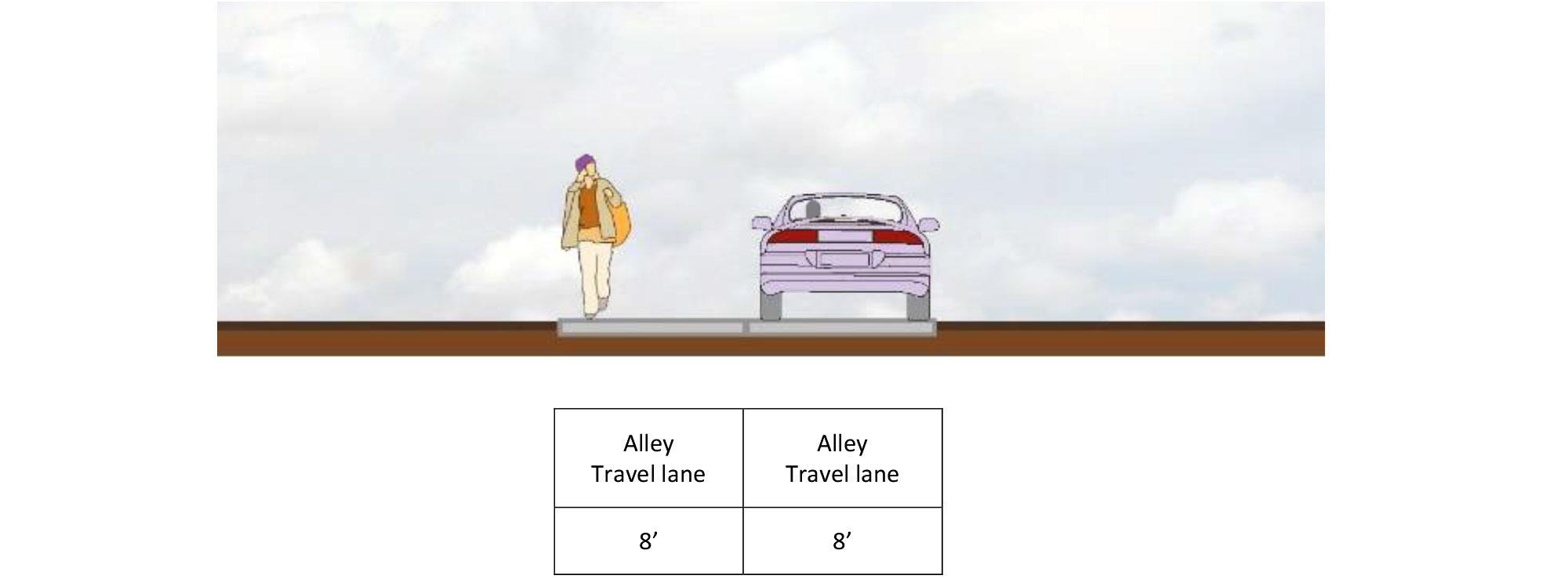
  5. Alleys shall be private streets with rights-of-way of 16 feet.  (See Comprehensive Plan Figure X-SV-6, Sunnyside Village Plan Alleys.)
  6. A traffic circle will mark the heart of Sunnyside Village and will provide suitable geometrics for the five radial streets that converge at this point.  Travel on the circle shall occur in one direction.  This shall be facilitated by traffic diverters that guide vehicles but still allow comfortable pedestrian movement. The raised diverters should consist of low raised curbs and/or special paving.  The travel lane within the circle should allow for easy merging.

    Special paving shall demark crosswalks.  Bike lanes shall be clearly marked and shall occur at the edge of the travel lane and define the inner boundary of the crosswalks and bus loading areas.  The bus loading areas shall be located adjacent to the Village Commercial area.  On the other side of the circle, this added dimension shall be used for planting strips with street trees, adjacent to nine-foot-wide sidewalks.

    The center island shall have a radius of at least 30 feet and shall be landscaped.  A vertical feature or monument identifying the entrance to Sunnyside Village should mark the center of the circle and shall be framed by blossoming trees.
  7. Intersection dimensions should be minimized to reduce pedestrian crossing-distances and slow vehicles.  Curb radiuses should not exceed 25 feet at corners.

1007.10 Vacations

  1. Road and Access Easement Vacations:  In the RTL and CC Districts, road vacations shall be prohibited in developments unless replaced with a new road or walkway that serves the same function. The replacement does not have to be in the same alignment as long as it provides access to the same areas the vacated road would have if constructed. 
  2. Internal Streets:  In the Clackamas Regional Center Area, to provide connectivity, existing platted roads within proposed developments shall not be vacated unless similar access is provided on the site.

[Amended by Ord. ZDO-224, 5/31/11; Amended by Ord. ZDO-230, 9/26/11; Amended by Ord. ZDO-232, 3/12/12; Amended by Ord. ZDO-246, 3/1/14; Amended by Ord. ZDO-250, 10/13/14; Amended by Ord. ZDO-253, 6/1/15; Amended by Ord. ZDO-258, 1/18/17; Amended by Ord. ZDO-266, 5/23/18; Amended by Ord. ZDO-268, 10/2/18; Amended by Ord. ZDO-276, 10/1/20; Amended by Ord. ZDO-282, 7/1/22; Amended by Ord. ZDO-283, 9/5/23]

Sidebar Heading
Related Information
New Format?
Off

ZDO 1006: Utilities, Street Lights, Water Supply, Sewage Disposal, Surface Water Management, And Erosion Control

1006.01 General Standards

  1. The location, design, installation, and maintenance of all utility lines and facilities shall be carried out with minimum feasible disturbance of soil and site consistent with the rules and regulations of the surface water management regulatory authority.
  2. All development that has a need for electricity, natural gas, and communications services shall install them pursuant to the requirements of the utility district or company serving the development. Except where otherwise prohibited by the utility district or company, utility service lines shall be installed underground.
  3. Coordinated installation of necessary water, sanitary sewer, and surface water management and conveyance facilities is required.  
  4. Easements shall be provided along lot lines as deemed necessary by the County, special districts, and utility companies. Easements for special purpose uses shall be of a width deemed appropriate by the responsible agency. 

1006.02 Street Lights

Street lights are required for all development inside the Portland Metropolitan Urban Growth Boundary. The following standards apply:

  1. Street lighting shall be installed pursuant to the requirements of Clackamas County Service District No. 5 and the electric company serving the development. A street light shall be installed where a new road intersects a County road right-of-way and, in the case of subdivisions, at every intersection within the subdivision.
  2. Areas outside Clackamas County Service District No. 5 shall annex to the district through petition to the district.

1006.03 Water Supply

  1. Development which has a need for, or will be provided with, public or community water service shall install water service facilities and grant necessary easements pursuant to the requirements of the district or company serving the development.
  2. Approval of a development that requires public or community water service shall be granted only if the applicant provides a preliminary statement of feasibility from the water system service provider. 
    1. The statement shall verify that water service, including fire flows, is available in levels appropriate for the development and that adequate water system capacity is available in source, supply, treatment, transmission, storage and distribution. Alternatively, the statement shall verify that such levels and capacity can be made available through improvements completed by the developer or the system owner.
    2. If the statement indicates that water service is adequate with the exception of fire flows, the applicant shall provide a statement from the fire district serving the subject property that states that an alternate method of fire protection, such as an on-site water source or a sprinkler system, is acceptable. 
    3. The statement shall be dated no more than one year prior to the date a complete land use application is filed and need not reserve water system capacity for the development.  
  3. Prior to final approval of a partition or subdivision, the applicant shall provide evidence that any wells in the tract subject to temporary or permanent abandonment under Oregon Revised Statutes (ORS) 537.665 have been properly abandoned. 
  4. The following standards apply inside the Portland Metropolitan Urban Growth Boundary, Government Camp, Rhododendron, Wemme/Welches, Wildwood/Timberline, and Zigzag Village:
    1. Land divisions or other development requiring water service shall not be approved, except as provided in Subsection 1006.03(D)(4), unless they can be served by a public water system in compliance with drinking water standards as determined by the Oregon Health Authority.
    2. Development requiring water service within the boundaries of a water service system, created pursuant to ORS chapters 264, 450, or 451, shall receive service from this system.
    3. New public water systems shall not be created unless formed pursuant to ORS chapters 264, 450, or 451.
    4. A lot of record not located within the approved boundaries of a public water system may be served by an alternative water source.
  5. The following standards apply outside the Portland Metropolitan Urban Growth Boundary, Government Camp, Rhododendron, Wemme/Welches, Wildwood/Timberline, and Zigzag Village:
    1. Applicants shall specify a lawful water source for the proposed development, such as a public or community water system, certificated water right, or exempt-use well.
    2. If use of an exempt-use well is proposed, subdivisions—as well as the following types of development in a sensitive groundwater area: partitions, Type II replats, and industrial, commercial, or institutional development—must affirmatively demonstrate that:
      1. The subject aquifer is capable of sustaining the proposed development with sufficient potable water. 
      2. The proposed development is not likely to unreasonably interfere with existing wells. "Unreasonably interfere" means that a proposed development will result in one or more senior groundwater appropriators being unable to obtain either the permitted or the customary quantity of groundwater, whichever is less, from a reasonably efficient well that fully penetrates the aquifer where the aquifer is relatively uniformly permeable. However, in aquifers where flow is predominantly through fractures, full penetration may not be required as a condition of finding substantial or undue interference.
      3. The proposed development is not likely to contribute to the overdraft of the affected aquifer. 
    3. Except for land divisions in which all proposed lots are already developed with the maximum number of dwelling units that would be allowable following the land division (excluding potential temporary dwellings for care), and except for  industrial, commercial, and institutional development demonstrated to have no statistical increase in water usage, an applicant for any proposed development subject to Subsection 1006.03(E)(2) shall submit a hydrogeologic review with the subject application. The purposes of a hydrogeologic review are to provide information and professional analysis regarding the geology and hydrogeology of the area in the immediate vicinity of the proposed development for the County to determine compliance with Subsection 1006.03(E)(2). Study findings, maps, and conclusions shall be presented in a clear and understandable report. 
      1. A hydrogeologic review report shall include sufficient evidence and analysis to demonstrate compliance with Subsection 1006.03(E)(2), and at a minimum, shall include the following information: 
        1. A map showing all lots and parcels within at least one-quarter mile of the proposed development; 
        2. The location, as determined by publicly available information, of all known wells on all lots or parcels within at least one-quarter mile of the proposed development, and the quantity of water permitted to be used; 
        3. The estimated use of groundwater within at least one-quarter mile of the proposed development, including but not limited to, 400 gallons per day of household use for each lot and parcel, 2,000 gallons per day for lawn and landscape irrigation from June through September, and water use from permitted wells. The estimated use of groundwater shall include any development or tentative land division which has been approved by the county, and shall assume development of a single-family residence on each undeveloped lot or parcel;   
        4. The quantity of water the proposed land use will utilize. If the proposal is for residential use, water use shall be calculated as 400 gallons per day per household and 2000 gallons per day for lawn and landscape irrigation from June through September. If the proposal is for a land division for residential purposes, all proposed lots or parcels shall be included in the calculation, and the calculation shall assume that the remainder of the tract will be developed at its allowed density; 
        5. Identification of aquifers in the area of the subject property;
        6. Compilation and review of available geologic and hydrogeologic studies of the review area;
        7. Compilation and evaluation of available well deepening and replacement well information in the review area; 
        8. Compilation and analysis of existing geologic information, including representative well logs, physical location of representative wells, and an evaluation of the local stratigraphy and geologic structure in the review area; 
        9. Compilation and analysis of existing and available water level and pump test information including evaluation of long-term stability and sustainability of groundwater levels (heads); and
        10. Interpretation of the information gathered for Subsections 1006.03(E)(3)(a)(i) through (ix), including preparation of geologic and hydrogeologic maps and cross sections necessary to support and/or illustrate the interpretation.
      2. A hydrogeologic review shall conclude that there is sufficient information to demonstrate compliance with Subsection 1006.03(E)(2), and may need to be based on draw down tests or other physical measurements where necessary. 
      3. The Planning Director may, at the Director's discretion, allow an applicant to modify the water use assumptions used in the hydrogeologic review where an applicant proposes enforceable water conservation and/or reuse measures, including but not limited to:
        1. Gray water use; 
        2. Water conserving appliances and fixtures;
        3. Landscaping with drought resistant plants; or
        4. Rainwater harvest and/or the use of cisterns. 
      4. To be deemed enforceable, any conservation or reuse measure must be approved by County Counsel.
    4. All reviews and plans required by Subsection 1006.03(E) shall be reviewed by a qualified professional of the County's choice during the development review process.  Such review shall include examination to ensure required elements have been completed, study procedures and assumptions are generally accepted, and all conclusions and recommendations are supported and reasonable.
    5. Outside of sensitive groundwater areas, the Planning Director may, at the Director's discretion, waive some or all of the requirements for a hydrogeologic review where an applicant demonstrates through well logs or other evidence that the specified information is not necessary to determine compliance with Subsection 1006.03(E)(2).   
    6. Water service for partitions and subdivisions shall be provided according to the provisions of ORS 92.090. When no water is to be provided by a public or community water system, there shall be a note on the final plat indicating that no public water service is being provided, in addition to the filing and disclosure requirements of ORS 92.090. 
    7. Approved land divisions at densities requiring public water service shall include a note on the final plat indicating public water service is required for development.  
    8. For a major subdivision, all lots shall be served by a single public or community water source. 

1006.04 Sanitary Sewer Service  

  1. All development that has a need for sanitary sewers shall install the facilities pursuant to the requirements of the district or company serving the development. 
  2. Approval of a development that requires sanitary sewer service shall be granted only if the applicant provides a preliminary statement of feasibility from the sanitary sewage treatment service provider and the collection system service provider.
    1. The statement shall verify that sanitary sewer capacity in the wastewater treatment system and the sanitary sewage collection system is available to serve the development or can be made available through improvements completed by the developer or the system owner.
    2. The service provider may require preliminary sanitary sewer system plans and calculations for the proposed development prior to signing a preliminary statement of feasibility. 
    3. The statement shall be dated no more than one year prior to the date a complete land use application is filed and need not reserve sanitary sewer system capacity for the development.
  3. Hotels and motels are permitted in unincorporated communities only if served by a community sewer system as defined by Oregon Administrative Rules 660-022-0010(2).

1006.05 Onsite Wastewater Treatment 

  1. All development that requires onsite wastewater treatment shall receive approval for the system from the County prior to submittal of a land use application for development. Onsite wastewater treatment systems shall be installed pursuant to: Oregon Revised Statutes 454.605 through 454.745; Oregon Administrative Rules chapter 340, divisions 71 and 73; and the policies of the County. 
  2. Inside the Portland Metropolitan Urban Growth Boundary (UGB), Government Camp, Rhododendron, Wemme/Welches, Wildwood/Timberline, and Zigzag Village, all land divisions or other development that requires onsite wastewater treatment shall be prohibited except for:   
    1. A lot of record that is outside of a sewage service district and was created:
      1. Prior to January 31, 1980; or
      2. On or after January 31, 1980, and prior to inclusion in the UGB;
    2. Lots of 10 acres or larger in the FU-10 District;
    3. Lots that do not have a sanitary sewerage system that is legally and physically available as defined in OAR 340-071-0160(4)(f)(A) and (B), including lots that have unique topographic or other natural features that make sewer extension impractical as determined on a case-by-case basis by the sewer service provider; and
    4. Areas under a sewer moratorium with sewer services five years or more away if the area is annexed into a city or district that can assure that future delivery of sewerage services is planned.
  3. Notwithstanding Subsection 1006.05(B), development of triplexes, quadplexes, townhouses, or cottage clusters in the VR-4/5, VR-5/7, R-5, R-7, R-8.5, R-10, R-15, R-20, or R-30 Districts and development of affordable housing subject to Section 846, Affordable Housing, is prohibited if the development requires onsite wastewater treatment.

1006.06 Surface Water Management And Erosion Control 

The following surface water management and erosion control standards apply:

  1. Positive drainage and adequate conveyance of surface water shall be provided from roofs, footings, foundations, and other impervious or near-impervious surfaces to an appropriate discharge point. 
  2. The requirements of the surface water management regulatory authority apply. If the County is the surface water management regulatory authority, the surface water management requirements of the Clackamas County Roadway Standards apply.
  3. Approval of a development shall be granted only if the applicant provides a preliminary statement of feasibility from the surface water management regulatory authority. The statement shall verify that adequate surface water management, treatment and conveyance is available to serve the development or can be made available through improvements completed by the developer or the system owner.
    1. The surface water management regulatory authority may require a preliminary surface water management plan and report, natural resource assessment, and buffer analysis prior to signing the preliminary statement of feasibility.
    2. The statement shall be dated no more than one year prior to the date a complete land use application is filed and need not reserve surface water treatment and conveyance system capacity for the development.
  4. Development shall be planned, designed, constructed, and maintained to:
    1. Protect and preserve existing natural drainage channels to the maximum practicable extent;
    2. Protect development from flood hazards;
    3. Provide a system by which water within the development will be controlled without causing damage or harm to the natural environment, or to property or persons within the drainage basin;
    4. Ensure that waters drained from the development are substantially free of pollutants, including sedimentary materials, through such construction and drainage techniques as sedimentation ponds, reseeding, and phasing of grading; and
    5. Ensure that waters are drained from the development in such a manner that will not cause erosion to any greater extent than would occur in the absence of development.
  5. Where culverts cannot provide sufficient capacity without significant environmental degradation, the County may require the watercourse to be bridged or spanned.
  6. If a development, or any part thereof, is traversed by any watercourse, channel, stream, creek, gulch, or other natural drainage channel, adequate easements for surface water management purposes shall be provided to the surface water management regulatory authority.
  7. Channel obstructions are not allowed, except as approved for the creation of detention, retention, or hydropower facilities approved under this Ordinance. Fences with swing gates may be utilized.
  8. The natural drainage pattern shall not be substantially altered at the periphery of the subject property. Greatly accelerated release of stored water is prohibited.  Flow shall not be diverted to lands that have not previously encountered overland flow from the same upland source unless adjacent downstream owners agree.
  9. A surface water management and erosion control plan is required for significant residential, commercial, industrial, and institutional development. The plan shall include:
    1. The methods to be used to minimize the amount of runoff siltation and pollution created from the development both during and after construction; and
    2. Other elements required by the surface water management authority.

1006.07 Preliminary Statements Of Feasibility Exceptions

  1. A land use application shall be deemed complete and may be approved without the submittal of one or more of the preliminary statements of feasibility required by Subsections 1006.03, 1006.04, and 1006.06 if the applicant demonstrates that a good faith attempt has been made to obtain the statement(s). At a minimum, demonstration of a good faith attempt shall require the applicant to submit the following:   
    1. A statement signed by the applicant indicating that the service provider or surface water management authority has not responded to a request for a preliminary statement of feasibility or has refused to issue one. When the refusal to issue a preliminary statement of feasibility is based upon a finding that adequate service cannot be provided, such refusal shall not qualify for an exception under this subsection; and
    2. A copy of a letter delivered to the service provider or surface water management authority clearly requesting a preliminary statement of feasibility. The letter shall be dated no less than 30 days prior to the submittal of the land use application. 
  2. In the absence of evidence in the record to the contrary, it shall be presumed that the failure of a service provider or surface water management authority to respond to a request for a preliminary statement of feasibility constitutes a finding of adequacy of service. This presumption shall be for the purposes of land use application approval only and does not guarantee that service can be provided.

[Amended by Ord. ZDO-252, 6/1/2015; Amended by Ord. ZDO-266, 5/23/2018; Amended by Ord. ZDO-282, 7/1/2022; Amended by Ord. ZDO-283, 9/5/2023; Amended by Ord. ZDO-285, 9/3/2024; Amended by Ord. ZDO-288, 9/9/2024]

Sidebar Heading
Related Information
New Format?
Off

ZDO 1005: Site And Building Design

1005.01 Purpose

Section 1005 is adopted to ensure sites are developed and buildings designed to:

  1. Efficiently utilize the land used in development, particularly urban land in centers, corridors, station communities and employment areas;
  2. Create lively, safe, attractive and walkable centers, corridors, station communities, employment areas and neighborhoods;
  3. Support the use of non-auto modes of transportation, especially pedestrian trips to and between developments;
  4. Support community interaction by creating lively, safe and attractive public use spaces within developments and on the street;
  5. Reduce impacts of development on natural features and vegetation;
  6. Utilize opportunities arising from a site's configuration or natural features;
  7. Encourage use of green building technologies and green site development practices, energy conservation and use of renewable energy resources;
  8. Design illumination so that dark skies are maintained to the extent possible, balanced with the lighting needs of safe and functional developments; and
  9. Accommodate the needs of the users to be located in developments.

1005.02      General Site Design Standards

The following site design standards apply:

  1. Where feasible, cluster buildings within single and adjacent developments for efficient sharing of walkways, on-site vehicular circulation, connections to adjoining sites, parking, loading, transit-related facilities, plazas, recreation areas, and similar amenities.
  2. Where feasible, design the site so that so that the longest building elevations can be oriented within 20 degrees of true south in order to maximize the south-facing dimensions.
  3. Minimum setbacks may be reduced by up to 50 percent as needed to allow improved solar access when solar panels or other active or passive solar use is incorporated into the building plan.
  4. A continuous, interconnected on-site walkway system meeting the following standards shall be provided.
    1. Walkways shall directly connect each building public entrance accessible to the public to the nearest sidewalk or pedestrian pathway, and to all adjacent streets, including streets that dead-end at the development or to which the development is not oriented.
    2. Walkways shall connect each building to outdoor activity areas including parking lots, transit stops, children's play areas, and plazas.
    3. Walkways shall be illuminated. Separate lighting shall not be required if existing lighting adequately illuminates the walkway.
    4. Walkways shall be constructed with a well-drained, hard-surfaced material or porous pavement and shall be at least five feet in unobstructed width.
    5. Standards for walkways through vehicular areas:
      1. Walkways crossing driveways, parking areas, and loading areas shall be constructed to be clearly identifiable to motorists through the use of different paving material, raised elevation, warning signs, or other similar methods.
      2. Where walkways are adjacent to driveways, they shall be separated by a raised curb, bollards, landscaping, or other physical barrier.
      3. Inside the Portland Metropolitan Urban Growth Boundary (UGB), if the distance between the building public entrance and street is 75 feet or greater and located adjacent to a driveway or in a parking lot, the walkway shall be raised, with curbs, a minimum four-foot-wide landscape strip and shade trees planted a maximum of 30 feet on center.
      4. The exclusive use of a painted crossing zone to make walkways identifiable to motorists may be used only for portions of walkways which are shorter than 30 feet and located across driveways, parking lots, or loading areas.
      5. Walkways bordering parking spaces shall be at least seven feet wide or a minimum of five feet wide when concrete bumpers, bollards, curbing, landscaping, or other similar improvements are provided which prevent parked vehicles or opening doors from obstructing the walkway.
    6. 6.   The interconnected onsite walkway system shall connect to walkways in adjacent developments, or stub to the adjacent property line if the adjacent land is vacant or is developed without walkways.
      1. a.   Walkway stubs shall be located in consideration of topography and eventual redevelopment of the adjacent property.
      2. b.   Notwithstanding the remainder of Subsection 1005.02(D)(6), walkway linkages to adjacent development shall not be required within industrial developments, to industrial developments, or to vacant industrially zoned land.
  5. Inside the UGB, except for industrial developments, a minimum of 50 percent of the street frontage of the development site shall have buildings located at the minimum front setback line.
    1. If the minimum front setback standard is less than 20 feet, the front setback may be increased to a maximum of 20 feet provided pedestrian amenities are developed within the front setback area.
    2. Primary building entrances for buildings used to comply with Subsection 1005.02(E), shall:
      1. Face the street;
      2. Be located at an angle facing both the street and a parking lot; or
      3. Be located to the side of the building, provided that the walkway connecting to the street is a minimum of eight feet wide and is developed with landscaping and pedestrian amenities.
    3. If a development has frontage on more than one street, Subsection 1005.02(E) must be met on only one frontage, as follows:
      1. If one of the streets is a major transit street, the standard shall be met on that street.
      2. If neither or both are a major transit street, then the standard shall be met on the street with the higher functional classification.
      3. If neither 1005.02(E)(3)(a) or (b) applies, then the standard shall be met on the longest frontage.
  6. Inside the UGB, parking lots larger than three acres in size shall be built with major on-site vehicular circulation ways that include raised walkways with curbs, a minimum four-foot-wide landscape strip, and shade trees planted a maximum of 30 feet on center.
  7. New retail, office, mixed use, and institutional buildings located on major transit streets shall have at least one public entrance facing a major transit street, or street intersecting a major transit street. 
    1. A private street used to meet the standards in Subsection 1005.02(G) must have raised walking surfaces on both sides, street trees, curbs, and pedestrian-scale street lighting, and must connect at both ends to an existing or proposed street.
    2. If a development has frontage on more than one major transit street, this orientation requirement needs to be met on only one side.
    3. The public entrance orientation requirement does not apply to warehouses or industrial buildings with less than 5,000 square feet of attached offices. 
  8. New retail, office, mixed use, multifamily, and institutional buildings located at a major transit stop shall be set back a maximum of 20 feet from at least one of the following: the major transit stop, the major transit street or an intersecting street, or a pedestrian plaza at the major transit stop or a street intersection. 
    1. For the purpose of Subsection 1005.02(H), a building is located at a major transit stop, if:
      1. The building is located on a lot that has frontage on the major transit street or an intersecting street; and
      2. Any portion of the building is within a 200-foot radius of the major transit stop.
    2. Lawfully established buildings that do not comply with the maximum setback standard may have additional height added as an expansion without being brought into conformance with the standard.
    3. The maximum setback standard does not apply to warehouses or industrial buildings with less than 5,000 square feet of attached offices.
  9. In the PMU District, there shall be no vehicular parking or circulation within the front setback area.
  10. In the OC District, the design and siting of structures shall control public access points into office buildings, utilizing a central lobby design, entrance courtyard, internal pedestrian walkway or mall, or similar designs that protect business/professional uses from the disturbances of direct public access.
     
  11. Where a minimum floor area ratio (FAR) is required by the standards of the applicable zoning district, it shall be calculated as follows:
    1. Calculate the building floor area by determining the square footage of all buildings in the proposed development, including:
      1. Gross floor area of all commercial structures (except parking structures), including storage and mechanical equipment;
      2. Square footage of commercial uses in a parking structure; and
      3. Square footage of the footprint of a multifamily residential structure.
    2. Calculate the net site area by subtracting from the gross site area the following:
      1. Right-of-way dedications;
      2. Off-road (except sidewalks) trails, bikeways, or multi-purpose trails; 
         
      3. Stormwater detention facilities;
      4. Design elements (plazas, greenways, transit stations, etc.);
      5. Parks;
      6. Civic spaces;
      7. Stream buffers;
      8. Wetlands; and
      9. 100-year floodplain (undeveloped portion)
    3. Divide the building floor area by the net site area. The result is the FAR. For example, if the building floor area is 20,000 square feet and the net site area is 40,000 square feet, the FAR is 0.5.
  12. The following standards apply in the HDR, RCHDR, and SHD Districts:
    1. 1.   The minimum distance on a north-south axis between any building and a site area line north of said building shall be the horizontal distance calculated by drawing a 60-degree angle line from the top of the structure to the natural ground elevation north of the structure. For purposes of this provision, the "top of the structure" shall be that part of projection of the structure which first intersects a 60-degree angle line projecting toward the ground north of the building. (See Figure 1005-0.) This provision shall be modified as follows:
      1. Intervening streets and 15 feet of setback into the property on the north side of said street may be included in the required separation distance.
      2. If an area on the adjacent site north of a proposed structure is developed or committed for use as a circulation drive or parking structure or lot, that area may be included in the required separation distance, provided no existing or proposed primary use structure on the adjacent site shall fall within the required separation distance.
      3. If the owner of the site area to the north grants a north-south separation easement, as provided under Subsection 1005.02(L)(2), that area may be included in the required separation distance.
    2. An owner, or owners, of a site area may grant a north-south separation easement to the owner, or owners, of a site area to the south provided that:
      1. Documentation and a map of the easement is submitted with the development plans for the site areas in question;
      2. The development plans for the two or more site areas in question are coordinated to the maximum extent possible; and
      3. Buildings are sited to minimize the loss of solar access to primary use structures. However, this provision shall not preclude or restrict the use or development of any north-south separation easement area.
    3. The minimum distance on an east-west axis between any building and a site area line, except when abutting a public, County or state road, shall be the horizontal distance calculated by drawing a 15-degree angle line from the top of the structure to the natural ground elevation east and west of the structure. (See Figure 1005-0.)

Formula:  Separation = b x .267 (tan 15 degrees)

  1. The north-south and east-west separation distance requirements shall not preclude structurally connecting two or more buildings on separate site areas provided that the proposed connection is approved as part of the development plans for the affected site areas.

Separation Distance Illustration

  1. 5.   The standards of Subsection 1005.02(L) are not subject to modification pursuant to Section 904, Height Exceptions. However, these standards may be modified if the modification requested is necessary to allow development of primary uses at densities allowed for the site area.

1005.03      Building Design

  1. The following standards apply to building facades visible from a public or private street or accessway and to all building facades where the primary entrance is located.
    1. Building facades shall be developed with architectural relief, variety and visual interest and shall avoid the effect of a single, long or massive wall with no relation to human size. Examples of elements that subdivide the wall:  change in plane, texture, masonry pattern or color, or windows. 
    2. Building facades shall have particular architectural emphasis at entrances and along sidewalks and walkways.
    3. Provide visual interest through use of articulation, placement and design of windows and entrances, building trim, detailing, ornamentation, planters, or modulating building masses.
    4. Utilize human scale, and proportion and rhythm in the design and placement of architectural features. 
    5. Use architectural features which are consistent with the proposed use of the building, level and exposure to public view, exposure to natural elements, and ease of maintenance.
    6. When uses between ground-level spaces and upper stories differ, provide differentiation through use of bays or balconies for upper stories, and awnings, canopies, trim, and other similar treatments for lower levels.
  2. Requirements for building entries:
    1. Public entries shall be clearly defined, highly visible, and sheltered with an overhang or other architectural feature, with a depth of at least four feet.
    2. Commercial, mixed-use and institutional buildings sited to comply with 1005.02(E) shall have public entries that face streets and are open to the public during all business hours.
  3. The street-facing facade of commercial, mixed-use and institutional buildings sited to comply with 1005.02(E) shall meet the following requirements:
    1. Facades of buildings shall have transparent windows, display windows, entry areas, or arcades occupying a minimum of 60 percent of the first floor linear frontage.
    2. Transparent windows shall occupy a minimum of 40 percent of the first floor linear frontage. Such windows shall be designed and placed for viewing access by pedestrians. 
    3. For large-format retail buildings greater than 50,000 square feet, features to enhance the pedestrian environment, other than transparent window, may be approved through design review. Such items may include, but are not limited to display cases, art, architectural features, wall articulation, landscaping, or seating, provided they are attractive to pedestrians, are built to human scale, and provide safety through informal surveillance.
  4. Requirements for roof design:
    1. For buildings with pitched roofs:
      1. Eaves shall overhang at least 24 inches.
      2. Roof vents shall be placed on the roof plane opposite the primary street.
    2. For buildings, other than industrial buildings, with flat roofs or without visible roof surfaces, a cornice or other architectural treatment shall be used to provide visual interest at the top of the building.
  5. Requirements for exterior building materials:
    1. Use architectural style, concepts, colors, materials, and other features that are compatible with the neighborhood's intended visual identity.
    2. Building materials shall be durable and consistent with the proposed use of the building, level and exposure to public view, exposure to natural elements, and ease of maintenance.
    3. Walls shall be surfaced with brick, tile, masonry, stucco, stone or synthetic equivalent, pre-cast masonry, gypsum reinforced fiber concrete, wood lap siding, architecturally treated concrete, glass, wood, metal, or a combination of these materials.
    4. The surfaces of metal exterior building materials that are subject to rust or corrosion shall be coated to inhibit such rust and corrosion, and the surfaces of metal exterior building materials with rust or corrosion shall be stabilized and coated to inhibit future rust and corrosion.
  6. Additional building design requirements for multifamily dwellings and middle housing, except middle housing developed pursuant to Section 845, Triplexes, Quadplexes, Townhouses, and Cottage Clusters:
    1. Facades of buildings that are two or more stories in height shall have a minimum of one balcony or bay per four dwelling units.
    2. Windows shall be frequent and coordinate with bays and balconies.
    3. Where feasible, place the buildings to minimize the potential of windows facing directly toward primary living areas of other dwelling units.
    4. For buildings that are one or two stories in height, roofs shall be hipped, gambrel, or gabled to provide visual interest. Flat roofs shall be allowed in areas of these buildings where mechanical equipment is mounted or where they are used for roof gardens or other outdoor activities.
    5. For multifamily developments, convenient areas shall be provided for storage of articles such as bicycles, barbecues, and outdoor furniture. These areas shall be completely enclosed and easily accessible to respective dwelling units. 
       
  7. Requirements to increase safety and surveillance:
    1. Locate buildings and windows to maximize potential for surveillance of entryways, walkways, and parking, recreation, and laundry areas.
    2. Provide adequate lighting for entryways, walkways, and parking, recreation, and laundry areas.
    3. Locate parking and automobile circulation areas to permit easy police patrol.
    4. Design landscaping to allow for surveillance opportunities.
    5. Locate mail boxes where they are easily visible and accessible.
    6. Limit fences, walls and, except for trees, landscaping between a parking lot and a street to a maximum of 30 inches in height.
    7. Locate play areas for clear parental monitoring.
  8. Solar access requirements:
    1. Except for uses with greater cooling needs than heating needs, such as many retail uses, concentrate window areas on the south side of buildings (within 20 degrees of due south) where there is good southern exposure.
    2. Provide overhangs, balconies, or other shading devices to prevent excessive summer heat gains.
    3. Use architectural features, shape of buildings, fences, natural landforms, berms, and vegetation to catch and direct summer breezes for natural cooling, and minimize effects of winter winds.
  9. Requirements for compatibility with the intent of the design type or with the surrounding area. For purposes of Subsection 1005.03(I), design types are Centers, Station Communities or Corridor Streets as identified on Comprehensive Plan Map IV-8, Urban Growth Concept; X-CRC-1, Clackamas Regional Center Area Design Plan, Regional Center, Corridors and Station Community; X-SC-1, Sunnyside Corridor Community Plan, Community Plan Area and Corridor Design Type Location; or X-MC-1, McLoughlin Corridor Design Plan, Design Plan Area. The intent of these design types is stated in Chapter 4 or 10 of the Comprehensive Plan.
    1. Use shapes, colors, materials, textures, lines, and other architectural design features that enhance the design type area and complement the surrounding area and development.
    2. Use colors, materials, and scale, as appropriate, to visually connect building exteriors to adjoining civic/public spaces such as gateways, parks, plazas, and transit stations.
    3. Use building orientation and physical design, including setbacks and modulations, to ensure a development is compatible with other activities onsite, nearby properties, intended uses, and the intent of the design type.
    4. Orient loading and delivery areas and other major service activity areas of the proposed project away from existing dwellings. Loading areas shall be located to the side or rear of buildings unless topography, natural features, rail service, or other requirements of this Ordinance dictate loading bays to the front of buildings.
    5. In industrial zoning districts, site areas used for vehicular operations, outdoor storage, and outdoor processing to minimize the impacts on adjacent dissimilar uses.
    6. Inside the Portland Metropolitan Urban Growth Boundary, use colors, materials and architectural designs to visually reduce the impact of large buildings.
    7. In unincorporated communities, design structures to reflect and enhance the local character and to be in scale with surrounding development.
    8. In rural and natural resource areas, use materials, colors and shapes that imitate or complement those in the surrounding areas, such as those used in typical farm structures.
    9. In open space or scenic areas, use natural color tones, lines, and materials which blend with the natural features of the site or site background.
  10. Requirements for screening mechanical equipment:
    1. Rooftop mechanical equipment, except for solar energy systems, shall be screened from view by the use of parapet walls or a sight-obscuring enclosure around the equipment. The screen shall be constructed of one of the primary materials used on the primary facades, and shall be an integral part of the building's architectural design.
    2. Ground mounted mechanical equipment shall be located away from the intersection of two public streets, to the extent practicable, and shall be screened by ornamental fences, screening enclosures, or landscaping that blocks at least 80 percent of the view.
    3. Wall mounted mechanical equipment shall not be placed on the front of a building or on a facade that faces a street. Wall mounted mechanical equipment that extends six inches or more from the outer building wall shall be screened from view from the streets; from residential, public, and institutional properties; and from public areas of the site or adjacent sites through one of the screening techniques used in Subsection 1005.03(J)(1) or (2).
  11. Requirements for specialized structures in industrial zoning districts:
    1. In the GI District, silos, towers, and other specialized storage or processing structures are permitted as part of a primary use only if such structures are enclosed in a building that complies with the other applicable standards of Subsection 1005.03, or if such structures have the following characteristics: 
      1. Provide windows and canopies, awnings, wood or masonry siding, or other exterior treatment to highlight accessory office areas within the same building, when applicable;
      2. Use exterior colors which blend with the landscape, such as brown, green, tan, or, in the case of tall structures, such as silos or towers, use light colors that blend with the sky; and 
      3. Do not use bright colors, white, or multiple colors, except as specifically approved pursuant to Section 1102 for trim, accents, or to provide visual interest to equipment or structures that are unique to the particular use.
    2. In the BP and LI Districts, silos, towers, and other specialized storage or processing structures are prohibited unless they are enclosed in a building that complies with the other applicable standards of Subsection 1005.03, or unless they are approved as part of a conditional use.
  12. Facades in the OA District:  In the OA District, facades are subject to the following standards:
     
    1. Building facades facing public streets shall be designed with windows and entries or bays. Sides or rears of buildings shall not consist of an undifferentiated wall when facing a public street, accessway, or a residential area.
    2. Arcades are encouraged along public street rights-of-way or along walkways within the complex of buildings.
    3. Consistent design elements shall be used throughout the office area to ensure that the entire complex is visually and functionally unified.

1005.04 Outdoor Lighting

  1. Outdoor lighting devices:
    1. Shall be architecturally integrated with the character of the associated structures, site design, and landscape.
    2. Shall not direct light skyward.
    3. Shall direct downward and shield light; or direct light specifically toward walls, landscape elements, or other similar features, so that light is directed within the boundaries of the subject property;
    4. Shall be suitable for the use they serve (e.g. bollard lights along walkways, pole mounted lights for parking lots);
    5. Shall be compatible with the scale and intensity of uses they are serving. The height of pole-mounted fixtures shall not exceed 25 feet or the height of the tallest structure onsite, whichever is less; and
    6. At entrances, shall be glare-free. Entrance lighting may not exceed a height of 12 feet and must be directed downward.
  2. The following are exempt from Subsection 1005.04(A):
    1. Temporary lights used for holiday decorations;
    2. Street lights regulated in Section 1006, Utilities, Street Lights, Water Supply, Sewage Disposal, Surface Water Management, and Erosion Control; and
    3. Lighting associated with outdoor recreation uses such as ball fields or tennis courts.

1005.05 Additional Requirements

Development shall comply with a minimum of one of the following techniques per 20,000 square feet of site area. Regardless of site size, a minimum of one and a maximum of five techniques are required. Partial site area numbers shall be rounded.

  1. Install a solar energy system in the development.
  2. Use passive solar heating or cooling techniques to reduce energy consumption. Examples of techniques:
    1. Modulate building masses to maximize solar access.
    2. For developments with more than one structure, locate taller structures to minimize negative impacts on solar access for the development site and adjacent sites.
    3. Locate buildings to maximize windbreaks.
    4. Locate structures and landscaping to avoid winter shading on the south side and optimize summer shading on the west and southwest sides of buildings.
    5. Utilize deciduous trees to provide summer shade and allow winter sun.
    6. Utilize deciduous vines on fences, trellises, and arbors to provide summer shade.
    7. Locate and form berms to protect buildings and exterior use spaces against winter winds or utilize dense evergreens or conifers to screen winter wind and protect against hostile winter elements.
    8. Provide skylights or clerestory windows to provide natural lighting, and/or solar heating of interior spaces.
  3. Use highly reflective (high albedo) materials on roof surfaces.
  4. Place major outdoor use areas such as plazas, playgrounds, gardens, etc. on the south side of buildings.
  5. Construct a minimum of 75 percent of walkway area of porous pavement.
  6. Construct a minimum of 75 percent of all parking spaces with porous pavement.
  7. Provide additional landscaping area at least 10 percent above the requirement for the site pursuant to Table 1009-1, Minimum Landscaped Area. For example, if the minimum area requirement is 20 percent, then 22 percent shall be provided. Credit shall be given for green roofs or other areas of vegetation that exceed the minimum area requirements.
  8. Include additional swales in development landscaping, pursuant to Section 1009, Landscaping. Credit shall be given for additional swale(s) that exceed the requirements of Subsection 1009.04(A)(2) by at least 10 percent of area. For example, if 1009.04(A)(2) requires 200 square feet of swale area, then an additional 20 square feet of swale area would be required.
  9. Collect rainwater from roofs and/or other impervious surfaces and use it for irrigation.
  10. Apply other techniques for onsite storm water treatment identified by the surface water management regulatory authority.
  11. Lay out sites and locate buildings and on-site vehicular circulation to create functional open areas such as plazas, courtyards, outdoor recreation areas, mini-parks, and accessways that are open to the general public.
  12. Enhance sidewalks and/or walkways by providing additional width, using higher quality materials; shielding from vehicular traffic with enhanced planting strips, street trees and on-street parking, and/or providing pedestrian amenities that are compatible with the design of the development as well as the neighborhood as a whole.
  13. Coordinate development between adjacent uses to provide for a more attractive and lively streetscape, enhance connections, minimize conflicts, and provide common-use areas.
  14. Enhance the pedestrian connection between the development and neighborhood shopping areas, nearby transit, trails, bikeways, or parks. Examples include additional width or pedestrian amenities.
  15. Provide functional and accessible rooftop gardens.
  16. For multifamily dwelling units that face the street, raise first floor units a minimum of two feet above street level.
  17. Provide structured or under-structure parking to meet all or part of the parking need.
  18. Provide no more than the minimum number of surface parking spaces set out in Table 1015-1, Automobile Parking Space Requirements, or 1015-2, Minimum Automobile Parking Space Requirements for Dwellings, all of which shall be no greater than the minimum dimensions allowed in Subsection 1015.02(A)(2).
  19. Lay out sites or orient structures, to maximize significant vistas.
  20. Locate and design structures to protect scenic views or vistas from adjacent properties and public thoroughfares. Setbacks, building height, and bulk should be considered.
  21. Utilize rail service opportunities abutting the site.
  22. Inside the Portland Metropolitan Urban Growth Boundary (UGB), a minimum of 75 percent of the street frontage of the development site shall have buildings located at the minimum front setback line. If the minimum front setback standard is less than 20 feet, the front setback may be increased to a maximum of 20 feet provided pedestrian amenities are developed within the front setback area.
  23. Outside the UGB, or for industrial developments, a minimum of 25 percent of the street frontage of the development site shall have buildings located at the minimum front setback line. Up to 20 feet of additional front setback area may be provided where pedestrian amenities are located.
  24. Locate buildings at the minimum side setback line or within 10 feet of the side lot line, whichever is greater.

1005.06      Modifications

Modification of any standard identified in Subsections 1005.02 and 1005.03 may be approved as part of design review if the proposed modification will result in a development that achieves the purposes stated in Subsection 1005.01 as well or better than the requirement listed.

1005.07 Clackamas Regional Center Area Design Standards

Subsection 1005.07 applies in the Clackamas Regional Center Area, including the Regional Center and the Fuller Road Station Community, as identified on Comprehensive Plan Map X-CRC-1, Clackamas Regional Center Area Design Plan Regional Center, Corridors, and Station Community. Where these standards conflict with other provisions in Section 1000, Subsection 1005.07 shall take precedence.

  1. Clackamas Regional Center Area Design Plan:  Development is subject to the Clackamas Regional Center Area Design Plan in Chapter 10 of the Comprehensive Plan.
  2. Urban Design Elements:  New development is subject to the urban design elements shown on Comprehensive Plan Map X-CRC-3, Clackamas Regional Center Area Design Plan Urban Design Elements. The urban design elements are described in the Clackamas Regional Center Area Design Plan in Chapter 10 of the Comprehensive Plan. 
    1. Urban design elements provided in a development may be used to reduce gross site area for calculating minimum density requirements in Subsection 1012.08, and to meet minimum landscaping requirements in Section 1009, Landscaping.
    2. For phased development approved through a master plan, requirements for the urban design elements may be roughly proportional to the amount of the master planned approved development being developed in any one phase.
  3. Parking Structure Orientation: Entrances for ground-level retail uses in parking structures located within 20 feet of a street shall be oriented to a street.
  4. Corner Lot Buildings:
    1. A corner lot is a lot, parcel, tax lot, or land area created by a lease agreement at the intersection of two streets.
    2. Buildings on street corners shall have corner entrances or other architectural features to enhance the pedestrian environment at the intersection.
    3. Development on lots at a Gateway intersection as shown on Comprehensive Plan Map X-CRC-3, and Comprehensive Plan Figure X-CRC-7, Clackamas Regional Center Area Design Plan Gateway Intersection (Boulevard and Main Street), shall be designed to accommodate future Gateway improvements.
  5. Building Setbacks from Private Streets:  Where a setback from a private street, as defined in Subsection 1005.07(G), is required by the standards of the applicable zoning district, the setback shall be measured from the back edge of the sidewalk.
  6. Parking Structures:  If a parking structure, including understructure parking, abuts a street, appropriate features shall be provided to create a transition between the parking structure, or the entrance to understructure parking, and the abutting street. Examples of appropriate features include, but are not limited to, landscape planters and trellises, awnings, canopies, building ornamentation, and art. As used in Subsection 1005.07(F), a parking structure "abuts a street" if no other building is sited between the parking structure and the street.
  7. Private Streets:  Private streets used to meet the structure orientation or setback standards shall include:
    1. Sidewalks or raised walking surfaces on both sides;
    2. Curbs;
    3. Street trees, pursuant to Subsection 1007.06; and
    4. Pedestrian-scale lighting.
    5. Private streets may also provide on-street parking and at-grade loading zones, as applicable.
  8. Internal Streets:
    1. Internal streets may be required to connect to adjacent properties to increase connectivity and provide grid patterns that allow for future development.
    2. Internal streets shall be designed to allow for future development when applicable.
    3. Development shall provide, when applicable, direct street and pedestrian connections between developments and schools, parks, open space, shopping areas, employment areas, and transit stops.
  9. New development shall not be sited such that it precludes the construction of the new walkways, or eliminates the existing walkways, that are shown on Comprehensive Plan Map X-CRC-7a, Clackamas Regional Center Area Design Plan Walkway Network, or identified in the Clackamas Regional Center Pedestrian/Bicycle Plan adopted by reference in Appendix A of the Comprehensive Plan, unless an alternative walkway location that provides a similar connection is established. An alternative walkway location shall not be deemed "similar" to a planned or existing location unless:
    1. It provides comparably safe, direct, and convenient pedestrian access to significant destinations, such as transit facilities, major employers, multifamily dwelling complexes, and retail and service establishments; and
    2. It fulfills a comparable function in terms of filling gaps in the pedestrian circulation system planned for the Clackamas Regional Center Area.

1005.08 Regional Center Design Standards

Subsection 1005.08 applies in the Regional Center, as identified on Comprehensive Plan Map X-CRC-1, Clackamas Regional Center Area Design Plan Regional Center, Corridors, and Station Community. Where these standards conflict with other provisions in Section 1000, Subsection 1005.08 shall take precedence.

  1. Freestanding parking structures located within 20 feet of pedestrian facilities, including public or private streets, pedestrian ways, greenways, a transit station or shelter, or plaza, shall provide a quality pedestrian environment on the facade facing the pedestrian facility. Techniques to use may include:
    1. Provide retail or office uses on the ground floor of the parking structure facing the pedestrian facility;
    2. Provide architectural features that enhance the first floor of the parking structure adjacent to the pedestrian facility, such as building articulation, awnings, canopies, building ornamentation, and art; and
    3. Provide pedestrian amenities in the transition area between the parking structure and pedestrian facility, including landscaping, trellises, seating areas, kiosks, water features with seating, plazas, outdoor eating areas, and drinking fountains.
  2. New buildings shall have at least one public entrance oriented to a street. Private streets used to meet this standard shall include the elements identified in Subsection 1005.07(G).
  3. Pedestrian amenities are required between the building and the front lot line. The following guidelines apply to pedestrian amenities used to meet this requirement:
    1. Pedestrian areas include plazas, courtyards, outdoor seating areas for restaurants, pocket parks, and atriums when there is direct access for pedestrians. Pedestrian areas in front of buildings should be visible from the street.
    2. Pedestrian areas must include landscape planters and at least two of the following amenities for every 100 square feet of pedestrian area: lawn areas with trees and seating; awnings or other weather protection; kiosks; outdoor eating areas with seating; water features with seating; and drinking fountains.
  4. In the RCHDR District, pedestrian amenities are required in the front setback area, except landscaping for privacy may also be provided as an option in the setback area for residential buildings.
  5. Internal streets and driveways are prohibited between buildings and the street to which building entrances are oriented.

1005.09 Fuller Road Station Community Dimensional and Design Standards

Subsection 1005.09 applies in the Fuller Road Station Community, as shown on Comprehensive Plan Map X-CRC-1, Clackamas Regional Center Area Design Plan Regional Center, Corridors and Station Community. Where these standards conflict with other provisions in Section 1000, Subsection 1005.09 shall take precedence. If the text of Subsection 1005.09 is unclear as applied to a specific development, Figures 1005-1 through 1005-11, as applicable, may be used to resolve the ambiguity.

  1. Subsections 1005.09(B) through (M) do not apply in Sectors 1 and 2, as shown on Map 1005-1, until:
    1. One or more additional stories are to be added to one or more existing buildings that are more than 150 feet from 82nd Avenue in either Sector 1 or Sector 2. For the purpose of this provision, a mezzanine shall not be considered an additional story; or
    2. More than 40,000 square feet of new building area is to be developed in either Sector 1 or Sector 2.
      1. The tally of new square footage will be cumulative starting with new development after March 7, 2011. 
      2. If an existing building is expanded, the square footage of the new building outside the existing building footprint will be counted toward the total of 40,000 square feet.
      3. If a mezzanine is added inside an existing building, the square footage of the mezzanine will be counted toward the total of 40,000 square feet.
      4. If one or more stories are added to a building 150 feet or less from 82nd Avenue, as allowed by Subsection 1005.09(A)(1), the additional square footage will be counted toward the total of 40,000 square feet.
      5. If a building is damaged or destroyed, regardless of the cause, and the building is restored or replaced, the square footage of the restored or new building that is constructed inside the previous building footprint will not be counted toward the total of 40,000 square feet, provided that restoration or replacement lawfully commences within three years of the occurrence of the damage or destruction. "Lawfully commenced" shall have the meaning given in Subsection 1206.03(B). However, if the new building has more stories than the previous building, Subsections 1005.09(B) through (M) will become applicable, if required pursuant to Subsection 1005.09(A)(1).
    3. Subsections 1005.09(A)(1) and (2) apply separately to Sectors 1 and 2, meaning that compliance with Subsections 1005.09(B) through (M) will not be required in Sector 1 or 2 until that particular sector exceeds the development threshold established by Subsection 1005.09(A)(1) or (2).
    4. Prior to the point at which Subsections 1005.09(B) through (M) become applicable, new development in Sectors 1 and 2 shall not be sited such that it:
      1. Precludes establishment of the "conceptual street grid" identified on Map 1005-2, or eliminates or reduces existing elements of that grid. All streets shown on the grid are planned to be Type D.; or
      2. Precludes establishment of a connection, with a Type D street cross section, between a signalized intersection at 82nd Avenue and a point on Fuller Road within the "access area" shown on Map 1005-2.
  2. Minimum Building Height:  20 feet, measured to top of parapet or roof.
  3. Minimum Side and Rear Setbacks:  Five feet, except a zero setback is allowed for attached structures. (See Figure 1005-1.)
  4. Maximum Driveway Width:  The maximum width of a curb cut for a driveway is 24 feet (not including sidewalks or landscaping) unless otherwise required by the Clackamas County Roadway Standards or applicable fire district. (See Figure 1005-1.)
  5. Regulating Plan:  Map 1005-1 is the regulating plan for the Fuller Road Station Community. It identifies each existing or planned street in the Fuller Road Station Community as one of four street types:  Type A, B, C, or D. As established by Subsections 1005.10(G) and (L), the building frontage and landscape screening regulations for the Fuller Road Station Community are applied by street type and are thereby "keyed" to the regulating plan.
  6. Streets:  Street improvements are required as follows:
    1. Except as set forth in Subsection 1005.09(F)(3), the locations of required new streets are shown on Map 1005-1, or will be determined pursuant to Subsection 1005.09(F)(2). New streets shown on Map 1005-1 are intended to create blocks with a perimeter no greater than 2,200 feet. Exact location of these new streets may vary up to 50 feet, provided the maximum block perimeter standard is met and provided that the new streets create the connections/intersections shown on Map 1005-1.
    2. In addition to the mapped streets (existing and new) illustrated on Map 1005-1, a through-block connection is required for any block face longer than 450 feet. (See Figure 1005-2.) 
      1. "Block face" means the curb to curb distance between any two streets, including Type E pedestrian/bicycle connections.
      2. These additional connections shall:
        1. Have a Type D street cross section or a Type E pedestrian/bicycle connection cross section;
        2. Be located no closer than 100 feet to an adjacent street intersection, whether existing or planned; and
        3. Align with other existing or planned streets or Type E pedestrian/bicycle connections where possible.
    3. Subsections 1005.09(F)(1) and (2) do not apply in Sectors 1 and 2 shown on Map 1005-1. Instead, compliance with either Subsection 1005.09(F)(3)(a) or Subsections 1005.09(F)(3)(b) and(c) is required.
      1. Development shall not occur until a connection with a Type D street cross section is constructed between a signalized intersection at 82nd Avenue and a point on Fuller Road within the "access area" shown on Map 1005-2. In addition:
        1. New development shall not be sited such that establishment of the "conceptual street grid" identified on Map 1005-2 is precluded, or existing elements of that grid are eliminated or reduced. All streets shown on the grid are planned to be Type D.
        2. New development is required to complete frontage improvements for all streets upon which it has street frontage, as necessary to achieve consistency with Subsection 1005.09(F)(4).
      2. In lieu of compliance with Subsection 1005.09(F)(3)(a), development shall not occur until an alternative connectivity plan is approved for Sectors 1 and 2 shown on Map 1005-1. This connectivity plan shall:
        1. Connect the on-site transportation system to the existing and planned facilities shown on Map 1005-1;
        2. Provide pedestrian, bicycle, and motor vehicle circulation that meets the needs of future residents and visitors;
        3. Emphasize pedestrian mobility and accessibility, demonstrating an effective and convenient system of pedestrian walkways leading through the subject site;
        4. Provide for bicycle connections and efficient motor vehicle movements through the site;
        5. Except where precluded by existing development, existing interests in real property, natural features, or topography, provide for block faces that do not exceed 450 feet between any two streets;
        6. Include a minimum of three street connections to 82nd Avenue and a minimum of two street connections to Fuller Road. These connections must be Type D streets, and one must connect to Fuller Road within the "access area" shown on Map 1005-2;
        7. Include a phasing plan for completion of the connectivity plan based on the submitted development application or conceptual future development, as appropriate. This phasing plan shall ensure that at no point is the overall connectivity in Sectors 1 and 2 reduced and that at least one connection from 82nd Avenue to Fuller Road is constructed to a Type D street cross section in conjunction with the first phase of new development; and
        8. Comply with the Clackamas County Roadway Standards and the requirements of the Oregon Department of Transportation, as applicable.
      3. Once an alternative connectivity plan is approved:
        1. New development shall not be sited such that establishment of the connections identified on the connectivity plan are precluded, or existing elements of that plan are eliminated or reduced.
        2. New development shall not occur until at least one connection from 82nd Avenue to Fuller Road is constructed to a Type D street cross section. The other connections required by the connectivity plan shall be constructed in a manner consistent with the approved phasing plan. However, at a minimum, if an existing connection is removed as allowed by the connectivity plan, a new connection that provides at least the same degree of connectivity shall be constructed.
        3. New development is required to complete frontage improvements for all streets upon which it has street frontage, as necessary to achieve consistency with Subsection 1005.09(F)(4). Frontage shall be determined based on the approved connectivity plan.
    4. Streets and Type E pedestrian/bicycle connections shall be designed in conformance with the design standards shown in Comprehensive Plan Figures X-CRC-8 through X-CRC-11, unless an alternative design is required pursuant to the Clackamas County Roadway Standards or to accommodate fire access, necessary truck circulation, or other engineering factors. An alternative design shall not change the designated street type for purposes of applying the building frontage and landscape screening regulations. Cross section designs for SE Johnson Creek Boulevard and SE 82nd Avenue shall be determined by Clackamas County and the Oregon Department of Transportation.
  7. Building Frontage Types:  Four building frontage types are established, each of which is allowed on one or more of the four street types allowed in the Fuller Road Station Community. Subsection 1005.09(G) applies to existing or future Type A, B, C, and D streets, regardless of whether they are shown on Map 1005-1. Table 1005-1 establishes which building frontage types are permitted on each street type. Figure 1005-3 summarizes the four building frontage types. 

Table 1005-1:  Permitted Building Frontage Type by Street Type

Permitted Building Frontage Type:Street Type
LandscapeA Street
LinearA, B, C, and D Streets
ForecourtA, B, C, and D Streets
Porch/Stoop/TerraceB, C, and D Streets
  1. Buildings, except parking structures, located wholly or partially within 40 feet of a Type A, B, C, or D street are required to comply with the standards for a building frontage type permitted on the applicable street type. 
  2. The entire length of street frontage designated on Map 1005-1 as "building frontage required," or "required retail opportunity area," excluding walkway cuts with a maximum width of eight feet and driveway cuts, shall be developed with one or more buildings that comply with the standards of a building frontage type permitted on the abutting street type. 
    1. Except along Otty Road, where the building frontage requirement extends the entire length of the street, the "building frontage required" designation extends a distance of 60 feet from the street intersection, and the "required retail opportunity area" designation extends a distance of 100 feet from the street intersection. The beginning point for measurement is the outside edge of the right-of-way, or in the case of a private street, the outside edge of the improved street surface, including any landscape strip or sidewalk.
  3. A minimum of 50 percent of the length of street frontage not designated as "building frontage required" or "required retail opportunity area" shall be developed with one or more buildings that comply with the standards of a building frontage type permitted on the abutting street type. The 50-percent building frontage requirement is calculated for each lot individually, rather than in the aggregate for an entire street.
    1. If part of the street frontage is designated as "building frontage required" or "required retail opportunity area," buildings developed pursuant to Subsection 1005.09(G)(2) may be counted toward meeting the 50-percent requirement for the entire street frontage. 
  4. If a lot has street frontage on more than one street:
    1. Compliance with Subsection 1005.09(G)(2) is required for all street frontage designated as "building frontage required" or "required retail opportunity area."
    2. Compliance with Subsection 1005.09(G)(3) is required for only one street frontage, unless one of the frontages is on Otty Road, in which case compliance with Subsection 1005.09(G)(3) is not required.
  5. Lots developed solely with parks and open space uses are exempt from Subsection 1005.09(G)(2) and (3).
  6. Landscape Building Frontage Type:  Landscape Building Frontage, which is permitted on Type A Streets, shall comply with the following standards (see Figure 1005-4):
    1. Front Setback: The street-facing facade of the building shall be set back a minimum of 10 feet and a maximum of 15 feet. 
      1. If it is not possible for a development to comply with the maximum setback standard and the intersection sight distance and roadside clear zone standards of the County Roadway Standards, the setback may be increased to the minimum extent necessary. 
      2. The front setback area shall be landscaped with plants, or paved with masonry pavers or stamped concrete. 
      3. No parking, storage, or display of motorized vehicles or equipment is allowed in the front setback area.
      4. Building service and utility equipment and outdoor storage of garbage or recycling is not permitted along the street-facing building facade or in the front setback area, except:
        1. Garbage and recycling receptacles for public use are permitted, provided that they do not exceed 35 gallons in size and are clad in stone or dark-colored metal.
      5. Fences:  Fences and walls are permitted in the front setback area, subject to the following standards:
        1. The fence or wall shall be a maximum of three feet high.
        2. A fence shall be wrought iron, steel, or a similar metal and shall be dark in color. Chain-link fences are prohibited.
        3. A wall shall be wood, masonry, concrete, or a combination thereof.
        4. A fence shall be a minimum of 20 percent transparent. The transparent portions of the fence shall be distributed along the length of the fence in a recognizable pattern (e.g., two-inch gaps alternating with eight-inch solid sections).
    2. Minimum Ground Floor Height: The ground floor of the building shall measure a minimum of 15 feet from floor to ceiling.
    3. Minimum Building Depth:  Buildings shall be a minimum of 40 feet deep.
    4. Building Entrances:  Building entrances shall either be covered by an awning or canopy, or be covered by being recessed behind the front building facade. If an awning or canopy is provided, it shall have a minimum vertical clearance of eight feet and a maximum vertical clearance of 13 ½ feet. If only a recessed entry is provided, it shall be recessed behind the front facade a minimum of three feet.
    5. Primary Building Entrances: Each building shall have at least one building entrance that faces the street and is directly connected to a public sidewalk by a walkway that is a minimum of five feet wide. 
      1. If the entrance serves a business (other than a home occupation), the entrance must be open to the public during regular business hours.
      2. If a fence or wall is within the front setback area as provided in Subsection 1005.09(H)(1)(e), a pedestrian opening a minimum of five feet wide shall be provided for the walkway.
    6. Windows: Transparent ground-floor windows shall be provided along a minimum of 60 percent of the ground-floor, street-facing facade area.
    7. Building Materials:  Exterior building materials and finishes shall be masonry, architecturally treated tilt-up concrete, glass, wood, stucco, metal, or a combination of these materials. The surfaces of metal exterior building materials that are subject to rust or corrosion shall be coated to inhibit such rust and corrosion, and the surfaces of metal exterior building materials with rust or corrosion shall be stabilized and coated to inhibit future rust and corrosion..
  7. Linear Building Frontage Type:  Linear Building Frontage, which is permitted on all street types, shall comply with the following standards (see Figure 1005-5):
    1. Front Setback:  The street-facing facade of the building shall be set back a maximum of five feet. There is no minimum front setback.
      1. If it is not possible for a development to comply with the maximum setback standard and the intersection sight distance and roadside clear zone standards of the County Roadway Standards, the setback may be increased to the minimum extent necessary.
      2. The front setback area, if any, shall be landscaped with plants, or paved with masonry pavers or stamped concrete. 
      3. No parking, storage, or display of motorized vehicles or equipment is allowed in the front setback area.
      4. Building service and utility equipment and outdoor storage of garbage or recycling is not permitted along the street-facing building facade or in the front setback area, except:
        1. Garbage and recycling receptacles for public use are permitted, provided that they do not exceed 35 gallons in size and are clad in stone or dark-colored metal.
      5. Fences:  Fences and walls are permitted in the front setback area, subject to the following standards:
        1. The fence or wall shall be a maximum of three feet high.
        2. A fence shall be wrought iron, steel, or a similar metal and shall be dark in color. Chain-link fences are prohibited.
        3. A wall shall be wood, masonry, concrete, or a combination thereof.
        4. A fence shall be a minimum of 20 percent transparent. The transparent portions of the fence shall be distributed along the length of the fence in a recognizable pattern (e.g., two-inch gaps alternating with eight-inch solid sections).
    2. Minimum Ground Floor Height:  The ground floor of the building shall measure a minimum of 15 feet from floor to ceiling, except when the building is designed to accommodate residential uses, in which case the minimum floor-to-floor height shall be 12 feet.
    3. Ground Floor Construction Type:  In areas designated "required retail opportunity area" on Map 1005-1, the ground floor construction type shall meet at least the minimum requirements for a commercial use, as set forth in the current edition of the Oregon Structural Specialty Code.
    4. Minimum Building Depth:  In areas designated "required retail opportunity area" on Map 1005-1, buildings shall be a minimum of 40 feet deep.
    5. Weather Protection:  Awnings or canopies shall be provided for a minimum of 50 percent of the linear distance of the street-facing building facade and shall comply with the following:
      1. Awnings and canopies shall project a minimum of five feet and a maximum of eight feet over the sidewalk.
      2. Awnings and canopies shall have a minimum vertical clearance of eight feet and a maximum vertical clearance of 13 ½ feet.
    6. Building Entrances:  Building entrances shall either be covered by an awning or canopy, or be covered by being recessed behind the front building facade. If an awning or canopy is provided, it shall have a minimum vertical clearance of 8 feet and a maximum vertical clearance of 13 ½ feet. If only a recessed entry is provided, it shall be recessed behind the front facade a minimum of three feet.
    7. Primary Building Entrances:  Primary building entrances shall face the street and be a minimum of 40 percent transparent. The minimum amount of transparency is measured as a percentage of the total area of the entrance.
      1. Primary building entrances shall open onto an abutting public sidewalk, or be directly connected to a public sidewalk by a walkway that is a minimum of five feet wide. 
      2. If the entrance serves a business (other than a home occupation), the entrance must be open to the public during regular business hours.
      3. If a fence or wall is within the front setback as provided in Subsection 1005.09(I)(1)(e), a pedestrian opening a minimum of five feet wide shall be provided for the walkway.
    8. Windows:  Transparent ground-floor windows shall be provided along a minimum of 60 percent of the ground-floor, street-facing facade area.
    9. Building Materials:  Exterior building materials and finishes shall be masonry, architecturally treated tilt-up concrete, glass, wood, stucco, metal, or a combination of these materials. The surfaces of metal exterior building materials that are subject to rust or corrosion shall be coated to inhibit such rust and corrosion, and the surfaces of metal exterior building materials with rust or corrosion shall be stabilized and coated to inhibit future rust and corrosion.
  8. Forecourt Building Frontage Type:  Forecourt Building Frontage, which is permitted on all street types, shall comply with the following standards (see Figure 1005-6):
    1. Front Setback: The street-facing facade of the building shall be set back a maximum of five feet. There is no minimum front setback. Except for the portion of the facade located behind a recessed courtyard, as required by Subsection 1005.09(J)(2), the street-facing facade of the building shall be built to the chosen setback line.
      1. If it is not possible for a development to comply with the maximum setback standard and the intersection sight distance and roadside clear zone standards of the County Roadway Standards, the setback may be increased to the minimum extent necessary.
      2. No parking, storage, or display of motorized vehicles or equipment is allowed in the front setback area or in the required courtyard. Bicycle parking may be permitted in the courtyard, subject to compliance with Section 1015, Parking and Loading.
      3. Building service and utility equipment and outdoor storage of garbage or recycling is not permitted along the street-facing building facade, in the front setback area, or in the required courtyard, except:
      4. Garbage and recycling receptacles for public use are permitted, provided that they do not exceed 35 gallons in size and are clad in stone or dark-colored metal.
    2. Courtyard:  A recessed courtyard is required and shall comply with the following standards:
      1. The courtyard shall be set back from the street-facing building facade a minimum of 10 feet and a maximum of 30 feet. 
      2. The courtyard shall not be covered. 
      3. The courtyard shall be landscaped with plants, or paved with masonry pavers or stamped concrete. 
      4. The courtyard shall span a minimum of 20 feet along the street-facing building facade and a maximum of 50 percent of the street-facing building facade. As a result, the building must have a street-facing building facade of at least 40 feet wide.
    3. Incorporation of Linear Building Frontage Type:  The street facing-building facade not located behind a recessed courtyard shall comply with the standards for the Linear Building Frontage Type in Subsection 1005.09(I). 
    4. Minimum Ground Floor Height:  The ground floor of the building shall measure a minimum of 15 feet from floor to ceiling, except when the building is designed to accommodate residential uses, in which case the minimum floor-to-floor height shall be 12 feet.
    5. Ground Floor Construction Type:  In areas designated "required retail opportunity area" on Map 1005-1, the ground floor construction type shall meet at least the minimum requirements for a commercial use, as set forth in the current edition of the Oregon Structural Specialty Code.
    6. Primary Building Entrances:  Primary building entrances shall face the street or the courtyard and be a minimum of 40 percent transparent. The minimum amount of transparency is measured as a percentage of the total area of the entrance. 
      1. Primary building entrances facing the street shall open onto an abutting public sidewalk, or be directly connected to a public sidewalk by a walkway that is a minimum of five feet wide. 
      2. If the entrance serves a business (other than a home occupation), the entrance must be open to the public during regular business hours.
    7. Windows:  Transparent ground-floor windows shall be provided along a minimum of 50 percent of the ground-floor, courtyard-facing facade area. See the Linear Building Frontage Type for window requirements for the street-facing facade.
    8. Building Materials:  Exterior building materials and finishes shall be high-image, such as masonry, architecturally treated tilt-up concrete, glass, wood, stucco, metal, or a combination of these materials. The surfaces of metal exterior building materials that are subject to rust or corrosion shall be coated to inhibit such rust and corrosion, and the surfaces of metal exterior building materials with rust or corrosion shall be stabilized and coated to inhibit future rust and corrosion.
    9. Fences:  Fences and walls are permitted in the courtyard setback area, subject to the following standards:
      1. The fence or wall shall be a maximum of three feet high.
      2. A fence shall be wrought iron, steel, or a similar metal and shall be dark in color. Chain-link fences are prohibited.
      3. A wall shall be wood, masonry, concrete, or a combination thereof.
      4. A fence shall be a minimum of 20 percent transparent. The transparent portions of the fence shall be distributed along the length of the fence in a recognizable pattern (e.g., two-inch gaps alternating with eight-inch solid sections).
      5. A minimum of one pedestrian opening per courtyard street frontage shall be provided in the fence or wall. Required pedestrian openings shall be a minimum of five feet wide.
  9. Porch/Stoop/Terrace Building Frontage Type:  Porch/Stoop/Terrace Building Frontage, which is permitted on Type B, C, and D Streets, shall comply with the following standards (see Figure 1005-7):
    1. Front Setback: The street-facing facade of the building shall be set back a minimum of five feet and a maximum of 15 feet. Entry thresholds, including roofs over the thresholds and steps to the thresholds, may extend to the front property line.
      1. If it is not possible for a development to comply with the maximum setback standard and the intersection sight distance and roadside clear zone standards of the County Roadway Standards, the setback may be increased to the minimum extent necessary.
      2. The front setback area shall be landscaped with plants. Hardscaping is permitted only to provide access to the threshold and shall consist of masonry pavers or concrete. 
      3. No parking, storage, or display of motorized vehicles or equipment is allowed in the front setback area.
      4. Building service and utility equipment and outdoor storage of garbage or recycling is not permitted along the street-facing building facade or in the front setback area, except:
        1. Garbage and recycling receptacles for public use are permitted, provided that they do not exceed 35 gallons in size and are clad in stone or dark-colored metal.
      5. Fences:  Fences and walls are permitted in the front setback area, subject to the following standards:
        1. The fence or wall shall be a maximum of three feet high.
        2. A fence shall be wrought iron, steel, or a similar metal and shall be dark in color. Chain-link fences are prohibited.
        3. A wall shall be wood, masonry, concrete, or a combination thereof.
        4. A fence shall be a minimum of 50 percent transparent. The transparent portions of the fence shall be distributed along the length of the fence in a recognizable pattern (e.g., two-inch gaps alternating with two-inch solid sections).
    2. Entry Threshold:  An entry threshold, such as a porch, stoop, terrace, patio, or light court, is required and shall comply with the following standards:
      1. The entry threshold shall have a minimum depth of five feet from the street-facing building facade to the front of the threshold. 
      2. The entry threshold height shall be no more than six feet above finished grade. An additional threshold may be provided to access a lower level and shall be no more than five feet below finished grade.
      3. The entry threshold may be covered by a roof no larger than the threshold.
    3. Primary Building Entrances:  Primary building entrances shall face the street and be a minimum of 10 percent transparent. The minimum amount of transparency is measured as a percentage of the total area of the entrance. Each ground-floor dwelling unit, if any, shall have an individual entrance that complies with this requirement. 
    4. Windows:  Transparent windows shall be provided along a minimum of 20 percent of the street-facing facade area. Windows shall be vertically oriented, but vertical windows may be grouped together to create square or horizontally-oriented rectangular windows.
    5. Building Materials:  Exterior building materials and finishes shall be high-image, such as masonry, architecturally treated tilt-up concrete, glass, wood, stucco, metal, or a combination of these materials. The surfaces of metal exterior building materials that are subject to rust or corrosion shall be coated to inhibit such rust and corrosion, and the surfaces of metal exterior building materials with rust or corrosion shall be stabilized and coated to inhibit future rust and corrosion.
  10. Landscape Screening Types:  Street frontage not developed with a building compliant with one of the four building types established by Subsections 1005.09(H) through (K), a walkway cut with a maximum width of eight feet, or a driveway cut, shall be developed with one of three landscape screening types, each of which is allowed on one or more of the four street types allowed in the Fuller Road Station Community. Table 1005-2 establishes which landscape screening types are permitted on each street type. Figure 1005-8 summarizes the three landscape screening types. If the subject property abuts an existing or future Type A, B, C, or D Street -- regardless of whether it is shown on Map 1005-1—compliance is required with the standards for a landscape screening type permitted on the applicable street type.

Table 1005-2:  Permitted Landscape Screening Type by Street Type

Permitted Landscape Screening TypeStreet Type
Low Wall and TrellisA, B, C, and D Streets
Urban Fence or WallA, B, C, and D Streets
Landscaped SetbackA, B, and C Streets
  1. Low Wall and Trellis Landscape Screening Type:  Low Wall and Trellis Screening, which is permitted on all street types, shall comply with the following standards (see Figure 1005-9):
    1. The low wall and the support structure for the trellis shall be set back a maximum of five feet from the front lot line. The trellis itself may extend to the front lot line, or may overhang an abutting sidewalk or walkway if permitted by the County Engineering Division.
    2. Any area between the back edge of the sidewalk or walkway and the low wall shall be planted with ground cover or shrubs, or paved with masonry pavers or stamped concrete. Shrubs at maturity shall not exceed the height of the low wall.
    3. The underside of the trellis portion of a Low Wall and Trellis shall be a minimum of eight feet above grade and a maximum of 13½ feet above grade.
    4. The trellis shall be heavy timber or steel (or a similar metal) and shall consist of an open structure with no decking or awning material. The trellis shall have masonry, heavy timber, or steel (or similar metal) supporting columns spaced no more than 30 feet on center.
    5. The low wall portion of a Low Wall and Trellis shall be a minimum of 18 inches high and a maximum of three feet high (30 inches if it is between a parking lot and a street) and have a minimum depth of 16 inches. The low wall shall be wood, masonry, concrete, or a combination thereof.
    6. Surface parking and loading areas shall be set back a minimum of five feet from the Low Wall and Trellis. Low shrubs, groundcover, and climbing plants shall be provided in this setback area, in lieu of trees ordinarily required pursuant to Section 1009 for perimeter surface parking and loading area landscaping. Climbing plants shall be planted at each support column.
    7. Openings in the Low Wall and Trellis Screening are permitted for plazas that comply with Subsection 1005.09(M).
  2. Urban Fence or Wall Screening Type:  Urban Fence or Wall Screening, which is permitted on all street types, shall comply with the following standards (see Figure 1005-10):
    1. The fence or wall shall be set back a maximum of five feet from the front lot line. 
    2. Any area between the back edge of the sidewalk or walkway and the fence or wall shall be paved with masonry pavers or stamped concrete.
    3. The fence or wall shall be a minimum of two feet high and a maximum of three feet high (30 inches if it is between a parking lot and a street). 
    4. A fence shall be wrought iron, steel, or a similar material and shall be dark in color. Chain-link fences are prohibited. A fence shall be a minimum of 50 percent transparent. The transparent portions of the fence shall be distributed along the length of the fence in a recognizable pattern (e.g., two-inch gaps alternating with two-inch solid sections).
    5. A wall shall be wood, masonry, concrete, or a combination thereof.
    6. Surface parking and loading areas shall be set back a minimum of five feet from the Urban Fence or Wall. This area shall be landscaped as follows:  
      1. One large tree is required a minimum of every 30 linear feet, except where a waiver is necessary to comply with the intersection sight distance and roadside clear zone standards of the County Roadway Standards.
      2. A minimum of six shrubs is required every 30 linear feet along the fence or wall. The minimum shrub height at maturity shall be the same as the height of the fence or wall, and the maximum shall be six feet.
      3. Ground cover plants must fully cover any remaining area at maturity.
    7. Openings in the Urban Fence or Wall Screening are permitted for plazas that comply with Subsection 1005.09(M).
  3. Landscaped Setback Screening Type:  Landscaped Setback Screening, which is permitted on Type A, B, and C Streets, shall include a landscape strip a minimum of 10 feet wide adjacent to the property line. This area shall be landscaped as follows (see Figure 1005-11):
    1. A continuous row of shrubs shall be planted at the inside edge of the landscape strip. The shrubs shall be a minimum of three feet high (maximum 30 inches between a parking lot and a street), and shall be mostly opaque year round.
    2. One large tree is required a minimum of every 30 linear feet except where a waiver is necessary to comply with the intersection sight distance and roadside clear zone standards of the County Roadway Standards. The required shrub row may be interrupted with a gap of up to two feet wide, in order to accommodate each tree.
    3. Ground cover plants must fully cover any remaining area at maturity.
    4. A three-foot-high masonry wall (30 inches between a parking lot and a street) may be substituted for the shrub row, but the trees and groundcover plants are still required.
    5. Openings in the Landscaped Setback Screening are permitted for plazas that comply with Subsection 1005.09(M).
  4. Plazas:  Openings in required landscape screening are permitted for plazas, subject to the following standards:
    1. The plaza shall be permanent space open to the public.
    2. The plaza shall be integrated in the development and be accessible from and visible from the street(s) upon which it fronts.
    3. The plaza shall be surfaced with masonry pavers or stamped concrete.
    4. Ten percent of the total plaza area shall be landscaped. Landscape planters may count toward this requirement.
    5. If the plaza abuts a surface parking or loading area, it shall be separated from that area by a landscape strip that complies with Subsection 1009.04(B).

1005.10 PMU District Standards

Subsection 1005.10 applies in the PMU District. Where these standards conflict with other provisions of Section 1000, Subsection 1005.10 shall take precedence.

  1. Access and Circulation:  Onsite circulation  shall meet the minimum requirements shown on Comprehensive Plan Map X-CRC-3, Clackamas Regional Center Area Design Plan, Urban Design Elements, and in addition:
    1. An internal circulation system shall include a network of public, private, and internal streets subject to Subsection 1005.07(G) through (I). Private streets shall function like local streets, with curbs, sidewalks, or raised walking surfaces on both sides, street trees, pedestrian scale lighting, and connections to state, county, or public streets. This internal street network shall create developable sites defined by streets.

      In addition, the internal circulation system may include a range of secondary facilities, including service roads, driveways, drive aisles, and other similar facilities. The overall intent is to provide a pattern of access and circulation that provides a clear and logical network of primary streets that have pedestrian orientation and amenities. A secondary network of pedestrian ways and vehicular circulation will supplement this system.
    2. Internal driveways shall not be located between buildings and the streets to which building entrances are oriented.
  2. Building Siting and Design:
    1. 1.   New buildings shall have at least one public entrance oriented to a state, county, public, or private street.
    2. 2.   Buildings shall have first floor windows with views of internal activity or display cases, and the major entrance on the building facade facing the street the building is oriented to. Entrances and windows on the street-side facade shall not be blocked, or entrances locked during operation hours. Additional major entrances may also be allowed facing minor streets and parking areas.
    3. 3.   Buildings on street corners shall have corner entrances or other architectural features to enhance the pedestrian environment at the intersection.
    4. 4.   First floor windows or display cases are required on building facades facing and adjacent to public and private streets, plazas, walkways, and pedestrian areas. Windows and doorways shall not be blocked or entrances locked during operation hours.
    5. 5.   Parking structures located within 20 feet of pedestrian facilities including public or private streets, pedestrian ways, greenways, a transit station or shelter, or plaza, shall provide a quality pedestrian environment on the facade facing the pedestrian facility. Techniques to use include, but are not limited to:
      1. Provide retail, office or similar uses on the ground floor of the parking structure with windows and activity facing the pedestrian facility; or,
      2. Provide architectural features that enhance the first floor of the parking structure adjacent to the pedestrian facility, such as building articulation, awnings, canopies, building ornamentation, and art; or,
      3. Provide pedestrian amenities in the transition area between the parking structure and the pedestrian facility, including landscaping, trellises, trees, seating areas, kiosks, water features with a sitting area, plazas, outdoor eating areas, and drinking fountains.
      4. The above listed techniques and features, and others of similar nature, must be used so that blank walls are not created.
    6. Buffering:  When existing residential uses are located adjacent to a PMU site, such uses shall be buffered from the PMU site with landscaped buffers or by the location of streets, parks, plazas, greenways, or low density residential uses in the PMU District.

1005.11 Sunnyside Village Standards

Subsection 1005.11 applies in Sunnyside Village, as identified on Comprehensive Plan Map X-SV-1, Sunnyside Village Plan Land Use Plan Map. Where these standards conflict with other provisions in Section 1000, Subsection 1005.11 shall take precedence.

  1. A.  Primary Dwellings in the VTH District:  In the VTH District, the following standards apply to primary dwellings:
     
    1. Primary entries shall be accessed directly from a street right-of-way and shall be visible from the street.
    2. Porches are required for each unit and shall be located immediately adjacent to the primary entry. Porches shall cover a minimum of 50 percent of the primary facade (not including the garage) with a minimum net depth of six feet.
    3. Front facades shall be designed with balconies and/or bays. Facades facing a street right-of-way or designated accessway shall not consist of a blank wall.
    4. Window trim shall not be flush with exterior wall treatment. Windows shall be provided with an architectural surround at the jamb, head, and sill.
    5. Hipped, gambrel, or gabled roofs are required. Flat roofs are prohibited.
    6. Townhouses shall orient to and line streets with a series of attached "rowhouse" units.
      B.  Garages and Driveways in the VTH District:  In the VTH District, the following standards apply:
  2. A detached garage may be placed at the rear of a lot.
    1. A front-access garage attached to the dwelling structure shall be recessed a minimum of two feet behind the front facade (not including porches, bays, and architectural features) and a minimum of 20 feet from the street right-of-way. 
    2. A minimum two-foot-deep trellis or bay window shall be placed above the garage opening. The trellis shall extend the full width of the garage, and the bay window shall be a minimum of eight feet in width.  
    3. If located in the front, the garage opening and the driveway shall not exceed a width of 10 feet.
    4. If a lot abuts an alley, then garage access from the street is prohibited.  
  3. Site Design in the VA District:  Except on Sunnyside Road, multifamily dwellings shall orient to and line the streets.
  4. Entries in the VA District:  In the VA District, entries are subject to the following standards:
    1. Primary entries shall be accessed directly from a street right-of-way and shall be visible from the street.  
    2. Secondary entries may face parking lots or loading areas.
    3. Ground floor units should have entries directly from the street; upper story units may share one or more entries.
  5. Facades in the VA District:  In the VA District, facades are subject to the following standards:
    1. Building facades shall be designed, at a minimum, with windows, entries, balconies, and bays. Towers, or other special vertical elements, may be used in a limited fashion to focus views to the area from surrounding streets. Facades facing a street right-of-way or pedestrian path shall not consist of a blank wall.
       
    2. Windows shall be frequent and coordinate with bays and balconies. Vertical proportions and divided lights are preferred. Window trim shall not be flush with exterior wall treatment. Windows shall be provided with an architectural surround at the jamb, head, and sill. All windows facing the front street shall be double-hung or casement windows.
       
  6. Roofs in the VA District:  In the VA District, hipped, gambrel, or gabled roofs are required. Flat roofs are prohibited except for mechanical equipment areas.
  7. Building Materials in the VA District:  In the VA District, exterior finishes shall be primarily wood and/or masonry. Human-scaled building elements and finishes are encouraged.
  8. Site Design in the VCS District:  In the VCS District, the following standards shall apply:
    1. The buildings occupying areas adjacent to the village green shall face the village green and traffic circle to better integrate with the surrounding neighborhood. Parking shall be to the rear of the buildings. 
    2. Circulation facilities, architectural features, signing, and landscaping shall be designed for pedestrian safety and convenience.  
  9. Site Design in the VO District:  In the VO District, the following standards shall apply:
    1. Driveway access from 142nd Avenue and Sunnyside Road shall be prohibited.  Access shall be off of 145th Avenue and Princeton Village Way. 
    2. A group of small low-rise buildings shall be required, oriented toward the primary surrounding streets and the adjacent multifamily dwellings and townhouses, to better integrate with the neighborhood. 
    3. Circulation facilities, architectural features, signing, and landscaping shall be designed for pedestrian safety and convenience.
  10. Facades in the VCS District:  In the VCS District, facades are subject to the following standards:
    1. Building facades shall be designed with windows, entries, and/or bays. Sides or rears of buildings shall not consist of an undifferentiated wall when facing a public street.
    2. Towers, or other special vertical elements, may be used in a limited fashion to focus views to the area from surrounding streets.
    3. Consistent design elements shall be used throughout the VCS area to ensure that the entire complex is visually and functionally unified.
    4. Windows shall be placed with no more than six feet of blank non-window wall space in every 25 feet of frontage and shall be coordinated with bays and balconies. Square or vertical proportions are preferred. Window trim shall not be flush with exterior wall treatment. Windows shall be provided with an architectural surround at the jamb, head, and sill. All windows shall be placed so that their sills are at least two feet above floor level. Glass walls and reflective glass are prohibited.
    5. Awnings shall have clearance of a minimum eight feet above sidewalks and walkways for pedestrian access.
  11. Facades in the VO District:  In the VO District, facades are subject to the following standards:
    1. Building facades shall be designed with windows, entries, or bays. Sides or rears of buildings shall not consist of an undifferentiated wall when facing a public street, an accessway, or a residential area.
    2. Towers, or other special vertical elements, may be used in a limited fashion to focus views to the area from surrounding streets.
    3. Consistent design elements shall be used throughout the office area to ensure that the entire complex is visually and functionally unified.
    4. There shall be no more than six feet of blank non-window wall space in every 25 feet of frontage. Windows shall be coordinated with bays and balconies. Square or vertical proportions are preferred. Windows shall not be flush with exterior wall treatment. Windows shall be provided with an architectural surround at the jamb, head, and sill. All windows shall be placed so that their sills are at least two feet above floor level. Glass walls and reflective glass are prohibited.
    5. Awnings shall have clearance of a minimum eight feet above sidewalks and walkways for pedestrian access.
    6. Arcades may be used along public street rights-of-way or along walkways within the complex of buildings.
  12. Roofs in the VCS and VO Districts: In the VCS and VO Districts, hipped, gambrel or gabled roofs are required. Flat roofs are not permitted except for mechanical equipment areas.
  13. Building Materials in the VCS and VO Districts: In the VCS and VO Districts, exterior finishes of buildings shall be primarily of materials such as masonry, wood siding or shingles, stucco, metal, or similar material. The surfaces of metal exterior finishes that are subject to rust or corrosion shall be coated to inhibit such rust and corrosion, and the surfaces of metal exterior finishes with rust or corrosion shall be stabilized and coated to inhibit future rust and corrosion. Cinder block and T1-11 are prohibited as exterior wall material.

1005.12 Government Camp Standards

Subsection 1005.12 applies in Government Camp. Where these standards conflict with other provisions in Section 1000, Subsection 1005.12 shall take precedence.

  1. A.  MRR District:  In the MRR District, the following standards shall apply to commercial developments. 
    1. Exterior Building Materials:  Primary and accessory structures shall use wood, stone, stone veneer, or stucco in exterior construction. Stucco and textured concrete may be used as secondary materials. Stucco must be acrylic-based and combined with heavy timber, wood, or stone cladding. A rock, rock veneer, or textured concrete base shall be provided around building exteriors visible from roadways. No exposed plywood, particle board, plain concrete, cinder block, or grooved T1-11 is permitted. 
    2. Roofing Materials:  No composition shingles are allowed. Metal roofing materials that are subject to rust or corrosion shall be coated to inhibit such rust and corrosion, and metal roofing materials with rust or corrosion shall be stabilized and coated to inhibit future rust and corrosion.
    3. Design:  Building design shall meet the design intent of mountain architecture as described in the Government Camp Design Guidelines Handbook. Examples of mountain architecture include "Cascadian", "Oregon Rustic", and the "National Park Style".
  2. RTC District:  In the RTC District, the following standards shall apply to all new development and, where reasonable, to remodels.
    1. Main Entrance Siting:  Properties with street frontage on Government Camp Loop shall locate the main entrance and pedestrian amenities on Government Camp Loop. 
    2. Walkways:  Walkways parallel to Government Camp Loop are not required; however, if a walkway is extended from the existing 10-foot-wide sidewalk fronting Government Camp Loop, it shall be constructed of materials consistent with the existing 10-foot-wide sidewalk. Covered walkways may be provided along the building frontage of development on properties with street frontage on Government Camp Loop from Wy'East Trail to Olive Street and on Little Trail from Olive Street to Church Street. When a covered walkway is constructed, it shall be a permanent structure at a minimum of 8 feet in width and attached to the building, shall not project beyond the lot lines, and shall be consistent with the building design and materials and existing 10-foot-wide sidewalk fronting Government Camp Loop. A covered walkway shall extend along the entire frontage of the building. 
    3. Exterior Building Materials:  Building and accessory structures shall use wood, stone, stone veneer, or stucco in exterior construction. Stucco and textured concrete may be used as secondary materials. Stucco must be acrylic-based and combined with heavy timber, wood, or stone cladding. A rock, rock veneer, or textured concrete base shall be provided around building exteriors with street frontage. No exposed plywood, particle board, plain concrete, cinder block, or grooved T1-11 is permitted.
    4. Roofing Materials:  No non-architectural composition shingles are allowed. Metal roofing materials that are subject to rust or corrosion shall be coated to inhibit such rust and corrosion, and metal roofing materials with rust or corrosion shall be stabilized and coated to inhibit future rust and corrosion.
    5. Design:  Building design shall meet the design intent of mountain architecture styles as described in the Government Camp Village Design Guidelines Handbook. Examples of mountain architecture include "Cascadian", "Oregon Rustic", and the "National Park Style".
    6. Loading:  Loading and delivery shall not be located on Government Camp Loop unless there is no other access.

[Amended by Ord. ZDO-224, 5/31/11; Amended by Ord. ZDO-243, 9/9/13; Amended by Ord. ZDO-246, 3/1/14; Amended by Ord. ZDO-249, 10/13/14; Amended by Ord. ZDO-250, 10/13/14; Amended by Ord. ZDO-252, 6/1/15; Amended by Ord. ZDO-266, 5/23/18; Amended by Ord. ZDO-268, 10/2/18; Amended by Ord. ZDO-280, 10/23/21; Amended by Ord. ZDO-282, 7/1/22; Amended by Ord. ZDO-283, 9/5/23]

Sidebar Heading
Related Information
New Format?
Off

ZDO 1004: Historic Protection

1004.01 Purpose

To preserve structures, sites, objects, and areas within Clackamas County having historic, cultural, or archaeological significance.

1004.02 Standards

  1. Refer to Section 707 for standards and provisions related to historic/cultural resource designation and County review of any proposed alteration.
  2. All developments shall be planned, designed, constructed, and maintained to assure protection of any designated historic or cultural resource on or near the site.  Restrictions on development may include:
    1. Clustering of buildings and incorporation of historic-cultural resources into site design in a manner compatible with the character of such resources.
    2. Limitations on site preparation and grading to avoid disturbances of areas within any historic or archaeological sites, monuments or objects of antiquity.
    3. Provision of adequate setbacks and buffers between the proposed development and the designated resources.
  3. The County may attach additional conditions with respect to the following design factors in protecting the unique character of historic/cultural resources:
    1. Architectural compatibility;
    2. Proposed intensity of development;
    3. Relationship to designated open space;
    4. Vehicular and pedestrian access;
    5. Proposed building or structural mass in relation to the designated resource.
Sidebar Heading
Related Information
New Format?
Off

ZDO 904: Height Exceptions

Maximum building and structure height standards established by this Ordinance do not apply to barns, silos, and other farm buildings or structures on farms; spires on places of worship;belfries; clock towers; cupolas and domes; monuments; water towers; fire and hose towers;observation towers; transmission towers; amateur (Ham) radio antennas and towers; windmills;chimneys; smokestacks; radio and television transmission and receiving towers; masts and antennas; and solar collection apparatus. Notwithstanding this provision, maximum height standards established by Section 835, Wireless Telecommunication Facilities, continue to apply. 

[Amended by Ord. ZDO-266, 5/23/18; Amended by Ord. ZDO-268, 10/2/18]

Sidebar Heading
Related Information
New Format?
Off

ZDO 903: Setback Exceptions

903.01 Applicability

Section 903 applies in all zoning districts except that only the minimum setback exemptions for bus shelters apply in the BP, GI, HDR, LI, RCHDR, and SHD Districts.

903.02 Minimum Front Setback Modifications

  1. The minimum front setback standard is reduced if one or both lots adjoining the subject lot, and with frontage on the same road as the subject lot, are developed with structures, other than accessory structures, whose front setback from that fronting road is lawfully nonconforming.
    1. For the purpose of Subsection 903.02(A):
      1. Lawfully nonconforming does not include a structure whose front setback was reduced through approval of a front setback variance.
      2. If the adjoining lot is a flag lot, that lot is excluded, and the next lot is included.
    2. If both adjoining lots qualify under Subsection 903.02(A), then the minimum front setback for the subject lot is the average of the setbacks on the two adjoining lots. (See Figure 903-1.)
    3. If only one adjoining lot qualifies under Subsection 903.02(A), then the minimum front setback for the subject lot is the average of the setback that would be required without an exception and the setback on the adjoining lot with the nonconforming setback.
  2. The minimum front setback standard is reduced for additions to an existing structure if the existing structure has a lawfully nonconforming front setback, subject to the following criteria. For the purpose of Subsection 903.02(B), lawfully nonconforming does not include a structure whose front setback was reduced through approval of a front setback variance.
    1. The minimum front setback for the addition is equal to the front setback of the existing structure; and
    2. The total floor area of all additions made pursuant to this provision shall not exceed 40 percent of the ground floor area of the original lawfully nonconforming structure. Only the floor area of the portion of the addition that is located closer to the front lot line than the current minimum setback standard counts toward the 40-percent maximum.
  3. Bus shelters are exempt from minimum front setback standards.

903.03 Public Dedications

Minimum setback standards do not apply to existing structures whose setback is reduced by a public dedication. Additions to such structures that do not comply with the minimum front setback shall be allowed pursuant to Subsection 903.02(B).

903.04 Rear And Side Setback Exemptions

The following structures are exempt from minimum rear and side setback standards:

  1. Underground structures, except there is no exemption where the perimeter wall of the structure is above finished grade or for openings into the structure, including doors, windows, skylights, plumbing, intake vents, and exhaust vents;
  2. Ground-mounted solar energy systems extending less than six feet above finished grade; 
  3. Rainwater collection facilities extending less than six feet above finished grade; and
  4. Bus shelters.

903.05 Projections Into Required Setbacks

Architectural features and certain structures may project into minimum setbacks, as follows:

  1. Architectural features may project a maximum of one-third the distance of the minimum setback, and a maximum of 40 inches into a minimum front setback.
  2. Open, unenclosed fire escapes may project a maximum of four feet

903.06 Decks And Similar Structures

Unless the subject zoning district provides for a lesser setback, the minimum setbacks for a deck, patio, porch, terrace, or underground structure are 10 feet from front and rear lot lines and three feet from side lot lines, provided:

  1. The structure shall not be covered; and
  2. The structure shall not extend more than 30 inches above finished grade.

903.07 Fences and Walls

Minimum setback standards do not apply to fences or walls unless the standard explicitly refers to fences or walls.

903.08 Flag Lots

On flag lots, the location of side, rear, and front lot lines may be modified, for the purpose of determining the minimum setbacks, if:

  1. It is not possible to extend a motor vehicle access easement to serve additional properties due to physical conditions such as topographic barriers or existing structures; or
  2. It is not necessary to extend a motor vehicle access easement to serve additional properties because such properties are already fully developed or have access from other existing roads or easements.

[Amended by Ord. ZDO-224, 5/31/2011; Amended by Ord. ZDO-249, 10/13/2014; Amended by Ord. ZDO-252, 6/1/2015; Amended by Ord. ZDO-266, 5/23/2018; Amended by Ord. ZDO-268, 10/2/2018; Amended by Ord. ZDO-285, 9/3/2024]

Sidebar Heading
Related Information
New Format?
Off

ZDO 847: Recreational Vehicles As Second Dwellings

847.01 Standards

A recreational vehicle as a second dwelling requires review as a Type I application pursuant to Section 1307, Procedures, and shall comply with the following standards:

  1. Only one recreational vehicle per lot of record shall be allowed for use as a second dwelling.
  2. The lot of record on which the recreational vehicle will be sited shall:
    1. Contain one, and only one, detached single-family dwelling, manufactured dwelling, or prefabricated structure;
    2. Not contain any other dwelling, including, but not limited to, dwellings approved pursuant to Section 839, Accessory Dwelling Units, or Section 1204, Temporary Permits; and
    3. Not contain a guest house.
  3. The existing primary dwelling on the lot of record shall:
    1. Be the primary residence of at least one of the property owners. For purposes of this provision, primary residence means a dwelling in which an owner resides for at least six months in each calendar year; and
    2. Contain no portion that is rented as a residential tenancy.
  4. Recreational vehicles to be occupied as second dwellings shall comply with the following standards:
    1. Notwithstanding the definition of recreational vehicle in Section 202, Definitions, the recreational vehicle does not need to be licensed. The recreational vehicle shall be titled with the Department of Transportation and shall not have been rendered structurally immobile.
    2. The recreational vehicle shall comply with the minimum setback standards for primary dwellings in the applicable zoning district.
    3. For purposes of compliance with the standards of any applicable overlay zoning district(s) regulated by Section 700, Special Districts, the recreational vehicle shall be considered a structure. However, the siting of a recreational vehicle as a second dwelling is prohibited in the Floodplain Management District regulated by Section 703, Floodplain Management District.
    4. The recreational vehicle shall be located a minimum of 10 feet and a maximum of 100 feet from the primary dwelling. This distance shall be measured from the closest portion of each.
    5. The recreational vehicle shall be subject to a written residential rental agreement.
    6. The recreational vehicle shall be owned by either the tenant or the property owner.
    7. The property owner shall provide essential services to the recreational vehicle space, as described in Oregon Revised Statutes (ORS) 90.100 (15)(b), including:
      1. Sewage disposal, water supply, electrical supply and, if required by applicable law, any drainage system; and
      2. Any other service or habitability obligation imposed by the rental agreement or ORS 90.730, the lack or violation of which creates a serious threat to the tenant's health, safety, or property or makes the rented space unfit for occupancy.
    8. The recreational vehicle shall:
      1. Be connected to a sanitary sewer system or to an onsite wastewater treatment system approved by the County. The sewage system shall be installed and connected according to the Oregon Plumbing Specialty Code and Oregon Administrative Rules chapter 340, division 71;
      2. Be provided with a supply of potable water with at least 20 psi (138 kPa) at the supply connection. All plumbing installations in connection with the recreational vehicle shall be made according to the Oregon Plumbing Specialty Code; and
      3. Be provided with electric power, the amount of which shall be equivalent to the amperage required for the recreational vehicle. All electrical installations in connection with the recreational vehicle shall be made according to the Oregon Electrical Specialty Code.
    9. The recreational vehicle shall contain a working sink and toilet connected to the sewage system approved pursuant to Subsection 847.01(D)(8)(a).
  5. Neither the recreational vehicle nor the primary dwelling shall be used as a short-term rental.
  6. Approval of a recreational vehicle as a second dwelling is valid for four years from the date of the final decision. If the County's final decision is appealed, the approval period shall commence on the date of the final appellate decision. During this four-year period, the approval shall be implemented, or the approval will become void. "Implemented" means all necessary County development permits shall be obtained and maintained for the siting of the recreational vehicle on the property.

[Added by Ord. ZDO-285, 9/3/2024]

Sidebar Heading
Related Information
New Format?
Off

ZDO 846: Affordable Housing

846.01 Definitions

  1. As used in Section 846, affordable housing means a development in which:
    1. Each dwelling unit on the property is made available to own or rent to families with incomes of 80 percent or less of the area median income (AMI) as defined by the U.S. Department of Housing and Urban Development; or
    2. The average of all dwelling units on the property is made available to families with incomes of 60 percent or less of AMI; or
    3. A manufactured dwelling park is operated that serves only households with incomes of 120 percent or less of AMI; and
    4. Whose affordability, including affordability under a covenant as described in Oregon Revised Statutes (ORS) 456.270 to 456.295, is enforceable for a duration of no less than 30 years.
  2. In a Commercial District, affordable housing also means a development with mixed use structures with ground floor commercial units and residential units subject to an affordable housing covenant as provided in ORS 456.270 to 456.295 making the properties affordable to households with incomes between 80 and 120 percent of AMI.

846.02 Standards

Affordable housing shall comply with the following standards:

  1. A. Ownership: Except for affordable housing defined under Subsection 846.01(B), the affordable housing shall be located on a lot that is owned by:
    1. A public body, as defined in ORS 174.109;
    2. A nonprofit corporation that is organized as a religious corporation;
    3. A nonprofit corporation that is organized as a public benefit corporation whose primary purpose is the development of affordable housing;
    4. A housing authority, as defined in ORS 456.005; or
    5. A manufactured dwelling park nonprofit cooperative, as defined in ORS 62.803.
  2. B. Development in Industrial Districts: In the BP and LI Districts, development of affordable housing is permitted only if:
    1. The lot is publicly owned;
    2. The lot abuts a residential or commercial zoning district; and
    3. The development does not include the conversion of a building from a commercial use to a residential use.
  3. Density Standards: If there are no density standards for housing in the applicable zoning district, or for development of affordable housing defined under Subsection 846.01(B), the housing shall be subject to the density standards in the abutting residential or commercial district with the highest maximum density allowance.
  4. Dwelling Type: The dwellings developed shall be of a type allowed under this Ordinance.
  5. Prohibitions: Development of affordable housing is prohibited:
    1. On slopes greater than or equal to 25 percent;
    2. In a mass movement hazard area regulated by Subsection 1003.02; and
    3. In the Floodplain Management District regulated by Section 703, Floodplain Management District.
    4. In the Habitat Conservation Area District regulated by Section 706, Habitat Conservation Area District.
    5. In the Water Quality Resource Area District regulated by Section 709, Water Quality Resource Area District.

[Added by Ord. ZDO-285, 9/3/2024

Sidebar Heading
Related Information
New Format?
Off

ZDO 845: Triplexes, Quadplexes, Townhouses, And Cottage Clusters

845.01 General Standards

  1. Minimum Lot Size: The subject lot shall be a minimum of:
  2. 5,000 square feet for a triplex, except in the VR-4/5 and VR-5/7 Districts, where there is no minimum; and
  3. 7,000 square feet for a quadplex or a cottage cluster.
  4. Exemptions: Subsections 845.02 through 845.04 do not apply to middle housing created through a conversion of the following, provided the conversion does not add any building square footage to the existing structure:
  5. An existing detached single-family dwelling;  
  6. An existing detached single-family dwelling with an attached accessory dwelling unit; or
  7. An existing duplex.          
  8. Prohibition: Development of triplexes, quadplexes, townhouses, and cottage clusters, either through new construction or through a conversion of a detached, single-family dwelling, is prohibited in the Floodplain Management District.

845.02 Triplexes And Quadplexes

  1. Triplexes and quadplexes shall comply with the following standards:
  2. Windows: A minimum of 15 percent of the area of all street-facing facades shall include windows or entrance doors. Facades separated from a street by a dwelling are exempt from compliance with this standard (see Figure 845-1, Window Coverage).
  3. Entry Orientation: At least one external door that enters into a common room of the triplex or quadplex shall comply with the standards of Subsections 845.02(B)(1) and (2). Any triplex or quadplex for which more than 50 percent of its street-facing facade is separated from the street by a dwelling is exempt from meeting these standards.
    1. The entrance shall be within eight feet of the longest street-facing wall of the dwelling unit; and
    2. The entrance shall either:
      1. Face the street (see Figure 845-2, Entrance Facing the Street);
      2. Be at an angle of up to 45 degrees from the street (see Figure 845-3, Entrance at 45-Degree Angle from the Street);
      3. Face a common outdoor area that is adjacent to the street and is abutted by dwellings on at least two sides (see Figure 845-4, Entrance Facing Common Outdoor Area); or
      4. Open onto a porch (see Figure 845-5, Entrance Opening onto a Porch) that:
        1. Is a minimum of 25 square feet in area; and
        2. Either has at least one entrance facing the street or has a roof.
  4. Driveway Entries: Driveway entries shall comply with the following:
    1. The total width of all driveway entries shall not exceed 32 feet.(see Figure 845-6, Driveway Entry Width and Separation on Local Street).
    2. Driveway entries may be separated when located on a local street (see Figure 845-6). If entries are separated, they shall comply with the driveway spacing standards of the Clackamas County Roadway Standards.
    3. Unless an exception is available under the Clackamas County Roadway Standards, lots of record with more than one street frontage shall access only the street with the lowest functional classification from which the lot has legal access. For lots abutting an improved alley that complies with Comprehensive Plan Figure 5-1e or 10-SV-6, access shall be taken only from the alley.
  5. Garages and Off-Street Parking Areas: Garages and off-street parking areas shall not be located between a building and a public street (other than an improved alley that complies with Comprehensive Plan Figure 5-1e or 10-SV-6), except in compliance with Subsections 845.02(1) and (2).
    1. The garage or off-street parking area is separated from the street by a dwelling; or
    2. The combined width of all garages and off-street parking areas located between a building and a public street does not exceed a total of 50 percent of the street frontage (see Figure 845-7, Width of Garages and Parking Areas)

845.03 Townhouses

Townhouses shall comply with the following standards:

  1. Setbacks: No minimum side setbacks shall be required from any side lot line where two townhouses share a common wall. No minimum rear setbacks shall be required from any rear lot line where two townhouses share a common wall.
  2. Entry Orientation: At least one external door that enters into a common room of each townhouse shall:
    1. Be within eight feet of the longest street-facing wall of the dwelling unit, if the lot has public street frontage; and
    2. Either:
      1. Face the street (see Figure 845-2, Entrance Facing the Street);
      2. Be at an angle of up to 45 degrees from the street (see Figure 845-3, Entrance at 45-Degree Angle from the Street);
      3. Face a common open space or access drive or driveway that is abutted by dwellings on at least two sides (see Figure 845-4, Entrance Facing Common Outdoor Area); or
      4. Open onto a porch (see Figure 845-5, Entrance Opening onto a Porch) that:
        1. Is a minimum of 25 square feet in area; and
        2. ii.   Either has at least one entrance facing the street or has a roof.
  3. Unit Definition: Each townhouse shall include at least one of the following on at least one street-facing facade (see Figure 845-8, Townhouse Unit Definition):
    1. A roof dormer a minimum of four feet in width;
    2. A balcony a minimum of two feet in depth and four feet in width and accessible from an interior room;
    3. A bay window that extends from the facade a minimum of two feet;
    4. An offset of the facade of a minimum of two feet in depth, either from the neighboring townhouse or within the facade of a single townhouse;
    5. An entryway that is recessed a minimum of three feet;
    6. A covered entryway with a minimum depth of four feet; or
    7. A porch meeting the standards of Subsection 845.03(B)(2)(d).
  4. Windows: A minimum of 15 percent of the area of all street-facing facades on each townhouse shall include windows or entrance doors. Fifty percent of the window area in the door of an attached garage may count toward meeting this standard. (see Figure 845-1, Window Coverage)
  5. Driveway Access and Parking: Townhouse lots with frontage on a public street shall comply with the following standards:
    1. Attached garages, off-street parking areas, and driveways are allowed to be located between a townhouse and a public street if they meet the following standards:
      1. Each townhouse lot for which the parking is being provided between a townhouse and a public street shall have a minimum of 15 feet of street frontage on a local street.
      2. A maximum of one driveway entry shall be allowed for each townhouse.
      3. Driveways and off-street parking areas shall not exceed 12 feet wide.
      4. The garage width shall not exceed 12 feet, as measured from the inside of the garage door frame.
    2. The following standards apply to driveways and parking areas for townhouse developments that do not comply with all of the standards in Subsection 845.03(E)(1).
      1. Off-street parking areas shall not be located between a townhouse and a public street.
      2. Townhouse developments shall consolidate access for all lots into a single driveway. The driveway and entry are not allowed in the area directly between a townhouse and the front lot line (see Figures 845-9, Townhouses on Corner Lot with Consolidated Access, and 845-10, Townhouses with Consolidated Access).
      3. A townhouse development that includes consolidated access shall grant access easements for shared and emergency vehicle access.
    3. Townhouse developments in which all townhouses take exclusive access from an improved alley that complies with Comprehensive Plan Figure 5-1e or 10-SV-6 are exempt from Subsection 845.03(E)(2).

845.04 Cottage Clusters

Cottage clusters shall comply with the following standards:

  1. Cluster Size: Dwelling units shall be developed in clusters of four to nine per cluster sharing a common courtyard.
  2. Development Size: A lot of record may contain more than one cottage cluster.
  3. Maximum Ground Floor Area: The maximum ground floor area of each dwelling shall be 900 square feet.
  4. Garages: Each dwelling may have a maximum of 200 square feet for an attached garage that is not included in the maximum ground floor area permitted pursuant to Subsection 845.04(C). Any additional garage square footage shall be deducted from the maximum ground floor area. Dwellings may have detached garages.
  5. Maximum Average Floor Area: The average floor area of all dwellings in a cottage cluster development shall not exceed 1,400 square feet. For the purpose of this provision, floor area of a dwelling includes the area of any attached garage.If the cottage cluster development includes community buildings, the community buildings shall be included in the average floor area calculation.
  6. Maximum Detached Accessory Building Floor Area: 400 square feet per building, except as provided under Subsections 845.04(E) and 845.04(L) for a community building. 
  7. Minimum Setbacks: The minimum front and rear setbacks are 10 feet. The minimum side setback is five feet.
  8. Minimum Separation Distance: The minimum distance between dwellings is six feet.
  9. Maximum Lot Coverage: There is no maximum lot coverage for a cottage cluster development.
  10. Dwelling Orientation: Dwellings in a cottage cluster shall comply with the following standards (see Figure 845-11, Cottage Cluster Orientation and Courtyard Standards):
    1. Each dwelling shall either abut the common courtyard or else it shall have a door that enters into a common room of the dwelling connected to a walkway leading to the common courtyard.
    2. A minimum of 50 percent of dwellings within a cluster shall:
      1. Have a door that enters into a common room of the dwelling and faces the common courtyard;
      2. Be within 10 feet of the common courtyard, as measured from a façade of the dwelling to the nearest edge of the common courtyard; and
      3. Be connected to the common courtyard by a walkway.
  11. Common Courtyard Design Standards: Each common courtyard shall comply with the following standards (see Figure 845-11):
    1. The common courtyard shall be a single, contiguous piece. The courtyard shall be a minimum of 15 feet wide at its narrowest dimension. A "single, contiguous piece" may include a courtyard that is divided by gardens or a pathway.
    2. Dwellings shall abut more than one side of the courtyard, unless the courtyard is roundeIf the courtyard is rounded, dwellings shall abut a minimum of 50 percent of the perimeter of the courtyard.
    3. The common courtyard shall contain a minimum of 150 square feet per dwelling within the associated cluster, as described in Subsection 845.04(A).
    4. The common courtyard shall be developed with a hard-surfaced walkway, landscaping, and a minimum of one of the following: recreational amenities, a patio, seating, or a gazebo. Impervious elements and recreational amenities of the common courtyard shall not exceed 75 percent of the total common courtyard area.
    5. The courtyard shall include a walkway. Walkways on the perimeter of or crossing the courtyard shall count toward the courtyard's minimum dimensions and area. Parking areas, required setbacks, and driveways do not qualify as part of a common courtyard.
  12. Community Buildings: Cottage clusters may include a community building for the shared accessory uses of the cottage cluster's residents and their guests. Community buildings shall comply with the following standards:
    1. Each cottage cluster is permitted one community building.
    2. The community building shall not be used as a dwelling.
  13. Pedestrian Access: A hard-surfaced walkway a minimum of five feet wide shall connect a door that enters into a common room of each dwelling in a cottage cluster to the following:
    1. The common courtyard;
    2. Any shared parking areas;
    3. The community building, if the cottage cluster contains a community building; and
    4. Sidewalks abutting the site, or roadways abutting the site if there are no sidewalks.
  14. Parking Design:
    1. Off-street motor vehicle parking shall be subject to the following standards:
      1. Developments with 15 or fewer dwellings shall not have more than five contiguous spaces.
      2. Developments with 16 or more cottages shall not have more than eight contiguous spaces.
      3. Each group of contiguous parking spaces shall be separated from any other group of parking spaces serving a cottage cluster development by landscaping that is a minimum of four feet wide.
    2. Off-street motor vehicle parking spaces and motor vehicle maneuvering areas, except driveways, shall not be located:
      1. Within 10 feet of a front lot line, except from a front lot line that separates the lot from an improved alley that complies with Comprehensive Plan Figure 5-1e or 10-SV-6; or
      2. Between a front lot line and the front facade of the dwelling(s) located closest to the front lot line, except from a front lot line that separates the lot from an alley.
    3. Off-street motor vehicle parking spaces shall not be located within 10 feet of rear or side lot lines, except a lot line that separates the lot from an improved alley that complies with Comprehensive Plan Figure 5-1e or 10-SV-6. Motor vehicle maneuvering areas are permitted within 10 feet of rear or side lot lines.
    4. Garages and carports:
      1. Detached garages or carports shall be separated from other detached garages or carports by a minimum of six feet.
      2. The maximum width of each garage door is 20 feet.
    5. Screening: Landscaping, fencing, or walls, any of which shall be aminimum of three feet high, shall separate the off-street parking areas, garages, and carports from all common courtyards in the cottage cluster development.
  15. Existing Structures: On a lot of record to be developed with a cottage cluster, an existing lawfully established detached single-family dwelling may remain within the cottage cluster under the following conditions:
    1. An existing dwelling that exceeds the maximum footprint or unit size of Subsections 845.04(C) through (E) may not be expanded.
    2. The floor area of the existing dwelling shall not count towards the maximum average floor area of dwellings in a cottage cluster development calculated pursuant to Subsection 845.04(E).
    3. The existing dwelling shall be excluded from the calculation of orientation toward the common courtyard in Subsection 845.04(J).

[Added by Ord. ZDO-282, 7/1/22; Amended by Ord. ZDO-283, 9/5/23]

Sidebar Heading
Related Information
New Format?
Off