Translate




1009.01 General Provisions
- Landscaping materials shall be selected and sited to produce a hardy and low-maintenance landscaped area with an emphasis on fast-growing plants. Selection shall include consideration of soil type and depth, spacing, exposure to sun and wind, slope and contours of the subject property, building walls and overhangs, and compatibility with existing vegetation to be preserved. Notwithstanding the requirement for hardiness, annuals are permitted as provided in Subsection 1009.01(B).
- A variety of plants, intermixed throughout landscaped areas, shall be provided, as follows:
- Evergreen and deciduous;
- Trees, shrubs, and groundcover;
- Plants of varying textures;
- Plants of varying widths and heights at maturity; and
- Plants with seasonal color interest (e.g., foliage, flowering perennials, annuals).
- The planting of invasive non-native or noxious vegetation shall be prohibited, and existing invasive non-native or noxious vegetation shall be removed.
- Landscaped areas shall not be used for other purposes, such as storage or display of automobiles, equipment, merchandise, or materials.
- Landscaping of the unimproved area between a lot line and the improved portion of an adjacent road right-of-way shall be required when there are no immediate plans to develop or otherwise disturb the unimproved area, and one or more of the following apply:
- The subject property is located inside the Portland Metropolitan Urban Growth Boundary;
- Landscaping is necessary to present an appearance consistent with the proposed development as viewed from the road;
- Landscaping is necessary to reduce dust, noise, erosion, or fire hazard; or
- The road is designated as a scenic road on Comprehensive Plan Map 5-1, Scenic Roads.
- Landscaping shall be used to highlight public entrances to buildings. If—due to the depth of a front setback, a required walkway, or both—there is insufficient area to permit a typical, in-ground landscaping bed between a public entrance and a front lot line, this requirement may be met with trellises, hanging baskets, or planters, any of which shall include plants.
- Where feasible, landscaping shall be required adjacent to walkways and other areas intended for pedestrian use.
- Existing significant plants, terrain, and other natural features shall be incorporated into the landscaping design and development if such features are required to be retained by other provisions of this Ordinance or if otherwise feasible.
1009.02 Minimum Area Standards
- Table 1009-1, Minimum Landscaped Area, establishes the minimum percentage of the area of the subject property that shall be landscaped.
- The minimum landscaped area shall be calculated after subtracting any public dedications from the area of the subject property.
- Landscaping in adjacent rights-of-way shall not count toward compliance with the minimum landscaped area.
- Requirements for surface parking and loading area landscaping, screening and buffering, scenic roads landscaping, landscaping strips, and recreational areas and facilities set forth in Section 1009 apply regardless of whether compliance with those requirements results in landscaping a greater percentage of the subject property than is required by Table 1009-1.
Table 1009-1: Minimum Landscaped Area
| Zoning District | Minimum Landscaped Area |
|---|---|
| CC, PMU, RCC, RCO, RTL | 10 percent |
| RTC |
|
| SCMU |
|
| BP, C-2, C-3, GI, LI, NC, RC, RI, VCS, VO | 15 percent |
| OA, OC, RCHDR | 20 percent |
| HDR, MR-1, MR-2, MRR, PMD, VA, VTH | 25 percent except 20 percent for townhouses in the MR-1 and MR-2 Districts |
| HR |
|
| FF-10, FU-10, R-2.5 through R-30, RA-1, RA-2, RR, RRFF-5, VR-4/5, and VR-5/7 | 25 percent for conditional uses |
| SHD | 40 percent |
- A minimum of 75 percent of the minimum landscaped area required by Table 1009-1—excluding any area occupied by pedestrian amenities, active recreational areas, or edible gardens—shall be landscaped with native or drought-tolerant plants.
- Outdoor recreational areas required by Subsection 1009.08(A), as well as outdoor recreational areas in the MRR District, shall count toward the minimum landscaped area required by Table 1009-1, except that impervious surface area exceeding 25 percent of the outdoor recreational area shall be excluded.
- Edible gardens may comprise a maximum of 10 percent of the minimum landscaped area required by Table 1009-1.
- Green roofs may comprise a maximum of 25 percent of the minimum landscaped area required by Table 1009-1.
- Turf lawn may comprise a maximum of 10 percent of the minimum landscaped area required by Table 1009-1. However, this limitation shall not apply to active recreational areas, provided that no other areas of the subject property are planted in turf lawn, and it shall not apply to cemeteries.
- Pedestrian amenities may comprise a maximum of one-third of the minimum landscaped area required by Table 1009-1. However, no more than 15 percent of the minimum landscaped area required by Table 1009-1 and developed with pedestrian amenities shall have an impervious surface.
- Area occupied by walls, fences, or trellises constructed to comply with Subsections 1009.03 and 1009.04 shall count toward the minimum landscaped area required by Table 1009-1.
- In the PMD, MR-1, MR-2, and HDR Districts, the following may comprise a maximum of 20 percent of the minimum landscaped area required by Table 1009-1: interior courtyards, atriums, solar greenhouses, solariums, roof gardens, indoor recreational areas, and other comparable amenities.
- In the RCHDR and SHD Districts, the minimum landscaped area required by Table 1009-1 shall be met with shared outdoor surface areas, including the following: landscaping, courtyards, pedestrian plazas, areas dedicated for parks, onsite walkways and bikeways, recreational areas and facilities, yards, decks, terraces, patios, and roof gardens. In addition, indoor recreational facilities identified in Subsection 1009.08(B), and over and above the minimum standard set forth in Subsection 1009.08(B), may be counted toward the minimum landscaped area required by Table 1009-1.Also, private outdoor areas may be counted toward meeting the minimum landscaped area required by Table 1009-1, as follows:
- A maximum of 25 percent of the minimum landscaped area required by Table 1009-1 may be comprised of usable private outdoor space, except that the 25-percent cap does not apply to usable private open space facing streets and accessory to residential development.
- When living areas face the street, usable balcony space may be applied toward achieving the minimum landscaped area required by Table 1009-1 on a 1:2 ratio (one square foot of credit for every two square feet of balcony space facing the street). The balconies must have non-opaque sides and be designed to incorporate landscaping or other decorative features.
- Exceptions: Notwithstanding Table 1009-1:
- If a commercial, industrial, or institutional development is lawfully nonconforming with regard to compliance with the minimum landscaped area standard, less than 5,000 square feet of building floor space may be added without bringing the subject property into full compliance with the standard, as follows:
- Additions of less than 1,000 square feet of building floor space do not require increased compliance with the minimum landscaped area standard.
- Additions of 1,000 to 1,999 square feet of building floor space require either an additional five percent of the subject property to be landscaped or compliance with Table 1009-1, whichever is less.
- Additions of 2,000 to 4,999 square feet of building floor space require either an additional 10 percent of the subject property to be landscaped or compliance with Table 1009-1, whichever is less.
- If a series of additions occur, the landscaped area shall increase until compliance with Table 1009-1 is reached.
- In the RTC District in Government Camp, the minimum landscaped area standard will be waived for lots or tracts with street frontage on Government Camp Loop from Wy'East Trail to Olive Street and on Little Trail from Olive Street to Church Street, if plaza space that complies with the following standards is provided:
- Plaza space shall be permanent space open to the public.
- Plaza space shall be integrated into the development and be both accessible and visible from Government Camp Loop or Little Trail.
- A minimum of 100 square feet of plaza space shall be provided for developments of up to 1,999 square feet of building floor space, and a minimum of 150 square feet of plaza space shall be provided for developments of 2,000 square feet of building floor space or more. This shall be developed as one contiguous space, except that developments of 5,000 square feet of building floor space or more may develop two separate plazas.
- Plaza space surface materials shall consist of textured concrete, concrete mixed with aggregate, rock, rock veneer, pavers, bricks, or wood. Asphalt is prohibited.
- A minimum of ten percent of the plaza space area shall be landscaped with planters or hardy native vegetation.
- A minimum of three permanent seating spaces shall be provided in the plaza space for developments of up to 1,999 square feet of floor space. One additional permanent seating space shall be provided for each additional 1,000 square feet of floor space. Seating spaces shall be constructed of textured concrete, rock, rock veneer, wood, or wrought iron.
- A minimum of one garbage receptacle shall be provided in each plaza, and all plaza space receptacles shall be clad in wood or stone.
- If a commercial, industrial, or institutional development is lawfully nonconforming with regard to compliance with the minimum landscaped area standard, less than 5,000 square feet of building floor space may be added without bringing the subject property into full compliance with the standard, as follows:
1009.03 Surface Parking And Loading Area Landscaping
Surface parking and loading areas shall be landscaped as follows:
- Surface parking areas that include more than 15 parking spaces shall comply with the following landscaping requirements:
- Twenty-five square feet of landscaping per parking space, excluding perimeter parking spaces, shall be provided, except that the standard shall be reduced to 20 square feet for each parking space developed entirely with porous pavement.
- One landscape swale located between two rows of parking spaces, as shown in Figure 1009-1, is required for every six rows of parking spaces, unless all parking spaces are developed entirely with porous pavement. Additional swales beyond the minimum requirement are allowed.
- For the purpose of Subsection 1009.03(A)(2), a "row" of parking spaces is one space deep, meaning that where two spaces abut at their ends, it is considered two "rows".
- Parking spaces separated by pedestrian or vehicle crossings perpendicular to the row of parking spaces are considered to be part of a single row.
- The first required swale shall be developed for the entire length of the longest row of parking spaces.
- Gaps in a required swale are permitted only to provide for pedestrian and vehicle crossings.
- The parking lot shall be graded to allow surface water to flow into a swale. Curbs shall not separate parking spaces from the swale, and gaps between parking space tire stops are required to allow surface water to flow into a swale.
- Swales shall be a minimum of four feet wide.
- If the front portions of parking spaces are landscaped as allowed by Subsection 1015.02(A)(10), the landscaped portion of the parking space shall be adjacent and in addition to the swale, as shown in Figure 1009-1.
- Turf lawn is prohibited in swales.
Figure 1009-1: Parking Lot Swale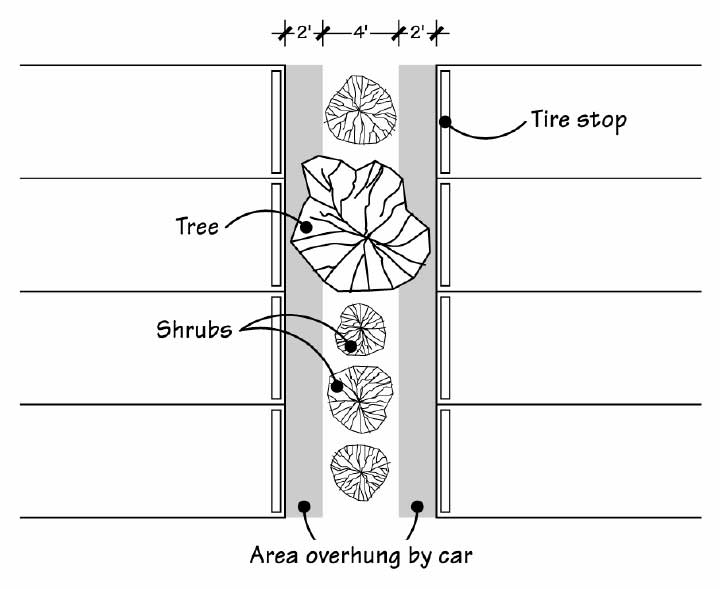
- Interior landscaping not developed as swales pursuant to Subsection 1009.03(A)(2) shall comply with the following standards:
- It shall be arranged in areas at the ends of rows of parking or between parking spaces within rows of parking. See Figure 1009-2.
- It may join perimeter landscaping as long as the interior landscape area extends at least four feet into the parking area from the perimeter landscape line. See Figure 1009-2.
- Landscaping that abuts, but does not extend into, the parking area may be included as interior landscaping if all of the following are met:
- The abutting landscaped area must be in addition to required perimeter landscaping;
- Only the first 10 feet of the abutting landscaped area, measured from the edge of the parking area, may be included as interior landscaping; and
- The landscaped area is not abutting and parallel to required perimeter landscaping. See Figure 1009-2.
- The interior length and width of landscaped areas shall be a minimum of four feet.
Figure 1009-2: Interior Landscaping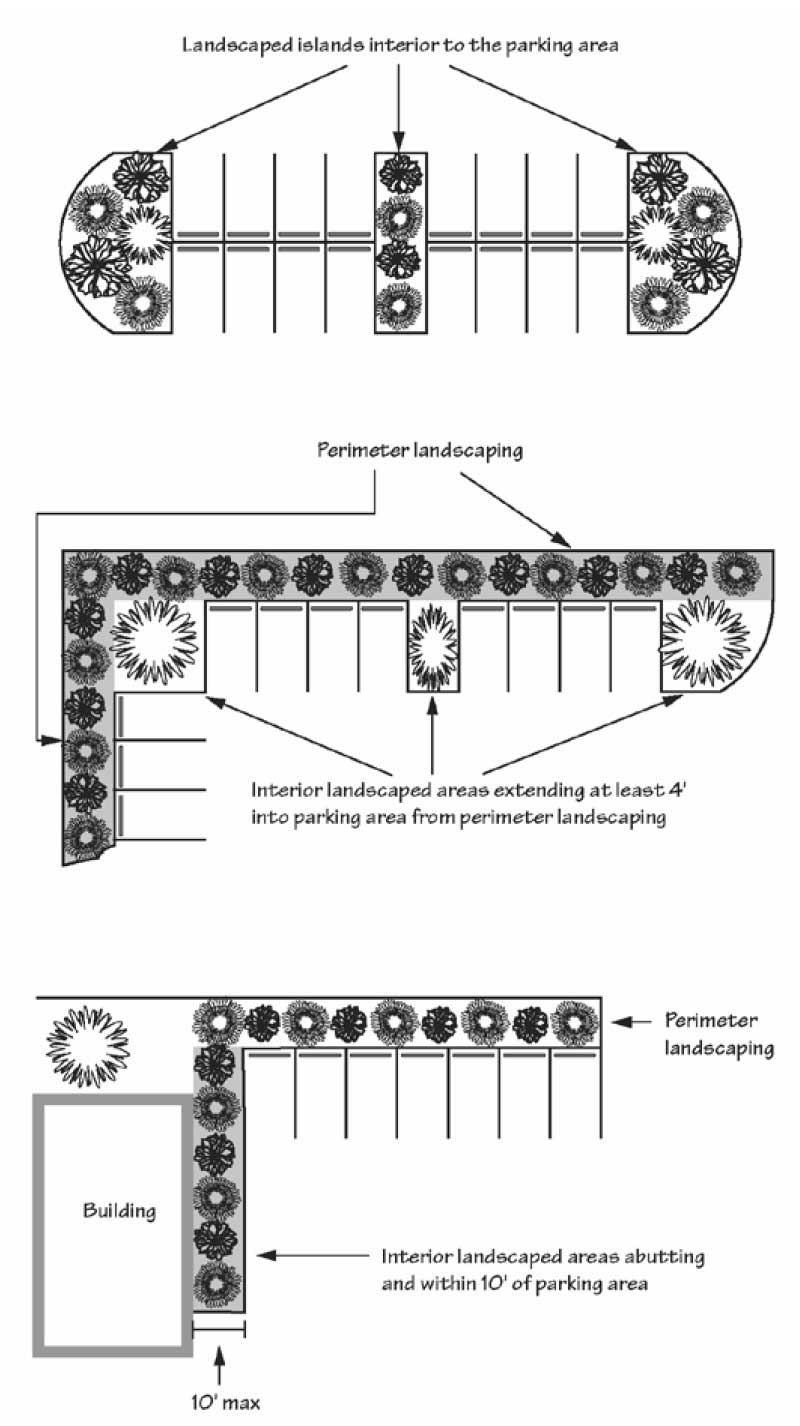
- Interior landscaped areas, including swales, shall include a minimum of one tree located every eight interior parking spaces, or fraction thereof, except in the OA, VA, VCS, and VO Districts, where a minimum of one tree shall be located every six interior parking spaces.
- Where necessary to accommodate other design considerations, variable spacing of the trees required by Subsection 1009.03(A)(4) is allowed, but in no case shall there be less than one tree planted in every 12 parking spaces.
- The species of trees required shall be determined on the basis of the growth habit and the need to provide maximum shading of surface parking areas.
B. Perimeter landscaping requirements for surface parking and loading areas adjacent to abutting lots or rights-of-way are as follows:
- A landscaping strip with a minimum width of five feet shall be provided adjacent to the perimeter of the surface parking or loading area, except:
- In the OA, VA, VCS, and VO Districts, the minimum width shall be 10 feet;
- In the BP and LI Districts, the minimum width shall be 15 feet abutting a front lot line; and
- In the GI District, the minimum width shall be 10 feet abutting a front lot line.
- The required landscaping strips shall comply with the following standards:
- Sufficient low shrubs shall be planted to form a continuous screen three feet high and 95 percent opaque, year-round; or a three-foot-high masonry wall or berm may be substituted for the shrubs. When applied along front lot lines, the screen or wall is to be placed along the interior side of the landscaping strip and shall be 30 inches high instead of three feet high.
- In addition, one tree is required for every 30 linear feet of landscaping strip, or as otherwise required to provide a tree canopy over the landscaping strip.
- Ground cover plants must fully cover the remainder of the landscaped area.
- A perimeter landscape strip is not required for a surface parking or loading area adjacent to an abutting lot if one or more interior driveways connect the two lots and if the abutting lot also is developed with a surface parking or loading area adjacent to the shared lot line.
- Required walkways may cross perimeter landscaping strips.
C. Inside the Portland Metropolitan Urban Growth Boundary (UGB), a development that includes more than one-half acre of new off-street surface parking shall include the following. A new parking area shall be measured based on the perimeter of all new off-street parking spaces, maneuvering lanes, and maneuvering areas, including driveways and drive aisles.
- Climate mitigation action, which shall include at least one of the following:
- Installation of solar panels with a generation capacity of at least 0.5 kilowatts per new off-street parking space. Panels may be located anywhere on the property;
- Tree canopy covering at least 40 percent of the new parking lot area at maturity but no more than 15 years after planting; or
- A mixture of actions under Subsection 1009.03(C)(a) and (b) that include solar panels with a generation capacity of at least 0.25 kilowatts per new off-street parking space plus tree canopy covering at least 20 percent the new parking lot area at maturity but no more than 15 years after planting.
- Tree canopy. Developments must provide tree canopy. Developments shall provide either trees along all internal streets or a minimum of 30 percent tree canopy coverage over new parking areas. The tree spacing and species planted shall be designed to maintain a continuous canopy except when interrupted by driveways, drive aisles, and other site design considerations. Trees shall be planted at a distance no greater than the average diameter of the tree canopy at maturity, for the trees chosen. Developments providing 40 percent tree canopy to comply with Subsection 1009.03(C)(1) comply with Subsection 1009.03(C)(2).
- Development of a tree canopy plan under Subsection 1009.03(C) shall be done in coordination with the local electric utility, including pre-design, design, building, and maintenance phases. In providing trees under Subsections 1009.03(C)(1) and (2), the standards in Subsection 1009.10 shall be met.
1009.04 Screening and Buffering
- Screening shall be used to eliminate or reduce the visual impacts of the following:
- Service areas and facilities, such as loading areas and receptacles for solid waste or recyclable materials;
- Storage areas;
- Ground-mounted rainwater collection facilities with a storage capacity of more than 100 gallons;
- Parking lots within or adjacent to an Urban Low Density Residential, VR-5/7, VR-4/5, RA-1, RA-2, RR, RRFF-5, FF-10, FU-10, or HR District; and
- Any other area or use, as required by this Ordinance.
- Screening shall be accomplished by the use of sight-obscuring evergreen plantings, vegetated earth berms, masonry walls, sight-obscuring fences, proper siting of disruptive elements, building placement, or other design techniques.
- Screening shall be required to substantially block any view of material or equipment from any point located on a street or accessway adjacent to the subject property. Screening from walkways is required only for receptacles for solid waste or recyclable materials. A sight-obscuring fence at least six feet in height and up to a maximum of 10 feet in height shall be required around the material or equipment.
- Buffering shall be used to mitigate adverse visual impacts, dust, noise, or pollution, and to provide for compatibility between dissimilar adjoining uses. Special consideration shall be given to buffering between residential uses and commercial or industrial uses, and in visually sensitive areas.
- Buffering shall be accomplished by one of the following:
- A landscaping strip with a minimum width of 15 feet and planted with:
- A minimum of one row of deciduous and evergreen trees staggered and spaced a maximum of 30 feet apart;
- A perennial, evergreen planting with sufficient foliage to obscure vision and which will grow to form a continuous hedge a minimum of six feet in height within two years of planting; and
- Low-growing evergreen shrubs and evergreen ground cover covering the balance of the area;
- A berm with a minimum width of ten feet, a maximum slope of 40 percent on the side away from the area screened from view, and planted with:
- A perennial, evergreen planting with sufficient foliage to obscure vision and which will grow to form a continuous hedge within two years of planting. The minimum combined height of the berm and planting shall be six feet; and
- Low-growing evergreen shrubs and evergreen ground cover covering the balance of the area;
- A landscaping strip with a minimum width of five feet and including:
- A masonry wall or sight-obscuring fence a minimum of six feet in height. The wall or fence is to be placed along the interior side of the landscaping strip;
- Evergreen vines, evergreen trees, or evergreen shrubs, any of which shall be spaced not more than five feet apart; and
- Low-growing evergreen shrubs and evergreen ground cover covering the balance of the area; or
- Another method that provides an adequate buffer considering the nature of the impacts to be mitigated.
- A landscaping strip with a minimum width of 15 feet and planted with:
- Required walkways shall be accommodated, even if such accommodation necessitates a gap in required screening or buffering.
1009.05 Scenic Roads
In the RA-1, RA-2, RRFF-5, FF-10, FU-10, MRR, and HR Districts, buildings in developments adjacent to roads designated as scenic roads on Comprehensive Plan Map 5-1, Scenic Roads, shall be set back a sufficient distance from the right-of-way to permit a landscaped or natural buffer zone.
1009.06 Landscaping Strips
- In the BP and LI Districts, a landscaping strip a minimum of 15 feet wide shall be provided abutting front lot lines.
- In the GI District, a landscaping strip a minimum of 10 feet wide shall be provided abutting front lot lines.
- In all other zoning districts, except SCMU, a landscaping strip a minimum of five feet wide shall be provided abutting front lot lines. (See Subsection 1005.09(L) for additional SCMU landscaping requirements.)
- This requirement will be waived or reduced in the NC, PMU, and VCS Districts, which are districts that have no minimum front setback standard, to the extent necessary to accommodate a building with a front setback of less than five feet.
- If—due to the depth of a front setback and the need to accommodate a required walkway, required pedestrian amenities, or both—there is insufficient area to permit a five-foot-wide landscaping strip, the landscaping strip may be reduced in width or the landscaping requirement may be met with a linear arrangement of trellises, hanging baskets, or planters, any of which shall include plants.
1009.07 Fences And Walls
- Fences and walls shall be of a material, color, and design complementary to the development.
- In the BP and LI Districts, the minimum front setback for fences and walls is 15 feet.
- In the GI District, the minimum front setback for fences and walls is 10 feet.
1009.08 Recreational Areas And Facilities
- An outdoor recreational area shall be provided in developments of duplexes, triplexes, quadplexes, or multifamily dwellings in the MR-1, MR-2, and HDR Districts, and in developments of triplexes, quadplexes, or multifamily dwellings, including mixed-use developments that include these uses, in the SCMU District, as follows:
- A minimum of 200 square feet of usable outdoor recreational space per dwelling unit shall be provided for studio, one- bedroom, and two-bedroom units. The minimum shall be increased to 300 square feet per dwelling unit for units with three or more bedrooms. However, in the SCMU District:
- The requirement shall apply only to the first 20 dwelling units per acre, or prorated equivalent thereof; and
- The amount of required outdoor recreational area may be reduced, to the minimum extent necessary, if—when combined with the minimum landscaping requirements of Subsections 1005.09(L), 1009.03, and 1009.04—full compliance would result in landscaping more than 15 percent of the lot.
- Outdoor recreational areas may be designed for passive or active recreation, including edible gardening.
- Outdoor recreational areas shall be designed for adequate surveillance opportunities.
- Outdoor recreational areas shall be conveniently located and accessible to all dwelling units.
- A minimum of 200 square feet of usable outdoor recreational space per dwelling unit shall be provided for studio, one- bedroom, and two-bedroom units. The minimum shall be increased to 300 square feet per dwelling unit for units with three or more bedrooms. However, in the SCMU District:
- In the SHD and RCHDR Districts, a residential development shall provide at least one of the following recreational facilities for the first 60 dwelling units, or portion thereof, and at least one additional facility for every additional 120 dwelling units, or portion thereof.
- An 800-square-foot or larger heated swimming pool;
- A minimum 1,000-square-foot exercise room with exercise equipment and mats;
- Two handball/racquetball courts;
- Whirlpool and sauna or steam bath rooms;
- Minimum 1,200-square-foot game room with pool and ping pong tables, folding tables and chairs, and kitchenette;
- An 800-square-foot shop equipped with hand tools, work benches, storage shelves, lockers, and ventilation;
- A 400-square-foot greenhouse with all-season solar exposure, equipped with benches, water, ventilation, summer shading materials, and storage areas for pots, tools, potting soil, fertilizers, etc;
- 3,000 square feet of hard-surface play area, such as a tennis court, basketball court, or roller-skating area;
- 4,200 square feet of soft surface play area with equipment provided for lawn games such as volleyball, badminton, croquet, and horseshoes; and
- Any other similar facility.
1009.09 Erosion Control
- Graded areas shall be re-vegetated with suitable plants to ensure erosion control.
- Netting shall be provided, where necessary, on sloped areas while ground cover is being established.
1009.10 Planting And Maintenance
- Impervious weed barriers (e.g, plastic sheeting) are prohibited.
- Plants shall not cause a hazard. Plants over walkways, sidewalks, pedestrian pathways, and seating areas shall be pruned to maintain a minimum of eight feet below the lowest hanging branches. Plants over streets, bikeways, accessways, and other vehicular use areas shall be pruned to maintain a minimum of 15 feet below the lowest hanging branches.
- Plants shall be of a type that, at maturity, typically does not interfere with above- or below-ground utilities or paved surfaces.
- Plants shall be installed to current nursery industry standards.
- Plants shall be properly guyed and staked to current nursery industry standards as necessary. Stakes and guys shall not interfere with vehicular or pedestrian traffic, shall be loosened as needed to prevent girdling of trunks, and shall be removed as soon as sufficient trunk strength develops, typically one year after planting.
- Landscaping materials shall be guaranteed for a period of one year from the date of installation. The developer shall either submit a signed maintenance contract for the one-year period or provide a performance surety pursuant to Section 1311, Completion of Improvements, Sureties, and Maintenance, covering the landscape maintenance costs for the one-year period.
- Plants shall be suited to the conditions under which they will be growing. As an example, plants to be grown in exposed, windy areas that will not be irrigated shall be sufficiently hardy to thrive under these conditions. Plants shall have vigorous root systems, and be sound, healthy, and free from defects and diseases.
- When planted, deciduous trees shall be fully branched, have a minimum caliper of two inches, and have a minimum height of eight feet.
- When planted, evergreen trees shall be fully branched, have a minimum height of eight feet, and have only one leader.
- Shrubs shall be supplied in minimum one-gallon containers or eight-inch burlap balls with a minimum spread of 12 inches.
- Ground cover shall be planted a maximum of 30 inches on center with a maximum of 30 inches between rows. Rows of plants shall be staggered. Ground cover shall be supplied in minimum four-inch containers, except that the minimum shall be reduced to two and one-quarter inches or equivalent if the ground cover is planted a minimum of 18 inches on center.
- Plants shall be spaced so that ground coverage three years after planting is expected to be 90 percent, except where pedestrian amenities, rainwater collection systems, or outdoor recreational areas count as landscaping pursuant to Subsection 1009.02. Areas under tree drip lines count as ground coverage.
- Irrigation of plants shall be required, except in wooded areas, wetlands, and in river and stream buffers. The irrigation system shall be automatic, except that hose bibs and manually operated methods of irrigation may be permitted in small landscaped areas close to buildings. Automatic irrigation systems are subject to the following standards:
- An automatic irrigation controller shall be required for irrigation scheduling.
- The system shall be designed to prevent runoff, low head drainage, overspray, or other similar conditions where irrigation water flows onto non-targeted areas, such as adjacent property, non-irrigated areas, hardscapes, roadways, or structures.
- In mulched planting areas, the use of low volume irrigation is required to maximize water infiltration into the root zone.
- Narrow or irregularly shaped areas, including turf lawn, less than eight feet in width in any direction shall be irrigated with subsurface or low volume irrigation.
- Overhead sprinkler irrigation is prohibited within two feet of any impervious surface unless:
- The landscaped area is adjacent to permeable surfacing and no runoff occurs; or
- The adjacent impervious surfaces are designed and constructed to drain entirely to landscaping; or
- The irrigation designer specifies an alternative design or technology that complies with Subsection 1009.10(M)(2).
- Appropriate methods of plant care and landscaping maintenance shall be provided by the property owner. Pruning shall be done to current nursery industry standards.
- Plants shall be protected from damage due to heavy foot traffic or vehicular traffic by protective tree grates, pavers, or other suitable methods.
[Amended by Ord. ZDO-224, 05/31/2011; Amended by Ord. ZDO-243, 09/09/2013; Amended by Ord. ZDO-246, 03/01/2014; Amended by Ord. ZDO-249, 10/13/2014; Amended by Ord. ZDO-250, 10/13/2014; Amended by Ord. ZDO-252, 06/01/2015; Amended by Ord. ZDO-253, 06/01/2015; Amended by Ord. ZDO-266, 05/23/2018; Amended by Ord. ZDO-276, 10/01/2020; Amended by Ord. ZDO-282, 07/01/2022; Amended by Ord. ZDO-283, 09/05/2023; Amended by Ord. ZDO-293, 09/08/2026]
Return to the Zoning and Development Ordinance main page. Contact zoninginfo@clackamas.us for additional information."