Translate




903.01 Applicability
Section 903 applies in all zoning districts except that only the minimum setback exemptions for bus shelters apply in the BP, GI, HDR, LI, RCHDR, and SHD Districts.
903.02 Minimum Front Setback Modifications
- The minimum front setback standard is reduced if one or both lots adjoining the subject lot, and with frontage on the same road as the subject lot, are developed with structures, other than accessory structures, whose front setback from that fronting road is lawfully nonconforming.
- For the purpose of Subsection 903.02(A):
- Lawfully nonconforming does not include a structure whose front setback was reduced through approval of a front setback variance.
- If the adjoining lot is a flag lot, that lot is excluded, and the next lot is included.
- If both adjoining lots qualify under Subsection 903.02(A), then the minimum front setback for the subject lot is the average of the setbacks on the two adjoining lots. (See Figure 903-1.)
- For the purpose of Subsection 903.02(A):
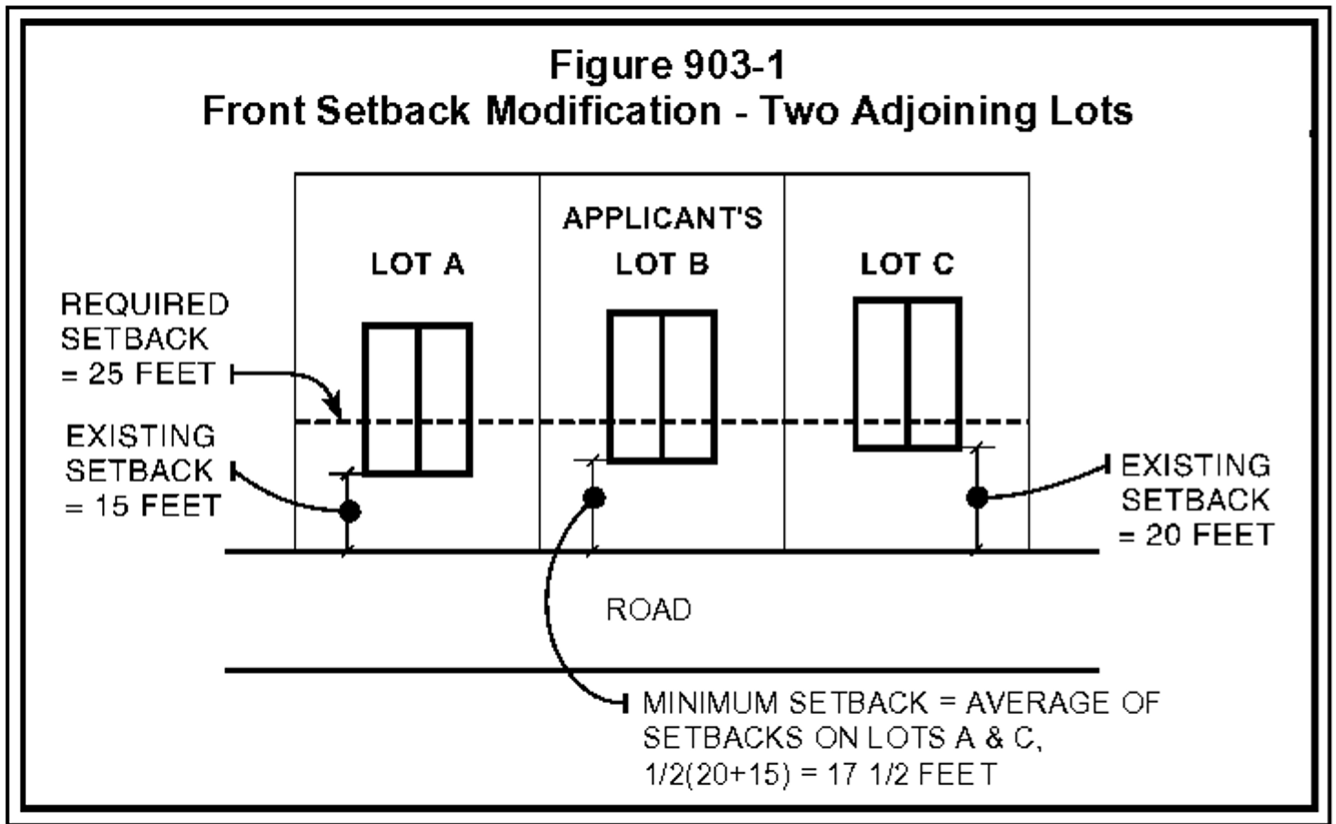
- If only one adjoining lot qualifies under Subsection 903.02(A), then the minimum front setback for the subject lot is the average of the setback that would be required without an exception and the setback on the adjoining lot with the nonconforming setback.
- Bus shelters are exempt from minimum front setback standards.
903.03 Public Dedications
Minimum setback standards do not apply to existing structures whose setback is reduced by a public dedication. Additions to such structures that do not comply with the minimum front setback shall be allowed pursuant to Subsection 903.02(B).
903.04 Rear And Side Setback Exemptions
The following structures are exempt from minimum rear and side setback standards:
- Underground structures, except there is no exemption where the perimeter wall of the structure is above finished grade or for openings into the structure, including doors, windows, skylights, plumbing, intake vents, and exhaust vents;
- Ground-mounted solar energy systems extending less than six feet above finished grade;
- Rainwater collection facilities extending less than six feet above finished grade; and
- Bus shelters.
903.05 Projections Into Required Setbacks
Architectural features and certain structures may project into minimum setbacks, as follows:
- Architectural features may project a maximum of one-third the distance of the minimum setback, and a maximum of 40 inches into a minimum front setback.
- Open, unenclosed fire escapes may project a maximum of four feet
903.06 Decks And Similar Structures
Unless the subject zoning district provides for a lesser setback, the minimum setbacks for a deck, patio, porch, terrace, or underground structure are 10 feet from front and rear lot lines and three feet from side lot lines, provided:
- The structure shall not be covered; and
- The structure shall not extend more than 30 inches above finished grade.
903.07 Fences and Walls
Minimum setback standards do not apply to fences or walls unless the standard explicitly refers to fences or walls.
903.08 Flag Lots
A. On flag lots, Tthe location of front, side, and rear, and front lot lines of a flag lot may be modified, for the purpose of determining the minimum setbacks, if:
- The subject property does not have more than one front lot line; and
- One of the following applies:
- The flagpole through which the property takes motor vehicle access does not enter the property parallel to any lot line that intersects the lot line at which the flagpole terminates;
- Properties located adjacent to the subject property and further from the road from which the subject property takes motor vehicle access are developed at the maximum density feasible under the current zoning designation as calculated pursuant to Section 1012, Lot Size and Density, and have lawful motor vehicle access from other than the same access as the flag lot;
- A natural feature (being a slope regulated pursuant to Section 1002, Protection of Natural Features; a mass movement hazard area regulated pursuant to Section 1003, Hazards to Safety; a river, stream, wetland, or other water body as mapped by the Department of State Lands; a Special Flood Hazard Area pursuant to Section 703, Floodplain Management District; a Habitat Conservation Area pursuant to Section 706, Habitat Conservation Area District; or mapped Open Space, as identified on any Comprehensive Plan Map) exists on the subject property and would preclude access being extended across the subject property to serve an adjacent lot or lots.
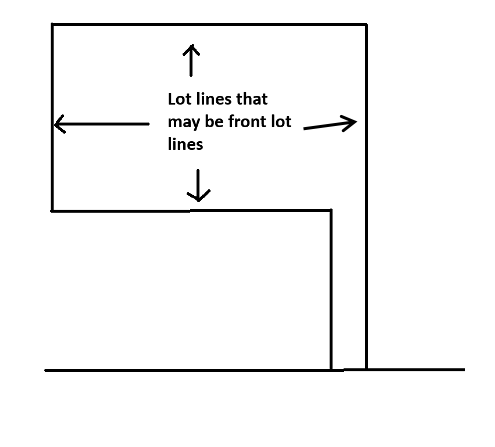
B. For a flag lot eligible for setback modification pursuant to Subsection 903.08(A), the property owner can choose which lot line is to be the front lot line, so long as it is one of the lot lines that makes up the flag portion of the lot. The rear lot line is the lot line most distant from, and opposite from, the chosen front lot line. See Figure 903-2.
Figure 903-2
[Amended by Ord. ZDO-224, 05/31/2011; Amended by Ord. ZDO-249, 10/13/2014; Amended by Ord. ZDO-252, 06/01/2015; Amended by Ord. ZDO-266, 05/23/2018; Amended by Ord. ZDO-268, 10/02/2018; Amended by Ord. ZDO-285, 09/03/2024; Amended by Ord. ZDO-293, 09/08/2026]
Return to the Zoning and Development Ordinance main page. Contact zoninginfo@clackamas.us for additional information."