Translate




We’re here to help you design garbage and recycling enclosures that meet county standards. Our team can advise on size, placement, and access, coordinate with your local solid waste collector, and share sample plans.
Before investing in detailed drawings, contact us at 503-557-6363 (option 7) or wasteinfo@clackamas.us to discuss your site’s needs.
Process
Step 1: Pre-Application Meeting
During this informal discussion, county staff—including Sustainability & Solid Waste—review your preliminary plans and outline requirements from solid waste, water, fire, sewer, and other service providers.
Step 2: Update Your Plans
If your project moves forward and is approved by staff and the Design Review Committee, revise your site plan to meet any required conditions. Most projects require meeting garbage and recycling enclosure standards and receiving a sign-off from Sustainability & Solid Waste.
Timing Matters
Engage with us early in your design process. Not meeting ZDO Section 1021 requirements can delay your Certificate of Occupancy or require costly enclosure reconstruction.
Basic Requirements
Size & Access
- Enclosures must accommodate all required garbage and recycling containers.
- Service trucks—similar in size to fire trucks—must be able to access, service, and exit the enclosure with minimal backing.
- See ZDO Section 1021 for full specifications.
Building Materials
Options include masonry, brick, or chain-link with slats, and more. Materials should reduce the visual impact of stored containers.
Pad
Pads must be poured Portland cement concrete on level ground for durability and weight support.
Gates, Bumpers & Signage
- Gates must fully open, be secured in the open and closed positions, and allow straight removal of containers.
- Interior bumpers protect the structure.
- “No Parking” signage and striped curbs keep the enclosure accessible.
What to Avoid
- Inadequate size: Small enclosures lead to containers being left outside or packed too tightly, creating safety and access problems. Larger spaces allow more recycling—saving money as recycling is included in the cost of garbage service.
- Poor siting: Avoid locations without adequate truck maneuvering room, such as dead-end alleys or tight corners. Improper siting puts drivers, pedestrians, vehicles, and property at risk.
- Inadequate gates: Gates that are too narrow or that swing shut can hinder safe collection.
- Insufficient pad: Uneven, soft, or sloped surfaces make moving heavy containers unsafe and can cause water to pool. Access grades must not exceed 3%.
- Failure to post no-parking signs: Parked vehicles can block access and prevent collection at any time—including early mornings, holidays, or staff schedule changes.
- No bumpers: Without interior bumpers, enclosure walls can be damaged by container impacts.
Waste Prevention Assistance for Businesses
We offer free technical assistance to help businesses reduce waste, reuse materials, and improve recycling. Support includes desk-side recycling boxes and guidance for setting up efficient indoor and outdoor systems.
Call 503-557-6363 (option 3) for a free consultation.
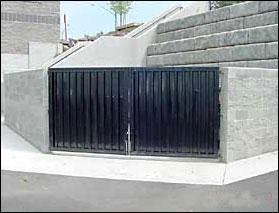
Enclosures do not have to be unsightly. This enclosure was designed to complement a new commercial office building.
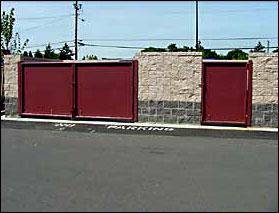
Another large, well-designed enclosure, this includes a smaller service door. It encourages employees and janitorial staff to put materials inside the enclosure because they do not have to open the heavier gates.
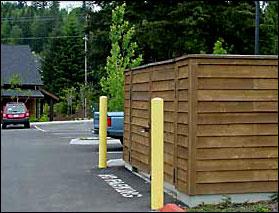
Built with the same cedar siding as the professional office building, this spacious enclosure looks good and works well. Posts provide extra protection.
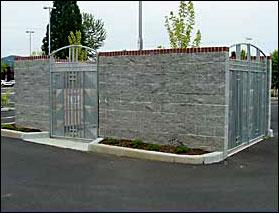
Using design elements from the main building, this enclosure sits in the middle of a parking lot. Service vehicles have good access to it.
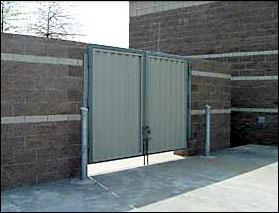
This large enclosure uses design elements from the new municipal building.
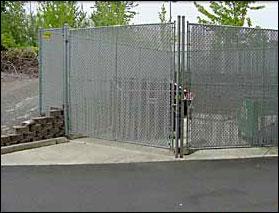
An example of a chain link and slat enclosure.
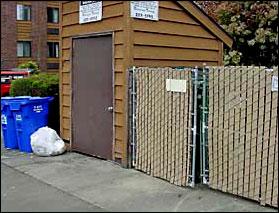
Too small for a group of strip mall tenants, this enclosure has been damaged. Tenants leave trash outside, creating an unsightly and potentially rat-infested area. Furthermore, it is not conducive to recycling.
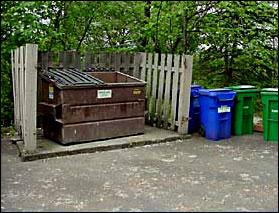
Small and unsightly, this enclosure does not meet the needs of this multifamily dwelling.
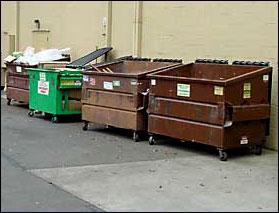
Approved before ZDO Section 1021 - this shopping mall places containers in full view of the street. It is unsightly for the residential development across the street, it promotes illegal dumping, and is prone to contamination of recyclables.
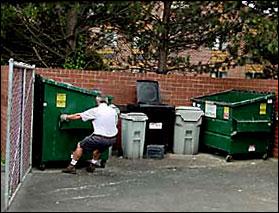
Don't try this at home! The collector is pulling out a 1,200 pound container that could have been picked up mechanically if the enclosure had been well designed.