 Translate


ClackCo Works - Episode 1: The best parks in Clackamas County
Guest: Tom Riggs, Parks Manager


Public & Government Affairs
Lorem ipsum dolor sit amet, consectetur adipiscing elit. Mauris scelerisque faucibus magna et eleifend. Vivamus facilisis tellus elementum est facilisis, id tristique nisi eleifend. Duis mollis justo vel elit pulvinar dapibus. In tempus lobortis ex, in ultricies libero commodo sed. Morbi posuere tellus eget eros malesuada, vitae viverra quam facilisis. Fusce gravida pulvinar quam et tempor. Curabitur imperdiet lectus urna, in iaculis nisi consequat at. Duis quam erat, scelerisque nec lorem eu, viverra rutrum nunc.
Nam id libero efficitur, varius purus sit amet, vestibulum odio. Vestibulum cursus, felis sed dapibus condimentum, risus sapien malesuada felis, a congue nisl nibh ac mi. Aenean at tellus sed arcu efficitur tempor ut et nunc. Phasellus sollicitudin euismod accumsan. Vestibulum magna justo, aliquet nec neque ut, eleifend pretium sem. Sed leo massa, posuere et quam at, hendrerit bibendum ante. Mauris sagittis tellus vel nibh malesuada, nec aliquam sapien laoreet.
Nulla facilisis tempor porta. Duis pulvinar odio vel lorem vehicula semper at sit amet tellus. Sed eget congue lacus. Maecenas volutpat sodales quam. Nulla suscipit dolor sed libero facilisis, finibus gravida odio vestibulum. Duis quis nulla malesuada, condimentum felis a, efficitur mauris. Aliquam hendrerit quam ac risus blandit, ac sodales sem egestas. Sed maximus arcu et enim ultricies, auctor placerat nisi elementum. Quisque vel felis nunc. Nunc congue vestibulum auctor.
Nunc pellentesque tempor ex a eleifend. Mauris sagittis ante sit amet consequat venenatis. Suspendisse rhoncus orci ut eleifend finibus. Nunc et pharetra ante, id venenatis lectus. Curabitur risus velit, tincidunt porttitor velit ut, auctor tincidunt sapien. Curabitur erat massa, dapibus eget dui et, mollis viverra augue. Vestibulum lorem justo, semper non lorem ut, efficitur aliquet libero. Class aptent taciti sociosqu ad litora torquent per conubia nostra, per inceptos himenaeos. Phasellus eu aliquet nisi. Nam nec diam quam.
Clackamas County is urban, suburban, rural, and wild. We are dedicated to welcoming new residents and businesses and committed to delivering community services that are dependable, accessible, and responsive to the public.
Clackamas County seeks $5 million in state legislative funding to advance construction
of a recovery campus to meet the rising needs of people suffering from substance use disorders (addictions).
Funding in 2026 will address a critical need and ensure the county can open the recovery campus by 2027, transforming lives and communities for years to come.

1000
people served annually

76
additional beds
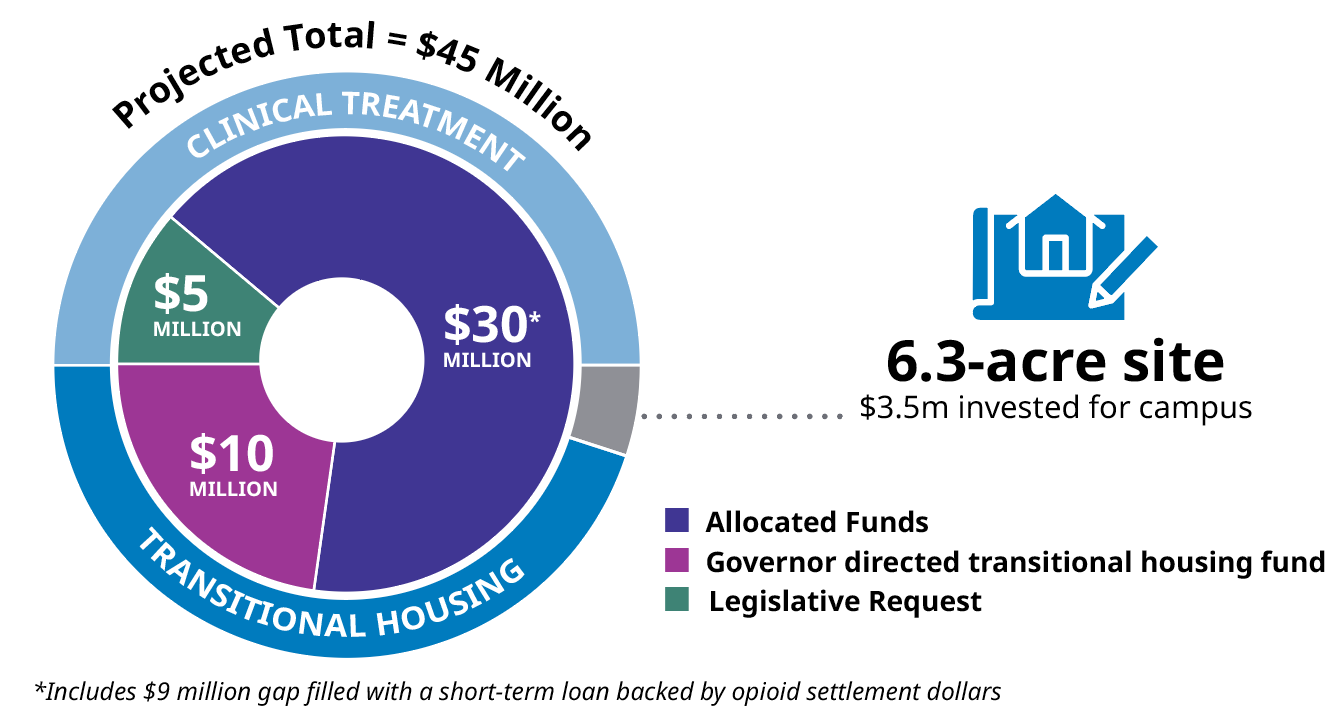
The Clackamas County Recovery Campus will address gaps in adult substance use treatment by increasing bed capacity, reducing wait times, and helping to prevent drug-induced fatalities that have doubled since 2019. Through partnerships with law enforcement, emergency services, and the medical community, the campus will divert individuals from inappropriate placements in jail or the emergency room. It will support a path from crisis to long-term recovery by providing timely, people-centered treatment delivered by experienced community-based organizations.
Clackamas County’s policy positions are guided by five strategic goals below:
Support access to community resources and the production of affordable housing for low-income populations, senior populations, and underserved parts of the county. Legislation should also help to reduce crime and recidivism, promote best practices for justice-involved individuals, improve disaster preparedness, and protect survivors of domestic violence and child abuse.
Support investments in major infrastructure projects to enhance the quality of life for county residents. Successful legislation will ease congestion, expand travel options, enhance seismic and disaster resiliency, spur economic growth, stimulate employment opportunities, increase housing inventory, broaden telecommunication access, and promote science-based and ratepayer-minded water quality protections.
Support business growth and countywide prosperity, ensuring the county has adequate resources to attract and retain industries, workforce, and childcare opportunities, as well as sufficient shovel-ready employment lands to capture economic development opportunities.
Support a recovery-oriented system of care, ensuring shelter, social services, behavioral health and substance use treatment for all who need it. Legislation should also support and fund community access to high-quality health services and resources.
Support the county’s financial sustainability, allocating sufficient resources, preserving shared revenue agreements, and ensuring adequate community engagement. Successful legislation will enhance the county’s ability to deliver effective, reliable, and responsive public services. Legislation should not impose unfunded or underfunded mandates, preempt local tax sources, or restrict local government authority.
For more information, contact Trent Wilson, Government Affairs Manager, at twilson2@clackamas.us or 971-263-4183
Clackamas County Board of Commissioners
Craig Roberts – Chair Diana Helm Paul Savas Martha Schrader Ben West
Construction, demolition or remodeling debris? The Oregon Department of Environmental Quality requires asbestos testing and documentation before disposal of construction, demolition and remodeling debris. Transfer stations will not accept suspect asbestos-containing materials without documentation.
Recycling, salvaging, and reusing construction debris can reduce disposal costs and save resources.
Note: facilities may close during extreme weather events.
19600 SE Canyon Valley Rd, Sandy
503-260-1577
Hours:
2001 Washington St, Oregon City
503-234-3000
Hours:
North Marion Recycling & Transfer Station
A Marion County facility
17827 Whitney Lane NE, Woodburn
503-588-5169
Hours:
Note: facilities may close during extreme weather events.
2001 Washington St, Oregon City
503-234-3000
Hours:
Always check with the location to confirm accepted items and pricing.
Canby Landscape Supply
These locations accept various materials for recycling, including some not accepted in your curbside recycling bin.
Always check with the location to confirm accepted items and pricing.
19600 SE Canyon Valley Road, Sandy
503-260-1577
K.B. Recycling (Clackamas location)
9602 SE Clackamas Road, Clackamas
503-659-7004
K.B. Recycling (Canby location)
1600 SE 4th Ave, Canby
503-266-7903
2001 Washington St., Oregon City
503-234-3000
10105 SE Mather Rd, Clackamas
503-655-5433
10151 SE Jennifer St., Clackamas
503-772-2236
Willamette Resources, Inc.
10295 SE Ridder Rd, Wilsonville
503-570-0626
Adopted April 27, 2004 Revised April 22, 2008 Revised October 28, 2014 Revised April 26, 2016
The name of this organization is the "Leaders for Equity, Diversity and Inclusion Council"
The Leaders for Equity, Diversity and Inclusion Council (hereinafter "Council") was formed by the Clackamas County Board of County Commissioners on May 15, 2003.
At the direction of the Board of County Commissioners (hereinafter "BCC") and in conjunction with the recommendations from the complete communities report, the main purpose of the Council is to act as a liaison to the County government on behalf of underserved communities.
In addition, some of the duties of the Council are to:
The Council may consist of up to 19 members all appointed by the Clackamas County BCC.
Members of the Council shall be appointed to terms not to exceed three years. The BCC may appoint a member for additional terms or may limit the number of terms that a member may serve at their sole discretion.
When a vacancy exists, the Chair shall appoint an Ad Hoc Nominations Committee to establish a list of candidates for the Council's endorsement and BCC approval. Nothing herein, including a lack of endorsement by the Council, shall be construed as limiting the BCC's general authority to appoint any applicant it deems appropriate.
The majority of Council members shall be non-county employees who either work or live in Clackamas County. The Assistant County Administrator will serve in an advisory capacity to the Council.
It is the BCC's goal that appointments to the Council reflect the county's diverse populations and expertise along the full spectrum of services provided by the County. A criteria that will be considered for membership is knowledge of the issues and needs of the diverse communities and underserved populations in Clackamas County.
Regular attendance at meetings is expected of each Council member. Council members anticipating absence from official Council meetings shall notify the Chair or her/his staff designee, at least 24 hours in advance of a meeting and be excused by the Chair or her/his staff designee.
In an emergency, the member shall contact them as soon as reasonably possible. After three absences the Chair will discuss the matter with the Council member in question. The Chair will bring his/her findings to the full Council. The council recognizes the subjective nature of the issue and will make recommendations on a case-by-case basis. A motion may be made to recommend that the position be declared vacant due to a pattern of absenteeism.
Upon a 2/3 affirmative vote, the council will recommend to the board that the position be declared vacant, and shall be filled according to the provisions of this Article.
The Chair and Vice-Chair of the Council shall be Clackamas County residents who are not employed by the county. The Chair will be appointed by the Board of County Commissioners on recommendation of the Council. The Chair and Vice-Chair shall serve for one-year terms beginning on September 1 of each year and may be reappointed, upon recommendation of the Council and approval of the BCC, for a maximum of one additional one-year terms.
The Chair shall call and preside at meetings, establish work groups and committees, and serve as an ex-officio member of all committees and task groups. The Vice-Chair shall perform the duties of the Chair in his/her absence and shall serve as an ex officio member of all committees and work groups. In the absence of both Chair and Vice-Chair, a designee will be assigned to preside.
Executive Committee: The following shall serve on this Committee. Chair, Vice-Chair, and the immediate past Chair, if still an active member of the Council. In the Chair's absence the Vice-Chair shall preside at the Executive Committee meetings. Meetings and Duties: The Executive Committee shall meet to develop and review agendas; review and approve requests from agencies and individuals wishing to come before the Council; recommend to the Council new or updated policies and procedures, and review and make recommendations on other items to come before the Council.
In between meetings and during months when the Council does not meet, the Executive Committee shall have general supervision of the affairs of the Council. Notice of items to come before the Executive Committee will be given to Council members.
Other Committees: Additional committees and work groups may be appointed at the discretion of the BCC or the Chair, and shall continue until the purpose is completed or as determined by the Council Chair. The Chairs of standing committees and work groups shall be current Council members.
The Council shall hold a minimum of four regular business meetings per year. All meetings of the Council shall comply with the provisions of the Oregon Public Meetings Law, ORS 192.610 to 192.695, as amended.
Council meetings will be held within the geographic boundaries of the county.
Special meetings may be called by the Chair, or by any three members of the Council.
A regular or special meeting of the Council may be held by telephone, video conferencing, or other electronic means in which all Council members may hear each other so long as it complies with the Oregon Public Meetings Law.
If a Council member is unable to attend any meeting in person, the member may participate via telephone, video conferencing or other electronic means, providing that all participants can hear each other and members of the public attending the meeting can hear any Council member who speaks during the meeting. Council members attending through such electronic means shall be included in constituting a quorum.
A quorum of the Council shall consist of a majority of appointed members. A majority of appointed members is needed to take any action. No proxies shall be allowed. Council members granted an approved leave of absence do not count toward the calculation of a quorum.
Notice of scheduled meetings of the Council, its committees and work groups, together with their agendas and minutes, shall be made available to all Council members and to the public at least ten (10) business days prior to such meetings, or if ten days' notice is not practicable, then such lesser notice as is practicable; however, notice shall comply with Oregon Public Meetings Law at all times. If a special meeting of the Council is called, members shall be provided a minimum of (3) business days' notice.
Typed draft summary of all meetings of the Council, its committees and work groups shall be distributed to all Council members and made available to the public no later than ten (10) business days after the meeting and are subject to amendment and approval at the next meeting of the Council.
The Council and its support staff shall maintain all records in accordance with the Oregon Public Records Law. The Council records, such as formal documents, discussion drafts, transcripts, meeting summaries, and exhibits are public records. The Council communications (oral, written, electronic, etc.) are not confidential and may be disclosed.
It is the policy of the Leaders for Equity, Diversity and Inclusion Council that members who have an actual conflict of interest are precluded from voting on or participating in the deliberation of funding allocations, or performance review of contract activities or actions.
A declaration of potential or actual conflict of interest will be noted in the minutes. Minutes shall include outcome of each vote or action in which a conflict of interest was declared.
The parliamentary procedure for meetings and operations of the Council shall be the responsibility of and within the authority of the Chair. Robert's Rules of Order, Newly Revised, shall be followed.
In the event any provisions of these bylaws are in conflict with Oregon Revised Statutes, Oregon Administrative Rules, the ordinances or administrative policies of Clackamas County, these bylaws shall be subordinate.
Proposed amendments to these bylaws may be recommended by 2/3 vote of the Council, provided notice of the proposed amendment, including it in full text, has been given in accordance with the notice requirements in Article VI of these Bylaws. Such recommendation shall be forwarded to the BCC who shall make a decision regarding such recommendations at its discretion.