 Translate




Attend the meeting
Free language assistance services are available for this meeting. Contact scotthoe@clackamas.us (48-hour notice needed).
Agenda
6:30 p.m. – Welcome: Approval of Prior Meeting Minutes and Public Comment
6:35 p.m. – Street Trust Legislative Update and Oregon Micromobility Network – Cameron Bennett, Street Trust
6:50 p.m. – Hot Spots Overview– Scott Hoelscher
7:15 p.m. – Cazadero Trail Updates – Scott Hoelscher
7:25 p.m. – Oak Grove Bike Parking Racks | General Discussion | Project Updates | Next Meeting | For the Good of the Order
7:30 p.m. - Adjourn
Staff Liaisons:
Mya Ganzer • Planner 1• Dept. of Transportation & Development (503) 742-4520 • mganzer@clackamas.us
Scott Hoelscher • Senior Planner – Multimodal Transportation • Dept. of Transportation & Development (503) 742-4533 • scotthoe@clackamas.us
Minutes
Attendees: Sheila Shaw, Jim Schroeder, Del Scharffenberg, Vanessa Dane-Slagle, Dave Weber, Emma Lugo, Kelli Grover, Mindy Montecucco, Steve Adams, Joseph Edge, Jennifer Martinez-Medina
Cameron Bennett, Nicole Perry; Street Trust
Mya Ganzer, Scott Hoelscher; Clackamas County
6:30 p.m. – Welcome: Approval of Prior Meeting Minutes and Public Comment
Introductions from Clackamas County Staff and PBAC Members.
Nicole Perry: Hi! I’m Nicole Perry, Safe Routes to School Coordinator for Clackamas County with The Street Trust. And I live in Milwaukie.
Cameron Bennett: I am here on behalf of the Street Trusr and on the Portland Bike Ped Committee.
Sheila: moves to approve the minutes
Jim: Seconds
Motions passes, January 6th minutes are approved.
6:42 p.m. – Street Trust Legislative Update and Oregon Micromobility Network – Cameron Bennett, Street Trust
Cameron: I am here for the Micromobility Network, I am an transportation consultant with Kittelson and Associates. Micromobility can apply to any small transportation device, typically less the 30 MPH, scooters and e-bikes are a good example. There has been a huge increase in e-bikes since the pandemic, as well as bike shares.
Micromobility is great investment, reduces VMT, affordable, key highlights is it increases physical activity and converts new riders.
2/3 of ebikes trips are utilitarian and ½ trips replace car trips.
Majority of e-bike crashes are single vehicle and 1/20 with another cyclists and 1 in 100 with pedestrian.
We bring together all sort of institutions, academic, environmental, SRTF, community orgs, governments, logistic providers, engineers and planners etc.
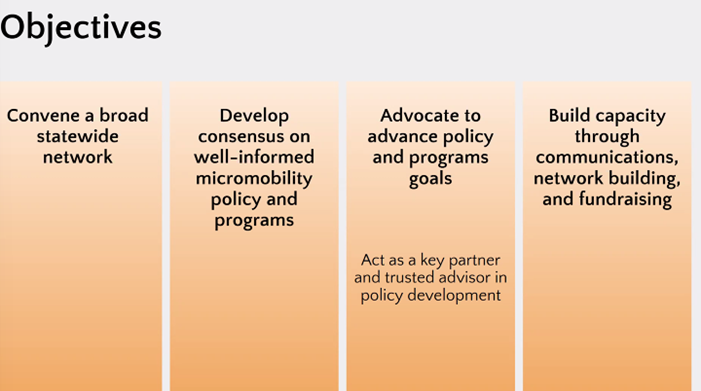
The Micromobility Network, works with a variety of groups, and leans on local government staff, as well as working closely with the Street Trust.
What’s going on in Salem?
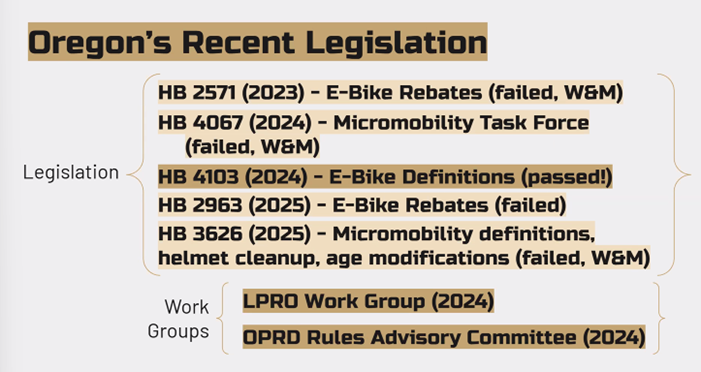
This year is the short session, February 2nd to March 8th. Technical fixes, plugging holes, and finishing visits from 2025. Very little room for fiscal impacts.
HB 4007
Device definition: Powered Micromobility devices, all devices under 28 mph that aren’t currently defined in the statutes, generally treated like a bike.
Helmet Regulation Cleanup: all micromobility devices treated like bikes, helmets required until age 16
Device ages: 14+ for class 1 e-bike (no throttle) and e-scooters (currently 16+); 16+ for class 2 and 3 e-bikes and micromobility devices.
Jim: so, e-bike riders on the road aren’t required to wear a helmet?
Cameron: correct, this is a cleanup of original rules and making it clearer.
Jim: thanks, I see, but that feels like a gap to me.
Sheila: I am with Jim, I am concerned about these devices being on the road and not required to wear a helmet. Is an electric scooter a micromobility device?
Cameron: there is an existing definition of e-scooters, they are within these regulations.
Sheila: are you trying to define all the different micromobility devices?
Cameron: are new definition is a catch all for those not already defined.
Cameron: We are also adding device safety, battery safety regulations and imposter vehicle restrictions, where devices are advertised as e-bikes but can exceed 28 mph.
Jim: I would be highly alarmed if someone is not wearing a helmet on these devices.
Cameron: I understand, this is just bringing these devices into existing rules regarding helmets. Many users will of course still choose to wear a helmet and some studies show drivers give more passing space to drivers without helmets.
Email Cameron to get signed up!
Vanessa: what happens if the house bill doesn’t pass?
Cameron: well we already have existing definitions, this captures new devices.
Sheila: without definitions, would these devices be able to use bike lanes?
Cameron: I believe they would be treated as ATVs as they don’t have VINs and wouldn’t be road legal.
Cameron: Oregon Micromobility Network
OregonMicromobility.org
omn@thestreettrust.org
HB 4007
Oregon Active Transportation Summit
Thank you for having me!
7:17 p.m. – Hot Spots Overview– Scott Hoelscher
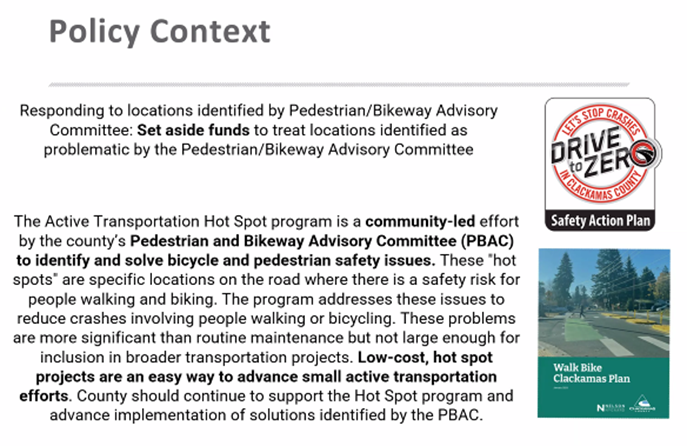
Scott: these are smaller scale projects and infrastructure improvements. These are also not routine maintenance. These are a middle category of small safety improvements that are not in our TSP or a CIP.
Here is an example where the paint stops, and the car lane crosses over the travel lane. Hot spots are usually paint an signage, a minimum fix indicating the conflict zone. Another solution, would be to put the cyclist up onto the sidewalk and prevent the conflict all together. There are a lot of unacceptable situations like this across the county.
Another one has been brought up to ODOT multiple times, on Sunnybrook Blvd looking straight ahead to an entrance to I-205. When you’re travelling southbound on the I-205 MUP, there is no red signal holding vehicles when you get the walk signal for pedestrians cyclists. The easy fix would be a new signal head, traffic signals are signs too.
This example, this sidewalk ends and there’s a steep drop, and so we put warning signs to indicate the edge.
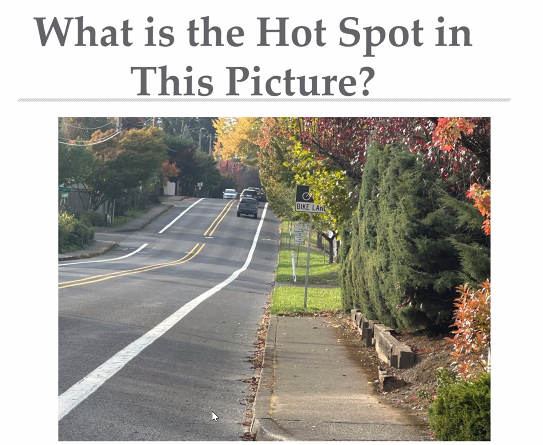
Del: is it at the shrubbery obscuring the sign?
Scott: That would be maintenance.
Sheila and Kelli: Pedestrian crossing?
Scott: that would be a CIP. The hot spot is that there’s not appropriate marking in the bike lane, by a bike stencil or symbol.
Jim: additionally, there’s no indication that the sidewalk is ending.
Scott: onto process, this the process document I sent out earlier. Keep an eye out for these and document them and take photos, if possible, and send to me or Mya. Mya will be tracking all of these in a document. We can then discuss them at meetings and brainstorm solutions. We can then approve or deny the hotspot.
Vanessa: there is some concerns on the Oak Grove community meeting for the crossings at Concord, near the new community center. The county has since put in signs regarding pedestrian crossings at state law. We also had the idea of using flags, for pedestrians to carry across with them.
Sheila: the parks committee had other ideas, and people were excited about the flag idea. Another idea, was changing it back into a school zone.
Jennifer: I take my son there, I would love if that crosswalk was even more visible with painting and illumination, such as reflecting painting.
Scott: we should look into painting reflective ladder striping at this crossing.
Scott: another is the conflict between parking and bike lanes and travel lanes, on Linn Ave, this example is in Oregon City, so what we’ve done in the past for roads not in our jurisdiction, is we write a letter to the subject jurisdiction.
Emma: I would love to work with you on that Scott, I am very familiar with that stretch of road.
Jim: I am not sure what the law is, but I think that truck is illegally parked. And if that is the case, I don’t think this road is wide enough for parking and a bike lane, and the risk of getting “doored” is very high.
Del: I agree, I think that cars have also gotten so large they don’t fit in driveways or parking spots.
Sheila: is there a minimum width for a bike lane? This needs more markings so its clearly a bike lane
Scott: it should be 5 or 6 feet
Mindy: in addition to being doored, this drives bikes into the car lane. Additionally, we need to communicate with law enforcement to enforce not parking in the bike lane.
Del: As far as enforcement goes, the law enforcement is not interested in enforcing parking violations.
Scott: Yeah, we want to take a different approach since the Sheriff doesn’t want to deal with it.
Emma: for something like this, we would go to Oregon City code enforcement, we would go through them instead of Oregon City Police.
Scott: would we want to file a CE case?
Emma: I think a friendly letter is a good idea.
Scott: this would be an opportunity to take a motion to prepare the letter to Oregon City CE regarding parking in the bike lane on Linn Ave.
Joseph motions
Mindy seconds
The motions passes
Kelli: do you draft the letter, Scott?
Scott: generally, we’ll draft it and share to the committee at the next meeting, or just send to Dave and the committee to review.
7:52 p.m. – Cazadero Trail Updates – Scott Hoelscher
Scott: The blue is the Springwater and goes all the way to Boring from SE Portland, and the Yellow goes from Boring to Farraday, but we are discussing the portion from Boring to Estacada.
With the PGE mitigation, we’ve discussed doing a gateway with a trail counter incorporated into the artwork. There would be gateways on each end of the park
8:00 p.m. – Oak Grove Bike Parking Racks | General Discussion | Project Updates | Next Meeting | For the Good of the Order
Scott: we came across in storage, some bike racks, so if you can think of an area for bike racks in oak grove let me know.
8:02 p.m. - Adjourn
Sheila motions to adjourn
Jim Seconds
Meeting adjourns
Staff Liaisons:
Mya Ganzer • Planner 1• Dept. of Transportation & Development (503) 742-4520 • mganzer@clackamas.us
Scott Hoelscher • Senior Planner – Multimodal Transportation • Dept. of Transportation & Development (503) 742-4533 • scotthoe@clackamas.us