 Translate




Meeting materials
Attend the meeting
- Join via Zoom
Webinar ID: 863 2407 9101
Phone: 253-215-8782
Free language assistance services are available for this meeting. Contact Darcy Renhard at drenhard@clackamas.us or 503-742-4545 (48-hour notice needed).
Notice
Applicant: David Hobbs / Oregon City School District 62
Property Owner: Oregon City School District 62
Proposal: The Oregon City School District seeks approval of a Conditional use permit application at Candy Lane Elementary School to permit a building addition and associated site improvements. The proposal includes the construction of a new cafeteria building of approximately 4,520 square feet as an addition to an existing gymnasium. Other proposed improvements include the reconfiguration and expansion of an existing parking lot, construction of a driveway to Portland Avenue, construction of a retaining wall along Portland Avenue, relocation and improvement of a playground, construction of trash enclosure, and the construction of storm water facilities.
Applicable Zoning and Development Ordinance Criteria: Sections 702, 805, 1002, 1005, 1006, 1007, 1009, 1010, 1011, 1015, 1021, 1203, and 1307. These criteria may be viewed online.
Site Address and/or Location: 5901 SE Hull Avenue, Milwaukie Oregon, 97267
Assessor’s Map: T2S, R2E, Section 18, Tax Lot(s) 2600, W.M.
Property Size: 6.09 acres
Zoning: Open Space Management District
How to obtain additional information
Staff Contact: Georgia McAlister, 503-742-4521 or gmcalister@clackamas.us
A copy of the application, all documents and evidence submitted by or on behalf of the applicant, and applicable criteria are available for inspection at no cost. In addition, a staff report on the application will be available for inspection at no cost at least seven days prior to the hearing. Copies may be purchased at the rate of $2.00 per page for 8 1/2” x 11” or 11” x 14” documents, $2.50 per page for 11” x 17” documents, $3.50 per page for 18” x 24” documents and $0.75 per sq ft with a $5.00 minimum for large format documents, or you may view these materials:
- By emailing or calling the staff contact; or
- View online through Accela. After selecting the “Planning” tab, enter the File Number to search. Select Record Info and then select “Attachments” from the dropdown list, where you will find the submitted application.
Community Planning Organization for Your Area: The following recognized Community Planning Organization (CPO) has been notified of this application and may develop a recommendation. You are welcome to contact the CPO and attend their meeting on this matter, if one is planned. If this CPO currently is inactive and you are interested in becoming involved in land use planning in your area, please contact Clackamas Clackamas County Community Engagement at communityinvolvement@clackamas.us. CPO: Jennings Lodge Contact: jenningslodgecpo@gmail.com
How to submit testimony on this application
- All interested parties are invited to “attend” the hearing remotely online or by telephone and will be provided with an opportunity to testify orally, if they so choose. One week prior to the hearing, specific instructions will be available online.
- Written testimony received by April 16, 2026, will be considered by staff prior to the issuance of the staff report and recommendation on this application. However, written testimony will continue to be accepted until the record closes, which may occur as soon as the conclusion of the public hearing.
- Written testimony may be submitted by email, fax, or regular mail. Please include the permit number on all correspondence and address written testimony to the staff contact who is handling this matter.
- Testimony, argument, and evidence must be directed toward the criteria identified above, or other criteria in the Zoning and Development Ordinance or Comprehensive Plan that you believe apply to the decision. Failure to raise an issue in person at the hearing or by letter prior to the close of the record, or failure to provide statements or evidence sufficient to afford the Hearings Officer an opportunity to respond to the issue, precludes an appeal to the Oregon Land Use Board of Appeals based on that issue.
- Written notice of the Hearing Officer’s decision will be mailed to you if you submit oral or written testimony or make written request for notice of decision and provide a valid mailing address.
Procedure for the conduct of the hearing
The hearing will be conducted by one of the Land Use Hearings Officers, who are appointed by the Board of County Commissioners to conduct public hearings and issue decisions on certain land use permit applications. The following procedural rules have been established to allow an orderly hearing:
- The length of time given to individuals speaking for or against an item will be determined by the Hearings Officer prior to the item being considered.
- A spokesperson representing each side of an issue is encouraged.
- Prior to the conclusion of the evidentiary hearing, any participant may request an opportunity to present additional evidence, argument, or testimony regarding the application. The Hearings Officer will either continue the hearing or leave the record open for additional written evidence, argument, or testimony.
Staff Report to the Hearings Officer
Permit Type: Conditional Use
File No. Z0032-26
Applicant’s Proposal: The Oregon City School District seeks approval of a Conditional use permit application at Candy Lane Elementary School to permit a building addition and associated site improvements. The proposal includes the construction of a new cafeteria building of approximately 4,520 square feet as an addition to an existing gymnasium. Other proposed improvements include the reconfiguration and expansion of an existing parking lot, relocation of the existing parking lot entrance off Hull Avenue to Portland Avenue, reconstruction and expansion of the drive off Portland Avenue, construction of a retaining wall along Portland Avenue, relocation and improvement of a playground, construction of trash enclosure, and the construction of storm water facilities.
Staff Recommendation: Denial
Date of Staff Report: April 23, 2026
Date of Hearing: April 30, 2026
Issued By: Georgia McAlister, Senior Planner, GMcAlister@clackamas.us, 503-742-4521
Applicant: David Hobbs, OCSD Capital Bond Director
Owner of Property: Oregon City School District #62
Zoning: Open Space Management (OSM)
Assessor’s Map & Tax Lot(s): T2S R2E Section 18DA Tax Lot 02600
Site Address: 5901 SE Hull Ave, Milwaukie, 97267
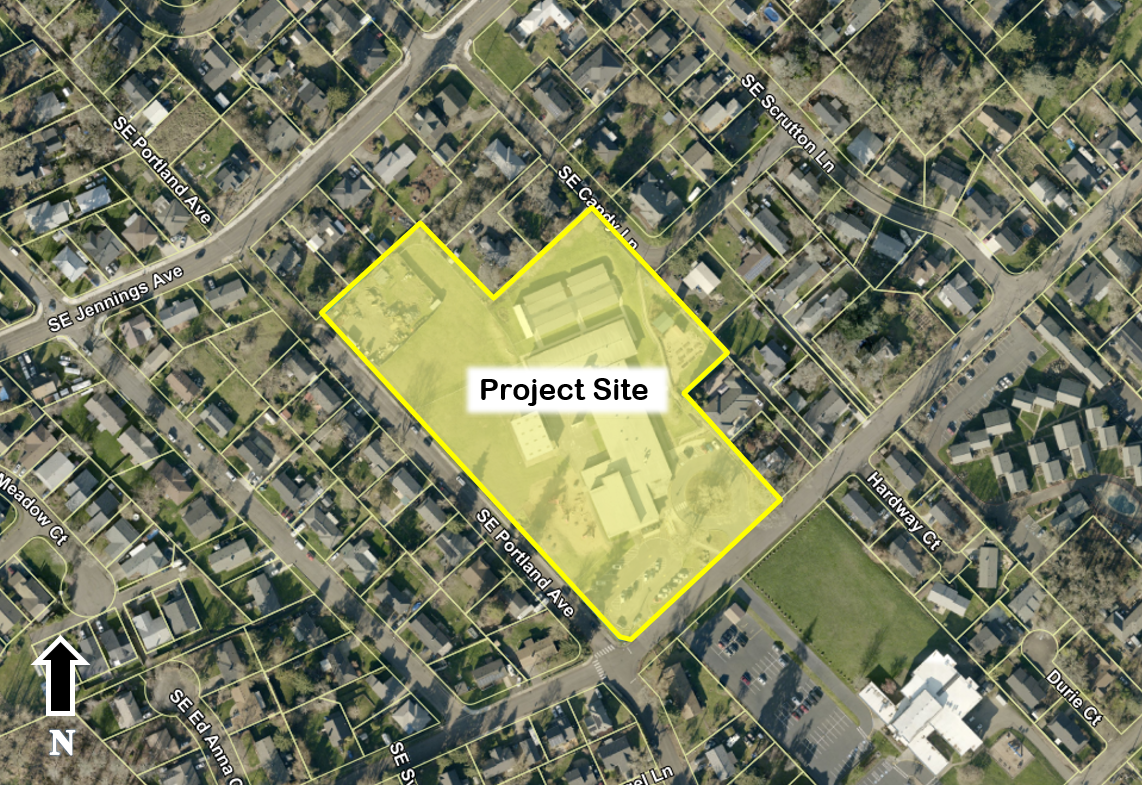
Community Planning Organization (CPO) for Area:
Jennings Lodge, jenningslodgecpo@gmail.com
Community Planning Organizations (CPOs) are part of the county’s community involvement program. They are advisory to the Board of County Commissioners, Planning Commission and Planning and Zoning Division on land use matters affecting their communities. CPOs are notified of proposed land use actions and decisions on land within their boundaries and may review these applications, provide recommendations or file appeals. If this CPO currently is inactive and you are interested in becoming involved in land use planning in your area, please contact Clackamas County Community Engagement at 503-655-8751.
Opportunity to Review the Record and Decision: The complete decision, including findings and conditions of approval, and the submitted application are available for review online. Select the Planning tab and enter the file number to search. Select Record Info and then select Attachments from the dropdown list, where you will find the submitted application. A copy of the decision, application, all documents and evidence submitted by or on behalf of the applicant, and applicable criteria are available for inspection at no cost by contacting the Planner listed above. Copies of all documents may be purchased at a cost established by the County fee schedule.
Appeal Rights: This decision will not become final or effective until the period for filing an appeal with the County has expired without the filing of an appeal. Any person who is adversely affected or aggrieved or who is entitled to written notice of the decision pursuant to Subsection 1307.09(C) of the Clackamas County Zoning and Development Ordinance may appeal this decision to the Clackamas County Land Use Hearings Officer by filing a written appeal. An appeal must include a completed Appeal Form and a $250.00 filing fee and must be received by the Planning and Zoning Division by the appeal deadline identified above.
Appeals may be submitted in person during office hours (8:00 am to 4:00 pm Monday through Thursday, closed Friday and holidays). Appeals may also be submitted by email or US mail.
A person who is mailed written notice of this decision cannot appeal this decision directly to the Land Use Board of Appeals under ORS 197.830.
NOTICE TO MORTGAGEE, LIENHOLDER, VENDOR OR SELLER: ORS CHAPTER 215 REQUIRES THAT IF YOU RECEIVE THIS NOTICE, IT MUST PROMPTLY BE FORWARDED TO THE PURCHASER.
Clackamas County is committed to providing meaningful access and will make reasonable accommodations, modifications, or provide translation, interpretation or other services upon request. Please contact us at 503-742-4545 or email DRenhard@clackamas.us.
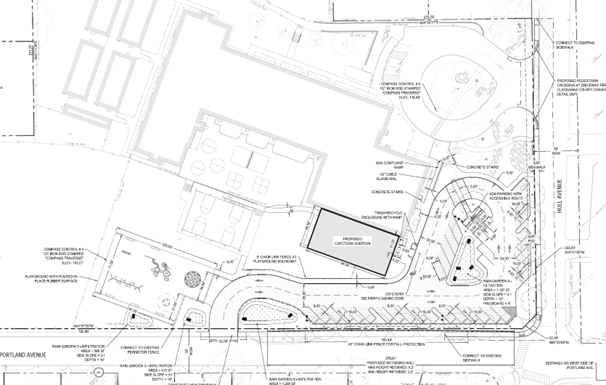
Site Plan:
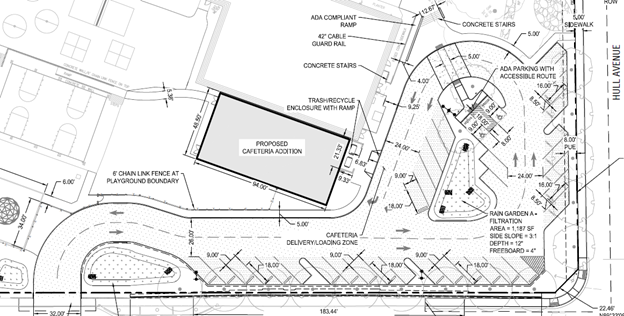
Parking Circulation:
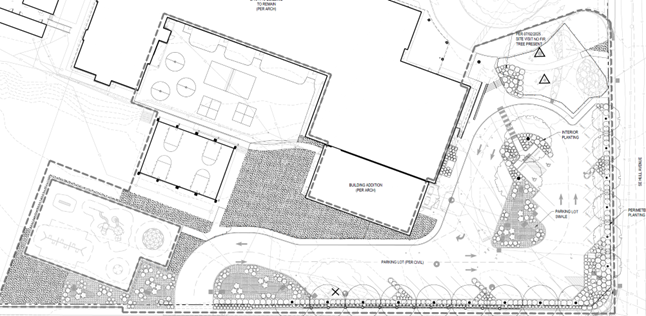
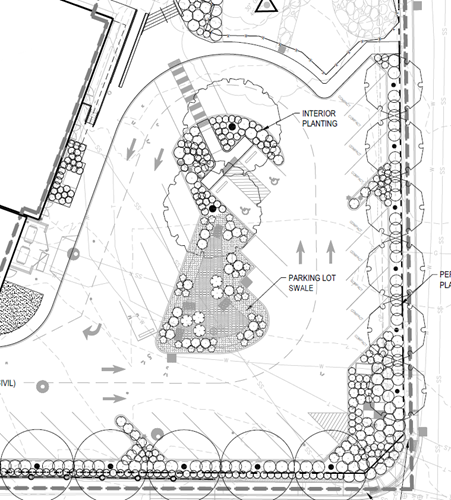
Landscaping Plan:
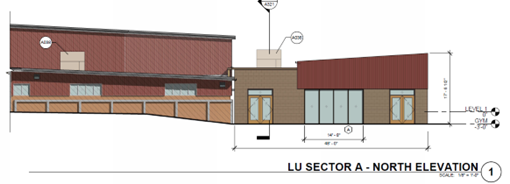
Building Elevation:
Staff Recommendation:
Staff recommends denial of the Conditional Use permit due to insufficient information in the applicant’s materials addressing ZDO Subsection 1203.03(D) regarding the impact of relocating the entrance of the parking area from SE Hull Avenue to SE Portland Avenue. Additionally, staff found the landscape plan to be out of compliance with the landscape strip requirement in ZDO Subsection 1009.06(C). Staff believes that application can be approved if additional evidence addressing both Subsection 1203.03(D) and Subsection 1009.06(C) is submitted prior to, or at the time of the hearing.
If the Hearings Officer moves to approve the application, staff recommends the following Conditions of Approval:
Recommended Conditions of Approval:
The conditions listed are necessary to ensure that approval criteria for this land use permit are satisfied. Where a condition relates to a specific approval criterion, the code citation for that criterion follows in parentheses. At all times, the use shall be sited and conducted in compliance with these conditions of approval. Noncompliance may result in code enforcement action or revocation of this permit.
- Approval of this land use permit is based on the submitted written narrative and plan(s) filed with the County on February 4, 2026 and additional documents submitted on February 27, 2026, March 13, 2026, April 10, 2026, April 13, 2026, and April 22, 2026. No work shall occur under this permit other than which is specified within these documents, unless otherwise required or specified in the conditions below. It shall be the responsibility of the property owner(s) to comply with these documents and the limitation of any approval resulting from the decision described herein.
- The surfaces of metal exterior building materials that are subject to rust or corrosion shall be coated to inhibit such rust and corrosion, and the surfaces of metal exterior building materials with rust or corrosion shall be stabilized and coated to inhibit future rust and corrosion. [1005.03(E)]
- The height of pole-mounted outdoor light fixtures shall not exceed 25 feet. At entrances, outdoor lighting shall be glare-free. Entrance lighting may not exceed a height of 12 feet and must be directed downward. [1005.04(A)]
- The proposed development is located within the service area of Oak Lodge Water Services for sanitary sewer, water and surfacewater and shall be subject to the Oak Lodge Rules and Regulations and Design and Construction Standards for applicable utilities.
- Property owner or designee shall apply for a utility permit from OLWS for each tax lot.
- Property owner or designee shall apply for an erosion and sediment control/surface water management permit from OLWS.
- All frontage improvements in, or adjacent to Clackamas County right-of-way, or on-site, shall be in compliance with Clackamas County Roadway Standards.
- The applicant shall grant an 8-foot wide public easement for sign, slope, and public utilities along the entire SE Hull Avenue right-of-way, consistent with Clackamas County Standards Drawing C110.
- Drainage facilities for frontage improvements within the public right-of-way shall be designed and constructed in accordance with Clackamas County Roadway Standards Chapter 4, as modified by approved Design Modification RW026926. Coordination with Oak Lodge Water Services shall be required for stormwater management of on-site improvements, as applicable.
- All traffic control devices associated with the development, including those located on private property or within the public right-of-way, shall conform to the Manual on Uniform Traffic Control Devices and relevant Oregon supplements
- The applicant shall provide and maintain minimum intersection sight distance of 280 feet at the driveway intersection with SE Portland Avenue, in accordance with Clackamas County Roadway Standards Section 240.
- Primary Inspector:
- The applicant shall enter into a Developer/Engineer Agreement for primary inspection services per Section 180 of the Clackamas County Roadway Standards. This form will be provided to the applicant and shall be signed and returned to County Plans Reviewer.
- Prior to Certificate of occupancy, the applicant shall provide a Certificate of Compliance signed by the Engineer of Record stating all materials and improvements have been completed.
- Prior to issuance of a Building Permit:
- The applicant to shall submit plans showing sheltered entries, of at least 4ft, on the north and south façade.[1005.02(B)1]
- The applicant must obtain a Development Permit from the Engineering Division for review and approval of frontage improvements and on-site access. The Permit shall be obtained prior to commencement of site work and issuance of a building permit.
- The applicant shall submit the following to the Clackamas County Engineering Office:
- Written approval from the Clackamas Fire District #1 for the planned access, circulation, fire lanes and water source supply. The approval shall be in the form of site and utility plans stamped and signed by the Fire Marshal.
- Written approval from Oak Lodge Water Services for adequate water supply source to serve the development. The approval shall be in the form of utility plans stamped and signed by the Water District representative.
- Written approval from Oak Lodge Water Services for surface water management facilities, surface water detention facilities, and erosion control measures.
- A set of street and site improvement construction plans in conformance with Clackamas County Roadway Standards Section 140, to Clackamas County's Engineering Office for review and obtain written approval, in the form of a Development Permit.
- Prior to Certificate of Occupancy
- All required improvements shall be constructed and inspected, or financially guaranteed in the form of a performance bond. Performance bonds shall be in the amount of 125% of the approved engineer's cost estimate of the required improvements, and shall be accepted only when access has met minimum Substantial Completion requirements, per Clackamas County Roadway Standards Section 190.
- All landscaping shall be installed in accordance with the approved landscaping plan. [1009]
- The developer shall either submit a signed maintenance contract for the one-year period or provide a performance surety pursuant to Section 1311, Completion of Improvements, Sureties, and Maintenance, covering the landscape maintenance costs for the one-year period [1009.10(F)]
- Prior Final Occupancy:
- The applicant shall design and construct frontage improvements along the SE Hull Avenue frontage in accordance with the approved Design Modification (RW026925) and Clackamas County Roadway Standards. A detailed list of required improvements is included in the Engineering Advisory Notes.
- The applicant shall design and construct on-site parking and maneuvering areas as follows:
- Adequate on-site circulation shall be provided for the parking and maneuvering of all vehicles anticipated to use the site.
- All parking and maneuvering areas shall be paved and constructed per Clackamas County Standard Drawing R100.
- Parking spaces shall meet minimum dimensional requirements of ZDO Section 1015, and Clackamas County Standard Drawings P100 or P200, as applicable. The plans shall list the number of parking spaces required and the number of parking spaces provided.
- All curbs shall typically be type "C", or curb and gutter if curb line slope is less than one percent, if they carry, direct or channel surface water. Alternative curbs will be considered when it is determined by the Clackamas County Department of Transportation and Development that type “C” curbs or curb and gutter are not appropriate. Extruded curbs for carrying, directing or channeling surface water, or used as a vehicle wheel stop, shall not be allowed.
- The applicant shall show the paths traced by the extremities of anticipated large vehicles (delivery trucks, fire apparatus, garbage and recycling trucks), including off-tracking, on the site plan to insure adequate turning radii are provided.
- Fire access lanes shall be clearly identified and maintained. Where required, fire lanes shall be striped and signed “No Parking – Fire Lane” in accordance with Fire District requirements.
- Prior to issuance of a Development Permit and/or prior to issuance of a building permit for the trash enclosure, the applicant shall submit detailed enclosure plans that clearly outline a waste and recycling enclosure that meets the requirements specified in ZDO 1021. The applicant shall work with Clackamas County’s Sustainability & Solid Waste staff to finalize plans that comply with design standards.
- APPLICABLE APPROVAL CRITERIA
This application is subject to Clackamas County Zoning and Development Ordinance (ZDO) Section(s) 202, 702, 1000-series, 1203 and 1307.
Public and Agency Comments
Notice was sent to applicable agencies and owners of property within 300 feet. Staff received comments from Clackamas County Development Engineering (Exhibit 11), Clackamas County Sustainability and Solid Waste (Exhibit 8), Oak Lodge Water Services (Exhibit 13), and two written comments from the public (Exhibit 9 and 10). Comments or issues raised related to relevant review criteria are addressed in this report.
Findings
The findings below identify the standards and criteria that are relevant to this decision, state the facts relied upon in rendering the decision, and explain the justification for the recommendation.
Background/Overview of Applicant’s Proposal:
Candy Lane Elementary was first established in 1968 under a Conditional Use Permit, CU44-68. At the time of approval, the property was zoned R10. Following the construction of the school the site was rezoned OSM. Subsequent approvals on the site include an alteration of non-conforming use (Z0115-14-E) and Open Space Review (Z0116-14-OSR) for an expansion of the community garden in 2014, and a Conditional Use for the addition of four modular classrooms in 2022 (Z0124-22).
The project site is developed with the main Candy Lane Elementary School building, four modular classrooms, a modular restroom, a bus loop with limited parking, a parking area taking access off SE Hull Avenue and existing to SE Portland Avenue, a playground, a covered play area, an uncovered hardscaped play area, open space, and onsite walkways.
The applicant proposes to construct a 4,520 square foot cafeteria addition to the existing Candy Lane Elementary School, reconfiguration of the existing parking including driveway relocation, a new trash enclosure, relocation of the covered play area, new stormwater facilities, landscaping improvements, and street improvements along SE Hull Avenue. The proposed improvements are not anticipated to result in additional traffic. However, the relocation of the driveway entrance from SE Hull Avenue to SE Portland Avenue will have an impact on traffic patterns and the queueing during drop-off and pick-up at the school.
The lot coverage of the proposed addition exceeds 25% of the original lot coverage approval precluding the development from being reviewed as a Modification to the original approval and requiting a new Conditional Use permit. Additionally, the relocation of the access requires Conditional Use review.
ZDO Section 702, Open Space Management (OSM) District
2A. Subsection 702.02, 702.03, and 702.05 Primary, Accessory, and Conditional Uses:
Finding: The subject property is located in the OSM zoning district. The proposed use is an addition to a public school, which is a Conditional use in the zoning district “when associated with open space or recreational facilities”.
The Candy Lane Elementary School site includes outdoor play areas, covered play areas, and fields for recreation, some of which will be altered as a part of this application. None of the recreation facilities are proposed to be removed as a part of the application. "Public and private outdoor recreation facilities” are permitted as primary uses; play equipment and ball fields are included as examples of allowed primary uses in ZDO Section 702.03. Therefore, the school is on a property that has a recreational facility and is allowed with an approved conditional use permit. The applicants have successfully applied for a conditional use permit and, with approval, this standard is met.
2B. Subsection 702.02 Development Standards:
Development in the OSM District is subject to the applicable provisions of Sections 1000, Development Standards, and 1100, Development Review Process. In addition, improvements shall comply with the following standards:
- Landscape the site to produce a setting appropriate to its function.
- Provide an efficient internal circulation system and facilities layout plan.
- Maximize access for pedestrians, bicyclists, transit riders, and people with disabilities in active recreation areas.
- Provide conveniences for users with disabilities.
- In the case of parks, conform to the classifications and standards in Comprehensive Plan Table 9-1.
- Locate principal and accessory buildings a minimum of 10 feet from any lot in a residential zoning district.
- Community and Design Plans: Development within a Community or Design Plan area identified in Chapter 10, Community Plans and Design Plans, of the Comprehensive Plan shall comply with the specific policies and standards for the adopted Community or Design Plan.
Finding: Applicable standards of ZDO Section 1000 for institutional uses are provided in this report. Comprehensive Plan Map IV-6: North Urban Area Land Use Plan Map, identifies the project site as a Public and Community Use Open Space (PCU). However, the regulations of ZDO Section 1100 are not applicable, because the project does not have development impacting any of the open space resources described in ZDO Section 1011.
Staff incorporates the findings provided by the applicant in their submitted project narrative. There is not a minimum requirement for the percent of development site landscaping in the OSM zone. Instead, landscaping shall be designed appropriately for the function of the site. The landscape plan included on Sheet L7.12 of Exhibit 7 shows landscaping incorporated throughout the parking area, adjacent to the covered play area, and within stormwater facilities. The majority of the site will remain turf to support the play activities of students. Trees are planted along the frontage of SE Hull Avenue and SE Portland Avenue, buffering the parking area from offsite view and providing and attractive and inviting atmosphere. Trees are proposed for retention where possible. The proposed landscaping is appropriate for the function of the site.
The proposed internal circulation system is a critical component of the application. The applicant proposes to alter the parking area, which also serves as the drop-off and pick-up loop, to add additional parking and consolidate the access to SE Portland Avenue, removing the access from SE Hull Avenue. The provided narrative notes how the changes to the parking/drop-off and pick-up area, will increase the available area for the queueing of cars. Current site conditions include two parent drop-off/pick-up parking spaces, and allows for the queuing of seven cars onsite. The proposed reconfiguration includes the addition of seven drop-off/pick-up parking spaces and will allow for the queuing of nineteen vehicles on site. In addition to changes to the sites vehicles circulation, the site improvements include alterations to the onsite pedestrian walkway system. Walkways extend from the entrance of the school to the parking area, the play areas, and SE Hull Avenue which has sidewalks connecting to SE Portland Avenue, providing adequate and safe site circulation for pedestrians. The layout of facilities on the site efficiently serve the needs of students, parents, visitors, and employees of Candy Lane Elementary, which complies with the applicable standards in Section 1000.
702.06(C) requires developments to maximize access for pedestrians, bicyclists, transit riders, and people with disabilities in active recreation areas. The site is designed with pedestrian access in mind, as described above. Improvements along SE Hull Avenue will ensure convenient access for bicyclists and transit riders as well. Improvements to the site include a new ADA accessible soft-scape play structure for the convenient use of users with disability. The upgraded interconnected walkway system and improvements along SE Hull Avenue will be ADA compliant. ADA parking is provided on site as well. The site has been designed for equal access to users of all abilities, to the extent possible.
The proposed use is not a park and therefore not subject to the classifications and standards in Comprehensive Plan Table 9-1.
702.06(F) requires the development to locate principal and accessory buildings a minimum of 10 feet from any lot in a residential zoning district. The school is surrounded on all sides by residentially zoned land. SE Portland Avenue separates the school from adjacent residential development to the south by more than 50’. The cafeteria addition is setback over 100’ from SE Hull Avenue, providing sufficient separation from adjacent residential land.
The property is not within a Community Plan Area identified in Comprehensive Plan Chapter 10 are being met.
These standards are met, or can be met with conditions.
ZDO Section 1001, General Provisions
Section 1001.03 and Table 1001-1 establishes the applicability of Section 1000 for Institutional uses. A school is an “institutional use”. Applicable sections are reviewed below.
ZDO Section 1002, Protection of Natural Features
Section 1002 addresses the protection of various natural features including hillsides, the excessive removal of trees prior to development, the protection of trees and wooded areas through development, river and stream corridors, the winter ranges of deer and elk populations, certain open spaces near Mount Hood, significant natural areas, and significant landforms and vegetation.
Finding: Staff incorporates the findings provided by the applicant. The site is generally flat and does not contain any slopes of 20% or greater. The subject property is within the Metropolitan Service District Boundary or the Portland Metropolitan Urban Growth Boundary and so the excessive tree removal standards apply. Staff has not seen any evidence that excessive tree removal has occurred on site in the last five years. The property is not within 100 feet of a resource identified on Comprehensive Plan Map X-MH-2. There are no designated Type F river and stream corridors on the subject property. The property is located outside of the deer and elk winter range, as identified on Comprehensive Plan Map III-2.
One tree is proposed for removal and two trees adjacent to construction are proposed for retention, as shown on Sheet L7.12 of Exhibit 7. Tree protection fencing is proposed for installation surrounding the two trees to be retained to provide protection during construction.
The standards of Section 1002, as applicable, are met.
ZDO Section 1003 and 1004,Hazards to Safety and Historic Preservation
Section 1003 addresses various hazards to safety including flood, soils, fire, and mass movement areas. Section 1004 addresses standards related to historic preservation.
Finding: The property is not within a mass movement hazard area and does not include soil hazards, as identified on the State Department of Geology and Mineral Industries Bulletin 99 maps. The property is not within the flood hazard area and was not identified as an area of significant fire hazard on the repealed State wildfire maps (reference Senate Bill 83). As applicable, the standards are met.
ZDO Section 1005, Site and Building Design
Section 1005 addresses the development of sites and design of buildings so as to efficiently utilize land, create lively, safe, and walkable centers, support the use of non-auto modes of transportation, reduce impact of development of natural features, utilize opportunities arising from a site’s configuration, design illumination so dark skies are maintained when possible and accommodate the needs of users of developments. It applies to institutional, commercial, and industrial development; multifamily dwellings; and developments of more than one, two- or three-family dwelling.
6A. Subsection 1005.02 – General Site Design Standards establishes standards for the sites of commercial, industrial, and multifamily developments and addresses standards for the placement and orientation of buildings, on-site pedestrian circulation, the placement and orientation of building entrances, and other use- and zone-specific standards.
Finding: Staff incorporates the findings made by the applicant in their written narrative. Subsections 1005.02(F) through 1005.02(F) are not applicable to the proposed development as the parking area is less than three acres, the development is not a new building, and the project site is within the OSM zoning district. Due to the fact the proposal is an addition to an existing building, meeting many of the building orientation standards within ZDO Subsection 1005.02 are not feasible. Constraints that hinder meeting the standards are addressed within the report findings and applicant’s narrative. No new buildings are proposed onsite. However, the existing buildings and proposed covered play area are clustered to the extent practical on the site. The existing school is not oriented such that the longest building elevation is within 20 degrees of true south. Aside from the requirement for all buildings to be at least 10’ from adjacent residentially zoned properties, there are no minimum or maximum setback requirements to meet.
Proposed site improvements include modifications to the existing interconnected walkway system, as shown on Sheet C2.00 of Exhibit 7 and the applicants submitted Sidewalk Connectivity Plan included in Exhibit 7. A minimum of 5’ wide concrete walkways are proposed extending from the main school entrance to the proposed parking area, play areas, and the proposed sidewalk along SE Hull Avenue, which connects to the existing sidewalk along SE Portland Avenue. A walkway is also provided from the cafeteria to the play area and the rest of the interconnected walkway system. A raised crosswalk is proposed from the walkway to the parking in the center of the parking area for safe pedestrian crossing. All proposed walkways will be illuminated.
The project site is located within the UGB, and therefore Subsection 1005.02(E), which required that a minimum of 50% of the street from of a development is sited at the minimum front setback line, would typically apply. However, the OSM zoning district does not have a true “minimum setback”. Instead, buildings are required to be sited at least 10’ from adjacent residentially zoned properties. It would not be possible, or practical, to site the cafeteria 10’ from the adjacent residentially zoned parcels, therefore Subsection 1005.02(E) does not apply.
As applicable, the standards of Subsection 1005.02 are met.
6B. Subsection 1005.03 – Building Design provides standards for building facades, entrances roof design, exterior building materials, the screening of mechanical equipment, and other use- and zone-specific standards.
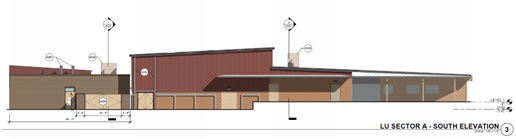
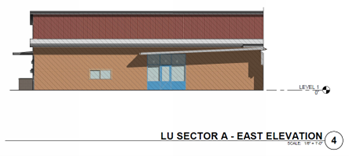
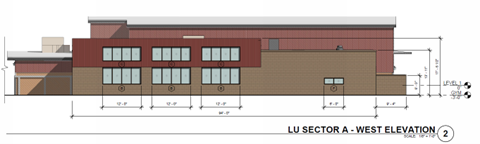
Finding: Staff incorporates the findings made by the applicant in their written narrative and concludes that the proposed design meets the standards of this subsection, as practical. The cafeteria addition does not include the primary entrance for the school, however will be visible from public ROW and therefore façade enhancement requirements apply. As noted in Finding 6A, staff has determined that Subsection 1005.02(E) does not apply to the addition of the cafeteria, therefore Subsection 1005.03(C) is also not applicable. While the applicant’s narrative claims that the requirements for building entries do not apply as no changes to main building entries are proposed, staff disagrees with that interpretation. The entries on the north and south portion of the addition will be used by students and staff regularly. Staff has consistently interpreted that Subsection 1005.03(B)1 applies to entries such as this. While the entries are clearly defined and highly visible, the submitted architectural plans do not show and overhang or architectural feature with a depth of at least four feet to shelter the doorways. No public entrances are proposed along the west façade. Staff recommends a condition of approval requiring the applicant to submit plans at the time of building permit showing sheltered entries on the north and south façade.
The proposed addition is designed to be complementary with the existing architecture of the school. Great care has been taken to ensure human scale design, with thoughtful placement of a variety of architectural treatments, enhancing both the design and functionally of the building. The façade includes a mix a materials including earth toned masonry with 4 inch blocks, larger ground face CMU blocks in two neutral shades of tan, metal wall panel in terracotta, and storefront style glazing with dark bronze frames. The smaller masonry blocks reflect the materials of the existing building incorporated with the larger CMU blocks for a visually interesting pattern The terracotta metal wall panels provides additional interest to the building design, which matches the existing building materials, tying the new and old portions of the school together harmoniously. Glazing breaks up the faced in strategic locations and will provide natural light to the interior of the structure. The neutral color pallet with terracotta accents blend seamlessly with the existing building and surrounding neighborhood. The roofline of the proposed building is flat. A parapet is proposed to break up the flat roofline and enhance the overall design. The proposed materials are of durable and high quality. The applicant’s architectural plans note the exposed masonry will be treated with graffiti restraint coating. A condition of approval requires that the surfaces of metal exterior building materials shall be coated to inhibit rust and corrosion.
The building and site have been designed to maximize safety including placing the building to limit the impact on the existing surveillance of school entryways, walkways, parking, and recreation areas. Landscaping is also designed to maximize surveillance. The submitted lighting plan demonstrates the site will be adequately illuminated to meet safety needs.
The applicant has request a modification to the requirement to screen rooftop mechanical equipment, addressed in Finding 6E. As conditioned, these standards can be met.
6C. Subsection 1005.04 – Outdoor Lighting provides standards to ensure that onsite lighting is compatible with the site and surrounding uses while preventing light trespass and pollution.
Finding: The applicants submitted a photometric plan that includes footcandle information and light fixture details. The proposed light fixtures do not shine light skyward. The pole-mounted site lighting can be mounted at a maximum height of 25 feet. Entrance lighting may not exceed a height of 12 feet. The proposed plans suggest that these standards will be met. As conditioned, these standards can be met.
6D. Subsection 1005.05 – Additional Requirements requires projects to employ one additional design element per 20,000 square feet of site area. Regardless of site size, a minimum of one and a maximum of five techniques are required.
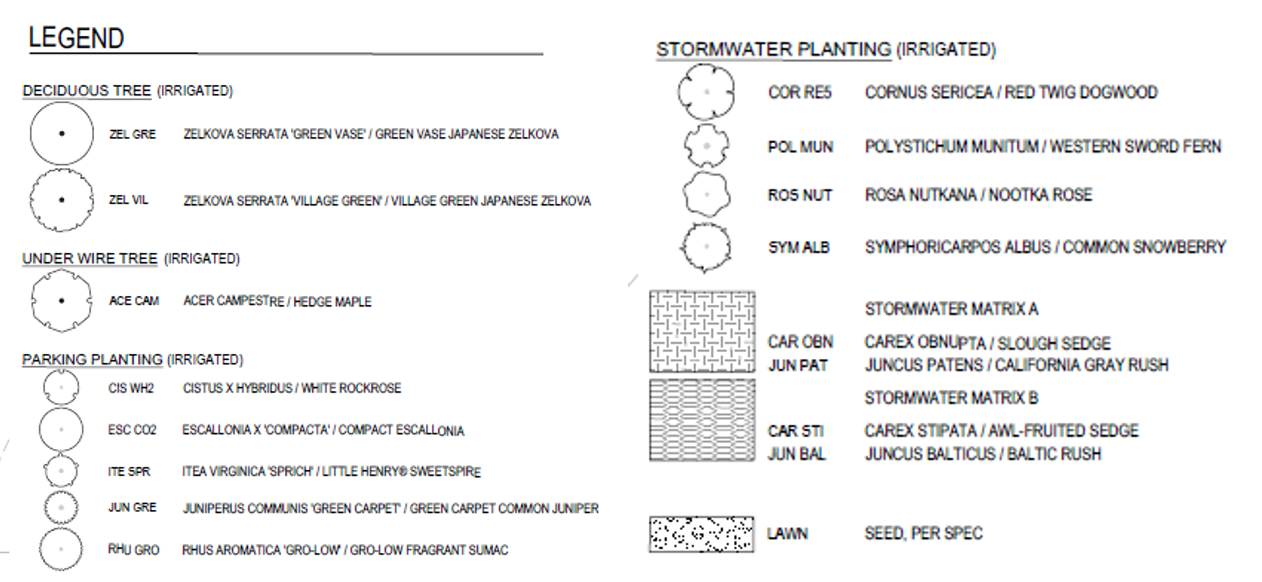
Finding: Section 1005.05 requires applicants to employ one “Additional Requirement” for every 20,000 square feet of site area. The site area is 265,027 square feet, therefore the maximum of five design elements are required. The applicant proposes to modulate the building masses to maximize solar access while avoiding winter shading of the south side and optimize summer shading on the west side of the building by siting the addition on the southwest corner of the school. Deciduous trees are proposed throughout the landscaped areas to provide summer shade and allow winter sun. The renovated outdoor spaces are sited on the south and west sides of the building. Clerestory windows are installed to provide ample natural lighting. The applicant proposes at least five design elements/techniques that are required. As described in the applicant’s narrative, the standard is met.
6E. Subsection 1005.06 – Modifications provides a path to modify the requirements of ZDO Subsection 1005.02 and 1005.03, provided the proposed modification will result in a development that achieves the purpose stated in ZDO Subsection 1005.01, as well or better than the listed requirement.
Finding: The applicant request a modification to the requirement to screen roof top mechanical equipment listed in Subsection 1005.03(J). Instead, the applicant proposed to paint the roof top mechanical equipment in a similar color as the building materials to reduce the visual impacts. The existing mechanical units are not screened. The applicant argues that screening the equipment would draw more attention to the rooftop and would be incompatible with existing building design. Additionally, given the distance between the ROW and the building the visibility of the equipment is minimal, as demonstrated on Sheet A321 of Exhibit 5. Staff agrees with the applicant’s justification for the proposed modification. This criteria is met.
ZDO Section 1006, Utilities, Street Lights, Water Supply, Sewage Disposal, Surface Water Management, and Erosion Control
Section 1006 addresses the provision of appropriate infrastructure for utilities, water supply, and sewage disposal, as well as the management of surface water and site erosion.
7A. Subsection 1006.01 General Standards. Except where otherwise prohibited by the utility district or company, utility service lines shall be installed underground.
Finding: The proposal demonstrates compliance with this subsection; all utility lines will be underground. Easements will be provided by the applicant if deemed necessary by the water, sewer and surface water management authorities. This standard is met.
7B. Subsection 1006.02 Street Lights. Street lights are required for all development inside the Portland Metropolitan Urban Growth Boundary (UGB).
Finding: No new roads are proposed as a part of the development. There is an existing streetlight located at the intersection of SE Hull Avenue and SE Portland Road which will remain. This standard is met.
7C. Subsection 1006.03 Water Supply. Development which has a need for, or will be provided with, public or community water service shall install water service facilities and grant necessary easements pursuant to the requirements of the district or company serving the development. Approval of a development that requires public or community water service shall be granted only if the applicant provides a preliminary statement of feasibility from the water system service provider.
Finding: Oak Lodge Water Services is the water provider in this area. A signed preliminary statement of feasibility was provided by the applicant confirming that water service, including fire flows, is available in levels appropriate for the development and adequate water system capacity is available in source, supply, treatment, transmission, storage, and distribution, or such levels and capacity can be made available through improvements completed by the developer or the system owner. This criterion is met.
7D. Subsection 1006.04 Sanitary Sewer Service. All development that has a need for sanitary sewers shall install the facilities pursuant to the requirements of the district or company serving the development. Approval of a development that requires sanitary sewer service shall be granted only if the applicant provides a preliminary statement of feasibility from the sanitary sewage treatment service provider and the collection system service provider.
Finding: Oak Lodge Water Services is the sewer provider in this area. A signed preliminary statement of feasibility was provided by the applicant confirming that sanitary sewer capacity in the wastewater treatment system and the sanitary sewage collection system is available to serve the development or can be made available through improvements completed by the developer or the system owner. This criterion is met.
7E. Subsection 1006.06 Surface Water Management. Positive drainage and adequate conveyance of surface water shall be provided from roofs, footings, foundations, and other impervious or near-impervious surfaces to an appropriate discharge point. Approval of a development shall be granted only if the applicant provides a preliminary statement of feasibility from the surface water management regulatory authority. The statement shall verify that adequate surface water management, treatment and conveyance is available to serve the development or can be made available through improvements completed by the developer or the system owner.
Finding: Oak Lodge Water Services is the surface water management authority for onsite surface water management; a signed preliminary statement of feasibility was provided by the applicant confirming that adequate surface water management, treatment, and conveyance is available to serve the development or can be made available through improvements completed by the developer or the system owner with conditions. Clackamas County Development Engineering will review the stormwater management related to street improvements during Development Permit review. This criterion is met.
ZDO Section 1007, Roads and Connectivity
Section 1007 addresses road and connectivity requirements ensuring a safe and functioning transportation system.
Finding: The applicant proposes a Conditional Use application to modify the existing Candy Lane Elementary School, including construction of a new cafeteria building, reconfiguration of on-site parking and circulation, and associated site improvements. The proposal includes removal of the existing access from SE Hull Avenue and consolidation of parent pick-up and drop-off access to SE Portland Avenue.
The proposed development consists primarily of site modifications, including construction of a new cafeteria building, playground improvements, and reconfiguration of on-site parking and circulation. Based on the information provided, the proposal is not anticipated to result in a significant increase in student enrollment or traffic generation beyond existing conditions. The proposed development is subject to the provisions of the Clackamas County Zoning and Development Ordinance (ZDO), including Section 1007 pertaining to roads and connectivity and Section 1015 pertaining to parking and loading, as well as the Clackamas County Roadway Standards, including Chapter 4, for surface water management.
Consistent with ZDO Section 1007, development applications are required to bring adjacent roadway frontage up to current standards through frontage improvements, as applicable. The project site includes frontage along SE Hull Avenue and SE Portland Avenue, both classified as local roadways. SE Hull Avenue is currently unimproved along the site frontage, lacking curb, sidewalk, and associated frontage improvements. SE Portland Avenue is improved with curb and sidewalk along the site frontage. Frontage improvements along SE Hull Avenue is required as part of the proposed development. No additional frontage improvements are required along SE Portland Avenue. The applicants submitted materials show proposed improvements along SE Hull Avenue.
A Design Modification (RW026925), approved by Clackamas County, modifies the applicable roadway standards for the SE Hull Avenue frontage. The approved modification allows the existing 50-foot right-of-way width to be maintained in lieu of additional right-of-way dedication and adjusts standard frontage improvements, including removal of the landscape strip, construction of a 5-foot sidewalk, omission of stormwater management within the frontage, and installation of a single ADA curb ramp at the SE Hull Avenue and SE Portland Avenue intersection.
The applicant has proposed these modifications due to existing right-of-way constraints and roadway alignment. Pursuant to Section 170 of the Clackamas County Roadway Standards, modifications may be approved where strict application of the standards is impractical and where the proposed design provides comparable public benefit. In this case, strict application of the standard cross-section would reduce the effective roadway width below what is practical for school-related traffic and would require modification of the on-site parking layout and circulation system, which is constrained by fire access requirements and site geometry. The proposed design maintains adequate vehicular circulation, provides pedestrian connectivity via a continuous sidewalk, and aligns with existing improvements along SE Portland Avenue. The absence of a landscape strip minimizes encroachment into the traveled way while maintaining pedestrian access. The single ADA curb ramp aligns with the existing ramp on the opposite side of SE Portland Avenue, providing a functional and connected pedestrian crossing. The proposal provides a public benefit by introducing pedestrian facilities where none currently exist while accommodating site constraints and school operations.
Clackamas County Roadway Standards Drawing C110 requires an 8-foot wide public easement for sign, slope, and utilities along the SE Hull Avenue frontage.
The school site is currently developed with on-site parking, a parent pick-up and drop-off area, and a separate on-site circulation loop for school bus operations. The proposal removes the existing access from SE Hull Avenue and consolidates all vehicular access to SE Portland Avenue. The proposed improvements primarily affect the parent pick-up and drop-off area and associated parking, while the existing bus circulation loop will remain in place.
Based on the information provided, the proposed development is not anticipated to result in a significant increase in student enrollment or overall traffic generation beyond existing conditions. The proposed parking lot reconfiguration and modest increase in on-site parking, along with the relocated access on SE Portland Avenue, will increase the available internal circulation length and provide additional on-site queueing capacity. The improved internal configuration allows vehicles to queue within the site more effectively and reduces the potential for vehicle stacking within the public right-of-way.
SE Portland Avenue is a low-volume, dead-end local roadway serving adjacent residential properties. Engineering staff finds that the roadway and internal site circulation will continue to operate adequately to serve the proposed development and satisfy the requirements of ZDO Section 1007.07.
The proposed development removes the existing access from SE Hull Avenue and consolidates site access to SE Portland Avenue, a local roadway. The proposed access is shifted west of the existing intersection with SE Hull Avenue, increasing separation from the intersection and improving overall access spacing. Clackamas County Roadway Standards Section 220 establishes access spacing standards for local roadways within the Urban Growth Boundary. The proposed access location meets applicable spacing requirements. Based on the above, the proposed access location is consistent with the access management and spacing requirements of ZDO Section 1007 and the Clackamas County Roadway Standards.
Clackamas County Roadway Standards Section 240 requires access points to meet minimum intersection sight distance standards based on roadway classification and design speed. The proposed access location provides adequate intersection sight distance in both directions along SE Portland Avenue, as demonstrated on the submitted site plan. The site frontage is relatively flat and free of significant visual obstructions, allowing for clear visibility between vehicles entering and traveling along SE Portland Avenue. Based on the above, the proposed access location appears to meet applicable intersection sight distance requirements of the Clackamas County Roadway Standards.
Access is proposed from SE Portland Avenue with a driveway. A minimum 28-foot-wide paved driveway approach is required. The applicant is proposing a 32-foot-wide driveway, which meets the minimum standard. Beyond the paved approach, on-site access, parking, and circulation areas require a paved surface in accordance with ZDO Section 1015.01(A).
As part of the Development Permit for this project, the applicant will be required to identify intended vehicle dimensions and turning radii, and to verify adequate on-site maneuvering. Parking spaces will be required to meet the minimum dimensional requirements of ZDO Section 1015 and Clackamas County Roadway Standards Drawings P100 and P200. Based on a review of the submitted plans, the development appears to comply with the maneuvering requirements.
The project site is located within the Oak Lodge Water Services District. The stormwater management plan for the proposed site improvements will require approval from the Oak Lodge Water Services District.
With conditions, these standards can be met.
ZDO Section 1009, Landscaping
The Section 1009 seeks to ensure that sites are design with appropriately selected, designed, installed, and maintained landscape materials and that landscaped areas are used for appropriate purposes.
Finding: There is no minimum required amount of landscaped area for properties in the OSM district. Instead, Section 702.06 requires the applicant to “landscape the site to produce a setting appropriate to its function.” As explained earlier in this report, and in the applicant’s submitted narrative, the proposed landscaping meets this criterion.
The applicant’s landscape plan is included on Sheet L7.12 of Exhibit 7. The proposed plantings are a mix of native and non-native species. A variety of plants are propose including evergreen and deciduous; trees shrubs, and groundcover; plants of varying texture; plants of varying widths and heights at maturity; and plants with seasonal color interests, meeting the variety standards include din ZDO Subsection 1009.01(B).
A minimum of one tree located every eight interior parking spaces, and 25 square feet of landscaping per interior parking space is required. Only nine of the provided parking spaces would be considered interior. 225 square feet of interior landscaping is required. The applicant exceeds the minimum requirement significantly. Two trees are provided in the landscape areas adjacent to the interior parking spaces, as is required. The two trees are proposed on the north side of the interior parking and a parking lot swale is proposed to the south which does not meet the locational/tree frequency requirements as intended by the ZDO. Where necessary to accommodate other design considerations, variable spacing of the trees required by Subsection 1009.03(A)(4) is allowed, but in no case shall there be less than one tree planted in every 12 parking spaces. This requirement is met.
Trees provided along the perimeter of the property will be used as additional screening for any portion of the waste enclosure visible from offsite.
The applicant proposes a landscape strip of less than the minimum required 5-foot wide landscape strip along both the SE Hull Avenue and SE Portland Avenue frontage. The submitted materials do not include measurements, however, staff estimates the strip is just over 3-foot wide along both frontages. The applicant’s narrative claims that the development is not required to meet this standard, however, staff disagrees with this interpretation. Subsection 1009.06(C)2 allows for landscape strips to be reduced if necessary due to setback constraints and the need to accommodate required walkways or pedestrian amenities. The applicant did not included evidence in the submitted narrative addressing this exception. Further, staff is concerned that the landscape strips will not have sufficient space to accommodate the proposed street trees due to the reduced width. Aside from the requirements of ZDO Subsection 1009.06(C) these standards are met. Staff finds that all standards can be met if additional evidence is submitted prior to the hearing.
ZDO Section 1010,Signs
The provisions of section 1010 are intended to maintain a safe and pleasing environment for the people of Clackamas County by regulating the size, height, number, location, type, structure, design, lighting, and maintenance of signs.
Finding: No signs are proposed as a part of this application. ZDO Section 1010 is not applicable.
ZDO Section 1015,Parking and Loading
Section 1015 is designed to ensure that developments in Clackamas County provide sufficient and properly designed parking for motor vehicles and bicycles as well as appropriate off-street loading areas.
Finding: The Climate Friendly and Equitable Communities (CFEC) rules are in effect pursuant to OAR 660, Division 12. Per OAR 660-012-0450, a minimum number of off-street vehicular parking spaces cannot be required for any development that is within the Urban Growth Boundary (UGB) and is served by and urban water and sanitary service. The property is eligible to follow the CFEC rules; therefore, no minimum vehicle parking is required. However, since the applicant is electing to provide new vehicle parking spaces, the dimensional standards of this subsection apply. Applicant’s materials demonstrate that the dimensional standards have been met.
1015-3, Minimum Required Bicycle Parking Spaces; and 1015-4, Minimum Required Off-Street Loading Berths do not apply because no additional classrooms will be added within the addition.
These standards are met.
ZDO Section 1021,Solid Waste and Recyclable Material Collection
Section 1021 applies to multifamily dwellings, and institutional, commercial, and industrial developments. It provides standards for the design, placement, and accessibility of trash enclosures.
Finding: The applicant has proposed a new, 21’4”W x 9’4”D x 6’H CMU trash enclosure set on a 4+in thick Portland Cement concrete pad at ground level and designed to discharge surface water runoff to avoid ponding. It is proposed to house two 4yd dumpsters (one each for trash and recycling) and food waste bins. The receptacles would be serviced in the drive aisle via a ramp. Additional detail is needed to illustrate the proposed enclosure complies with ZDO Subsections 1021.04, 1221.05, 1021.06, and 1021.07, including the receptacle footprints and gate details with the swing and restrainers, spacing details, the slope of the ramp, and any signs. The trash and recycling enclosure is addressed in the submitted narrative, but without detailed plans, it is unclear that the proposed enclosure satisfies all elements for the proposed uses.
The Clackamas County Sustainability division reviewed the submitted plans and determined that, although minor details were missing from the submittal, the proposal demonstrates that the standards of this section can be met with conditions or if additional information is submitted prior to the Hearing. As conditioned, this section can be met.
ZDO Section 1203, Conditional Uses
1203.02: Submittal Requirements
This application includes a completed land use application form, site plan, application fee and completed supplemental application addressing the criteria in ZDO Section 1203. The application also includes a description of the proposed use and vicinity map. All the submittal requirements under Subsection 1203.02 are included in the application. The application was submitted on February 4, 2026 and application was deemed complete on February 27, 2026.
1203.03(A): The use is listed as a conditional use in the zoning district in which the subject property is located.
13A. Finding: The subject property is located in the OSM zoning district. The proposed use is the addition of a cafeteria, improvements to outdoor recreation spaces, modifications to the parking area and access and other associated site improvements, which is a Conditional use in the zoning district “when associated with open space or recreational facilities”.
The Candy Lane Elementary School site includes outdoor play areas, covered play areas, and fields for recreation, some of which will be altered as a part of this application. None of the recreation facilities are proposed to be removed as a part of the application. "Public and private outdoor recreation facilities” are permitted as primary uses; play equipment and ball fields are included as examples of allowed primary uses in ZDO Section 702.03. Therefore, the school is on a property that has a recreational facility and is allowed with an approved conditional use permit. This standard is met.
1203.03(B): The characteristics of the subject property are suitable for the proposed use considering size, shape, location, topography, existence of improvements and natural features.
13B. Finding: The proposed cafeteria addition, and improvements to the outdoor recreation area are suitable for the site. The school and its associated uses were established in the late 1960s. Schools are often integrated within residential neighborhoods, allowing for convenient access and community connection. There is ample space to provide for the expansion onsite. As described in the above findings, the location of the addition was carefully considered to ensure for optimal functioning on the site. When considering the characteristics of the subject property, staff finds that this criterion is met.
1203.03(C): The proposed use is consistent with Subsection 1007.07, and safety of the transportation system is adequate to serve the proposed use.
13C. Finding: Clackamas County Development Engineering staff reviewed the proposal for compliance with 1007.07 and determined that the transportation system is adequate to support the proposed use. While traffic patterns are changing, no additional traffic is expected as a result of the addition. This criterion is met.
1203.03(D): The proposed use will not alter the character of the surrounding area in a manner that substantially limits, impairs or precludes the use of surrounding properties for the primary uses allowed in the zoning district(s) in which surrounding properties are located.
13D. Finding: Staff incorporates the findings provided by the applicant. The area surrounding the subject property is majority Low-Density Urban Residential. Adjacent land uses to the northeast, northwest, and southwest include single family residential. A Church is located to the southeast, within the City of Gladstone. Evidence has not be presented that the expansion of the cafeteria and other minor site improvements will substantially limit, impair or preclude the use of the surrounding properties for their primary use. Candy Lane Elementary School has been operating since 1969, in harmony with the surrounding land uses. The development will not include additional classrooms, and therefore increased traffic is not anticipated. Aside from temporary impacts from construction, no new noise-generating features are proposed. Staff agrees with the submitted narrative regarding the impact of the cafeteria expansion and continuation of the existing use.
Staff received several calls and submitted comments, included as Exhibits 9 and 10, from concerned neighbors regarding the proposed changes to the access of the site. The submitted comments note that they are generally in support of the project, aside from the potential impact of traffic pattern changes. Specifically, the commenters are concerned about the impact of consolidating the parking area/drop-off and pick-up access to SE Portland Avenue.
Currently, the parking area entrance is located on SE Hull Avenue and the exit is located on SE Portland Avenue. The proposed updates to the parking area and access will remove the entrance from SE Hull Avenue and relocate the entrance to SE Portland Avenue. With the new design both vehicles entering the site and leaving the site will be taking access via SE Portland Avenue, which is a dead end street. The submitted comments note traffic congestion is already an issue for residents of SE Portland Avenue during drop-off and pick-up. There is concern that increased traffic and congestion could result in increased conflict between pedestrians and vehicles, along with other safety issues, as well as impair residents’ ability to freely leave and return to their homes as necessary. One comment notes that while SE Portland Avenue is a dead end, there is a bicycle only access connecting SE Jennings Rd to SE Portland Avenue. The commenter is concerned that additional traffic could create conflict with bicyclists. Comments reference a potential pinpoint due to the stormwater swales. Additional concerns were raised by the fact a Traffic Impact Study (TIS) was not included with the application. Staff notes that a TIS is not required, however, could be helpful to better understand the impact of the increased traffic. No improvements are proposed for the frontage of SE Portland Avenue. Submitted comments note their concerns that the road is not adequately sized to accommodate the additional traffic without improvements, and that the existing infrastructure is old and in need of repair. In summary, the comments submitted by the public are requesting denial due to the potential for the project to alter the character of the area, and impair the primary residential use of the properties located along SE Portland Avenue.
The provided narrative notes how the changes to the parking/drop-off and pick-up area, will increase the available area for the queueing of cars. Current site conditions include two parent drop-off/pick-up parking spaces, and allows for the queuing of seven cars onsite. The proposed reconfiguration includes the addition of seven drop-off/pick-up parking spaces and will allow for the queuing of nineteen vehicles on site for a total of 26 vehicles. The applicant’s materials state that the access changes are intended to resolve queueing issues along SE Hull Avenue. The proposed modifications remove vehicles from SE Hull Avenue, potentially improving traffic flow along the road. The applicant submitted a “Queuing Evaluation” completed by a licensed engineer from AKS Engineering & Forestry, LLC on April 22, 2026. Staff was unable to review and incorporate the findings of the study into the staff report. The study is included as Exhibit 12 and will be addressed as a part of staff presentation and the hearing. It is possible the submitted study addresses some or all of the concerns referenced in the submitted comments and staff analysis.
While the materials provided by the applicant, prior to April 22, 2026, address the issue of queuing vehicles, staff is unable to determine whether the relocation of the access will alter the character of the surrounding area in a manner that substantially limits, impairs or precludes the use of surrounding properties for the primary uses allowed in the zoning district. Staff’s primary concern is the potential for traffic to block the residents of SE Portland Avenue from either accessing their home or leaving their home due to increased congestion.
Additional evidence that would support a recommendation for approval may include a TIS, information on the number of vehicles during drop-off and pick-up, the typical duration of drop off and pick up, and/or a plan for the facilitation of safe traffic flow (use of crossing guards, flaggers, etc.). Staff believes that the access relocation could be approval with additional evidence. However, the applicant has not provided sufficient evidence that the relocation of the parking area’s access will not impair the primary use of the residential properties located along SE Portland Avenue.
1203.03(E): The proposed use is consistent with the applicable goals and policies of the Comprehensive Plan.
13E. Finding: Staff has reviewed this proposal relating to the Comprehensive Plan and finds the goals and policies from Chapter 4: Land Use, Chapter 5: Transportation, and Chapter 7: Public Facilities and Services. The project has been reviewed to ensure compliance with Chapter 5 of the Comprehensive Plan, with particular interest in ensuring that the County Roadway Standards are met. The applicant’s addresses Chapter 4 as follows:
This proposal consists of a conditional use permit that includes findings to site-related criteria. This ensures that the proposed improvements to Candy Lane Elementary, which is in the OSM zoning district, are evaluated for compliance in accordance with this policy.
The applicant’s narrative addresses Chapter 7 as follows:
The applicant for this proposal is the Oregon City School District, who is attempting to make changes that will improve the existing school facilities for students. The proposal is consistent with Chapter 7 as it supports school facilities as a focal point of community activity by providing better on-site services for students and visitors. The proposal will encourage the maximum use of the existing school facility.
Chapter 5 is address in the findings related to ZDO Section 1007.
This criterion is met.
1203.03(F): The proposed use complies with any applicable requirements of the zoning district and overlay zoning district(s) in which the subject property is located, and Section 1000 Development Standards.
13F. Finding: Staff reviewed compliance with ZDO Section 1000, as applicable. The findings are included in this staff report.
Advisory Notes
Development Engineering:
- Development Permit is required from the Engineering Division for review and approval of frontage improvements and on-site access. The Permit shall be obtained prior to commencement of site work and issuance of a building permit. To obtain the permit, the applicant shall submit construction plans prepared and stamped by an Engineer registered in the State of Oregon, or plans acceptable to the Engineering Division, and pay a plan review and inspection fee. The fee will be calculated as a percentage of the construction costs if it exceeds the minimum permit fee. The minimum fee and the percentage will be determined by the current fee structure at the time of the Development Permit application.
- Prior to final occupancy, the applicant shall design and construct frontage improvements along the SE Hull Avenue frontage in accordance with the approved Design Modification (RW026925) and Clackamas County Roadway Standards. These improvements shall consist of the following:
- A one half-street pavement width of 16 feet, measured from the centerline of the right-of-way. The structural section for SE Hull Avenue improvements shall be in accordance with Clackamas County Standard Drawing C100 for an urban local roadway. An overlay, grind and inlay or full depth reconstruction shall be based on Clackamas County Roadway Standards Section 225.5.
- The half street improvement design shall include cross sections every 25 feet per Clackamas County Roadway Standards Section 250.7.5. The design shall demonstrate that the new curb line and cross slope to the existing centerline allow for construction of a curb on the opposite side of the road with cross slopes that meet minimum standards.
- Standard curb, or curb and gutter if curbline slope is less than one percent, constructed per Clackamas County Standard Drawing S100/S150.
- A minimum 5-foot-wide unobstructed sidewalk shall be constructed along the site frontage in accordance with Clackamas County Standard Drawing S960.
- A single ADA curb ramp shall be constructed at the SE Hull Avenue and SE Portland Avenue intersection, aligned with the existing ramp on the opposite side of the street.
- Where the on-site ADA walkways intersect the public sidewalk, a minimum 5-foot by 5-foot landing shall be provided.
- The existing driveway approach on SE Hull Avenue shall be reconstructed to include a pedestrian crossing in accordance with Clackamas County Standard Drawing D675.
- A minimum 28-foot wide concrete driveway approach shall be constructed from SE Portland Avenue in accordance with Clackamas County Standard Drawing D675.
- Retaining walls and other structures shall be located outside of the public right-of-way to the maximum extent practicable. Where placement within the public right-of-way cannot be avoided, the applicant shall obtain a Revocable Encroachment Permit from Clackamas County prior to construction.
Oak Lodge Water Services:
- General:
- The proposed development is located within the service area of Oak Lodge Water Services for sanitary sewer, water and surfacewater and shall be subject to the Oak Lodge Rules and Regulations and Design and Construction Standards for applicable utilities.
- The application will be reviewed by the rules, regulations and design and construction standards in effect on the date of complete application to OLWS; not Land Use application.
- Property owner or designee shall apply for a utility permit from OLWS for each tax lot.
- Property owner or designee shall apply for an erosion and sediment control/surface water management permit from OLWS.
- All fees and charges shall be paid before the permits are issued or plat approval. All costs associated with the design, construction and testing of any applicable utility shall be proved by and at the sole expense of the owner and performed prior to plat approval.
- Water and Sewer:
- Each tax lot shall have separate water and sewer connections to the public systems.
- No additional domestic water services are proposed as part of the development. Existing lines are proposed to be reused. Meter and service line size will be assessed by OLWS during permit review. A new fire suppression line is proposed.
- A water service backflow device for fire supply shall be required and inspected by Oak Lodge.
- Sanitary sewer and/or water SDCs will be assessed
- Utilities exist to serve the property. OLWS does not require any public utility extensions.
- Erosion Control and Storm:
- Oak Lodge records indicate that there is a storm sewer line in Hull Avenue. Any public stormwater utility installations or upgrades or connections are authorized by the utility owner which is Clackamas County.
- Property owner shall be responsible for the maintenance of any stormwater facilities constructed on private property. OLWS does not review, approve, or inspect stormwater facilities constructed in the public right-of-way. A maintenance agreement will be required to be recorded against the property.
- Stormwater treatment including water quality and detention is required. All water for all new or altered impervious surfaces on private property is to be captured and treated. Stormwater causes by public right-of-way improvements must be captured and treated per Clackamas County requirements. OLWS does not approve or inspect public treatment facilities. Per OLWS MS4 permit, open vegetated systems are required unless they are unfeasible. A written request to use UIC facilities is required prior to approval from OLWS.
Actions
X Closed Hearing:
X Left the Record Open:
- Record left open 1 week(s), until 4:00 p.m. on May 7, 2026 for anyone to submit additional written evidence, argument, or testimony;
- Record left open an additional 1 week(s), until 4:00 p.m. on May 14, 2026 for any participant to respond to new evidence submitted during the prior open-record period; and
- Record left open an additional 1 week(s), until 4:00 p.m. on May 21, 2026 for the applicant to submit final written argument in support of the application.
- Decision expected within 5 weeks.
BEFORE THE LAND USE HEARINGS OFFICER
CLACKAMAS COUNTY, OREGON
Case File No: Z0032-26 (Oregon City School District: Candy Lane Elementary School)
Regarding an Application for a Conditional Use Permit by the Oregon City School District to Permit a Building Addition and Associated Site Improvements, Including Relocation of the Existing Parking Lot Entrance Off Hull Avenue to Portland Avenue, at the Existing Candy Lane Elementary School.
A. SUMMARY OF FINDINGS, HEARING, AND RECORD HIGHLIGHTS
- The Hearings Officer received testimony and evidence at the April 30, 2026 public hearing about this application. All exhibits and records of testimony are filed with the Planning Division, Clackamas County Department of Transportation and Development. The public hearing was conducted virtually over the Zoom platform, with the County providing an explanation for virtual participation. At the beginning of the hearing, the Hearings Officer made the declaration required by ORS 197.763. The Hearings Officer disclaimed any ex parte contacts, bias, or conflicts of interest. The Hearings Officer stated that the only relevant criteria were those identified in the County’s staff report, that participants should direct their comments to those criteria, and failure to raise all arguments may result in waiver of arguments at subsequent appeal forums.
- The owner of the subject property is the Oregon City School District #62 and the applicant is David Hobbs, OCSD Capital Bond Director. The subject property is an approximately 6.12-acre parcel located at 5901 SE Hull Ave., Milwaukie, OR 97267, also known as T2S, R2E, Section 18DA, Tax Lot 0260. The property is zoned Open Space Management (OSM) and is the site of the existing Candy Lane Elementary School. The properties along SE Portland Avenue to the west are zoned R-7 and developed with residential homes. The surrounding area for the site is primarily in residential use, with the New Life Church located to the south immediately across SE Hull Avenue from the school. The Oregon City School District seeks approval of a Conditional use permit application at Candy Lane Elementary School to permit a building addition and associated site improvements. The proposal includes the construction of a new cafeteria building of approximately 4,520 square feet as an addition to an existing gymnasium. Other proposed improvements include the reconfiguration and expansion of an existing parking lot, relocation of the existing parking lot entrance off SE Hull Avenue to SE Portland Avenue, reconstruction and expansion of the drive off Portland Avenue, construction of a retaining wall along SE Portland Avenue, relocation and improvement of a playground, construction of a trash enclosure, and the construction of storm water facilities.
- County staff initially recommended denial of the application due to insufficient information in the applicant’s materials regarding the impact of relocating the entrance of the parking area from SE Hull Avenue to SE Portland Ave, and insufficient information concerning certain landscaping requirements. However, after issuance of the staff report, the applicant submitted a “Queuing Evaluation” (Exhibit 12), a letter from the school district confirming that staff resources will continue providing assistance with traffic coordination upon completion of the new parking lot configuration for 30 minutes during the morning drop off and 20 minutes during the afternoon pick up (Exhibit 14), and information clarifying the proposed landscaping. County engineering staff also sent revised findings and recommended conditions of approval to planning staff after issuance of the staff report (Exhibit 17). County planning staff reviewed the additional submissions and recommended approval of the application subject to proposed conditions.
- At the conclusion of the public hearing, the Hearings Officer asked whether any party or member of the audience wanted an opportunity to provide additional evidence, arguments, or testimony, noting that Mr. Michael Harland had already requested that the record remain open following the hearing. At the request of the parties, the Hearings Officer agreed to hold the record open as follows: one week (until 4:00 pm Thursday May 7, 2026) for any party to submit additional written evidence, argument, or testimony, for an additional one week (until 4:00 pm Thursday May 14, 2026) for any party to submit rebuttal of new evidence submitted during the initial open record period, and for a last additional week (until 4:00 pm Thursday May 21, 2026) for the applicant to provide a final responsive written statement, to include no new evidence. On May 14, 2026, the applicant submitted a rebuttal statement that included their final written argument. On May 15, 2026, the applicant submitted a written statement waiving the last period for submitting an additional written argument. After closing the record in this matter, the Hearings Officer approved the application subject to conditions of approval.
Prehearing Submissions and Comments
- This application was submitted to the County February 4, 2026 but was deemed incomplete. The applicant submitted additional materials and the application was deemed complete February 27, 2026 The site is located inside an urban growth boundary making the deadline for final action pursuant to ORS 215.427(1) June 29, 2026. Notice was sent to applicable agencies and owners of property within 300 feet. Prior to the hearing, staff received comments from Clackamas County Development Engineering (Exhibit 11), Clackamas County Sustainability and Solid Waste (Exhibit 8), Oak Lodge Water Services (Exhibit 13), a written comment from the Jennings Lodge CPO (Exhibit 16)1, and three public comments (Exhibits 9, 10, 20). The comment from the Jennings Lodge CPO and all three public comments submitted in advance of the hearing were generally in support of the cafeteria expansion but expressed significant concern regarding the proposed relocation of the entrance to the parking area/drop-off and pick up area from SE Hull Avenue to SE Portland Avenue and recommended denial of the application for this reason.
- The site is within the Jennings Lodge Citizen’s Planning Organization, which submitted a statement opposing this application. Linda Neumann, Acting Chair of the Jennings Lodge CPO, reported that the CPO held a special meeting on April 7, 2026 to discuss the application and voted unanimously to recommend denial of the conditional use application due to reasons related to the applicable criteria referenced by the County, in addition to other concerns. The CPO is particularly concerned with sections of ZDO 1007: Roads and Connectivity, ZDO 1015: Parking and Loading, ZDO 1203.03(C) and (D), pointing to Street Design, Access Management, Off-Street Parking and Loading, Transportation Safety, and Protection of Residential Properties. Ms. Neumann describes the CPO as a strong supporter of the improvements proposed for the Candy Lane Elementary school and excited about the planned improvements. The CPO, however, is greatly concerned with the proposal to move all school traffic except buses from SE Hull Ave. to SE Portland Ave, closing the SE Hull Entrance entirely. The CPO describes SE Portland Ave. as a narrow, dead-end 748-foot residential street not designed for high traffic, with no turn around and a drainage swale along the east side of the street creating a choke point. The CPO notes that residents and visitors park on both sides of the street and there are safety issues already with existing use, particularly with emergency access for residents, asserting that these issues require additional study prior to approval of this application and the applicant has not submitted supporting materials to show no harm to these residents. (Exhibit 16)
- Staci Butler is an interested citizen who resides on SE Portland Ave. across the street from Candy Lane Elementary school. Ms. Butler affirms that all nine households along her block support the proposed improvements and expansion of Candy Lane Elementary. However, she states that they all have a significant and unified concern with the proposal for a new driveway approach onto SE Portland Ave. for vehicle access to the school parking lot. Ms. Butler describes SE Portland Ave. as a narrow, dead-end residential street, asserting it was not designed to accommodate high volumes of vehicular traffic and has multiple constraints, including: a limited width that cannot safely support two-way traffic alongside residential street parking, a drainage swale2 along the eastern side of the street that creates a “choke point” approximately halfway down the block, deteriorating and uneven roadway conditions that include aging and broken asphalt and areas of loose gravel, and existing challenges for large vehicles such as garbage trucks, delivery vehicles, and emergency responders. (Exhibit 9)
- Ms. Butler contends that approving the proposed new access point [and related changes to school traffic circulation] would increase the likelihood of conflicts between vehicles, pedestrians, and residents. She also reports that on-street parking is already limited, particularly during school events, asserting that the proposal will further constrain parking for residents, citing the County code in several places. Ms. Butler describes SE Portland Ave. as a quiet residential street and asserts the proposed change would alter its character and safety. She further asserts that the current school access via SE Hull Ave. functions without issue, with the frontage shared by a church with compatible hours and underutilized parking. Ms. Butler proposes alternatives, including restricting the SE Portland Ave. access to exit-only use. (Exhibit 9)
- Michael Harland is an interested citizen who resides on SE Portland Ave. across the street from Candy Lane Elementary school. Mr. Harland supports the proposed cafeteria and site improvements at Candy Lane Elementary, but objects to the proposal to consolidate all school vehicle traffic (parents, staff, deliveries, garbage, and community events)3 into a single new higher volume driveway on SE Portland Ave. He describes SE Portland Ave. as a 748-foot dead-end street with no turnaround and nine homes that depend on it as their only way in or out. Mr. Harland points to an existing rain garden [the bio swale] on the east side of SE Portland Ave., reporting that it narrows the street to 25 feet 8 inches between 261 and 340 feet from the SE Hull Ave. intersection. He observes that the current exit driveway is 85 to 115 feet from the SE Hull Ave. intersection, a location well before this narrowing, whereas the proposal moves the access to approximately 340 feet, a location immediately after this chokepoint for the road. Mr. Harland observes this will create a narrow space for two-way traffic as parents are driving past the rain garden and turning into the parking lot, while other parents are exiting the school parking lot and driving through the same narrow road section adjacent to the rain garden. Mr. Harland states that the west side of SE Portland Ave. across from the rain garden is used for street parking, reporting that when a vehicle is parked at that location the drivable width of the street is reduced to approximately 18 feet 8 inches, with the fire code requiring 20 feet of unobstructed access. He contends these constraints will create an unsafe situation for emergency vehicles as they will be unable to reach the homes past the proposed new school driveway during drop-off and pick-up times. (Exhibit 10)
- Mr. Harland asserts that the application should be denied because it fails to satisfy the criteria of County ZDO 1203.03 (C), (D), and (E), also pointing to Comprehensive Plan Policy 5.J.8. requiring support for the Safe Routes to School program, Policy 5.E.4. requiring support for safe bicycle and pedestrian routes connecting neighborhoods and schools, Policy 5.R.1. requiring adequate transportation facilities and access points designed and constructed to safely accommodate all modes of travel, Policy 5.R.3. requiring assessment of anticipated off-site traffic impacts, Policy 4.R.6. requiring school siting ensure adequate design and safety, “particularly with regard to vehicular and pedestrian access”, Policy 5.R.6. requiring on-site traffic circulation within the boundaries of the site (not overflowing onto public roads), Policy 7.F.1. requiring coordination between fire districts and developers, Policy 5.C.2. requiring the County to protect neighborhoods, recreation uses, pedestrian facilities, bikeways, and sensitive land use (such as schools) from transportation-related environmental degradation”, Policy 5.R.8. requiring development of neighborhood traffic circulation plans, Policy 7.H.5. requiring safe walking distances for students, and TSP Goal 4 to maintain or improve safety, heath, and security. He contends that the District has failed to demonstrate that the proposal complies with transportation concurrency requirements, or that the safety of the transportation system is adequate to serve the proposed use.
- Mr. Harland notes that the applicant provided no traffic study, no queuing analysis [at the time he submitted his comment], no emergency access analysis for SE Portland Ave., and no assessment of off-site impacts with the application. He asserts that SE Portland Ave. is unsafe for this volume of traffic, pointing to the rain garden chokepoint, existing queuing data, and fire access concerns. Mr. Harland essentially contends that it is not reasonable to approve the proposal with no studies or data demonstrating safety. He disputes the applicant’s position that no traffic study is required because they are not increasing trips, or there will be no increase in motor vehicular traffic, asserting that traffic on SE Portland Ave. will increase from the approximately 116 vehicles currently exiting the school parking lot onto SE Portland Ave. to approximately 250 vehicles either entering or exiting the school parking lot [two-way traffic instead of the current one-way exit-only traffic]. Mr. Harland further contends that the on-site queue will overflow onto SE Portland Ave., pointing to the District’s own diagram showing that the on-site queue will be completely full at 26 vehicles. (Exhibit 10)
- Mr. Harland reported observing one morning and counting 136 vehicles entering the school parking lot from SE Hull Ave. and 116 vehicles exiting onto SE Portland Ave. in 65 minutes. He reported observing one afternoon and counting 37 vehicles simultaneously queued in the afternoon pick-up line, with the queue stretching approximately 900 feet from the school’s parking lot entrance onto SE Hull Ave., noting that parents were also using the parking lot of the church across the street. Mr. Harland further points to the District’s SRTS Action Plan data from 2024 showing that 105 students are picked up by parents. He also notes that the school is only at 74% capacity with 387 students whereas it has a capacity of 520 students, asserting that as enrollment grows so will the line of vehicles. Mr. Harland points to the current use of the church parking lot across SE Hull Ave. for overflow parking and use by parents for drop-off and/or pickup, noting that the District’s SRTS Action Plan stated approximately 40 students are picked up daily as “walkups” with families parking in the church lot across and students walking across SE Hull Ave. He notes that use of the church lot is an informal arrangement that the church could terminate, resulting in additional use of the school parking lot and more vehicles queuing for car line. (Exhibit 10)
- Mr. Harland argues that the proposal will impair the residential properties along SE Portland Ave., and will change the character of this part of the surrounding area. He observes that the proposal converts this quiet dead-end residential street from an exit-only route to the sole access point for two-way traffic for the school. Mr. Harland notes that houses 1-3 would experience two-way school traffic and queuing in front of their homes, and contends houses 4-9 would be cut off from emergency access by the increased school-related traffic, and these are fundamental changes to the character of the street. Further, Mr. Harland contends that vehicles exiting the school driveway will sweep headlights across these residential homes with every departure, whereas the current driveway is situated before the first home. He asserts that this impact will worsen as the school district expands community use of the school facilities and argues that keeping the parking lot entrance on SE Hull Ave. is the better, safer alternative. (Exhibit 10)
- Mr. Harland advances arguments that the additional traffic proposed for SE Portland Ave. will create additional pollutants on the road, potentially affecting Boardman Creek, a tributary of the Willamette River. He points to requirements of ZDO 1006.06(D)(3) requiring development to be designed without causing harm to the natural environment or property or persons within the drainage basin, and points to ZDO 1006.06(AD)(4) requiring that waters drained from the development be substantially free of pollutants, noting that the applicant provided no analysis of these issues. Mr. Harland requests denial of the application but also makes suggestions concerning conditions prior to any approval of the application, requesting also that the record remain open after the scheduled April 30, 2026 hearing and including several supporting attachments to his written statement. (Exhibit 10)
- The applicant submitted additional supplemental application materials that were not reviewed by County staff prior to issuance of its April 23, 2026 staff report to the hearings officer. These additional materials include an April 22, 2026 Queuing Evaluation by Jennifer Danziger, PE, of AKS Engineering, who stamped the evaluation, comments from Oak Lodge Water Services with certain requirements for sanitary sewer, water and surface water management, and a letter from the applicant confirming the District will continue to have staffing resources available for 30 minutes during the morning drop-off and 20 minutes during the afternoon pick-up to assist with traffic coordination upon completion of the new parking lot configuration, consistent with current operations. The applicant also submitted an updated landscape plan addressing certain issues. (Exhibits 1, 12, 14, 15)
- In her queuing evaluation, Ms. Danziger reviews the current parking lot design and provides an explanation concerning how the proposed redesign will better accommodate the school’s needs. She describes the existing layout and operations with the entrance on SE Hull Ave. and exit on SE Portland Ave., with one-way traffic flow from entrance to exit. Ms. Danziger states that the current lot provides 23 parking spaces with no ADA spaces and room for 9-10 queued vehicles, including 2-3 spaces for parent vehicles in the drop-off/pick-up zone. She reported that morning drop-off and afternoon pick-up activity and general traffic patterns were observed on Tuesday, April 14, 2026 during these peak periods. For the morning peak drop-off period, Ms. Danziger reported that parents started to arrive to drop off children at about 7:30 am, when the school first opened to students, with drop-off activity picking up over the next 15 minutes and peaking at about 7:50 am, then tapering to almost no activity once the bell rang at 7:55 am. She observed that queuing was accommodated within the parking lot for the entire period with two exceptions: once at 7:48 am for 10-15 seconds, and once at 7:53 am for 5 seconds. (Exhibit 12)
- Ms. Danziger’s queuing evaluation also discussed the afternoon pick-up period stating that (according to staff) parents begin arriving in the parking lot about 30 minutes before children are released at 2:10 pm. She observed that by 2:00 pm a queue of 25 vehicles had formed with 10 vehicles in the parking lot and 15 vehicles extending onto SE Hull Ave. northeastward along the school frontage and up the street. Ms. Danziger reported that three of the queued vehicles were District vehicles. She further reported that when the last bell rang at 2:10 pm the queue had grown to 40+ vehicles, including the 10 vehicles in the parking lot, with the queue extending up the hill along the north side of SE Hull Ave. Ms. Danziger reported that once children were released and started entering vehicles the queue began to dissipate and by 2:21 pm was largely dispersed and parents could drive directly into the parking lot to pick up remaining children. Ms. Danziger reported observing that during the afternoon pick-up two people associated with the school directed the flow of queued vehicles on SE Hull Ave. She noted one of these people was located on the northeast side of the school bus access and the second person was located where parents and children crossed between the church parking lot across the street and the walkway to the school. Ms. Danziger reported that the access was never blocked and people could safely and visibly cross the street. (Exhibit 12)
- Ms. Danziger stated that the SE Hull Ave. and SE Portland Ave. intersection is all-way stop controlled, and under existing operations parents arriving at the school are either traveling eastbound along SE Hull Ave. or northbound along SE Portland Ave., noting that minimal congestion and delays were observed at the intersection during either the morning or afternoon peak periods. Ms. Danziger describes the proposed parking lot layout and operations, noting that the proposed parking lot will be expanded westward with a two-way access located approximately 270 feet west of the current one-way exit, with traffic entering the site from SE Portland Ave., circulating one-way through the parking lot, and exiting onto SE Portland Ave. She states that the proposed parking lot will provide 35 parking spaces, including two ADA spaces, and will have room for 26 queued vehicles including 7 spaces for parent vehicles in the drop-off/pick-up zone. Ms. Danziger states that the queuing capacity of the proposed new parking lot will increase from 10 vehicles to 26 vehicles, and the drop-off/pick-up zone will increase from 3 vehicles to 7 vehicles. She concludes that “[w]ith these improvements in place, the morning drop-off activity can easily be accommodated within the parking lot with no queuing into the street.” (Exhibit 12)
- With respect to the afternoon pick-up period, Ms. Danziger reports that “the proposed parking improvements are anticipated to significantly reduce the number of vehicles queued on the street and the duration of the queuing.” She states that with the increase in queuing capacity, queues will not begin to extend into the street until about 10 minutes before students are released, with maximum queuing expected at 10+ vehicles. Ms. Danziger further states that with children loading into vehicles at more than twice the current rate because of the longer curbside drop-off/pick-up zone, queues are expected to disperse more quickly. Ms. Danziger reports that the duration of the queuing on street is expected to shorten from the 25-30 minutes observed in her queuing evaluation to about 15+ minutes with the new layout. She also notes that with the new layout, the District staff traffic coordinator could potentially be located on SE Portland Ave. to help facilitate traffic flow and vehicle queuing at the new access, helping maintain a clear travel lane on SE Portland Ave. during the peak period of pick-up activity. (Exhibit 12)
- Ms. Danziger states that the total traffic volume through the SE Hull Ave. and SE Portland Ave. intersection will not change with the proposed layout. Rather, the traffic flow for parents arriving at the school will change, but there will be no changes in traffic flow through the intersection for parents exiting the new layout. She notes that the intersection is all-way stop-controlled and “the changes in turning patterns for vehicles arriving at the school should have a minimal effect on the intersection operations.” Ms. Danziger states that operation performance of the intersection will remain similar to current conditions with low delays and congestion. She concludes that: “The proposed new parking layout will accommodate more queuing on site and reduce off-site queue lengths and duration. Operation performance at the intersection of SE Hull Avenue and SE Portland Avenue will remain similar to current conditions.” (Exhibit 12)
- Michael Harland submitted an additional written statement shortly prior to the hearing responding to the supplemental exhibits submitted by the applicant. In his additional written statement, Mr. Harland points to the Queuing Evaluation from AKS Engineering, noting it was submitted one day before the County’s staff report and staff were unable to review it before issuing their report. Mr. Harland points out that the applicant’s Queuing Evaluation is based on a single day of observation and asserts it has significant gaps, including lack of evaluation of the storm planter choke point and noting that there is no mention of this 25-foot-eight-inch narrowing of the road just before the proposed new entrance/exit from SE Portland Ave. into the proposed new school parking lot. Further, he points to findings within the Queuing Evaluation that estimate “the maximum queue extending into the street is estimated at 10+ vehicles.” Mr. Harlan points out this queue will be directly in front of his house and asserts it would block the entrance to his home. (Exhibit 20)
- Mr. Harlan further contends that the applicant’s queuing analysis is deficient because it fails to provide analysis of two-way traffic through the storm planter constraint or provide analysis of the width with a parked car on the west side of the street, or how emergency vehicles would navigate through the queue. Mr. Harland contests the queuing analysis findings assuming faster processing, contending there is no supporting evidence. Further, he contests the Queuing Evaluation’s subtraction of 3 OCSD vehicles from the queue count and asserts that these vehicles will continue to be present. In addition, he refers to the use of the church parking lot, noting permission to use those facilities could be revoked, and refers to school district enrollment growth goals and goals to promote the availability of district facilities such as the new cafeteria, generating additional traffic. With respect to school district use of a traffic coordinator, Mr. Harland contends this is a staffing promise and not a land use condition. (Exhibit 20)
- Mr. Harlan questions the accuracy of the analysis in the applicant’s Queuing Evaluation, contending the predicted queuing numbers are misleading because they include exit queuing numbers and counts vehicles utilizing the proposed new onsite parking spaces. Mr. Harlan points out that drivers utilizing those parking spaces will be trapped behind the queue line, and it will require the queue line to slow to allow them to leave, resulting in a longer queue onto SE Portland Ave. Mr. Harlan points to the applicant’s hearing presentation (Exhibit 19) and asserts the proposed fire turnaround does not address Portland Avenue residences. He contends that while the school’s proposed new access may provide a turnaround for fire apparatus responding to the school, it does not help the six homes on SE Portland Ave beyond this access. Rather, Mr. Harlan contends the situation is worsened because a fire truck would still drive past the storm planter/rain garden choke point and the proposed new access to reach those homes but would have to navigate through additional vehicles including any remaining queue extending onto SE Portland Ave. He contends that this application should not be approved before fire district approval is obtained and SE Portland Ave. determined safe for the proposal. (Exhibit 20)
- Mr. Harlan points to the applicant’s hearing presentation’s argument that the storm planter is marked no parking, and the applicant’s statement: “Distance between driveways on opposite side does not accommodate a standard parked car without blocking driveways.” He notes that the storm planter area already has “No Parking” signs at both ends, and states no one parks there and it has never been an issue. However, Mr. Harlan also notes that many vehicles are smaller than a standard car and states that vehicles regularly park in the space on the west side of SE Portland Ave. opposite the rain garden. Mr. Harlan reports that when vehicles park at this location opposite the storm planter, the drivable width through this chokepoint is reduced to approximately 18 feet 8 inches, below the 20-foot fire apparatus minimum. Mr. Harlan further contends that eliminating this area from available street parking intensifies the impact to the neighborhood and still does not prevent a queue of idling vehicles from blocking this space. Mr. Harlan also disagrees with the applicant’s description of the impact being “170 school days a year (47%), 1 hour per date, ~2% of hours in the year.” He contends the impact is nearly two hours per day and this does not account for expansion. Mr. Harlan reiterates disagreement with the applicant concerning statements that there will be “No increase in traffic/trips.” He notes that SE Portland Ave currently has about 116 vehicle exit trips per morning, and the proposal would result in approximately 250 vehicle movements per morning and over 100 additional afternoon pickups, as the proposed new access will be both entrance and exit. Mr. Harlan contends that the applicant “must either include a Traffic Impact Study or provide substantial evidence demonstrating why one is not required.” (Exhibit 20)
April 30, 2026 Hearing
- At the hearing, County Senior Planner Georgia McAlister discussed the staff review of this application for a conditional use permit and shared a presentation (Exhibit 18), with a slide of the applicant’s submitted Overall Site Plan shown below:
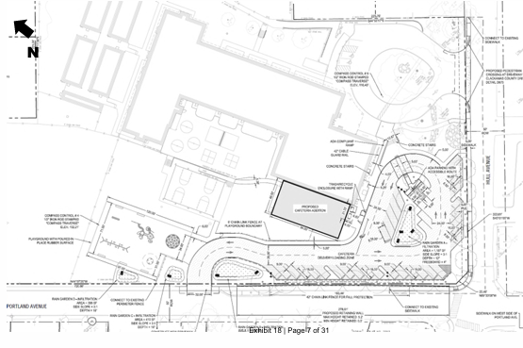
- Ms. McAlister provided relevant background information concerning the application, the County’s review, the reasons for the County’s initial recommendation of denial and its changed recommendation of approval. Ms. McAlister noted that the application was deemed complete on February 27, 2026, with the decision due by June 29, 2026. She also noted that the application is subject to Clackamas County Zoning and Development Ordinance (ZDO) Sections 202, 702, 1000-series, 1203 and 1307. Ms. McAlister pointed to ZDO Section 702 Open Space Management District (OSM) and noted that public schools are a Conditional Use in the OSM zone when associated with open space or recreational facilities. She pointed to Candy Lane Elementary School’s campus recreational facilities and open space, including outdoor play areas, covered play areas, and fields for recreation. Ms. McAlister also pointed to the application’s proposed improvements to the playground. She noted that the applicant submittal additional materials supplementing the application after the staff report was completed, including Exhibit 12, “Queuing Evaluation”, Exhibit 14, “Letter from OCSD”, and Exhibit 15, “Updated Landscape Plan”, that staff reviewed and considered in changing the recommendation to “approve subject to conditions.”
- Ms. McAlister provided discussion of the approval criteria in ZDO Section 1203 Conditional Uses, reviewing Section 1203.03(B) and related proposed findings that the capacity of the transportation system is adequate or will be made adequate with completion of improvements, noting that additional discussion of findings related to the capacity of the transportation system is also related to proposed findings concerning ZDO Section 1007, [Roads and Connectivity] later in her presentation. Ms. McAlister also provided discussion of the Conditional Uses approval criteria in Section 1203.03(C) and related proposed findings that the characteristics of the subject property are suitable for the proposed use considering size, shape, location, topography, existence of improvements and natural features. She noted that that proposed development is an expansion of an existing school established in 1969, that schools are common features in residential neighborhoods, that the proposed expansion appropriately uses the site as the proposed new cafeteria is adjacent to an existing building, and the proposal also includes redeveloping an existing parking area thus limiting expansion of impervious surfaces. Ms. McAlister pointed out that there are few natural features on the site, with two existing trees proposed for removal.
- Ms. McAlister provided discussion of the Conditional Uses approval criteria in Section 1203.03(D) and related proposed findings that the proposed use will not alter the character of the surrounding area in a manner that substantially limits, impairs or precludes the use of surrounding properties for the primary uses allowed in the zoning district(s) in which surrounding properties are located. She noted that existing structures on the site are set back from adjacent residential areas and screening is used to limit impacts of the parking areas. Ms. McAlister pointed to the applicant’s proposal and how the proposed addition is designed to be complimentary to the existing building, describing the proposed landscaping as thoughtfully designed. With respect to noise, Ms. McAlister reports that the expansion and site improvements are not anticipated to result in an increase of noise, aside from temporary impacts during construction. She reiterated that schools are common uses within residential neighborhoods and are generally compatible.
- Ms. McAlister stated that the proposed expansion of the cafeteria, updates to the playground area, and improvements to the parking area are not expected to negatively impact the surrounding area. She noted that while no additional vehicular traffic is expected, the applicant’s proposed changes to existing traffic patterns are the primary concerns of public comments. Ms. McAlister explained that, currently, the entrance to the school parking lot is on SE Hull Ave. and the exit is on SE Portland Ave., thus the current vehicle queue for parents accessing the parking lot extends onto SE Hull Ave. and all vehicles [except buses, which use a separate access] exit onto SE Portland Ave. She explained that staff reviewing the application found they needed additional information from the applicant prior to recommending approval of this application, due to the proposal to move the entrance and exit for the school parking lot to a single new access on SE Portland Ave. Ms. McAlister pointed to the concerns raised by public commenters in Exhibits 9, 10, and 16 (also consistent with concerns raised in Exhibit 20 submitted the day of the hearing) regarding relocating the access from SE Hull Avenue to SE Portland Avenue, including: increased congestion, bicyclist and pedestrian safety, adequate access, adequate improvements, and emergency access. She noted that planning staff found that additional information from the applicant was needed to address concerns related to ZDO Section 1203.03(D). Ms. McAlister noted the applicant provided additional information showing the proposed access changes resulted in increasing on-site vehicle space queuing and parking. She noted that the queuing study was based on observations from a single day, and that school staff were directing traffic. However, Ms. McAlister further reported that the applicant submitted a letter from the school district stating that school staff would continue to direct traffic, also noting that the proposal would create greater on-site capacity and asserting the proposal will result in faster pickup times and the additional space will mitigate any impacts by greatly reducing or eliminating vehicle queues extending onto the public roadway. She further reported that Clackamas County Engineering staff reviewed the applicant’s plans for concurrency and access and found no concerns and that Clackamas Fire District #1 found no concerns for Fire Access.
- Ms. McAlister pointed to the applicant’s additional submitted materials (Exhibits 12 and 14) addressing Planning staff concerns regarding congestion during drop-off and pick-up times. She pointed to the queuing evaluation submitted by the applicant reporting AM queuing [entering current access from SE Hull Ave.] was accommodated within the current parking lot aside from two brief instances. The study found PM queuing to be more extensive with 25 vehicles at 2pm and over 40 at 2:10pm, with queuing cleared by 2:21pm [exiting via current access located on SE Portland Ave.]. The study reported that school staff were directing traffic so the access was never blocked and the street could be safely crossed. (Exhibit 12) Ms. McAlister pointed to a letter submitted by the Oregon City School District confirming that staff will continue to direct traffic during drop-off and pick-up. (Exhibit 14)
- Ms. McAlister provided discussion of the approval criteria in the ZDO 1000-series, beginning with Section 1001, Development Standards. She noted that the elementary school is an institutional use and therefore all development standards for an institutional use must be met. Next, she pointed to Section 1005.02, Site Design, noting that the proposed structures are clustered onsite where feasible and a continuous, interconnected walkway system is proposed, noting that ZDO Subsections 1005.02(E) - 1005.02(L) are not applicable due to the nature of the development [use for an elementary school]. Ms. McAlister pointed to Section 1005.03, Building Design and provided discussion noting that the proposed cafeteria addition is designed to be complimentary with the existing architecture of the school. She noted that proposed Condition of Approval 11 (as amended) relates to ZDO Subsection 1005.03.B.1. requirements that public entries are sheltered by an overhang or other architectural feature must be met for entrances located on the north and south facade of the proposed addition. Ms. McAlister explains that users of the building, including students, staff, visitors, etc., are all considered members of the public. Ms. McAlister discussed a modification requested by the applicant for ZDO Subsection 1005.03(J), which requires screening of rooftop mechanical equipment, noting that the school’s existing rooftop equipment is not screened and observing that building setbacks and screening of the school grounds will also result in reduced visual impacts of mechanical equipment from the public ROW, recommending approving the proposed modification eliminating further screening requirements.
- Ms. McAlister pointed to Section 1007, Roads and Connectivity, and provided discussion reporting that the proposed development is not anticipated to result in increased trip generation. She pointed to proposed half-street improvements along SE Hull Ave., noting that Design Modification (RW026925) approves a 50-foot right-of-way, curb-tight sidewalk, and omission of stormwater management within the frontage, and installation of dual ADA curb ramps at the SE Hull Ave. and SE Portland Ave. intersection, explaining that SE Portland Ave. is currently improved with curb and sidewalk. Ms. McAlister pointed to Section 1009, Landscaping, and states that the applicant submitted a revised landscape plan that meets the requirements, discussing diversity, screening and buffering, and parking area elements, and providing a proposed related finding. With respect to Section 1021, Solid Waste and Recyclable Material Collection, Ms. McAlister reported that the Clackamas County Sustainability and Solid Waste division reviewed the submitted plans and determined that, although minor details were missing from the submittal, the proposal demonstrates that the standards of this section can be met with conditions. Ms. McAlister then provided discussion concerning recommended revisions to proposed Conditions of Approval.
Applicant
- Mercedes Serra of 3J Consulting appeared at the hearing on behalf of the applicant and discussed this application for a conditional use permit, providing information concerning the applicant’s request, the site description and surrounding land use, and discussion related to the proposal, also sharing a presentation (Exhibit 19). She explained that Candy Lane Elementary school was built on the 6.08-acre site in 1969, has an existing 52,100 SF building, and has access from both SE Hull Ave. and SE Portland Ave.
- Ms. Serra provided an overview of the applicant’s proposed improvements, including a 4,520 SF cafeteria/kitchen addition, parking lot reconfiguration, a new trash enclosure, a soft play area, hardscape resurfacing and paint, new pathways, and stormwater improvements. She noted that the proposed new cafeteria will accommodate more students per lunch period, with the new trash enclosure proposed adjacent to the proposed kitchen area. Ms. Serra shared portions of the applicant’s site plans showing areas designated for a new playground, resurfacing of play areas, and several proposed pedestrian pathways including a sidewalk along SE Hull Ave., new connections to SE Hull Ave., pathways connecting new proposed parking to play areas and building entry, and a larger student loading area. She also shared renderings of the proposed new cafeteria/kitchen showing various elevations and discussed how building materials were selected to compliment the existing structure with a combination of ground face block, metal panel, and metal siding/flashing.
- Ms. Serra shared a site plan showing proposed new stormwater management, including four new Low Impact Development Approach (LIDA) raingardens to treat the proposed impervious surface area (mainly parking and vehicle access). She also shared slides showing the existing school parking lot and showing how it accommodates 9-10 queuing vehicles on site and has 23 parking spaces, with parents instructed to queue their vehicles onto SE Hull Ave. for the afternoon pick up. Ms. Serra reported that a queuing analysis shows that morning drop-off queuing starts at 7:30am, with a peak drop-off time of 7:50am with all queuing contained on site and school starting at 7:55am. She further reported that afternoon pick-up queuing begins at 1:40pm, and by 2:00pm 25 vehicles are queued, including 10 in the parking lot, and when school ends at 2:10pm there are 40+ vehicles queuing in the parking lot and on SE Hull Ave., with the queue largely dispersed by 2:21pm. Ms. Serra explained that the proposed parking lot has a new driveway located further down SE Portland Ave. (away from the SE Hull Ave. intersection) due to student safety, grading, and intersection location. She stated that the proposed new configuration will accommodate 26 queuing vehicles on site and will have 35 parking spaces.
- Ms. Serra shared the following slides showing how the car line is currently configured (left) and the proposed new parking lot configuration (right) showing the existing drainage swale in the roadway near the proposed new access:
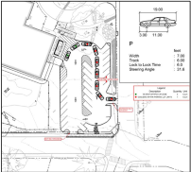
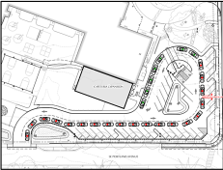
- Ms. Serra stated that the proposed new parking lot configuration is expected to eliminate the off-site queue during morning drop-off and to reduce the afternoon queuing time from 25 minutes to 15 minutes while reducing queuing on the street by 15 vehicles and reducing conflicts with buses and pedestrians on SE Hull Ave. Ms. Serra shared a slide and provided discussion of the applicant’s proposed new fire access plan, explaining that the proposed apparatus road meets access requirements, meets hose pull requirements, and has received preliminary review and approval by the Clackamas Fire District #1.
- Ms. Serra pointed to the County ZDO approval criteria for the proposed conditional use, providing discussion consistent with that presented by Ms. McAlister, noting that schools are a conditional use in the OSM district, that there is already a school on site, and the proposed improvements are accommodated on the existing site. She asserted that the proposal is consistent with applicable goals/policies of the County Comprehensive Plan pointing to 7.H.1’s policy to encourage maximum use of school facilities and the proposed expansion of the site. Ms. Serra pointed to the proposed findings provided with the applicant’s narrative and the County staff report and asserted that the proposal complies with all applicable requirements of the zoning district, special use requirements, and development standards. She addressed safety concerns by noting that the proposal will not result in an increase in traffic/trips, that new road improvements to SE Hull Ave. including sidewalks are proposed, that the proposed new access meets requirements of the Clackamas County Fire department and also meets County design standards, and the proposed new parking lot configuration will provide an additional 15 on-site queuing spaces and an additional 11 on-site parking spaces.
- Ms. Serra discussed various identified impacts of the proposal on the surrounding area, asserting that the proposed use will not alter the character of the surrounding area in a manner that substantially limits, impairs, or precludes the use of the surrounding properties for the primary use allowed in the zoning districts in which surrounding properties are located. She explained that with respect to identified impacts, Candy Lane Elementary is an existing school and the proposal results in no change to capacity, no change to events/activities, and will result in no new noise. With respect to traffic, she noted that the proposal will result in an increase in traffic entering the site via SE Portland Ave., and a decrease in traffic entering the site via SE Hull Ave. Ms. Serra noted identified potential impacts to fire access while vehicles are queuing on SE Portland Ave., and that headlights from vehicles exiting the proposed parking lot will be visible to residents along SE Portland Ave. She asserts that these anticipated impacts will not substantially limit residential use of surrounding properties.
- Ms. Serra pointed to design features that will lessen these identified potential impacts from the proposal, including more on-site capacity for pick-up/drop-off that will remove 15 cars from the street queue and increase on-site parking by 11 spaces. She also noted that vehicles currently queue on SE Hull Avenue, blocking the SE Portland Ave/SE Hull Ave intersection and conflicting with buses and pedestrians. Ms. Serra further noted that the pick-up time is between 2:00pm and 2:30pm, and not during peak travel times, and with 170 school days in a year these impacts will occur for only about 2% of the hours in a year. She also pointed to the proposal’s parking perimeter, noting it will be planted with 3-foot evergreen shrubs to screen headlights. She also pointed to the proposed new parking lot access on SE Portland Ave. and noted that it will provide a fire turnaround. Ms. Serra explained that fire department trucks will not back up more than 150 feet, and the proposed new driveway provides a turnaround and better fire access for SE Portland Ave., a dead-end road.
- Ms. Serra also addressed the pavement width of SE Portland Ave. and the existing County storm planter on SE Portland Ave., explaining that the pavement width narrows to 25.5 feet along the length of this storm planter, whereas the pavement width is 32 feet elsewhere. However, Ms. Serra states that SE Portland Ave. still meets local roadway standards and points out that the storm planter location is marked “No Parking”. She also points out that the distance between the two driveways on the opposite side of SE Portland Ave. is only 16 feet and does not accommodate a standard parked car without blocking driveways.
- Ms. Serra provided discussion of proposed conditions of approval and certain proposed requirements in the County’s staff report, particularly requesting removal of proposed Condition of Approval 11. This proposed Condition of Approval requires the applicant to submit plans showing sheltered entries of at least 4 ft. on the north and south façade of the building consistent with ZDO 1005.03(B)(1). Ms. Serra explained that the entries shown on the north and south façade of the proposed new structure will remain locked and accessible only by key card and only intended for use by students and members of the public as an exit and not as an entrance and therefore should not be considered a “public entry” subject to the requirement. This issue was discussed at the hearing and the Hearings Officer requested submission of a written proposal on the matter by the applicant and County staff. Ms. Serra requested approval of this application.
Members of the General Public
- Michael Harland is an interested citizen who resides on SE Portland Ave. across the street from Candy Lane Elementary school. Mr. Harland also submitted written comments in advance of the hearing expressing his concerns and asserting that the application should be denied. Mr. Harland’s family has owned their home on SE Portland Ave. for more than 50 years. He largely supports the proposed project and supports the underlying bond measure and most of the proposed improvements to the school. However, Mr. Harland is very concerned with the impacts to SE Portland Ave. from the proposed changes to the location of the access and configuration of the school parking lot that will result in traffic both entering and exiting the new parking lot from a point further down SE Portland Ave. He notes that there were no changes made to the existing constraints on SE Portland Ave., yet staff changed their recommendation from denial to approval. Mr. Harland requested that the record remain open after the hearing to allow for additional submissions.
- Traci Hayes is an interested citizen who resides on SE Portland Ave. across the street from Candy Lane Elementary school. Ms. Hayes is opposed to the application because of the proposed change to the location access, citing her agreement with the reasons given by Mr. Harland. Ms. Hayes expressed her concerns that approval of the proposal would interfere with emergency access to her property and the other homes along SE Portland Ave. She described seeing SE Hull Ave. backed up during school vehicle queuing and states that SE Hull Ave. is more spacious than SE Portland Ave. Ms. Hull also notes that SE Portland Ave. has no exit, expressing concerns that she will be unable to exit during school vehicle queueing.
Open Record Period Submissions
- Nate Purscelley is an interested citizen who resides on SE Portland Ave. across the street from the proposed relocated entrance/exit for Candy Lane Elementary school, with the drainage swale directly across from his driveway. Mr. Purscelley submitted a written statement during the open record period stating that the existing entrance on SE Hull Avenue does not significantly impact any residential driveways, whereas relocating the entrance to SE Portland Avenue will significantly impact four residential driveways and also impact five additional driveways further down the street. He describes the street as narrow, with cars going in opposite directions currently waiting for oncoming traffic. Mr. Purscelley contends this will become a significant issue if the proposal is approved and vehicles must pass the narrow bioswale to enter and exit the school’s new access. He is also concerned that the only street parking spot in front of his house will become a no-parking zone, noting it’s too narrow for high traffic/congestion and could impact emergency vehicle responses for himself and his neighbors. Mr. Purscelley asserts that approving the proposal will diminish neighborhood enjoyment for those walking and biking down their street and expresses concerns with distracted drivers leaving the school. Mr. Purscelley describes the street as in need of repair and believes it will worsen if the proposal is approved. Mr. Purscelley states that he and his wife voted for the bond and support this school where their four children attended but assert the proposal should be denied due to impacts from the proposed access change. (Exhibit 21)
- Linda Keith is an interested citizen who resides on SE Portland Ave. across the street from the proposed relocated entrance/exit for Candy Lane Elementary school and submitted a written statement during the open record period. Ms. Keith generally supports the school; however, she opposes this application due to the access change, describing traffic issues with the current configuration. Ms. Keith reports that parents will run stop signs and block the road while idling and talking to one another, with her neighbors often blocked from exiting due to vehicle queuing. Ms. Keith also expresses concerns with potential delays in emergency vehicles reaching her home and the other homes along SE Portland Ave. (Exhibit 22)
- The applicant’s consultant, Mercedes Serra, submitted a memorandum with proposed language for a condition of approval requiring parking lot monitoring. She also provided a detailed analysis of requirements for sheltered entries in support of the applicant’s request that proposed conditional of approval 11 requiring sheltered entries for entries at the north and south façade be removed. County Senior Planner Georgia McCallister submitted a memorandum also providing a detailed analysis of requirements for sheltered entries, recommending a revised condition of approval requiring sheltered entries on the north façade of the addition. (Exhibits 23, 24)
- Traci Hayes is an interested citizen who resides on SE Portland Ave. across the street from the proposed relocated entrance/exit for Candy Lane Elementary school, in the second to last house. Ms. Hayes submitted a written statement during the open record period further explaining her opposition to this application, disputing characterization of the queuing traffic at drop-off and pick-up times as a minor inconvenience and noting that these time periods are the same busy time periods she and other residents are taking their own children to other schools and returning home, or using the road for getting to work. Ms. Hayes points out this is the only route for residents of SE Portland Ave., asserting continued use of the entrance from SE Hull Ave. remains a better option as that location provides other options for traffic flow. Further, she contends that school staff have not been placed near the exit as described by the applicant, and despite her complaints parents of local school children come close to hitting her car when she’s leaving or returning. She also describes safety issues with the previous contractors working at the school property, particularly with speeding and use of SE Portland Ave. (Exhibit 25)
- Ms. Hayes also reports an incident when parents were blocking street access and one local resident of SE Portland Ave. who is an officer with Gladstone PD was unable to respond to an emergency. Ms. Hayes contends that approving this proposal will create an unsafe situation along SE Portland Ave. for residents in need of emergency services. She contends that the proposed changes to the access are not required to update the school and alternatives were not seriously considered. Ms. Hayes submitted the following photographs of SE Portland Ave. illustrating the narrowing of the street at the bioswale location. (Exhibit 25)
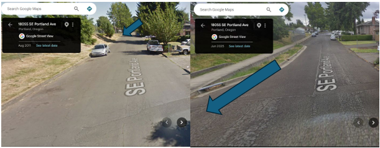
- Ryan Huddleston is a citizen who was on the zoom call for the public hearing. Mr. Huddleston submitted a written statement during the open-record period asserting that, while he supports the school, the proposal should be denied because of the associated changes to the street and parking lot for the school (Exhibit 26)
- Michael Harland submitted additional written comments during the open record period, reiterating many of the concerns he has raised in this matter. He points to statements made by staff such as describing the applicant’s queuing evaluation’s one day of observation by stating it “probably is a good sample of what it may look like”, and contends this does not meet the standard for a finding concerning the adequacy of the transportation system, further contending the submitted queuing evaluation is not a substitute for a traffic impact study. Mr. Harland also points to staff acknowledging that “queuing will likely always be an impact during these particular hours” and contends, therefore, the approval criterion under ZDO 102.03(D) that the “use will not alter the character of the surrounding area in a manner that substantially limits, impairs, or precludes the use of surrounding properties” is not met. (Exhibit 27)
- Mr. Harland notes that although staff confirmed Clackamas Fire “did not note concerns for fire access to the school specifically” this is not the same as emergency access to the nine SE Portland Avenue residences. He contends that the fire district has never evaluated whether their equipment can reach these homes while vehicles are queued for the proposed new school access, particularly through the rain garden chokepoint area. Mr. Harland further asserts that the fire district has not approved the school’s driveway as a turnaround for serving these SE Portland Ave. homes and therefore he contends it should not be suggested as a benefit for approving the proposal. Mr. Harland notes assertions by the applicant that there would be “no change to the events and activities at the school” and again points to the school district’s Strategic Plan’s goals to “promote the availability of district facilities, and the rental and reservation process” including “evening events, athletic events, facility rentals, and summer programs.” He contends that the proposed new cafeteria is the type of facility that would host such events. (Exhibit 27)
- Mr. Harland points to discussion at the hearing initiated by the Hearings Officer concerning proposing a condition of approval requiring that the school district provide traffic coordinators. He asserts that such a condition cannot ensure compliance required by the ZDO, pointing out that the requirement is different than other verifiable conditions such as requirements for construction of a sidewalk, making suggestions related to enforcement of any such condition. With respect to the concurrency exemption, Mr. Harland disputes the applicant’s assertion that there is “no increase in trips” and contends the concurrency exemption under ZDO 1007.07(B)(2) applies only where “an increase in motor vehicle traffic does not result.” He points to the proposed change in school access as an increase in traffic on SE Portland Ave. Mr. Harland also points to the comments opposed to this proposal and requests that the application be denied. The neighbors residing along SE Portland Ave. submitted a signed petition requesting that the application as submitted be denied. (Exhibits 27, 28)
- Mr. Harland also submitted a rebuttal statement responsive to materials submitted by the applicant during the open record period, specifically Exhibit 23, as well as the language the applicant proposed for the traffic coordinator condition. Mr. Harlan asserts the proposed language for any such condition is too vague and undefined and too limited in scope, essentially contending it is inadequate to address the impact of the applicant’s proposed access on SE Portland Ave. He references his arguments refuting the applicant’s testimony asserting there will be no change to events and activities at the school, reporting that at a May 11, 2026 school board meeting the District presented a draft Facility Use Fee Schedule listing Candy Lane Elementary’s cafeteria, gym, fields, classrooms, parking lot, and outside covered areas as available for rental to outside organizations. Mr. Harland notes that the school district already rents Candy Lane Elementary school facilities. (Exhibit 29)
- Mr. Harland contends that the applicant has not met its burden of proof and this proposal should be denied, noting also that the applicant did not respond to substantive arguments he made in his written arguments, including: (Exhibit 29)
- That the concurrency exemption does not apply
- That the queuing will likely always be an impact
- That the one-day queuing evaluation was only “probably” a good sample
- That the proposed parking access is not an approved fire apparatus turnaround
- That the proposed parking access would not address all homes on SE Portland Ave
- That the proposed language for a traffic coordinator condition is not enforceable
- That there will be changes to uses and events at the school
- The applicant’s consultant, Mercedes Serra of 3J Consulting, submitted a combined rebuttal statement and final written argument in support of the proposal, responding to the issues raised in writing and orally at the public hearing. Ms. Serra discusses testimony and written arguments opposing the proposal, noting opposition primarily relates to the proposed relocation of the entrance driveway from SE Hull Avenue to SE Portland Avenue. She noted that opposition to the proposal pointed to several ZDO requirements, including internal circulation requirements in ZDO 702, parking lot design requirements in ZDO 1015, stormwater treatment requirements in ZDO 1006, transportation standards and requirements in ZDO 1007, and the conditional use criteria in ZDO 1203, and provided responses in each area. (Exhibit 30)
- Ms. Serra asserts that the school’s existing parent and staff lot does not fully accommodate the school’s needs. She points out that the existing parking lot has 24 spaces and queuing space for 9-10 cars, with a loading area that accommodates 2 cars. Ms. Serra further points out that the entry to the current parking lot is located on SE Hull Avenue within 60 feet of the intersection of SE Hull Avenue and SE Portland Avenue. She notes that the parking lot currently exits onto SE Portland Avenue approximately 50 feet from the intersection of SE Hull Avenue and SE Portland Avenue. Ms. Serra discussed the proposal to consolidate the entrance and exit to a single driveway on SE Portland Avenue, with a new single access on SE Portland Avenue located 312 feet from the from the intersection of SE Hull Avenue and SE Portland Avenue. She also points to the proposed new internal circulation system, stating it will provide queuing for 25 cars on site and parking for 35 cars. Ms. Serra also states that the proposed parent loading area will have two lanes, allowing for cars to exit the queuing lane and parking stalls once students are picked up, and leave the site. In sum, she asserts that the proposed new parking lot will provide on-site queuing space, additional loading areas, additional on-site parking, two one-way travel lanes, and will reduce conflicts with nearby intersections. Ms. Serra asserts that the proposal provides an efficient internal circulation system that meets the requirements of ZDO 702.05(B), pointing to Exhibit 6, Page 52. (Exhibit 30)
- Ms. Serra addressed concerns regarding increased traffic on SE Portland Avenue causing an increase in the types of pollutants vehicle traffic deposits on the road and violations of ZDO 1006.06(D)(3) and (4) because of the increase in off-site traffic on SE Portland Avenue. Ms. Serra points out that the north half of SE Portland Avenue is treated by a storm planter in the public right-of-way before the drainage is piped further into the public system. She notes that stormwater detention treatment and detention requirements are calculated based on the total impervious surface of the facility and not on a per vehicle calculation, pointing out that the proposed development will not increase the impervious surface on SE Portland Avenue. Ms. Serra also points out the existing parking lot currently contributes run-off to the existing stormwater system in SE Portland Avenue. She notes that the proposed new parking lot on the school site will be treated with a new on-site storm facility and asserts this will result in reducing the total impervious area that the existing storm planter on SE Portland Avenue will treat. (Exhibit 30)
- Ms. Serra addressed concerns regarding off-street parking and the requirements of ZDO 1015, pointing out the existing parking lot has an entry-only driveway approximately 60 feet east of the intersection of SE Hull Ave. with SE Portland Ave. She notes that approximately 10 vehicles can queue on site while waiting to pick up students before exiting onto SE Portland Ave. Ms. Serra also notes that the exit-only driveway on SE Portland Avenue is approximately 50 feet from the crosswalk on SE Portland Ave. and accommodates two vehicles between the driveway and the stop sign. She points to the applicant’s queuing analysis and notes that during the morning drop-off period between 7:30 am and the bell at 7:55 am vehicle queuing is generally contained within the existing parking lot. Ms. Serra references comments by several neighbors that the morning drop-off period occurs during the morning peak hour while they are leaving for work or school drop-off. She responds by asserting that the proposal will result in all morning queuing occurring on-site and not on the surrounding streets, and vehicles exiting the site will continue to exit as they currently do onto SE Portland Ave. (Exhibit 30)
Ms. Serra also points to the afternoon pick-up period, noting that parents begin to queue at approximately 1:40 pm with approximately 25 vehicles in the pick-up queue by 2:00 pm, with 10 vehicles in the parking lot and 15 vehicles queued east of the school on the north side of SE Hull Ave. She notes that at the peak of the queue, approximately 40 vehicles were queued, with 10 vehicles in the parking lot and 30 queued east of the school on the north side of SE Hull Ave. in the public roadway. Ms. Serra noted that once children were released the queue began to disperse and by 2:21 pm parents were able to drive directly into the parking lot to pick up their children. She points out that the proposed new parking lot has on-site queuing capacity for 25 vehicles and the additional on-site queuing will continue to accommodate all morning queuing. Ms. Serra asserts that with the proposed expanded parking lot afternoon queuing on the street will occur between 2:10 pm and 2:21 pm, with a peak of approximately 15 vehicles. She stated that the expected result of the new parking lot design is that on-street queuing will be reduced from 21 minutes to 11 minutes and the vehicles queuing on the street will be reduced from 30 to 15, a reduction of 50%. Ms. Serra asserts that the relocation of the parking lot entrance will increase capacity on the site provided by the parking lot and reduce the number of vehicles queuing on the street creating congestion during the afternoon pick-up period, and references the chart shown below of data from the applicant’s queuing evaluation: (Exhibit 30)
Time of Day Existing Pick-Up Queue (Cars) Proposed Pick-Up Queue (Cars) Parking Lot Street Parking Lot Street 1:40 PM 1 0 1 0 2 PM 10 15 25 0 2:10 PM 10 30 25 15 2:21 PM 10 0 10 0 - Ms. Serra addressed arguments regarding the conditional use criteria in ZDO 1203.03 (C-E), asserting the application materials provide detailed information on the expected impact of the relocation of the parking lot access and addressing several specific criteria. Ms. Serra points to ZDO 1203.03.C’s requirements that the proposed use complies with ZDO Subsection 1007.07, that the safety of the transportation system is adequate to serve the proposed use. She addresses public testimony and written comments asserting that SE Portland Avenue is not adequate to accommodate the additional traffic generated by the proposed consolidation of the school’s entrance and exit access. Ms. Serra notes that while the proposal would change the entry to the parking lot, no additional traffic is expected due to the proposed cafeteria addition and related parking lot changes, and therefore a traffic study was not required by County Engineering. (Exhibits 2, 6, 11, 30)
- Ms. Serra refers to the school district’s November 6, 2025 pre-application conference with the County, pointing to County Engineering Pre-application conference notes citing frontage improvements to SE Hull Ave. as required based on the increase of square footage, increase in parking, and previous approval of modular classrooms on the site. She also points to the County Engineering notes stating that while SE Portland Ave. does not include a standard landscape strip the frontage along the school property is adequate and both SE Hull Ave. and SE Portland Ave. are classified as Local Roads within the County’s Transportation System Plan (TSP). Ms. Serra notes that the school district submitted and received approval of a roadway design modification to maintain the current 50-foot-wide right-of-way and provide a 5-foot-wide sidewalk without a landscape strip, based on the limited space in the existing right-of-way, as the roadway is not centered in the right-of-way. Ms. Serra notes that the paved width of the travel lanes on SE Hull Ave. range between 27 feet and 34 feet. She notes that, by comparison, the pavement width on Portland Ave. is approximately 32 feet wide with a 54-foot length section that tapers to approximately 26 feet where the County installed a stormwater facility noting also this facility is marked with no parking signs. Ms. Serra points out that the width and improvements of SE Portland Ave. and SE Hull Ave. are similar and both meet County local road standards and the minimum design standards in ZDO 1007.07. She further points out that the County’s Engineering staff found that the proposed roadway and internal circulation will continue to adequately serve the proposed development and will satisfy the requirements of ZDO Section 1007.07. (Exhibits 2, 11, 30)
- Ms. Serra references several submitted comments stating that SE Portland Ave. is not designed for through-traffic and is a dead-end road, and points to Comprehensive Plan Goal 5.Q.6 that developments should be designed to place driveway accesses on streets with the lowest functional classification or the lowest traffic volume, pointing out that while SE Portland Ave. and SE Hull Ave. are both local roads, this section of SE Portland Ave. has the lowest traffic volume. Further, she asserts that consolidating the access will reduce vehicle conflict points to this one driveway that will meet the County’s access management standards, whereas the existing driveways are both too close to the intersection of SE Hull Ave. with SE Portland Ave. and lack the required intersection spacing. (Exhibits 1, 11, 30)
- Ms. Serra addressed arguments regarding the conditional use criteria in ZDO 1203.03.D, requiring that the proposed use will not alter the character of the surrounding area in a manner that substantially limits, impairs, or precludes the use of surrounding properties for the primary uses allowed in the zoning district(s) in which surrounding properties are located. She notes that Candy Lane Elementary has been in the neighborhood for 57 years and there is no proposed change to the enrollment or capacity of the school, no change to the events and activities at the school, and no expected change to noise. Ms. Serra addressed concerns with vehicle headlights by asserting the additional landscaping will provide screening of headlights within the parking lot. Ms. Serra points out that SE Portland Ave. meets the County’s design requirements for a local road, and that the County’s Engineering staff found SE Portland Ave. adequate to accommodate the proposed parking lot entrance relocation. Further, she points to the proposed parking lot as providing additional parking and on-site queuing that will reduce the duration and amount of off-site queuing that currently impacts the neighborhood. Ms. Serra also reiterates her point that shifting the access to the west increases separation from the intersection of SE Hull Avenue and SE Portland Avenue, improving overall access spacing. (Exhibits 1, 6, 11, 12, 19, 30)
- Ms. Serra points out that Clackamas Fire District #1 provided preliminary approval of the proposal, showing that the it meets access and hose pull requirements , including the proposed new access on SE Portland Avenue past where the stormwater facility is located. She responded to concerns with respect to vehicles blocking SE Portland Avenue and not moving to accommodate emergency vehicles by pointing out that it is Oregon law that vehicles must move over. Ms. Serra contends that, while SE Portland Ave. is a dead-end road, parking is available on both sides of the street and, if necessary, in private driveways to accommodate emergency vehicles. (Exhibits 1, 19, 30)
- With respect to concerns regarding conflicts with vehicles and pedestrians and the safety of pedestrians and bicyclists on SE Portland Avenue, Ms. Serra contends the consolidation of the vehicle entrance and exit to a single access driveway will reduce such conflicts as the currently separate driveways are each located within 50-60 feet of the intersection of SE Hull Avenue with SE Portland Avenue. Ms. Serra also points out that the proposal includes a new sidewalk along SE Hull Ave. that will connect with the existing sidewalk along SE Portland Ave. and provide a contiguous path between the school, the parking lot, and on-site play areas, and the on-site pedestrian network will connect the public sidewalks with the building entrance, parking lot, and student loading area and other areas. Ms. Serra points out that the proposed new parking lot will accommodate more vehicles and will separate pedestrian circulation from vehicles with a raised curb. She acknowledges that any development of the school property has a potential impact of surrounding properties but points out the code does not require that a conditional use has no impact. Rather, Ms. Serra notes that a proposed use must not alter the character of the surrounding area in a manner that substantially limits, impairs, or precludes the surrounding properties from the primary uses allowed in the zoning district. Ms. Serra points out that the surrounding properties are zoned R-10 residential and generally intended for single-family homes, contending that the proposed driveway relocation will not substantially limit, impair or preclude the surrounding properties from their primary residential uses. (Exhibits 1, 19, 30)
- Ms. Serra addressed assertions that the proposal violates applicable goals and policies of the County’s Comprehensive Plan. Ms. Serra points to Comprehensive Plan policy 4.R.6 direction to ensure adequate provisions for schools, churches, and recreational facilities which are integral parts of all residential neighborhoods, noting that siting of these facilities is subject to conditions ensuring adequate design and safety, particularly with regard to vehicular and pedestrian access. Ms. Serra points out that the applicant’s consultants, County Engineering staff, County Planning staff, and the Clackamas County Fire District #1 have found that the proposed public facilities and on-site design are adequately designed with regard to vehicular and pedestrian access. Further, she points to several conditions of approval proposed in the staff report related to ensuring adequate design and safety of vehicles and pedestrians. With respect to Comprehensive Plan policy 5.E.4’s direction to support programs that work with schools to identify safe bicycle and pedestrian routes to connect neighborhoods and schools, and to seek partnerships and funding to support improvement of these routes, Ms. Serra notes again that the new sidewalk along SE Hull Avenue will provide a safe pedestrian facility directly connecting to the existing sidewalk on SE Portland Ave., enhancing overall pedestrian safety in the area. (Exhibits 1, 19, 30)
- Ms. Serra points to Comprehensive Plan policy 5.Q.6’s direction that developments should be designed to place driveway accesses on streets with the lowest functional classification or the lowest traffic volume. She reiterates her points that both SE Portland Ave. and SE Hull Ave. are classified as Local Roads within the County’s TSP, SE Portland Ave. has a lower traffic volume than SE Hull Ave., and SE Portland Ave. is an appropriate location for driveway access. Ms. Serra points to Comprehensive Plan policy 5.R.6’s direction that new development accommodate on-site traffic circulation within the boundaries of the site, not by circulating vehicles on and off the site through multiple access points using the public road system, and that internal circulation plans should avoid relying on “backing out” maneuvers for new driveways onto all rural arterials and collectors. Ms. Serra reiterates her discussion that the proposed driveway will provide on-site capacity for 15 additional vehicles, asserting it will result in an overall reduction of off-site queuing. She points out that queuing is expected to occur for only 10 minutes during the afternoon pick-up period, asserting that the proposed parking lot has been designed to reduce access points to a single consolidated driveway. (Exhibits 11, 12, 30)
- Ms. Serra points to Comprehensive Plan policy 7.F.1’s direction to facilitate coordination between fire districts and developers prior to approval of future development to ensure appropriate levels of fire safety, pointing again to the Clackamas County Fire District #1’s preliminary notes at the pre-application conference meeting, and the preliminary review and approval of the applicant’s site plan. Ms. Serra asserts that the applicant has provided detailed analysis of the proposed development and the adequacy of the surrounding transportation system by qualified, professional and licensed land use planners, architects, transportation, civil, and geotechnical engineers and school district staff. Ms. Serra further asserts that the proposal will enhance pedestrian and bicyclist safety for students and the public by including public sidewalk, new on-site pedestrian facilities, and overall reduction in vehicle conflict points, and requests approval of the application (Exhibits 19, 30).
B. FINDINGS AND DISCUSSION
The evidence presented is reliable, probative and substantial evidence upon which to base a determination in these matters. This application is subject to the standards and criteria of Clackamas County Zoning and Development Ordinance (ZDO) Section 1203. This application is being processed as a Type III Permit, pursuant to Section 1307. A Type III Permit is quasi-judicial in nature and involves land use actions governed by standards and approval criteria that require the use of discretion and judgment. The issues associated with the land use action may be complex and the impacts significant, and conditions of approval may be imposed to mitigate the impacts and ensure compliance with this Ordinance and the Comprehensive Plan. The Type III procedure is a quasi-judicial review process where the review authority receives testimony, reviews the application for conformance with the applicable standards and approval criteria, and issues a decision.
This application is subject to Clackamas County Zoning and Development Ordinance (ZDO) Section(s) 202, 702, 1000-series, 1203 and 1307; and the Comprehensive Plan. Clackamas County Planning and Zoning Staff reviewed these Sections of the ZDO and Comprehensive Plan in conjunction with this proposal and submitted proposed findings and conclusions. These proposed findings were reviewed and adopted and/or modified by the Hearings Officer as denoted by boldface type in italics:
BACKGROUND INFORMATION, SITE AND AREA DESCRIPTION AND SERVICES
Background/Overview of Applicant’s Proposal:
Candy Lane Elementary was first established in 1968 under a Conditional Use Permit, CU44-68. At the time of approval, the property was zoned R10. Following the construction of the school the site was rezoned OSM. Subsequent approvals on the site include an alteration of non-conforming use (Z0115-14-E) and Open Space Review (Z0116-14-OSR) for an expansion of the community garden in 2014, and a Conditional Use for the addition of four modular classrooms in 2022 (Z0124-22). The project site is developed with the main Candy Lane Elementary School building, four modular classrooms, a modular restroom, a bus loop with limited parking, a parking area taking access off SE Hull Avenue and exiting to SE Portland Avenue, a playground, a covered play area, an uncovered hardscaped play area, open space, and onsite walkways.
The applicant proposes to construct a 4,520 square foot cafeteria addition to the existing Candy Lane Elementary School, reconfiguration of the existing parking lot including driveway relocation, a new trash enclosure, relocation of the covered play area, new stormwater facilities, landscaping improvements, and street improvements along SE Hull Avenue. The proposed improvements are not anticipated to result in additional traffic. However, the relocation of the driveway entrance from SE Hull Avenue to SE Portland Avenue will have an impact on traffic patterns and the queuing during drop-off and pick-up at the school. The lot coverage of the proposed addition exceeds 25% of the original lot coverage approval precluding the development from being reviewed as a Modification to the original approval and requiring a new Conditional Use permit. Additionally, the relocation of the access requires Conditional Use review.
ZDO Section 702, Open Space Management (OSM) District
2A. Subsection 702.02, 702.03, and 702.05 Primary, Accessory, and Conditional Uses:
Finding: The subject property is located in the OSM zoning district. The proposed use is an addition to a public school, which is a Conditional Use in the zoning district “when associated with open space or recreational facilities”.
The Candy Lane Elementary School site includes outdoor play areas, covered play areas, and fields for recreation, some of which will be altered as a part of this application. None of the recreation facilities are proposed to be removed as a part of the application. "Public and private outdoor recreation facilities” are permitted as primary uses; play equipment and ball fields are included as examples of allowed primary uses in ZDO Section 702.03. Therefore, the school is on a property that has a recreational facility. Therefore, the proposed use is allowed with an approved conditional use permit. These standards are met.
2B. Subsection 702.02 Development Standards:
Development in the OSM District is subject to the applicable provisions of Sections 1000, Development Standards, and 1100, Development Review Process. In addition, improvements shall comply with the following standards:
- Landscape the site to produce a setting appropriate to its function.
- Provide an efficient internal circulation system and facilities layout plan.
- Maximize access for pedestrians, bicyclists, transit riders, and people with disabilities in active recreation areas.
- Provide conveniences for users with disabilities.
- In the case of parks, conform to the classifications and standards in Comprehensive Plan Table 9-1.
- Locate principal and accessory buildings a minimum of 10 feet from any lot in a residential zoning district.
- Community and Design Plans: Development within a Community or Design Plan area identified in Chapter 10, Community Plans and Design Plans, of the Comprehensive Plan shall comply with the specific policies and standards for the adopted Community or Design Plan.
Finding: Applicable standards of ZDO Section 1000 for institutional uses are provided in the County’s staff report. Comprehensive Plan Map IV-6: North Urban Area Land Use Plan Map, identifies the project site as a Public and Community Use Open Space (PCU). However, the regulations of ZDO Section 1100 are not applicable, because the project does not have development impacting any of the open space resources described in ZDO Section 1011.
The County’s staff report incorporates the findings provided by the applicant in their submitted project narrative. There is not a minimum requirement for the percent of development site landscaping in the OSM zone. Instead, the requirement is that landscaping be designed appropriately for the function of the site. The landscape plan included on Sheet L7.12 of Exhibit 7 shows landscaping incorporated throughout the parking area, adjacent to the covered play area, and within stormwater facilities. The majority of the site will remain turf to support the play activities of students. Trees are shown planted along the frontage of SE Hull Avenue and SE Portland Avenue, buffering the proposed parking area from offsite view and providing an attractive and inviting atmosphere, and the applicant proposes retention of existing trees where possible. The proposed landscaping is appropriate for the function of the site.
he proposed changes to the internal circulation system are described by staff and the applicant as critical components of the application, and these proposed changes are also the core controversy for the Jennings Lodge CPO and local residents residing on SE Portland Avenue across from the school. The concerns raised by members of the public opposed to this component of the application are not relevant to the development standards of ZDO Section 702 but are discussed and addressed in the relevant sections.
The applicant proposes to alter the parking area, which also serves as the drop-off and pick-up loop, adding additional parking and consolidating the access to SE Portland Ave., thus removing the current access from SE Hull Ave. The applicant submitted an April 22, 2026 Queuing Evaluation stamped by Jennifer Danziger, PE, of AKS Engineering reviewing the current parking lot design and providing an explanation concerning how the proposed redesign will better accommodate the school’s needs. Ms. Danziger notes that the current parking lot provides 23 parking spaces with no ADA spaces and room on-site for 9-10 queued vehicles, including 2-3 spaces for parent vehicles in the drop-off/pick-up zone. Ms. Danziger observed that with this existing configuration vehicle queuing was mostly accommodated on-site during the approximately 25 minute morning drop-off period, with two brief 5-15 second exceptions when queuing extended off-site and onto SE Hull Ave. Ms. Danziger also provided her observation that under the existing configuration the approximately 45 minute afternoon pick-up period resulted in 40+ vehicles queued when the last bell rang for dismissal at 2:10 pm (including the 10 vehicles in the parking lot) with the vehicles extending up the hill along the north side of SE Hull Ave., with the queue largely dispersed by 2:21 pm and no longer extending into the public roadway. Further, Ms. Danziger noted that two people associated with the school directed the afternoon pick-up queue, providing a safe crossing from the school to the church parking lot across SE Hull Ave. and ensuring that the access was never blocked and parents and children could safely and visibly cross the street. These observations are consistent with those reported by Mr. Harland, who reported counting 37 vehicles in the afternoon pick-up queue with the queue stretching from the school’s parking lot entrance onto SE Hull Ave. a significant distance. Mr. Harland also reported use of the church parking lot by parents dropping off or picking up their children, and the presence of school safety crossing staff directing the school traffic.
The applicant asserts that the proposed changes to the parking/drop-off and pick-up area will increase the size of the school parking lot to accommodate 35 on-site parking spaces (including two ADA spaces) and will accommodate 26 queuing vehicles on-site with room for 7 parent vehicles in the drop off/pick up zone. Further, the County’s Planner, Ms. McAlister and the County’s Consultant, Ms. Serra, both point to the proposed configuration with its additional space in the pick-up zone as greatly increasing the speed at which the car line queue will function, projecting significantly reducing the afternoon queuing time by as much as 50%.
The total traffic volume through the SE Hull Ave. and SE Portland Ave. intersection will not change with the proposed new parking lot and access configuration. However, as noted by the Jennings Lodge CPO as well as Mr. Harland and the other residents of SE Portland Ave. concerned with this proposal, all school traffic except for buses will enter and exit the school parking lot via the proposed new single access driveway on SE Portland Ave., effectively doubling the number of cars associated with the school that will drive on this section of SE Portland Ave. and increasing the length of road these cars will travel from the current exit, located perhaps 50 feet from the intersection with SE Hull Ave. to a new access located more than 300 feet from this intersection.
In addition to changes to the site’s vehicle circulation, the proposed site improvements include alterations to the onsite pedestrian walkway system. Walkways extend from the entrance of the school to the parking area, the play areas, and SE Hull Avenue which has sidewalks connecting to SE Portland Avenue, providing adequate and safe site circulation for pedestrians. The layout of facilities on the site efficiently serves the needs of students, parents, visitors, and employees of Candy Lane Elementary, which complies with the applicable standards in Section 1000. Further, Ms. Serra points out that shifting the access on SE Portland Avenue to the west increases separation from the intersection of SE Hull Avenue and SE Portland Avenue, improving overall access spacing and further reducing vehicle and pedestrian conflicts.
702.06(C) requires developments to maximize access for pedestrians, bicyclists, transit riders, and people with disabilities in active recreation areas. The site is designed with pedestrian access in mind, as described above. Improvements along SE Hull Avenue will ensure convenient access for bicyclists and transit riders as well. Improvements to the site include a new ADA accessible soft-scape play structure for the convenient use of users with disabilities. The upgraded interconnected walkway system and improvements along SE Hull Avenue will be ADA compliant. ADA parking is provided on site as well, whereas the existing parking lot does not provide ADA parking. The site has been designed for equal access to users of all abilities, to the extent possible. By improving the frontage along SE Hull Avenue, providing for an improved internal circulation system and facilities layout plan, providing for better pedestrian and bicycle circulation, and providing for conditions ensuring adequate design and safety, the proposal satisfies County Comprehensive Plan Goals 4.R.6. and 5.E.4.
The proposed use is not a park and therefore not subject to the classifications and standards in Comprehensive Plan Table 9-1. ZDO 702.06(F) requires the development to locate principal and accessory buildings a minimum of 10 feet from any lot in a residential zoning district. The school is surrounded on all sides by residentially zoned land. SE Portland Avenue separates the school from adjacent residential development to the south by more than 50’. The cafeteria addition is setback over 100’ from SE Hull Avenue, providing sufficient separation from adjacent residential land.
The property is not within a Community Plan Area identified in Comprehensive Plan Chapter 10 are being met.
These standards are met or can be met with conditions.
ZDO Section 1001, General Provisions
Section 1001.03 and Table 1001-1 establishes the applicability of Section 1000 for Institutional uses. A school is an “institutional use”. Applicable sections are reviewed below.
ZDO Section 1002, Protection of Natural Features
Section 1002 addresses the protection of various natural features including hillsides, the excessive removal of trees prior to development, the protection of trees and wooded areas through development, river and stream corridors, the winter ranges of deer and elk populations, certain open spaces near Mount Hood, significant natural areas, and significant landforms and vegetation.
Finding: The County’s staff report incorporates the findings provided by the applicant. The site is generally flat and does not contain any slopes of 20% or greater. The subject property is within the Metropolitan Service District Boundary or the Portland Metropolitan Urban Growth Boundary and so the excessive tree removal standards apply. Staff reported there is no evidence submitted indicating that excessive tree removal has occurred on site in the last five years. The property is not within 100 feet of a resource identified on Comprehensive Plan Map X-MH-2. There are no designated Type F river and stream corridors on the subject property. The property is located outside of the deer and elk winter range, as identified on Comprehensive Plan Map III-2. One tree is proposed for removal and two trees adjacent to construction are proposed for retention, as shown on Sheet L7.12 of Exhibit 7. Tree protection fencing is proposed for installation surrounding the two trees to be retained to provide protection during construction. The standards of Section 1002, as applicable, are met.
ZDO Section 1003 and 1004,Hazards to Safety and Historic Preservation
Section 1003 addresses various hazards to safety including flood, soils, fire, and mass movement areas. Section 1004 addresses standards related to historic preservation.
Finding: The property is not within a mass movement hazard area and does not include soil hazards, as identified on the State Department of Geology and Mineral Industries Bulletin 99 maps. The property is not within the flood hazard area and was not identified as an area of significant fire hazard on the repealed State wildfire maps (reference Senate Bill 83). As applicable, these standards are met.
ZDO Section 1005, Site and Building Design
Section 1005 addresses the development of sites and design of buildings so as to efficiently utilize land, create lively, safe, and walkable centers, support the use of non-auto modes of transportation, reduce impact of development of natural features, utilize opportunities arising from a site’s configuration, design illumination so dark skies are maintained when possible and accommodate the needs of users of developments. It applies to institutional, commercial, and industrial development; multifamily dwellings; and developments of more than one, two- or three-family dwelling.
6A. Subsection 1005.02 – General Site Design Standardsestablishes standards for the sites of commercial, industrial, and multifamily developments and addresses standards for the placement and orientation of buildings, on-site pedestrian circulation, the placement and orientation of building entrances, and other use- and zone-specific standards.
Finding: The County’s staff report incorporates the findings made by the applicant in their written narrative. Subsections 1005.02(F) through 1005.02(F) are not applicable to the proposed development as the parking area is less than three acres, the development is not a new building, and the project site is within the OSM zoning district. Due to the fact the proposal is an addition to an existing building, meeting many of the building orientation standards within ZDO Subsection 1005.02 are not feasible. Constraints that hinder meeting the standards are addressed within the report findings and the applicant’s narrative. No new buildings are proposed onsite. However, the existing buildings and proposed covered play area are clustered to the extent practical on the site. The existing school is not oriented such that the longest building elevation is within 20 degrees of true south. Aside from the requirement for all buildings to be at least 10’ from adjacent residentially zoned properties, there are no minimum or maximum setback requirements to meet.
Proposed site improvements include modifications to the existing interconnected walkway system, as shown on Sheet C2.00 of Exhibit 7 and the applicant’s submitted Sidewalk Connectivity Plan included in Exhibit 7. A minimum of 5’ wide concrete walkways are proposed extending from the main school entrance to the proposed parking area, play areas, and the proposed sidewalk along SE Hull Avenue, which connects to the existing sidewalk along SE Portland Avenue. A walkway is also provided from the cafeteria to the play area and the rest of the interconnected walkway system. A raised crosswalk is proposed from the walkway to the parking in the center of the parking area for safe pedestrian crossing. All proposed walkways will be illuminated.
The project site is located within the UGB, and therefore Subsection 1005.02(E), which requires that a minimum of 50% of the street frontage of a development are sited at the minimum front setback line, would typically apply. However, the OSM zoning district does not have a true “minimum setback”. Instead, buildings are required to be sited at least 10’ from adjacent residentially zoned properties. It would not be possible, or practical, to site the cafeteria 10’ from the adjacent residentially zoned parcels, therefore Subsection 1005.02(E) does not apply. As applicable, the standards of Subsection 1005.02 are met.
6B. Subsection 1005.03 – Building Design provides standards for building facades, entrances roof design, exterior building materials, the screening of mechanical equipment, and other use- and zone-specific standards.
Finding: The County’s staff report incorporates the findings made by the applicant in their written narrative and concludes that the proposed design meets the standards of this subsection, as practical. The applicant contends that the requirements for building entries do not apply as no changes to main building entries are proposed. County staff disagree with that interpretation. The cafeteria addition does not include the primary entrance for the school. However, the cafeteria will include exits visible from the public ROW and therefore County staff assert façade enhancement requirements apply. The entries on the north and south portion of the addition are not shown with facades on the applicant’s plans, and County staff assert in the staff report that these entries should be made to comply with this section as they will be used by students and staff regularly. Staff report that the County has consistently interpreted that Subsection 1005.03(B)(1) applies to entries such as these. While the entries are clearly defined and highly visible, the submitted architectural plans do not show an overhang or architectural feature with a depth of at least four feet to shelter the doorways as required. No public entrances are proposed along the west façade. Staff initially recommended a condition of approval requiring the applicant to submit plans at the time of building permits showing sheltered entries on both the north and south façade. The applicant asserts that these entries are not public because they are always locked and are accessed only by keycard entry for staff, requesting deletion of the proposed condition of approval requiring sheltered entries on the north and south façade of the proposed cafeteria addition. Essentially, all entries except the main entrance at the front of the school are kept locked in this manner, and this will be the case for new entries for the proposed cafeteria as well. County staff, however, note that the doors on the north façade of the proposed cafeteria addition will be used as exits for students and teachers at recess time. This issue was discussed at the hearing, and the Hearing Officer requested that County staff and the applicant provide a written statement addressing this issue further.
County staff submitted a memo noting that the doors of all schools within the Oregon City School District are kept locked as a matter of safety. The staff memo reviews the north and south façade doors for the proposed addition and agrees with the applicant that the door on the south façade of the proposed cafeteria addition will only be used by staff for service purposes and therefore is not a public entrance. The south entry is in the kitchen for the proposed cafeteria addition, exiting to a location adjacent to the proposed new parking lot and next to the proposed new waste enclosure. However, the staff memo contends that the doors for the north façade remain public entrances, even though locked, as they will be used as an exit for students and teachers at recess time. The staff memo contends that while the doors for the north façade will not be a primary entry for the school, these doors remain public entries used by students and staff for access to primary use areas of the development, which includes access from the cafeteria to the recess area. Staff describe the primary concern as ensuring that those utilizing the doors are adequately sheltered and that the interior of the building is protected from the elements in weather events. As also pointed out by staff, this is a public-school building serving students, who are members of the public. I also note that the applicant’s submitted site plan for the proposed cafeteria addition shows an outside walkway connecting the two north-facing doors to the playground areas. Further, I note that this public building is not limited to only serving elementary students during school hours but is also available for other activities and uses with the proposed cafeteria’s north façade doors providing access not only between the outside playground areas and the cafeteria, but also through the cafeteria to the school’s gymnasium.
The applicant disagrees with the interpretation of the requirements of this section by County staff, asserting that although the doors on the north of the building will provide access from the cafeteria to the playground, these doors will only be used for exiting as students will enter through other doors at the end of recess. Further, the applicant contends these entries should not be made more visible as they are not intended to provide public access and making them appear like public entries does not align with the school’s general safety plan to direct all visitor traffic to the primary secure entry of the school. I reviewed and considered the arguments submitted by both County staff and the applicant on this issue.
I agree that a school is a unique type of public building that, while public, must ensure that all visitors and volunteers are appropriately screened and provided with identification badges. This requires ensuring that all visitors and volunteers are appropriately directed to the main entrance for the building and are not encouraged by a sheltering façade to approach another door and seek to enter the building at that location, even if the door is locked. However, I note that although the north and south entries to the proposed cafeteria addition will be visible to drivers entering the parking lot through the proposed new access, a 6-foot chain link fence will separate the north entries from the parking area. Thus, even with sheltered entries, these doors will not appear to be primary entries for the school. There is no dispute that the south entry will maintain the appearance of a service entry as no shelter will be required for that entry. I agree with County staff that although the doors for the north façade will not be primary entries for the school, these doors remain public entries used by students, staff, and other members of the public for access to primary use areas of the development, which includes access from the cafeteria and gymnasium to the recess area. A condition of approval is warranted requiring sheltered entries for the north façade doors to the proposed cafeteria addition.
As noted in Finding 6A, Subsection 1005.02(E) does not apply to the addition of the cafeteria and therefore Subsection 1005.03(C) is also not applicable.
The proposed addition is designed to be complementary with the existing architecture of the school. The applicant states that great care has been taken to ensure human scale design, with thoughtful placement of a variety of architectural treatments, enhancing both the design and functionally of the building. The façade includes a mix a materials including earth toned masonry with 4-inch blocks, larger ground face CMU blocks in two neutral shades of tan, metal wall panel in terracotta, and storefront style glazing with dark bronze frames. The smaller masonry blocks reflect the materials of the existing building incorporated with the larger CMU blocks for a visually interesting pattern The terracotta metal wall panels provide additional interest to the building design, which matches the existing building materials, tying the new and old portions of the school together harmoniously. Glazing breaks up the façade in strategic locations and will provide natural light to the interior of the structure. The neutral color pallet with terracotta accents blend seamlessly with the existing building and surrounding neighborhood. The roofline of the proposed building is flat. A parapet is proposed to break up the flat roofline and enhance the overall design. The proposed materials are of durable and high quality. The applicant’s architectural plans note the exposed masonry will be treated with graffiti restraint coating. A proposed condition of approval requires that the surfaces of metal exterior building materials shall be coated to inhibit rust and corrosion.
The building and site have been designed to maximize safety including placing the building to limit the impact on the existing surveillance of school entryways, walkways, parking, and recreation areas. Landscaping is also designed to maximize surveillance. The submitted lighting plan demonstrates the site will be adequately illuminated to meet safety needs.
The applicant has requested a modification to the requirement to screen rooftop mechanical equipment, addressed in Finding 6E. As conditioned, these standards can be met.
6C. Subsection 1005.04 – Outdoor Lighting provides standards to ensure that onsite lighting is compatible with the site and surrounding uses while preventing light trespass and pollution.
Finding: The applicant submitted a photometric plan that includes footcandle information and light fixture details. The proposed light fixtures do not shine light skyward. The pole-mounted site lighting can be mounted at a maximum height of 25 feet. Entrance lighting may not exceed a height of 12 feet. The proposed plans suggest that these standards will be met. As conditioned these standards can be met.
6D. Subsection 1005.05 – Additional Requirementsrequires projects to employ one additional design element per 20,000 square feet of site area. Regardless of site size, a minimum of one and a maximum of five techniques are required.
Finding: Section 1005.05 requires the applicant to employ one “Additional Requirement” for every 20,000 square feet of site area. The site area is 265,027 square feet, therefore the maximum of five design elements are required. The applicant proposes to modulate the building masses to maximize solar access while avoiding winter shading of the south side and optimize summer shading on the west side of the building by siting the addition on the southwest corner of the school. Deciduous trees are proposed throughout the landscaped areas to provide summer shade and allow winter sun. The renovated outdoor spaces are sited on the south and west sides of the building. Clerestory windows are installed to provide ample natural lighting. The applicant proposes at least five design elements/techniques as is required. As described in the applicant’s narrative, this standard is met.
6E. Subsection 1005.06 – Modifications provides a path to modify the requirements of ZDO Subsection 1005.02 and 1005.03, provided the proposed modification will result in a development that achieves the purpose stated in ZDO Subsection 1005.01, as well or better than the listed requirement.
Finding: The applicant requested a modification to the requirement to screen roof top mechanical equipment listed in Subsection 1005.03(J). Instead, the applicant proposes to paint the roof top mechanical equipment in a similar color as the building materials to reduce the visual impacts. The existing mechanical units are not screened. The applicant argues that screening the equipment would draw more attention to the rooftop and would be incompatible with existing building design. Additionally, given the distance between the ROW and the building the visibility of the equipment is minimal, as demonstrated on Sheet A321 of Exhibit 5. Staff and the Hearings Officer agree with the applicant’s justification for the proposed modification. This criterion is met.
ZDO Section 1006, Utilities, Street Lights, Water Supply, Sewage Disposal, Surface Water Management, and Erosion Control
Section 1006 addresses the provision of appropriate infrastructure for utilities, water supply, and sewage disposal, as well as the management of surface water and site erosion.
7A. Subsection 1006.01 General Standards. Except where otherwise prohibited by the utility district or company, utility service lines shall be installed underground.
Finding: The proposal demonstrates compliance with this subsection; all utility lines will be underground. Easements will be provided by the applicant if deemed necessary by the water, sewer and surface water management authorities. This standard is met.
7B. Subsection 1006.02 Street Lights. Street lights are required for all development inside the Portland Metropolitan Urban Growth Boundary (UGB).
Finding: No new roads are proposed as a part of the development. There is an existing streetlight located at the intersection of SE Hull Avenue and SE Portland Road which will remain. This standard is met.
7C. Subsection 1006.03 Water Supply. Development which has a need for, or will be provided with, public or community water service shall install water service facilities and grant necessary easements pursuant to the requirements of the district or company serving the development. Approval of a development that requires public or community water service shall be granted only if the applicant provides a preliminary statement of feasibility from the water system service provider.
Finding: Oak Lodge Water Services is the water provider in this area. A signed preliminary statement of feasibility was provided by the applicant confirming that water service, including fire flows, is available in levels appropriate for the development and adequate water system capacity is available in source, supply, treatment, transmission, storage, and distribution, or such levels and capacity can be made available through improvements completed by the developer or the system owner. This criterion is met.
7D. Subsection 1006.04 Sanitary Sewer Service. All development that has a need for sanitary sewers shall install the facilities pursuant to the requirements of the district or company serving the development. Approval of a development that requires sanitary sewer service shall be granted only if the applicant provides a preliminary statement of feasibility from the sanitary sewage treatment service provider and the collection system service provider.
Finding: Oak Lodge Water Services is the sewer provider in this area. A signed preliminary statement of feasibility was provided by the applicant confirming that sanitary sewer capacity in the wastewater treatment system and the sanitary sewage collection system is available to serve the development or can be made available through improvements completed by the developer or the system owner. This criterion is met.
7E. Subsection 1006.06 Surface Water Management. Positive drainage and adequate conveyance of surface water shall be provided from roofs, footings, foundations, and other impervious or near-impervious surfaces to an appropriate discharge point. Approval of a development shall be granted only if the applicant provides a preliminary statement of feasibility from the surface water management regulatory authority. The statement shall verify that adequate surface water management, treatment and conveyance is available to serve the development or can be made available through improvements completed by the developer or the system owner.
Finding: Oak Lodge Water Services is the surface water management authority for onsite surface water management; a signed preliminary statement of feasibility was provided by the applicant confirming that adequate surface water management, treatment, and conveyance is available to serve the development or can be made available through improvements completed by the developer or the system owner with conditions. Clackamas County Development Engineering will review the stormwater management related to street improvements during Development Permit review.
Mr. Harlan expressed concern that increased traffic on SE Portland Avenue will cause an increase in the types of pollutants vehicle traffic deposits on the road. Ms. Serra addressed these concerns by pointing out that the north half of SE Portland Avenue is treated by the existing drainage swale/storm planter in the public right of way before the drainage is piped further into the public system. Further, Ms. Serra notes that stormwater detention and detention treatment requirements are calculated on the total impervious surface of the facility and not a per vehicle calculation, pointing out that the proposed development will not increase the impervious surface on SE Portland Avenue. With respect to the proposed new parking lot, Ms. Serra points to the applicant’s submitted plans to treat stormwater in the proposed parking lot with a new on-site stormwater facility, thus reducing the total impervious surface area currently treated by the existing storm planter. This criterion is met.
ZDO Section 1007, Roads and Connectivity
Section 1007 addresses road and connectivity requirements ensuring a safe and functioning transportation system.
Finding: The applicant proposes a Conditional Use application to modify the existing Candy Lane Elementary School, including construction of a new cafeteria building, reconfiguration of on-site parking and circulation, and associated site improvements. The proposal includes removal of the existing access from SE Hull Avenue and consolidation of parent pick-up and drop-off access to SE Portland Avenue. This proposed new consolidated pick-up and drop-off access is the core controversy for the Jennings Lodge CPO and local neighbors residing on SE Portland Avenue across from the school.
The proposed development consists primarily of site modifications, including construction of a new cafeteria building, playground improvements, and reconfiguration of on-site parking and circulation. Based on the information provided, the proposal is not anticipated to result in a significant increase in student enrollment or traffic generation beyond existing conditions, although the residents along SE Portland Avenue argue that the proposal will result in more traffic on the portion of the local roadway located between SE Hull Avenue and the proposed new access. The proposed development is subject to the provisions of the Clackamas County Zoning and Development Ordinance (ZDO), including Section 1007 pertaining to roads and connectivity and Section 1015 pertaining to parking and loading, as well as the Clackamas County Roadway Standards, including Chapter 4, for surface water management.
Consistent with ZDO Section 1007, development applications are required to bring adjacent roadway frontage up to current standards through frontage improvements, as applicable. The project site includes frontage along SE Hull Avenue and SE Portland Avenue, both classified as local roadways. SE Hull Avenue is currently unimproved along the site frontage, lacking curb, sidewalk, and associated frontage improvements. SE Portland Avenue is improved with curb and sidewalk along the site frontage. Frontage improvements along SE Hull Avenue are required as part of the proposed development. No additional frontage improvements are required along SE Portland Avenue.
The applicants submitted materials showing proposed improvements along SE Hull Avenue. A Design Modification (RW026925), approved by Clackamas County, modifies the applicable roadway standards for the SE Hull Avenue frontage. The approved modification allows the existing 50-foot right-of-way width to be maintained in lieu of additional right-of-way dedication and adjusts standard frontage improvements, including removal of the landscape strip, construction of a 5-foot sidewalk, omission of stormwater management within the frontage, and installation of dual ADA curb ramps at the SE Hull Avenue and SE Portland Avenue intersection.
The applicant has proposed these modifications due to existing right-of-way constraints and roadway alignment. Pursuant to Section 170 of the Clackamas County Roadway Standards, modifications may be approved where strict application of the standards is impractical and where the proposed design provides comparable public benefit. In this case, strict application of the standard cross-section would reduce the effective roadway width below what is practical for school-related traffic and would require modification of the on-site parking layout and circulation system, which is constrained by fire access requirements and site geometry. The proposed design maintains adequate vehicular circulation, provides pedestrian connectivity via a continuous sidewalk, and aligns with existing improvements along SE Portland Avenue. The absence of a landscape strip minimizes encroachment into the traveled way while maintaining pedestrian access. The dual ADA curb ramps align with the existing ramp on the opposite side of SE Portland Avenue, providing a functional and connected pedestrian crossing. The proposal provides a public benefit by introducing pedestrian facilities where none currently exist while accommodating site constraints and school operations.
Clackamas County Roadway Standards Drawing C110 requires an 8-foot-wide public easement for sign, slope, and utilities along the SE Hull Avenue frontage. The school site is currently developed with on-site parking, a parent pick-up and drop-off area, and a separate on-site circulation loop for school bus operations. The proposal removes the existing access to the current on-site parking, parent pick-up, and drop-off area from SE Hull Avenue and consolidates all vehicular access to SE Portland Avenue. The proposed improvements primarily affect the parent pick-up and drop-off area and associated parking, while the existing bus circulation loop will remain in place.
Based on the information provided, the proposed development is not anticipated to result in a significant increase in student enrollment or overall traffic generation beyond existing conditions. Meaning that, although existing school-related traffic will travel to the proposed new access on SE Portland Avenue to both enter and exit the on-site parking, parent pick-up, and drop-off areas, the proposed development does not generate any new traffic to the area and thus no additional burden to the transportation system.
The proposed parking lot reconfiguration and modest increase in on-site parking, along with the relocated access on SE Portland Avenue, will increase the available internal circulation length and provide additional on-site queuing capacity. The improved internal configuration allows vehicles to queue within the site more effectively and reduces the potential for vehicle stacking within the public right-of-way. The applicant submitted a queuing evaluation by Jennifer Danziger, PE, that describes current queuing conditions during morning drop-off and afternoon pick-up times. Ms. Danziger states that the small amount of queuing of vehicles into the public roadway on SE Hull Avenue taking place during the morning drop off will no longer occur, concluding: “With these improvements in place, the morning drop-off activity can easily be accommodated within the parking lot with no queuing into the street.”
With respect to the afternoon pick-up queuing, Ms. Danziger describes parents as arriving about 30 minutes before children are released at 2:10 pm, with a queue of 25 vehicles observed at 2:00 pm that included 15 vehicles extending into the public roadway. Ms. Danziger reported that when the last bell rang at 2:10 pm the queue had grown to 40+ cars, including the 10 vehicles in the parking lot, and extended in the public roadway up the hill along the north side of SE Hull Avenue, dispersing by 2:21 pm. She described the assistance of two people associated with the school directing the flow of the queued vehicles on SE Hull Avenue, directing when queued vehicles could move forward across the bus access and crossing so that the access was never blocked and people could safely and visibly cross the street.
Ms. Danziger states that: “[T]he proposed parking improvements are anticipated to significantly reduce the number of vehicles queued on the street and the duration of the queuing.” Ms. Danziger asserts that the queues will not begin to extend into the street until about 10 minutes before students are released. By comparison, she notes that under the current configuration, afternoon vehicle queues begin to extend into the street prior to the bell ringing, with the parking lot full and 15 vehicles queued in the public roadway 10 minutes before students are released and the afternoon queuing growing to 30 vehicles in the public roadway when students are released. The applicant asserts that the new configuration will increase on-site capacity and reduce the number of vehicles queuing on the street for afternoon pickup by 50%.
The proposed development removes the existing access from SE Hull Avenue and consolidates site access to SE Portland Avenue, a local roadway. The proposed access is shifted west of the existing intersection with SE Hull Avenue, increasing separation from the intersection and improving overall access spacing. Clackamas County Roadway Standards Section 220 establishes access spacing standards for local roadways within the Urban Growth Boundary. The proposed access location meets applicable spacing requirements. Based on the above, the proposed access location is consistent with the access management and spacing requirements of ZDO Section 1007 and the Clackamas County Roadway Standards. SE Portland Avenue is a low-volume, dead-end local roadway serving adjacent residential properties. County Engineering staff findings state that the roadway and internal site circulation will continue to operate adequately to serve the proposed development and satisfy the requirements of ZDO Section 1007.07.
Clackamas County Roadway Standards Section 240 requires access points to meet minimum intersection sight distance standards based on roadway classification and design speed. The proposed access location provides adequate intersection sight distance in both directions along SE Portland Avenue, as demonstrated on the submitted site plan. The site frontage is relatively flat and free of significant visual obstructions, allowing for clear visibility between vehicles entering and traveling along SE Portland Avenue. Based on the above, the proposed access location appears to meet applicable intersection sight distance requirements of the Clackamas County Roadway Standards.
Access is proposed from SE Portland Avenue with a driveway. A minimum 28-foot-wide paved driveway approach is required. The applicant is proposing a 32-foot-wide driveway, which meets the minimum standard. Beyond the paved approach, on-site access, parking, and circulation areas require a paved surface in accordance with ZDO Section 1015.01(A). As part of the Development Permit for this project, the applicant will be required to identify intended vehicle dimensions and turning radii, and to verify adequate on-site maneuvering. Parking spaces will be required to meet the minimum dimensional requirements of ZDO Section 1015 and Clackamas County Roadway Standards Drawings P100 and P200. Based on a review of the submitted plans, the development appears to comply with the maneuvering requirements.
This was pointed out by Ms. Serra, who referred to the applicant’s November 6, 2025 pre-application conference with the County, and County Engineering Pre-application conference notes that the County’s Engineering staff found the proposed roadway and internal circulation will adequately serve the proposed development and will satisfy the requirements of ZDO Section 1007.07.
The Jennings Lodge CPO, as well as Mr. Harland and several other residents of the area along SE Portland Avenue adjacent to the school, contend that SE Portland Avenue is not safely capable of serving the proposed new access and associated school traffic. They describe SE Portland Avenue as a narrow, dead-end road in need of repairs, with loose gravel and uneven roadway conditions. Local residents opposed to the application point to the existing drainage swale that creates a “choke point” and constrains the width of the road, asserting the road is inadequate to support a higher volume of two-way traffic, particularly with the proposed new access located past this drainage swale. The applicant reports that the pavement width on SE Portland Avenue is approximately 32 feet wide, except for the approximately 54-foot length section affected by the drainage swale stormwater facility where the pavement with is reduced to approximately 26 feet, a roughly 6-foot-wide reduction in the width of the travel lane. I note that the affected section of SE Portland Avenue is marked “No Parking.” Clackamas County Roadway Standards provide Parking and Aisle Layout Details in Standard Drawings P100 and P200 showing the dimensional standards for various parking configurations, with both standards showing the following diagram for parallel parking requirements on public streets:
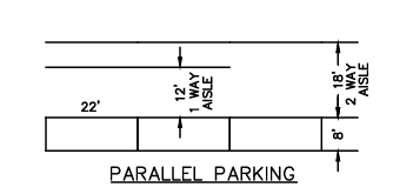
As shown, Clackamas County Roadway Standards for vehicle parallel parking spaces on public streets require a space 8 feet wide and 22 feet long, regardless of whether the parking is adjacent to a 1-way drive aisle or a 2-way drive aisle. Further, as shown, the minimum width for a two-way drive aisle is 18 feet. Thus, a two-way street must be a minimum of 26 feet wide to accommodate parallel parking on one side of the street and must be a minimum of 34 feet wide to accommodate parallel parking on both sides of the street.
The drainage swale within SE Portland Avenue is roughly 6 feet wide and 54 feet long. Mr. Harland reports he measured the width of the travel lane adjacent to the drainage swale as being 25 feet, eight inches. Thus, the width of the SE Portland Avenue is currently already too narrow for parking on the street opposite the drainage swale as this roadway is a 2-way aisle. Therefore, the travel width on SE Portland Avenue at the narrowest point where the drainage swale is located is more than sufficient to provide the 18-foot minimum 2-way aisle meeting County Roadway Standards.
By comparison, the applicant reports that the width of the 2-way aisle travel lanes on SE Hull Avenue range between 27 feet and 34 feet. This width is enough to support parallel parking on at least one side of the street. With parallel parking at the 27-foot width, SE Hull Avenue has an effective width of 19 feet for its 2-way aisle. Thus, the travel lanes for SE Portland Ave and SE Hull Avenue are functionally no different.
The project site is located within the Oak Lodge Water Services District. The stormwater management plan for the proposed site improvements will require approval from the Oak Lodge Water Services District.
With conditions, these standards can be met.
ZDO Section 1009, Landscaping
The Section 1009 seeks to ensure that sites are designed with appropriately selected, designed, installed, and maintained landscape materials and that landscaped areas are used for appropriate purposes.
Finding: There is no minimum required amount of landscaped area for properties in the OSM district. Instead, Section 702.06 requires the applicant to “landscape the site to produce a setting appropriate to its function.” As explained earlier in this report, and in the applicant’s submitted narrative, the proposed landscaping meets this criterion.
The applicant’s landscape plan is included on Sheet L7.12 of Exhibit 7. The proposed plantings are a mix of native and non-native species. A variety of plants are proposed including evergreen and deciduous trees, shrubs, and groundcover; plants of varying texture; plants of varying widths and heights at maturity; and plants with seasonal color interests, meeting the variety standards included in ZDO Subsection 1009.01(B).
A minimum of one tree located every eight interior parking spaces, and 25 square feet of landscaping per interior parking space is required. Only nine of the proposed parking spaces are considered interior, thus 225 square feet of interior landscaping is required. The applicant exceeds the minimum requirement significantly. Two trees are provided in the landscape areas adjacent to the interior parking spaces as is required. The two trees are proposed on the north side of the interior parking lot, and a parking lot swale is proposed to the south which does not meet the locational/tree frequency requirements as intended by the ZDO. Where necessary to accommodate other design considerations, variable spacing of the trees required by Subsection 1009.03(A)(4) is allowed, but in no case shall there be less than one tree planted in every 12 parking spaces. This requirement is met.
Trees provided along the perimeter of the property will be used as additional screening for any portion of the waste enclosure visible from offsite.
The applicant proposes a landscape strip of less than the minimum required 5-foot wide landscape strip along both the SE Hull Avenue and SE Portland Avenue frontage. The submitted materials do not include measurements; however, staff estimates the strip is just over 3-foot wide along both frontages. A Design Modification (RW026925), approved by Clackamas County, modifies the applicable roadway standards for the SE Hull Avenue frontage. The approved modification allows the existing 50-foot right-of-way width to be maintained in lieu of additional right-of-way dedication and adjusts standard frontage improvements, including removal of the landscape strip, construction of a 5-foot sidewalk, omission of stormwater management within the frontage, and installation of dual ADA curb ramps at the SE Hull Avenue and SE Portland Avenue intersection. Subsection 1009.06(C)2 allows for landscape strips to be reduced if necessary due to setback constraints and the need to accommodate required walkways or pedestrian amenities. With conditions, these standards can be met.
ZDO Section 1010, Signs
The provisions of section 1010 are intended to maintain a safe and pleasing environment for the people of Clackamas County by regulating the size, height, number, location, type, structure, design, lighting, and maintenance of signs.
Finding: No signs are proposed as a part of this application. ZDO Section 1010 is not applicable.
ZDO Section 1015, Parking and Loading
Section 1015 is designed to ensure that developments in Clackamas County provide sufficient and properly designed parking for motor vehicles and bicycles as well as appropriate off-street loading areas.
Finding: The Climate Friendly and Equitable Communities (CFEC) rules are in effect pursuant to OAR 660, Division 12. Per OAR 660-012-0450, a minimum number of off-street vehicular parking spaces cannot be required for any development that is within the Urban Growth Boundary (UGB) and is served by an urban water and sanitary service. The property is eligible to follow the CFEC rules; therefore, no minimum vehicle parking is required. However, since the applicant is electing to provide new vehicle parking spaces, the dimensional standards of this subsection apply. Applicant’s materials demonstrate that the dimensional standards have been met.
1015-3, Minimum Required Bicycle Parking Spaces; and 1015-4, Minimum Required Off-Street Loading Berths do not apply because no additional classrooms will be added within the addition. These standards are met.
ZDO Section 1021, Solid Waste and Recyclable Material Collection
Section 1021 applies to multifamily dwellings, and institutional, commercial, and industrial developments. It provides standards for the design, placement, and accessibility of trash enclosures.
Finding: The applicant has proposed a new, 21’4”W x 9’4”D x 6’H CMU trash enclosure set on a 4+in thick Portland Cement concrete pad at ground level and designed to discharge surface water runoff to avoid ponding. It is proposed to house two 4yd dumpsters (one each for trash and recycling) and food waste bins. The receptacles would be serviced in the drive aisle via a ramp. Additional detail is needed to illustrate the proposed enclosure complies with ZDO Subsections 1021.04, 1221.05, 1021.06, and 1021.07, including the receptacle footprints and gate details with the swing and restrainers, spacing details, the slope of the ramp, and any signs. The trash and recycling enclosure is addressed in the submitted narrative, but without detailed plans it is unclear that the proposed enclosure satisfies all elements for the proposed uses.
The Clackamas County Sustainability division reviewed the submitted plans and determined that, although minor details were missing from the submittal, the proposal demonstrates that the standards of this section can be met with conditions or if additional information is submitted prior to the Hearing. As conditioned, this section can be met.
ZDO Section 1203, Conditional Uses
1203.02: Submittal Requirements
This application includes a completed land use application form, site plan, application fee and completed supplemental application addressing the criteria in ZDO Section 1203. The application also includes a description of the proposed use and vicinity map. All the submittal requirements under Subsection 1203.02 are included in the application. The application was submitted on February 4, 2026 and the application was deemed complete on February 27, 2026.
1203.03(A): The use is listed as a conditional use in the zoning district in which the subject property is located.
13A. Finding: The subject property is located in the OSM zoning district. The proposed use is the addition of a cafeteria, improvements to outdoor recreation spaces, modifications to the parking area and access and other associated site improvements, which is a Conditional use in the zoning district “when associated with open space or recreational facilities”.
The Candy Lane Elementary School site includes outdoor play areas, covered play areas, and fields for recreation, some of which will be altered as a part of this application. None of the recreation facilities are proposed to be removed as a part of the application. "Public and private outdoor recreation facilities” are permitted as primary uses; play equipment and ball fields are included as examples of allowed primary uses in ZDO Section 702.03. Therefore, the school is on a property that has a recreational facility and is allowed with an approved conditional use permit. This standard is met.
1203.03(B): The characteristics of the subject property are suitable for the proposed use considering size, shape, location, topography, existence of improvements and natural features.
13B. Finding: The proposed cafeteria addition, and improvements to the outdoor recreation area are suitable for the site. The school and its associated uses were established in the late 1960s. Schools are often integrated within residential neighborhoods, allowing for convenient access and community connection. There is ample space to provide for the expansion onsite. As described in the above findings, the location of the addition was carefully considered to ensure for optimal functioning on the site. When considering the characteristics of the subject property, the Hearings Officer finds that this criterion is met.
1203.03(C): The proposed use is consistent with Subsection 1007.07, and safety of the transportation system is adequate to serve the proposed use.
13C. Finding: Clackamas County Development Engineering staff and the Hearings Officer reviewed the proposal for compliance with 1007.07 and determined that the transportation system is adequate to support the proposed use. While traffic patterns are changing, no additional traffic is expected as a result of the addition. The Hearings Officer provided additional discussion supporting this finding in the discussion of ZDO Section 1007, Roads and Connectivity. This criterion is met.
1203.03(D): The proposed use will not alter the character of the surrounding area in a manner that substantially limits, impairs or precludes the use of surrounding properties for the primary uses allowed in the zoning district(s) in which surrounding properties are located.
13D. Finding: The County staff report incorporates the findings provided by the applicant. The area surrounding the subject property is majority Low-Density Urban Residential. Adjacent land uses to the northeast, northwest, and southwest include single family residential. A Church is located to the southeast, within the City of Gladstone. Evidence has not been presented that the expansion of the cafeteria and other minor site improvements will substantially limit, impair or preclude the use of the surrounding properties for their primary use. Candy Lane Elementary School has been operating since 1969, in harmony with the surrounding land uses. The development will not include additional classrooms, and therefore increased traffic is not anticipated. Aside from temporary impacts from construction, no new noise-generating features are proposed. The Hearings Officer agrees with the submitted narrative regarding the impact of the cafeteria expansion and continuation of the existing use.
The County received several calls and submitted comments prior to the hearing, included as Exhibits 9, 10, 16, and 20, from the Jennings Lodge CPO and concerned neighbors regarding the proposed changes to the access of the site. The submitted comments note that they are generally in support of the project, aside from the potential impact of traffic pattern changes. Specifically, the commenters are concerned about the impact of consolidating the parking area/drop-off and pick-up access to SE Portland Avenue.
Currently, the parking area entrance is located on SE Hull Avenue and the exit is located on SE Portland Avenue. The proposed updates to the parking area and access will remove the entrance from SE Hull Avenue and relocate the entrance to SE Portland Avenue. With the new design both vehicles entering the site and leaving the site will be taking access via SE Portland Avenue, which is a dead-end street. No improvements are proposed for the frontage of SE Portland Avenue. The submitted comments note traffic congestion is already an issue for residents of SE Portland Avenue during drop-off and pick-up. There is concern that increased traffic and congestion could result in increased conflict between pedestrians and vehicles, along with other safety issues, as well as impair residents’ ability to freely leave and return to their homes as necessary. One commenter notes that while SE Portland Avenue is a dead end, there is a bicycle only access connecting SE Jennings Rd to SE Portland Avenue. The commenter is concerned that additional traffic could create conflict with bicyclists. Comments reference a potential “choke point” due to the existing drainage swale on SE Portland Avenue that narrows the two-way travel aisle to less than 26 feet for an approximately 54-foot section that ends just prior to the location of the proposed new access. Additional concerns were raised by the fact that a Traffic Impact Study (TIS) was not included with the application. Staff noted in the staff report that while a TIS is not required, such a study could be helpful to better understand the impact of the increased traffic. Submitted comments note their concerns that the road is not adequately sized to accommodate the additional traffic without improvements, and that the existing infrastructure is old and in need of repair. In summary, the comments submitted by the public are requesting denial due to the potential for the project to alter the character of the area and impair the primary residential use of the properties located along SE Portland Avenue.
The applicant responded by submitting a Queuing Evaluation by Jennifer Danziger, PE, of AKS Engineering, supporting the proposal to remove the entrance from SE Hull Avenue and combine the entrance and exit access to the proposed new location further down SE Portland Avenue. The evaluation narrative notes how the changes to the parking/drop-off and pick-up area, will increase the available area for the queuing of cars. Current site conditions include two parent drop-off/pick-up parking spaces, and allows for the queuing of seven cars onsite. The proposed reconfiguration includes the addition of seven drop-off/pick-up parking spaces and will allow for the queuing of nineteen vehicles on site for a total of 26 vehicles. The applicant’s materials state that the access changes are intended to resolve queuing issues along SE Hull Avenue. The proposed modifications remove vehicles from SE Hull Avenue, improving traffic flow along the road. The applicant submitted a “Queuing Evaluation” completed by Jennifer Danziger, PE, a licensed professional engineer from AKS Engineering & Forestry, LLC on April 22, 2026. County staff were unable to review and incorporate the findings of the study into the staff report. However, the study is included as Exhibit 12, was addressed as a part of the staff presentation at the hearing, and sufficiently addressed the concerns referenced in the submitted comments and staff analysis such that staff recommended approval of this application.
Ms. Danziger’s evaluation states that the proposed new access configuration will eliminate vehicle queuing in the public roadway during the morning drop-off period. She further states that the proposed new access configuration will greatly reduce the vehicle queuing in the public roadway during the afternoon pick-up period from the current 40+ vehicles to a projected 10+ vehicles, shortening the time the vehicle queue extends into the public roadway from the current 25-30 minutes to about 15 minutes. Mr. Harland, a resident of SE Portland Avenue, submitted comments critical of Ms. Danziger’s Queuing Evaluation, noting that it is not a TIS and the data was taken for a single observation day. While Mr. Harland’s criticisms are accurate, I note that the Queuing Evaluation and its findings were submitted by a licensed professional engineer. Further, I note that the submitted Queuing Evaluation was reviewed by the County’s Engineering staff who revised their findings to recommend approval of the application. Thus, the evaluation is substantial evidence supporting finding that the proposed new access configuration will greatly reduce the vehicle queuing current occurring in the public roadway.
By relocating the access to SE Portland Avenue, a dead-end road with a lower functional classification and lower traffic volume than SE Hull Avenue, the proposal satisfies County Comprehensive Plan Goal 5.Q.6. By reducing or eliminating off-site vehicle queuing in the public roadway and better accommodating on-site traffic circulation within the boundaries of the site, the proposal satisfies County Comprehensive Plan Goal 5.R.6. By including the Clackamas County Fire District at the pre-application conference and obtaining preliminary review and approval of the applicant’s site plan, the proposal satisfies County Comprehensive Plan Goal 7.F.1.
Mr. Harland points out that parent vehicle headlights will be visible to residents along SE Portland Ave. particularly as they exit the proposed new parking lot, with the applicant pointing out that the landscape buffering will provide screening of headlights as vehicles leave the parking lot. Headlights and noise from parent vehicles as children are dropped off and picked up at school will occur but will be partly mitigated by the screening landscape buffering. While these annoyances will occur, they are appropriately mitigated and I do not find that they will substantially impair residential use of the adjacent properties.
Mr. Harland and other residents along SE Portland Avenue (as well as the Jennings Lodge CPO) expressed concerns regarding the potential for school traffic to block access to their homes or while leaving their homes due to increased congestion, as well as the potential for such traffic to impede access by emergency vehicles to their homes. Ms. Serra addressed these concerns by pointing out that SE Portland Avenue meets the County’s design requirements for a local road, the same as SE Hull Avenue, and the County’s Engineering staff found SE Portland Avenue adequate to accommodate the proposed parking lot and access relocation. Further, she points to the queuing evaluation showing that the off-site queuing on the public roadway that currently impacts the neighborhood will be greatly reduced in amount and duration. Ms. Serra responds to concerns with respect to access by emergency vehicles by noting that the Clackamas County Fire Department provided preliminary approval of the proposal showing that it meets access and hose pull requirements. She responded to concerns regarding vehicles blocking SE Portland Avenue and not moving to accommodate emergency vehicles by pointing out that vehicles must move over per Oregon State law. Lastly, Ms. Serra points out that the County code does not require that the proposed use have no impact. Rather, she observes the code requires that the proposed use must not alter the character of the surrounding area in a manner that substantially limits, impairs, or precludes the surrounding properties from the primary uses allowed in the zoning district, in this case their primary residential use. I am persuaded that the off-site queuing of vehicles will be greatly reduced as stated by Ms. Danziger in her analysis of the current and proposed access configuration, and as supported by County Engineering and Ms. Serra. Even so, there will be continuing impacts to local residents associated with the new proposed access configuration that will continue to inconvenience them, even with reduced queuing duration. I find that a condition of approval is warranted to ensure that during drop-off and pick-up times, school district parking monitors direct traffic, ensure student safety, and maintain smooth ingress and egress to/from the parking lot. The presence of the parking monitors will further reduce vehicle queuing in the public roadway and help ensure that residents along SE Portland Avenue and emergency vehicles are not blocked from ingress and egress to/from these resident’s driveways by school traffic. This condition appropriately mitigates the impact to local traffic, ensuring that the change in school traffic on SE Portland Avenue will not substantially impair residential use of the adjacent properties.
1203.03(E): The proposed use is consistent with the applicable goals and policies of the Comprehensive Plan.
13E. Finding: County staff reviewed this proposal relating to the Comprehensive Plan and recommended finding it consistent with the applicable goals and policies from Chapter 4: Land Use, Chapter 5: Transportation, and Chapter 7: Public Facilities and Services. The project has been reviewed to ensure compliance with Chapter 5 of the Comprehensive Plan, with particular interest in ensuring that the County Roadway Standards are met. The applicant addresses Chapter 4 as follows:
This proposal consists of a conditional use permit that includes findings to site-related criteria. This ensures that the proposed improvements to Candy Lane Elementary, which is in the OSM zoning district, are evaluated for compliance in accordance with this policy.
The applicant’s narrative addresses Chapter 7 as follows:
The applicant for this proposal is the Oregon City School District, who is attempting to make changes that will improve the existing school facilities for students. The proposal is consistent with Chapter 7 as it supports school facilities as a focal point of community activity by providing better on-site services for students and visitors. The proposal will encourage the maximum use of the existing school facility.
Chapter 5 is addressed in the findings related to ZDO Section 1007. Specific goals and policies within various portions of the County Comprehensive Plan were addressed in the relevant discussion sections.
As conditioned, these criteria are met.
1203.03(F): The proposed use complies with any applicable requirements of the zoning district and overlay zoning district(s) in which the subject property is located, and Section 1000 Development Standards.
13F. Finding: Staff reviewed compliance with ZDO Section 1000, as applicable. The findings are included in this staff report. The Hearings Officer provided discussion of applicable requirements, particularly with respect to ZDO Section 1000 Development Standards.
Advisory Notes
Development Engineering:
- Development Permit is required from the Engineering Division for review and approval of frontage improvements and on-site access. The Permit shall be obtained prior to commencement of site work and issuance of a building permit. To obtain the permit, the applicant shall submit construction plans prepared and stamped by an Engineer registered in the State of Oregon, or plans acceptable to the Engineering Division, and pay a plan review and inspection fee. The fee will be calculated as a percentage of the construction costs if it exceeds the minimum permit fee. The minimum fee and the percentage will be determined by the current fee structure at the time of the Development Permit application.
- Prior to final occupancy, the applicant shall design and construct frontage improvements along the SE Hull Avenue frontage in accordance with the approved Design Modification (RW026925) and Clackamas County Roadway Standards. These improvements shall consist of the following:
- A one half-street pavement width of 16 feet, measured from the centerline of the right-of-way. The structural section for SE Hull Avenue improvements shall be in accordance with Clackamas County Standard Drawing C100 for an urban local roadway. An overlay, grind and inlay or full depth reconstruction shall be based on Clackamas County Roadway Standards Section 225.5.
- The half street improvement design shall include cross sections every 25 feet per Clackamas County Roadway Standards Section 250.7.5. The design shall demonstrate that the new curb line and cross slope to the existing centerline allow for construction of a curb on the opposite side of the road with cross slopes that meet minimum standards.
- Standard curb, or curb and gutter if curbline slope is less than one percent, constructed per Clackamas County Standard Drawing S100/S150.
- A minimum 5-foot-wide unobstructed sidewalk shall be constructed along the site frontage in accordance with Clackamas County Standard Drawing S960.
- Dual ADA curb ramps shall be constructed at the SE Hull Avenue and SE Portland Avenue intersection, aligned with the existing ramp on the opposite side of the street.
- Where the on-site ADA walkways intersect the public sidewalk, a minimum 5-foot by 5-foot landing shall be provided.
- The existing driveway approach on SE Hull Avenue shall be reconstructed to include a pedestrian crossing in accordance with Clackamas County Standard Drawing D675.
- A minimum 28-foot wide concrete driveway approach shall be constructed from SE Portland Avenue in accordance with Clackamas County Standard Drawing D600.
- Retaining walls and other structures shall be located outside of the public right-of-way to the maximum extent practicable. Where placement within the public right-of-way cannot be avoided, the applicant shall obtain a Revocable Encroachment Permit from Clackamas County prior to construction.
Oak Lodge Water Services:
- General:
- The proposed development is located within the service area of Oak Lodge Water Services for sanitary sewer, water and surfacewater and shall be subject to the Oak Lodge Rules and Regulations and Design and Construction Standards for applicable utilities.
- The application will be reviewed by the rules, regulations and design and construction standards in effect on the date of complete application to OLWS; not Land Use application.
- Property owner or designee shall apply for a utility permit from OLWS for each tax lot.
- Property owner or designee shall apply for an erosion and sediment control/surface water management permit from OLWS.
- All fees and charges shall be paid before the permits are issued or plat approval. All costs associated with the design, construction and testing of any applicable utility shall be proved by and at the sole expense of the owner and performed prior to plat approval.
- Water and Sewer:
- Each tax lot shall have separate water and sewer connections to the public systems.
- No additional domestic water services are proposed as part of the development. Existing lines are proposed to be reused. Meter and service line size will be assessed by OLWS during permit review. A new fire suppression line is proposed.
- A water service backflow device for fire supply shall be required and inspected by Oak Lodge.
- Sanitary sewer and/or water SDCs will be assessed
- Utilities exist to serve the property. OLWS does not require any public utility extensions.
- Erosion Control and Storm:
- Oak Lodge records indicate that there is a storm sewer line in Hull Avenue. Any public stormwater utility installations or upgrades or connections are authorized by the utility owner which is Clackamas County.
- Property owner shall be responsible for the maintenance of any stormwater facilities constructed on private property. OLWS does not review, approve, or inspect stormwater facilities constructed in the public right-of-way. A maintenance agreement will be required to be recorded against the property.
- Stormwater treatment including water quality and detention is required. All water for all new or altered impervious surfaces on private property is to be captured and treated. Stormwater causes by public right-of-way improvements must be captured and treated per Clackamas County requirements. OLWS does not approve or inspect public treatment facilities. Per OLWS MS4 permit, open vegetated systems are required unless they are unfeasible. A written request to use UIC facilities is required prior to approval from OLWS.
CONDITIONS OF APPROVAL
The conditions listed are necessary to ensure that approval criteria for this land use permit are satisfied. Where a condition relates to a specific approval criterion, the code citation for that criterion follows in parentheses. At all times, the use shall be sited and conducted in compliance with these conditions of approval. Noncompliance may result in code enforcement action or revocation of this permit.
The Clackamas County Land Use and Zoning staff recommends approval of this application for Conditional Use Permit subject to the following conditions, reviewed, adopted and/or modified by the Hearings Officer, with changes denoted by boldface type in italics:
- Approval of this land use permit is based on the submitted written narrative and plan(s) filed with the County on February 4, 2026 and additional documents submitted on February 27, 2026, March 13, 2026, April 10, 2026, April 13, 2026, and April 22, 2026. No work shall occur under this permit other than which is specified within these documents, unless otherwise required or specified in the conditions below. It shall be the responsibility of the property owner(s) to comply with these documents and the limitation of any approval resulting from the decision described herein.
- The surfaces of metal exterior building materials that are subject to rust or corrosion shall be coated to inhibit such rust and corrosion, and the surfaces of metal exterior building materials with rust or corrosion shall be stabilized and coated to inhibit future rust and corrosion. [1005.03(E)]
- The height of pole-mounted outdoor light fixtures shall not exceed 25 feet. At entrances, outdoor lighting shall be glare-free. Entrance lighting may not exceed a height of 12 feet and must be directed downward. [1005.04(A)]
- The proposed development is located within the service area of Oak Lodge Water Services for sanitary sewer, water and surfacewater and shall be subject to the Oak Lodge Rules and Regulations and Design and Construction Standards for applicable utilities.
- Property owner or designee shall apply for a utility permit from OLWS for each tax lot.
- Property owner or designee shall apply for an erosion and sediment control/surface water management permit from OLWS.
- All frontage improvements in, or adjacent to Clackamas County right-of-way, or on-site, shall be in compliance with Clackamas County Roadway Standards.
- The applicant shall grant an 8-foot wide public easement for sign, slope, and public utilities along the entire SE Hull Avenue right-of-way, consistent with Clackamas County Standards Drawing C110.
- Drainage facilities for frontage improvements within the public right-of-way shall be designed and constructed in accordance with Clackamas County Roadway Standards Chapter 4, as modified by approved Design Modification RW026926. Coordination with Oak Lodge Water Services shall be required for stormwater management of on-site improvements, as applicable.
- All traffic control devices associated with the development, including those located on private property or within the public right-of-way, shall conform to the Manual on Uniform Traffic Control Devices and relevant Oregon supplements. During drop-off and pick-up times, district parking monitors shall direct traffic, ensure student safety, and maintain smooth ingress and egress to/from the parking lot. [Condition amended by Hearings Officer.]
- The applicant shall provide and maintain minimum intersection sight distance of 280 feet at the driveway intersection with SE Portland Avenue, in accordance with Clackamas County Roadway Standards Section 240.
- Primary Inspector:
- The applicant shall enter into a Developer/Engineer Agreement for primary inspection services per Section 180 of the Clackamas County Roadway Standards. This form will be provided to the applicant and shall be signed and returned to County Plans Reviewer.
- Prior to Certificate of occupancy, the applicant shall provide a Certificate of Compliance signed by the Engineer of Record stating all materials and improvements have met the approved plans and specifications.
- Prior to issuance of a Building Permit:
- The applicant shall submit plans showing sheltered entries, of at least 4ft, for both doors on the north façade of the addition. [1005.03(B)(1)] [Condition amended by Hearings Officer.]
- The applicant must obtain a Development Permit from the Engineering Division for review and approval of frontage improvements and on-site access. The Permit shall be obtained prior to commencement of site work and issuance of a building permit.
- The applicant shall submit the following to the Clackamas County Engineering Office:
- Written approval from the Clackamas Fire District #1 for the planned access, circulation, fire lanes and water source supply. The approval shall be in the form of site and utility plans stamped and signed by the Fire Marshal.
- Written approval from Oak Lodge Water Services for adequate water supply source to serve the development. The approval shall be in the form of utility plans stamped and signed by the Water District representative.
- Written approval from Oak Lodge Water Services for surface water management facilities, surface water detention facilities, and erosion control measures.
- A set of street and site improvement construction plans in conformance with Clackamas County Roadway Standards Section 140, to Clackamas County's Engineering Office for review and obtain written approval, in the form of a Development Permit.
- Prior to Certificate of Occupancy
- All required improvements shall be constructed and inspected, or financially guaranteed in the form of a performance bond. Performance bonds shall be in the amount of 125% of the approved engineer's cost estimate of the required improvements, and shall be accepted only when access has met minimum Substantial Completion requirements, per Clackamas County Roadway Standards Section 190.
- All landscaping shall be installed in accordance with the approved landscaping plan. [1009]
- The developer shall either submit a signed maintenance contract for the one-year period or provide a performance surety pursuant to Section 1311, Completion of Improvements, Sureties, and Maintenance, covering the landscape maintenance costs for the one-year period [1009.10(F)]
- Prior to Final Occupancy:
- The applicant shall design and construct frontage improvements along the SE Hull Avenue frontage in accordance with the approved Design Modification (RW026925) and Clackamas County Roadway Standards. A detailed list of required improvements is included in the Engineering Advisory Notes.
- The applicant shall design and construct on-site parking and maneuvering areas as follows:
- Adequate on-site circulation shall be provided for the parking and maneuvering of all vehicles anticipated to use the site.
- All parking and maneuvering areas shall be paved and constructed per Clackamas County Standard Drawing R100.
- Parking spaces shall meet minimum dimensional requirements of ZDO Section 1015, and Clackamas County Standard Drawings P100 or P200, as applicable. The plans shall list the number of parking spaces required and the number of parking spaces provided.
- All curbs shall typically be type "C", or curb and gutter if curb line slope is less than one percent, if they carry, direct or channel surface water. Alternative curbs will be considered when it is determined by the Clackamas County Department of Transportation and Development that type “C” curbs or curb and gutter are not appropriate. Extruded curbs for carrying, directing or channeling surface water, or used as a vehicle wheel stop, shall not be allowed.
- The applicant shall show the paths traced by the extremities of anticipated large vehicles (delivery trucks, fire apparatus, garbage and recycling trucks), including off-tracking, on the site plan to insure adequate turning radii are provided.
- Fire access lanes shall be clearly identified and maintained. Where required, fire lanes shall be striped and signed “No Parking – Fire Lane” in accordance with Fire District requirements.
- Prior to issuance of a Development Permit and/or prior to issuance of a building permit for the trash enclosure, the applicant shall submit detailed enclosure plans that clearly outline a waste and recycling enclosure that meets the requirements specified in ZDO 1021. The applicant shall work with Clackamas County’s Sustainability & Solid Waste staff to finalize plans that comply with design standards.
C. DECISION
Based on the findings, discussion, conclusions, and record in this matter, the Hearings Officer APPROVES application Z0032-26, subject to conditions of approval.
Dated: June 25, 2026
Carl D. Cox
Clackamas County Hearings Officer
APPEAL RIGHTS
ZDO 1307.10(F) provides that, with the exception of an application for an Interpretation, the Land Use Hearings Officer’s decision constitutes the County’s final decision for purposes of any appeal to the Land Use Board of Appeals (LUBA). State law and associated administrative rules promulgated by LUBA prescribe the period within which any appeal must be filed and the manner in which such appeal must be commenced. Presently, ORS 197.830(9) requires that any appeal to LUBA “shall be filed not later than 21 days after the date the decision sought to be reviewed becomes final.” This decision is “final” for purposes of a LUBA appeal as of the date of the decision appearing by my signature.
- The site is located within the Jennings Lodge Community Planning Organization.
- This existing drainage swale feature is variously referred to by different individuals as a “bioswale” or a “rain garden” or a “stormwater planter” or “storm planter” or simply as a “chokepoint” in the road.
- School buses will continue to use the existing separate access on SE Hull Ave. to enter and exit.