Translate




Effective September 3, 2024, accessory dwelling units (ADUs) will be allowed in more areas of Clackamas County, including on some rural residential properties.
Why did the county change the rules to allow ADUs in more places?
In 2021, the Oregon Legislature approved a bill (SB 391) that enabled counties to allow ADUs on rural residential lands outside an urban growth boundary (UGB), but only after the state’s wildfire hazard map was completed. In 2023, since the wildfire map was not yet completed, the legislature amended the law to allow counties to permit ADUs in these areas without the wildfire map.
In light of the pressing need for additional housing, the Clackamas County Board of Commissioners chose to take advantage of this option.
Did the county change my zoning?
No. The new regulations did not change anyone’s zoning designation; they simply added another housing option in certain existing zones.
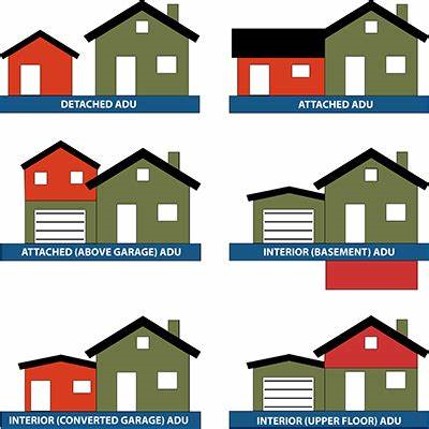
What is an ADU?
An accessory dwelling unit (ADU) is a second (usually smaller) dwelling unit located on the same lot as a detached single-family or manufactured home. The ADU may be attached or detached from the primary home.
Where are ADUs allowed?
ADUs were already allowed inside urban growth boundaries in single-family residential zones and in some designated Unincorporated Communities on Mt. Hood. As of Sept 3, 2024, ADUs are also allowed outside urban growth boundaries (but not within urban reserves) in the following rural residential zones:
- RA-2 (rural area residential, 2-acre)
- RRFF-5 (rural residential farm forest, 5- acre)
- FF-10 (farm forest, 10-acre)
- RR (recreational residential)
- FU-10 (future urban, 10-acre)
As of Sept 3, 2024, ADUs are also allowed in the RA-1 (rural area residential, 1-acre) zone, found within some designated Unincorporated Communities (like Mulino, Redland, or Colton).
ADUs are not allowed in the EFU (exclusive farm use), AG/F (ag/forest) and TBR (timber) zones.
What kinds of dwellings can be used as ADUs?
An ADU must be a permitted dwelling; it may be a “stick-built” dwelling, a manufactured dwelling, or a prefabricated structure. The ADU may not be a recreational vehicle (RV), “tiny home” on wheels, or similar temporary or mobile structure.
Are there any special rules or regulations for rural ADUs?
Yes. Inside urban growth boundaries and unincorporated communities, ADUs have very few rules aside from a size limit (in most cases, 900 sq. ft. maximum). However, ADUs outside those boundaries must meet a number of standards including the following:
The lot:
- Must be two acres or greater
- Must have one, and only one, single-family dwelling (may be a manufactured dwelling). Cannot have any other dwelling units, a recreational vehicle as a second dwelling, or a guest house.
- Must not have been declared a nuisance property or be subject to pending action related to nuisance property
- Must be served by a fire protection service provider
The ADU:
- Must comply with state laws relating to water supply, sanitation and wastewater disposal
- May be no larger than 900 square feet
- Must be located within 100 feet of the single-family dwelling
- Cannot be used as a short-term rental
You can find the specific requirements for ADUs requirements in Section 839 of the county’s Zoning & Development Ordinance (ZDO).
What is the process for getting approval to build an ADU?
- Understand the rules: Does your zoning district allow for ADUs? Can you meet the requirements in ZDO Section 839? Contact Planning and Zoning at 503-742-4500 or zoninginfo@clackamas.us to find out whether any overlays, protected areas, or other special circumstances will affect your ability to site an ADU on your property.
- Get permits: In most cases, no land use approvals are needed and you can proceed directly to apply for building permits or manufactured dwelling placement permits. Please contact county Building Codes at 503-742-4240 or bldservice@clackamas.us for more information about the permitting process and costs.
For more information, visit the Planning and Zoning project webpage.