Building Codes

Building Codes

Unincorporated Clackamas County Erosion Control Permits

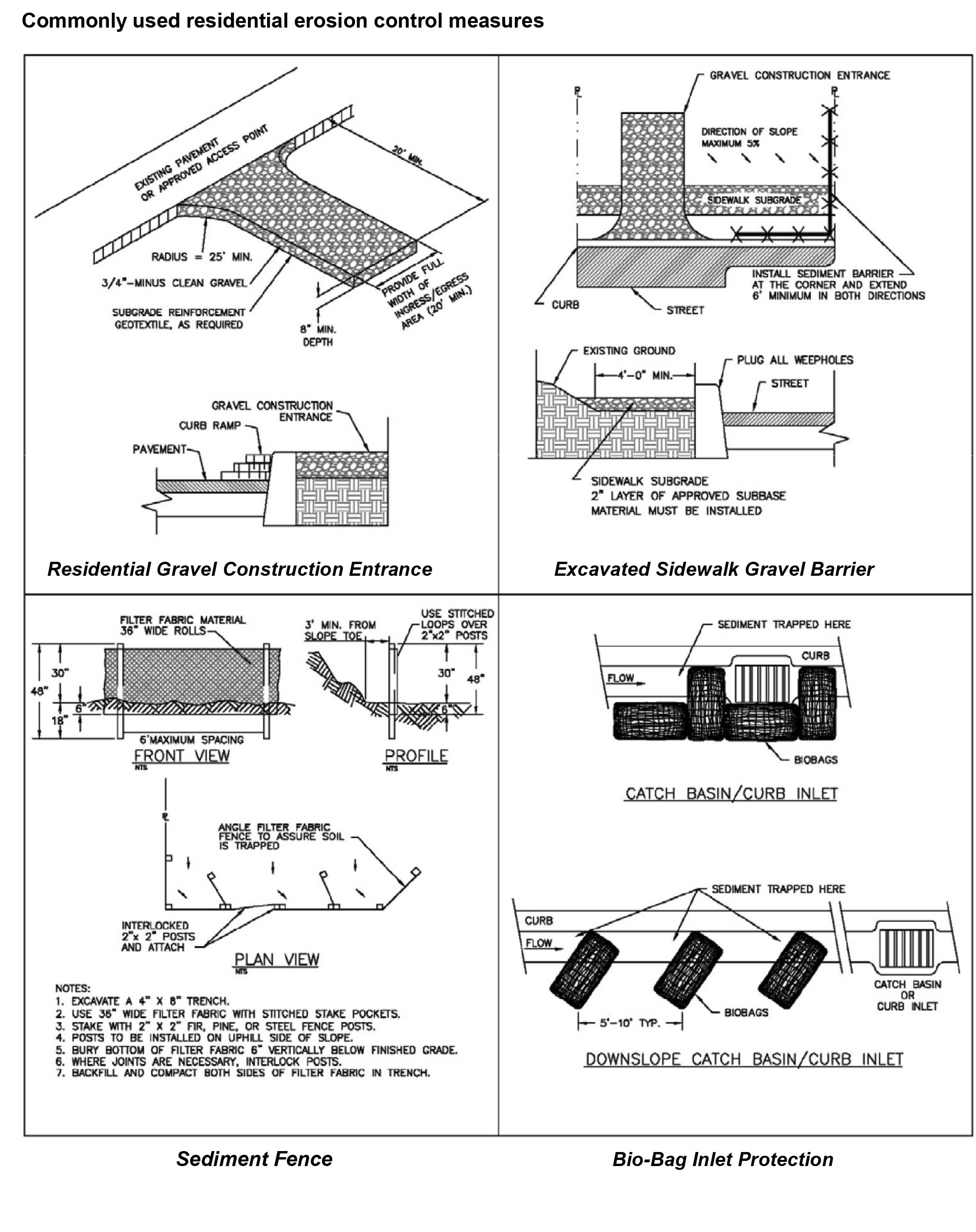
All development projects in unincorporated Clackamas County (outside cities and special districts) must use erosion prevention and sediment control (EPSC) measures when soil is disturbed.

Some projects also require a separate erosion control permit, depending on the disturbance's size and location. See below to see if your project requires a permit.

Note: Erosion control permitting in Clackamas County is handled by different districts, including WES. Before applying, visit Erosion Control Permits in Clackamas County to confirm which district applies to your site.

Do I Need an Erosion Control Permit?

Many smaller projects do not require separate permits, but all projects must install and maintain erosion control measures when soil is disturbed.

Soil DisturbancePermit Required
Less than ½ acreNo separate permit required. EPSC measures must still be installed and maintained.
½ to 1 acreDTD Building Division EPSC permit
1 acre or moreOregon DEQ 1200-C permit
500 sq. ft. or more within 50 feet of state surface watersDTD Building Division EPSC

Applying for a DTD EPSC Permit

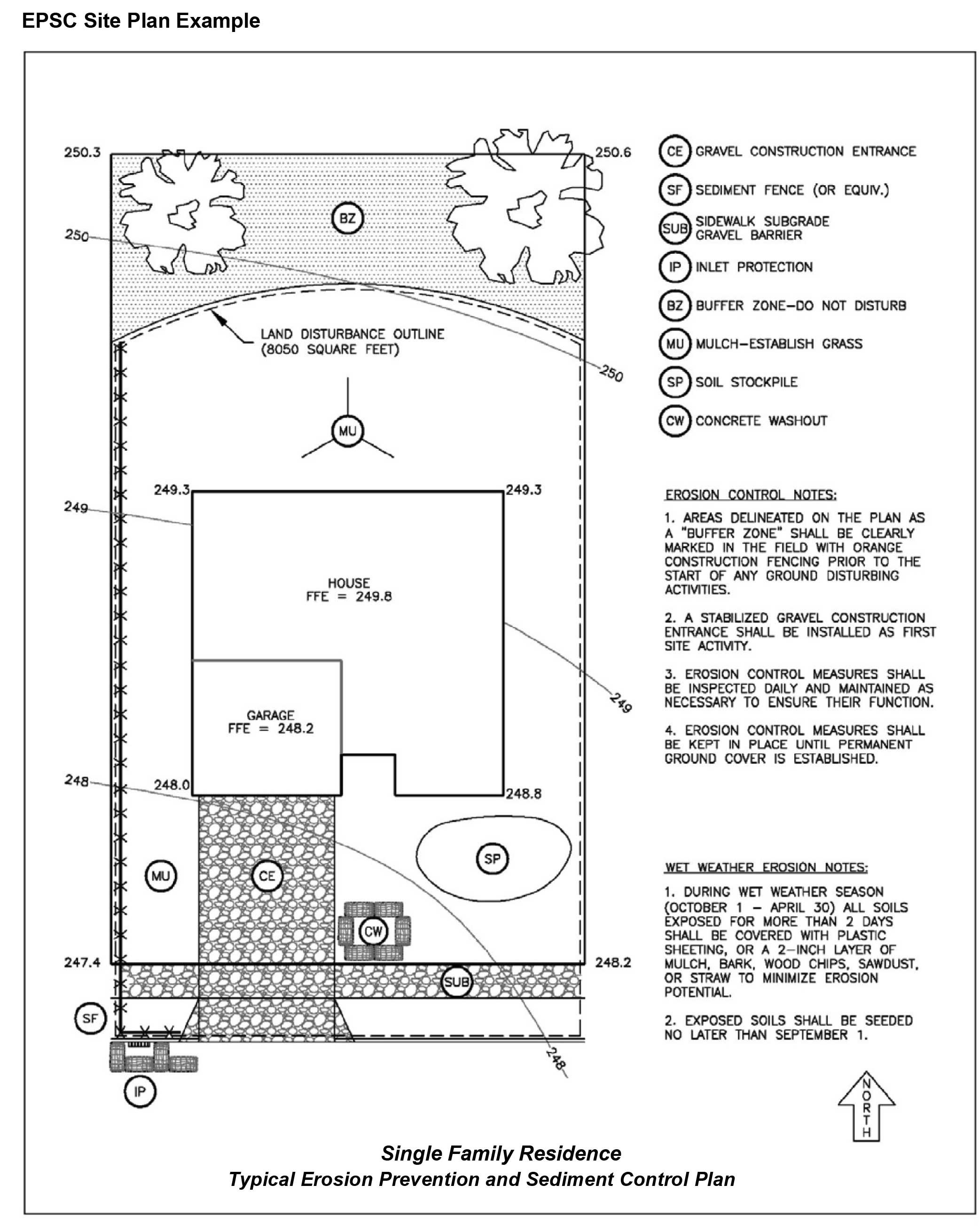
Apply through Development Direct or visit the How to Apply for Permits page to submit your application and erosion control plans.

DTD EPSC permits generally apply to:

  • Residential construction
  • Small commercial additions and improvements
  • Industrial additions and improvements

Note: An EPSC plan is required for all projects involving ground disturbance, even when a separate EPSC permit is not required.

Erosion Control Inspections

Most projects require an initial erosion control inspection.

  • Single-family homes and additions
    Inspection must be approved before or at the footing/foundation inspection.
  • Commercial, industrial, and multi-family projects
    Inspection must be approved before any soil disturbance, except for installing erosion control measures.

A final inspection is required after the site has been permanently stabilized.

EPSC Planning and Design Manual

The Erosion Prevention and Sediment Control (EPSC) Planning and Design Manual provides approved methods, materials, and maintenance standards for construction sites.

Training

Training on erosion control installation and maintenance is available from private providers. Clackamas County does not approve or endorse specific training companies.

Sidebar Heading
Related Information
New Format?
Off

Erosion Control Permits in Clackamas County

When construction or development disturbs soil, it can cause erosion that harms nearby properties, streams, and rivers. Erosion control helps protect water quality and keep our communities healthy.

Depending on your project's location, your erosion control (EPSC) permit will be issued by one of several local agencies. The rules are the same countywide, but the permitting process and point of contact may differ.

Find Out Who Issues Your Permit

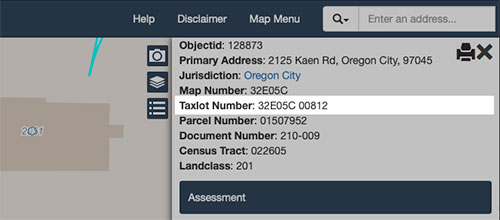
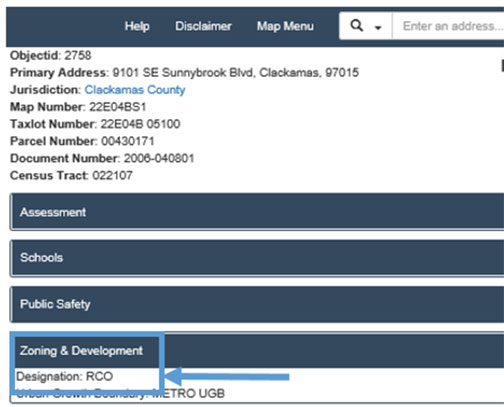
Not sure which erosion control district you live in? Put your address in the field below to return the contact information for your specific address.

Find my district

Sidebar Heading
Related Information
New Format?
Off

Tagged Buildings and Preoccupancy

Evacuation orders in some areas of Clackamas County are lifting. Those permitted to return to evacuated areas are encouraged to proceed carefully.

Some structures may have been evaluated by emergency responders and tagged with green, yellow or red tags.

Individuals who did not receive a tag on their home in unincorporated Clackamas County — but have flood damage —  can request a building code administrator inspection by emailing ccdm@clackamas.us.

Contact CCVOAD via online form if they do not have insurance or resources for assistance with flood cleanup.

Green inspected card

Green tag
This structure has been inspected, and no apparent structural hazard has been found. You can enter the building.

Yellow restriced used card

Yellow tag
This structure has been inspected and found to be damaged. Use caution and follow the instructions on the placard. It is OK for people to go in yellow tagged structures, but these buildings may be unsafe to live in because of ongoing conditions like structural issues or lack of utilities.

Red unsafe card

Red tag
This structure has been inspected, found to be seriously damaged and is unsafe to occupy. Do not enter and follow the instructions on the placard.

If your home or business was affected by the flood and has not received a red tag, you are able to work on cleaning and repairing any damage from flooding.

  • When working on your home or place of business, use appropriate safety gear such as boots, rubber gloves, face masks, and goggles as the circumstances warrant.
  • Dry out flooded areas. Use fans and dehumidifiers to remove excess moisture as soon as possible. Weather permitting, open the windows and doors to ventilate the room.
  • Once the structure has dried out, remove mold from hard surfaces by washing with soap and water, and letting all washed surfaces dry completely. Bleach can be used following all label instructions, paying special attention to the precautionary statements and dilution rate.
  • Check crawl spaces and basements for wet insulation, compromised mechanical and electrical systems, as flood damage may not be readily apparent.
  • Save receipts, take photos, and document every loss and expense. Contact your insurance agent.
  • High winds may cause trees to fall or break. As you cut down branches and limbs, wear safety glasses and heavy work gloves. Remember to always cut at waist level or below. If using an electric chain saw, use extreme caution to avoid electrical shock. Avoid contact with power lines.
  • Never turn power on or off while standing in water. If electrical circuits and electrical equipment have gotten wet or are in or near water, turn off the power at the main breaker or fuse on the service panel. If you must enter standing water to access the main power switch, then call an electrician to turn the power off.
  • Never use a generator, grill, camp stove or other gasoline, propane, natural gas or charcoal burning devices inside a home, garage, basement, crawlspace or any partially enclosed area. Keep these devices at least 20 feet from doors, windows, and vents.
  • Don't push mud and debris back into the river.;
  • Don't start construction or land movement (grading). You may remove the mud that came in from the floods and place it on your property but do not change the underlying landforms or build new walls and structures without first contacting the following Clackamas programs:

For more information on cleaning your home or business

For additional information and resources visit the Clackamas County Flood Preparedness website.

Sidebar Heading
Related Information
New Format?
On

School District Construction Excise Tax

Since May 2007, the State of Oregon has allowed school districts to impose a construction excise tax on projects that result in a new structure or additional square footage to an existing structure.

Clackamas County administers this tax for some cities and the unincorporated areas in the participating school districts in the County. The table below shows the assessment amounts for the school districts that have passed resolutions to implement this tax.

School districtResidential rate (sq. ft.)Non-residential 
rate (sq. ft.)
Exemptions
Canby
503-266-7861
$1.67$0.84<1,000 sq. ft.
Centennial
503-760-7990
1.670.84Contact district
Estacada
503-630-6871
1.670.84 
Gladstone
503-655-2777
1.260.63<500 sq. ft.
Gresham / Barlow
503-261-4550
1.000.50 
Lake Oswego
503-534-2000
1.630.82 
Molalla River
503-829-2359
1.350.50 
Newberg
503-554-5000
1.670.84 
North Clackamas
503-353-6000
1.630.82<1,000 sq. ft.
Oregon City
503-785-8000
1.630.82 
Oregon Trail
503-668-5541
1.000.50<1,000 sq. ft.
Riverdale
503-262-4840
1.000.50 
Sherwood
503-217-5365
1.670.84 
Silver Falls
503-873-5303
1.000.50Contact district
Tigard-Tualatin
503-431-4000
1.670.84 
West Linn/Wilsonville
503-673-7000
1.560.78 
*Should your project change, resulting in lower fees, you may request refunds through the school district.

How tax rates are determined

SB 1036 set initial tax rate limits, and beginning in 2009, tax rates were indexed to inflation using the Engineering News-Record Construction Cost Index. As prescribed in statute, the Department of Revenue is responsible for updating tax rate limits and notifying affected districts.

Fiscal yearResidential**Non-residential**Non-residential max
2019-20$1.35$0.67$33,700
2020-211.390.6934,600
2021-221.410.7035,200
2022-231.450.7236,100
2023-241.560.7839,100
2024-251.630.8240,800
2025-261.670.8442,400
**Dollars per square foot

Before a school district can pass a resolution implementing these taxes, it must develop a long-term facilities plan for making capital improvements. The plan is adopted by resolution and the expenditure of the money collected is restricted.  ‘Capital improvements’ can include:

  • Land acquisition
  • The construction, reconstruction or improvement of school facilities
  • The acquisition or installation of equipment, furnishings or other tangible property
  • The cost for architectural, engineering, legal or similar costs related to capital improvements
  • Assets that have a useful life of more than one year
  • Payment of obligations and related costs that are issued to finance/re-finance capital improvements

Residential

  • The construction tax may not exceed the rate set by the Department of Revenue, as outlined in ORS320.176, and approved by the local school district.
  • The excise tax is not assessed on garage or porch areas; the tax is assessed per square foot on structures or portions of structures intended for residential use.
  • Replacement dwellings may receive credit for existing square footage on record with the county tax assessor.

Commercial

  • The construction tax may not exceed the rate set by the Department of Revenue, as outlined in ORS320.176, and approved by the local school district.
  • The tax imposed on structures intended for non-residential use may not exceed maximum amount allowed per square footage.
  • Replacement structures may receive credit for existing square footage on record with the county tax assessor.

Additional exemptions

These construction taxes may not be imposed on the following:

  • Private school improvements
  • Public improvements as defined in ORS 279A.010(cc);
    • “Public improvement” means a project for construction, reconstruction or major renovation on real property by or for a contracting agency.
    • “Public improvement” does not include certain exempted projects, emergency work and alterations. (Please refer to the ORS for the full definition.)
  • Residential housing that is guaranteed to be affordable, under guidelines established by the US Department of Housing and Urban Development, to households that earn no more than 80 percent of the median household income for the area in which the tax is imposed, for a period of at least 60 years following the date of construction of the housing;
  • Public or private hospital improvements;
  • Improvements to religious facilities primarily used for worship or education associated with worship;
  • Agricultural buildings, as defined in ORS 455.315(2)(a);
  • Facilities that are operated by a not-for-profit corporation and that are:
    • Long term care facilities, as defined in ORS 442.015;
    • Residential care facilities, as defined in ORS 443.400; or
    • Continuing care requirement communities, as defined in ORS 101.020 [2007c.829 3;209 c.534 2]

If a person believes they are exempt from the tax, they must contact the appropriate school district, which may grant the exemption if it appears to be valid under the district's resolution. A permit will not be released until the exemption is approved or the excise tax has been paid in full. 

This webpage only provides a basic outline of the restrictions and guidelines for applying the School District Excise Tax. Each jurisdiction has the option to make minor modifications to the guidelines given in the executed Senate Bill. For complete overview of the Senate Bill, please review the full text version on the Oregon State website.  

Sidebar Heading
Related Information
New Format?
Off

Do Agricultural Buildings Require an Electrical Plan Review?

Yes, and No.

Yes: If the agricultural building is used primarily for a commercial farm or business and will have equipment and processing of agricultural products or hazardous conditions as defined in the Oregon Electrical Specialty Code (OESC) Article 547, a plan review will be required.

No: If the agricultural building is primarily used for light hobby agricultural uses in association with a residential structure and the service is less than 400 amps, a plan review will not be required. (Note: Tamper resistant receptacles will be required in buildings used for light hobby agricultural purposes)

(The building official will make a final determination regarding the use of the structure and plan review requirements)

Statutory Reference

OAR 918-311-0010 describes the plan review rules authorized by ORS 479.870 which requires mandatory electrical plan review in connection with a permit for the construction, alteration, or repair of electrical installations when it goes beyond the threshold standards set in OAR 918-311-0040 which states (1) A jurisdiction providing electrical code plan review services may only require electrical plan review for complex structure. The following list describes what makes a complex structure.

  1. A jurisdiction providing electrical code plan review services may only require electrical plan review for a complex structure. For the purpose of this rule, "complex structures" have an electrical system designed, constructed or reconstructed with any of the following:
    1. A service or feeder beginning at 400 Amps where the available fault current exceeds 10,000 Amps at 150 Volts or less to ground or exceeds 14,000 Amps for all other installations; or
    2. Installation of a 150 KVA or larger separately derived system as defined in Article 100 of the National Electrical Code (NEC); or
    3. Addition of a new motor load of 100 HP or more; or
    4. Fire pump installations as defined in Article 695 of the NEC; or
    5. Emergency systems installations as defined in Article 700 of the NEC; or
    6. A service or feeder rated at 600 Amps or over; or
    7. Voltage. More than 600 supply volts nominal; or
    8. Renewable Energy. Renewable electrical energy systems rated over 25 KVA; or
    9. Height. More than three stories; or
    10. Occupancy.
      1. Six or more residential units in one structure; or
      2. An "A" (Assembly) occupancy, "E" (Educational) occupancy, or "I-2" or "I-3" (Institutional) occupancy as defined in the adopted Oregon Structural Specialty Code; or
      3. Any of the following special occupancies as described in Chapter 5 of the NEC adopted by the board in OAR 918-305-0100 (Adoption of Oregon Electrical Specialty Code):
        1. Hazardous (Classified) locations as defined in Articles 500 to 516; or
        2. Installations in patient care areas of health care facilities as defined in Article 517; or
        3. Agricultural buildings used for commercial purposes, as defined in Article 547; or
        4. Floating buildings as defined in Article 553; or
        5. Marinas and boat yards as defined in Article 555; or
    11. Recreational Vehicle Park. A new recreational vehicle park, or any addition or alteration to an existing park.
  2. Plan review is not required for work permitted through minor installation labels under OAR 918-309-0210 (Use of Minor Labels) to 918-309-0260 (Misuse of Minor Installation Labels).
  3. A jurisdiction requiring electrical plan review may not require plan review on more than one building or structure under construction or reconstruction at the same job site, as long as:
    1. The electrical systems of the buildings or structures are materially alike, and;
    2. A person obtains electrical permits for the buildings or structures within a reasonable time.
  4. Standardized Format for Plan Review. When electrical plan review is required the electrical plan shall meet the following requirements:
    1. Copies. Submit two sets of electrical plans;
    2. Readability. The plans shall be drawn to scale, contain definitions for legends used, be of sufficient clarity to indicate the location, nature and extent of the work proposed and show in detail that it will conform to the applicable electrical code requirements, laws, ordinances, rules and regulations;
    3. Contents. The plans shall contain the following minimum requirements:
      1. Feeder riser diagram showing panel location and circuit schedules;
      2. One line riser diagram showing bonding and grounding and conductor sizes;
      3. Available fault current on the line side of service disconnect;
      4. Complete load calculations, or provide applicable load records, for all new installations and for additions to existing installations;
      5. Fixture schedule, showing type, location and layout of the fixtures;
      6. Address of the installation and name of owner and address;
      7. Identification of the employer, identification and signature of person who prepared the plan, license number if the person is an electrical supervisor and professional registration number if the person is an architect or registered professional electrical engineer; and
      8. Location of emergency systems, identifying the power source and the system on plan.
  5. Nothing in these rules shall prohibit a jurisdiction from requiring a lighting energy budget.
  6. Nothing in these rules shall prohibit the owner or the owner's agent from requesting and receiving plan review for non-complex structures.[Publications: Publications referenced are available from the agency.]
Sidebar Heading
Related Information
New Format?
On

Simple Bathroom Permits

The county has created a simple bathroom affidavit that can be used by any Oregon-licensed contractor for submittal and quick approval. Please see below for the requirements to qualify.
The affidavit can be used in the following circumstances:

  • Work is located in the permitted primary residence; not in any accessory structures
  • Interior only; no exterior alterations or footprint change
  • No changes to load-bearing framing
  • No more than 5 existing toilets on the property
  • New bathroom must be located in already conditioned space; cannot add a bathroom to an attached garage or non-conditioned basement
  • No additional work can be done on this permit
  • If the property is on a septic system and an ejector pump will be used on the new bathroom, pre-approval from the septic department will be required
  • The contractor must have an active CCB license

The submittal must include:

  • All trade permits -- either the active permit numbers, acknowledgement that a minor label permit is being used or completed applications -- including all of the following.
    • Electrical
    • Plumbing
    • Mechanical
  • The signed affidavit
  • Before and after floor plan with fixture details of new bathroom
  • All fixture spacing adhere to section R307 of the current ORSC
  • Safety glazing on existing and new as required (R308)
  • Mechanical fan on humidistat or timer (M1505.6)
  • Wall framing details (If any partition walls are being installed)

Please go to https://www.clackamas.us/building/building.html to get the bathroom affidavit to complete and submit for review. You can also find applications for other required trade permits on this page.

Sidebar Heading
Related Information
New Format?
Off