Building Codes

Building Codes

How to Apply for a Permit

Learn how to apply for a specific permit by clicking on the links below.

Use Development Direct to apply for:

  • All Development Engineering permits, including:
    • Development Permits
    • Entrance Permits (Driveway)
    • Erosion Control
    • Right of Way Permits
    • Utility Permits
  • All Building, Electrical, Plumbing and Mechanical permits that require a plan review
  • Licensed contractor Electrical, Plumbing and Mechanical permits that do not require a plan review
  • All Septic projects (except operation and maintenance reports)

Development Direct logo
Login to Development Direct

Instructions to submit using Development Direct

You must use the Chrome or Edge browser to access Development Direct.

Sidebar Heading
Related Information
New Format?
Off

How to Apply for a Permit: Septic

Decide what type of septic application is right for you and prepare your documents

Septic permits and projects are for homes and businesses located in areas of the county not served by community sewer systems.
These applications cover installations, updates, and repairs you make to your septic system, as well as connecting to an existing system or adding bedrooms to your home. There are several kinds of applications depending on the work you are doing, so you may need more than one application type for your project.

Types of ProjectsDocuments to Prepare Before Submitting an Application

Authorization Notice
Apply for an authorization notice if you propose making one or more of the following changes to an existing septic system:

  • Connecting a new or replacement structure to an existing system
  • Changing the use (for example, from residential to a daycare, or residential to commercial), or
  • Increasing the projected daily sewage flow (for example, adding a new bedroom).
Existing System Review
To confirm the location of an existing system, generally for a Building permit, when there are insufficient septic records on file.
See the Existing System Verification Guide for more information
Site Evaluations
Apply for a site evaluation to evaluate the soil before designing or installing a new or replacement drainfield. This is also the first step for constructing a new septic system. See the Site Evaluation Guide for more information
Construction Permits
Construction permits are needed to replace, repair, alter or install a septic system.
  • Site Plan (sample)
  • Land Use Compatibility Statement
    (for new systems or alteration of an existing system)
  • The file number or a copy of an approved Site Evaluation, if a drainfield is to be installed or modified
  • Product information sheets for all materials you plan to install
  • An Operation & Maintenance contract if your system requires one
  • Information on proposed pumps & controls

Prepare your drawings and documents

You'll need to submit project drawings and documents electronically. We use electronic plan review, and do not accept paper or email submittals. The guidelines on the Development Direct webpage provide information on how to prepare your project plans and documents.

  • All documents must be sent as PDFs.  
  • Plans must be legible, and to scale with correct dimensions.  
  • If you need help scanning your drawings, a local printing shop may be able to help.  
  • All drawings and documents must use the county naming conventions.

Submit and manage your project

After you determine what permits you need and prepare your drawings and documents, you are ready to apply. The Development Direct webpage and User's Guide provide information on how to perform these tasks.

  • It may take up to 4 business days for initial pre-screen/intake review of your permit documents before your project is set-up in the system.
  • Project review times vary depending on the type and complexity of the project, as well as the number of applications currently under review.
  • Watch your Development Direct account for information regarding payments, requests for additional information and for when to download your approved drawings and documents.

Receive permits and download drawings

When your project is approved and your permits are ready, you will receive your permits and approved drawings directly in Development Direct. Print a color copy of all approved plans, documents, and permits, and be sure to have these documents on-site for inspections. Your plans will be permanently stored in Development Direct, so if they are lost or destroyed later on, you can log in and download them again.

Begin work and call for your inspections

There are 3 convenient ways to schedule an inspection.

Answers to common questions
Email: soilsconcern@clackamas.us
Phone: 503-742-4740

Customer Service Hours
Monday to Thursday
8 a.m. to 4 p.m.

Development Services Building
150 Beavercreek Road
Oregon City, OR 97045

Sidebar Heading
Related Information
New Format?
Off

How to Apply for a Permit: Planning/Land Use

Verify your property zoning and allowable uses

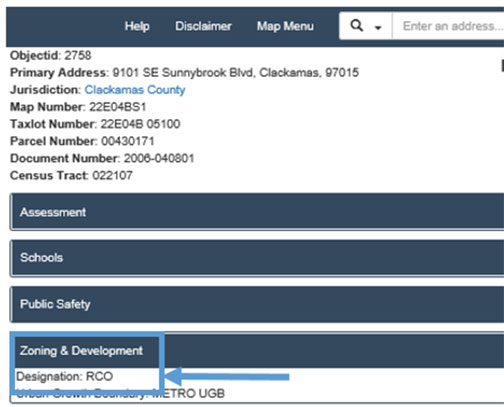
You can verify property zoning on CMap by performing a search for an address.

Property Zoning

Look up the zone designation in the County Zoning and Development Ordinance to learn more about zoning and the allowable uses.

Download the land use application(s) that best fits your project

This is the land use application process for residential, commercial and industrial development. Our most common land use applications are listed below, additional forms can be found on the Planning and Zoning webpage.

  • Accessory Dwelling in Conjunction with Farm Use – for a second accessory dwelling to house farm workers.
  • Accessory Historic Dwelling – for turning a historic dwelling in to a second accessory dwelling.
  • Appeal Form – appeal a Planning Director decision, or conditions of approval, to the Land Use Hearings Officer. Specific timelines apply; please work with our staff prior to submitting.
  • Conditional Use – request to use your property in a way that is not outright permitted in your zone. A Pre-Application Conference is required.
  • Design Review – review of proposed site development and structures for commercial, industrial and multifamily projects. A Pre-Application Conference is required.
  • Dwelling in Conjunction with a Farm Use on High or Low Value Farm Land – a single-family dwelling on Exclusive Farm Use (EFU) or Agricultural/Forest (AG/F) land when the land is currently being farmed and when a certain amount of income has been generated from the sale of crops and livestock grown/raised on the property.
  • Farm Stand – approval to operate a farm stand in AG/F or EFU zoning district.
  • Forest Dwelling – for lot of Record Dwelling, Forest Template Dwelling, 160 Acre Minimum Forest Dwelling, or 200 Acre Noncontiguous Dwelling on land zoned Timber District (TBR) or AG/F.
  • General Land Use Application - to request County land use approval when Planning and Zoning has no other application form for the type of request.
  • Home Occupation – to seek approval to use your home for your business.
  • Nonconforming Use – to request verification, restoration, replacement or a change of an existing use that does not comply with current zoning.
  • Partition – to split your property in to two or three lots. A Pre-Application Conference is required.
  • Pre-Application Conference – a meeting to provide project specific information on Clackamas County development policies, procedures, fees, and environmental regulations.
  • Property Line Adjustment – to relocate a common property line between two abutting lots. No new lots can be created with this application.
  • Subdivision – request to divide your property into four or more lots. A Pre-Application Conference is required.
  • Temporary Dwelling for Care – for a temporary manufactured dwelling or recreational vehicle to house a person who requires assistance from another person with daily activities as well as their caregiver.
  • Temporary Dwelling While Building – for a temporary second dwelling while constructing the primary residence.
  • Temporary Emergency Shelter – for a temporary manufactured dwelling or recreational vehicle to live in while constructing the primary residence.
  • Time Extension – to request additional time to implement an approved land use.
  • Variance – to request an exception to a dimensional standard, such as a minimum setback, that typically applies in your zone.
  • Vested Right Determination – determine whether an existing use is legal, based on the regulations that were in place when it was started/built.
  • Zone Change – a request to change the zone of your property. A Pre-Application Conference is required.

Paying for your permit

  • Email the rest of your completed application forms to: zoninginfo@clackamas.us.
    • Application(s)
    • Required additional documents
    • Credit card authorization
  • The subject line must read:
    • New [TYPE OF APPLICATION] Application; YOUR ADDRESS (unless the site has no address)
    • Example: New Non-Conforming Use Application; 150 Beavercreek Rd

Please note:

  • We can only accept .PDF file types.
  • Send the Credit Card Authorization as a separate PDF so we can delete it after use.
  • Staff will review for completeness.
  • We can accept attachments of up to 40MB total per email. If attachments are larger than that, please split the package into separate emails with one consistent subject line.
  • If you are unable to submit your plans electronically, please contact us. You can reach us by phone at 503-742-4500, via email at zoninginfo@clackamas.us, or you can stop by to obtain in-person assistance at our counter during our business hours

Customer Service Hours
Monday to Thursday
8 a.m. to 4 p.m.

Development Services Building
150 Beavercreek Road
Oregon City, OR 97045

Submit all documentation and payment

  • Email the rest of your completed application forms to: zoninginfo@clackamas.us.
    • Application(s)
    • Required additional documents
    • Credit card authorization
  • The subject line must read:
    • New [TYPE OF APPLICATION] Application; YOUR ADDRESS (unless the site has no address)
    • Example: New Non-Conforming Use Application; 150 Beavercreek Rd

Please note:

  • We can only accept .PDF file types.
  • Send the Credit Card Authorization as a separate PDF so we can delete it after use.
  • Staff will review for completeness.
  • We can accept attachments of up to 40MB total per email. If attachments are larger than that, please split the package into separate emails with one consistent subject line.
  • If you are unable to submit your plans electronically, please contact us. You can reach us by phone at 503-742-4500, via email at zoninginfo@clackamas.us, or you can stop by to obtain in-person assistance at our counter during our business hours

Customer Service Hours
Monday to Thursday
8 a.m. to 4 p.m.

Development Services Building
150 Beavercreek Road
Oregon City, OR 97045

Sidebar Heading
Related Information
New Format?
Off

How to Apply for a Permit: Licensed Contractors

Go to Development Direct 

All licensed contractors who need permits for mechanical, electrical or plumbing work can apply online through Development Direct Self Service Permits. These permits do not require a plan review.

  • Applications submitted through Development Direct with payment by credit card or echeck have the shortest turnaround time.
  • Applications may also be submitted in-person at the Development Services Building if paying by cash, money order, cashier's check or business checks that cannot be processed online.

Begin work and call for your inspections

There are 3 convenient ways to schedule an inspection.

Answers to common questions.
Still have questions or need further assistance:
Email: bldservice@clackamas.us
Phone: 503-742-4240

Customer Service Hours
Monday to Thursday
8 a.m. to 4 p.m.

Development Services Building
150 Beavercreek Road
Oregon City, OR 97045

Sidebar Heading
Related Information
New Format?
Off

How to Apply for a Permit: Development Engineering

Decide which permit(s) you need for your project

Utility Permits
  • Utility work and associated repairs in the public right of way
  • Utility potholing
  • Emergency work — although emergency work may initially be completed without a permit, a Utility Permit is required as soon as practicable
  • Review of erosion control and stormwater impacts associated with utility work

Notes:

  • "Wet" (sewer, storm and water) utility work associated with a development must be permitted as part of a Development Permit. "Dry" (gas, electric, telecommunications) utility work is preferably included as part of a Development Permit, but may be installed as a separate Utility Permit. All utility work associated with a development must be completed to satisfy the requirements of a Development Permit.
  • Other preliminary utility explorations are completed as a Right of Way Permit (see below).
  • Utility work not requiring a permit:
    • Over lashing work (tying additional cables to cables that are already attached to a utility pole) that does not affect the flow or safety of users of the transportation system.
    • Utility work on private property.
Development Permits
  • Public improvements, and private access and circulation work for commercial, industrial, institutional and multi-family (including apartments and condominiums) developments, subdivisions, partitions or other land use approvals
  • Improvements in the public right of way that:
    • Involve bridges, walls or other structures
    • impact drainage
    • Exceed the parameters of an Entrance or Right of Way permit (see below)
  • Dedication of public right of way or easements as part of land development
  • Work that involves environmental resource land use or environmental permitting outside a surface water management district
  • Erosion control work not related to other permits
Entrance Permits
  • New, upgraded or extended residential, agricultural or logging driveways
  • Review of adequate fire-fighting vehicle access for new structures
  • Review of erosion control and stormwater impacts associated with driveways

Note: An Entrance Permit may be upgraded to a Development Permit if land use requirements call for a construction management plan/erosion control plan.

Right of Way Permits

Miscellaneous activities in the public right of way including:

  • Minor sidewalk repair/replacement (excluding curb ramps)
  • Ditch work
  • Temporary road closures and traffic control not related to another permit
  • Paving on a local access road not related to land development
  • Block parties or organized bike, run, walk or parade events
  • Film and media
  • Revocable encroachments (privately-owned structures and facilities placed in the right of way)
  • Road vacations (converting a public road to a private road)
  • Permanent installation of gates and signs (traffic control, tourist, hamlet and village)
  • Coring and other underground explorations
  • Review of erosion control and stormwater impacts associated with work in the right-of-way

Notes

  • This permit may be upgraded to a Development Permit if there is major grading, fill, or surface water management review or that require in depth review
  • Temporary road closure applications should be submitted at least four weeks in advance of the requested road closure date to account for the two-week public notice period
  • Revocable encroachments can take several weeks to process
  • Utility potholing while boring is covered by a Utility Permit

Prepare your drawings and documents

You'll need to submit project drawings and documents. Detailed submittal requirements for each permit type are provided below:

We do not accept paper submittals. Helpful Tips:

  • All documents must be sent as PDFs.
  • Plans must be legible, and to scale with correct dimensions.
  • Plans and drawings must be in landscape/horizontal orientation.
  • If you need help scanning your drawings, a local printing shop may be able to help.
  • All drawings and documents must use the county naming conventions.

Submit and manage your project

After you determine what permits you need and the submittal requirements, you are ready to apply in Development Direct. After you apply, you will be sent an email with instructions of what drawings and documents are needed.

You will use Development Direct to respond to reviewer comments and monitor the progress of your project.

Receive permits and download drawings

When your project is approved and your permits are ready, you will receive your permits, approved drawings, and permit conditions in Development Direct. You are responsible for ensuring compliance with these documents, and should have them on-site for inspections. Your documents will be permanently stored in Development Direct, so if they are lost or destroyed, you can log in and download them again.

Start your application

Start your application or visit Using Development Direct for further guidance.

The quality of your submittal can greatly affect timelines.

Typical permit review timelines (subject to workload and staffing):

Permit TypeInitial Review TimeSubsequent Resubmittal Review Time
Development Permit4–8 weeksLess than two weeks
Entrance PermitLess than a weekTypically not required
Right of Way PermitLess than a weekTypically not required
Utility permit
(without traffic control review)
1–2 daysTypically not required
Utility Permit
(with traffic control review)
4–5 daysTypically not required

Begin work and call for your inspections

There are 3 convenient ways to schedule an inspection.

Email: engineering@clackamas.us
Phone: 503-742-4691

Customer Service Hours 
Monday to Thursday
8 a.m. to 4 p.m.

Development Services Building 
150 Beavercreek Road
Oregon City, OR 97045

Sidebar Heading
Related Information
New Format?
Off

How to Apply for a Permit: Building

Decide which permit(s) you need for your project

Agricultural Exemptionfor new, or updates to, agricultural buildings for farm use, equine and marijuana, and storage buildings related to forestry. (Make sure you review the criteria for EXEMPT structures.) NOTE: If an exemption is approved, no inspections are required.
Commercial

for constructing or altering a commercial building or commercial space. Multiple permits are often required. Please see below list of potential permits needed for a project.

  • Building/Structural Permits
    Types of work requiring Building Permits (referred to as "structural permits " to distinguish from the umbrella term "building permits ")
    • Building/Structural
      a structural permit for remodeling/altering existing spaces (tenant improvements), constructing new or adding on square footage.
    • Fire Alarm
    • Fire Sprinkler
    • Underground Fire (UG) Lines
    • Walk-in refrigerator/ freezer
  • Mechanical Permits for making changes to various mechanical units, such as heating/cooling, piping, venting, refrigeration and more.
  • Electrical Permits for installing or updating the wiring and electricity in your home business or commercial building. Low voltage systems also require an electrical permit.
  • Plumbing Permits required for:
    • Exterior – "Site work" on private property
    • Interior
    • Medical Gas

Note: "Site work" for new water, sewer or storm located in the Public Right of Way or in a public easement, will require a Development Engineering permit.

Gradingfor changing the slope or grade of your property by backfill or excavation
Manufactured Dwellingfor placement only of, mobile homes, trailers or manufactured homes. For additions and updates a building permit is required. 
Renewable Energyrelated to solar energy, water efficiency and other renewable energies.
Single Family Residential or DuplexMultiple permits are required for the construction of a new single-family residential home or duplex, or in most situations for an addition or modification to a single-family residential home or dupplex. The One & Two Family Dwelling Checklist provides additional guidance on the information and documents needed.

Contact Planning and Septic

After you decide which permit is right for you, connect with County Planning, or for our partner jurisdictions the cities of Canby, Gladstone and Molalla, to understand the land use requirements, necessary permits and submittals for your project. (You can check your jurisdiction by using CMap to search for an address). If your project will use a septic system (including revising or adding capacity to an existing system), also check with County Septic about the requirements prior to developing your project plans and documents. Failure to coordinate with Planning and Septic prior to submitting an application could substantially extend review times or lead to your submittal being rejected during Planning or Septic review.

Prepare your site plan

As part of your building permit application you must submit a site plan. The site plan can be created by the project architect, engineer, or designer, or you can use this example site plan and template to draw your proposed development then convert it to a PDF format. This plan must show all of the items listed below (where relevant).

Items to include in a Site Plan

  • Applicant's name and address
  • Legal description of the property (Township, Range, Section and Tax Lot) You can copy the Taxlot Number from CMap by search for the address. (Example: 32E05C 00812)
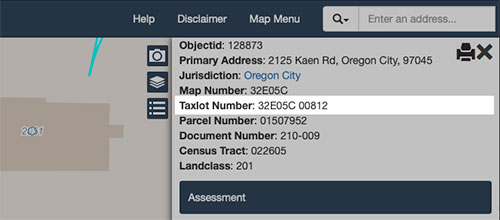
    finding your tablet number with CMap
  • Direction of north
  • Driveway location and location of adjacent streets
  • Proposed and existing structures
  • Location of any existing wells on this or adjacent properties (if not on public water)
  • Location of the septic tank, drainfield, and drainfield replacement area (if not on public sewer)
  • Approximate ground slope and direction of the slope
  • Proposed setbacks from all property lines
  • Position of all creeks, streams, ponds, springs, or other drainage-ways
  • Relative elevations at lot corners or construction area, and at the building site

Prepare your drawings and documents

You'll need to submit project drawings and documents. The guidelines on the Development Direct webpage provide information on how to prepare and submit your project plans and documents.

Please note:  

  • All documents must be sent as PDFs.  
  • Plans must be legible, and to scale with correct dimensions.  
  • Plans and drawings must be in landscape/horizontal orientation.  
  • If you need help scanning your drawings, a local printing shop may be able to help.  
  • All drawings and documents must use the County naming conventions as provided on the Development Direct webpage.

Submit and manage your project

After you determine what permits you need, connect with Planning and Septic (if needed), and prepare your drawings and documents, you are ready to submit in Development Direct. You will use Development Direct to respond to reviewer comments and monitor the progress of your project. The User Guide provides information on how to perform these tasks in the system.

  • It takes up to 10 business days for initial pre-screen/intake review of your permit documents before your project is set-up in the system.
  • Plan review takes three to seven weeks, depending on the complexity of the project.
  • Watch your Development Direct account for information regarding payments, requests for additional information and for when to download your approved drawings.

Receive permits and download drawings

When your project is approved and your permits are ready, you will receive your permits and approved drawings directly in Development Direct. Print a color copy of all approved plans, documents, and permits, and be sure to have these documents on-site for inspections. Your plans will be permanently stored in Development Direct, so if they are lost or destroyed later on, you can log in and download them again.

Begin work and call for your inspections

There are 3 convenient ways to schedule an inspection.

Answers to common questions.
Email: bldservice@clackamas.us
Phone: 503-742-4240

Customer Service Hours 
Monday to Thursday
8 a.m. to 4 p.m.

Development Services Building 
150 Beavercreek Road
Oregon City, OR 97045

Sidebar Heading
Related Information
New Format?
Off

How to Apply for a Permit: Basic Homeowner

This process is for homeowners who are doing mechanical, electrical or plumbing work on your own residence or your home based business.

These applications typically have a quick turnaround time and do not require plan review or applying through Development Direct.

Decide if a Basic Homeowner electrical, mechanical or plumbing permit is right for you

These permits cover updates and repairs you are making to your home's electrical wiring, mechanical fixtures and plumbing systems. Depending on your project, you may need more than one permit.

  • Electrical Permits
    For a homeowner to update the wiring and electricity.
  • Mechanical Permits
    For a homeowner to make changes to various mechanical units, such as heating/cooling, piping, venting, woods stoves and more.
  • Plumbing Permit
    For a homeowner to update water, sewer or storm drain lines/fixtures.

Download, fill out and submit documentation

Submit all documents to bldservice@clackamas.us for processing.  Please allow up to 48 hours for us to process your submittal. Before submitting your documents please make sure to review the following payment options.

Options for paying for your permit

Pay by credit card (Please note: credit card and/or bank service fees will apply):

  • Email authorization - Download and fill out the Credit Card Authorization to allow us to charge your credit card for your permit fees and submit with your application forms.   
  • By phone – If the balance due is less than $500, note in your email you want to pay by phone and include your daytime phone number.  We will call you when we are ready for payment.

Pay by check in person / mail: 

  • We can accept a check in person during our business hours
    8 a.m. to 4 p.m., Monday through Thursday.
  • Send check by mail:

Clackamas County
Attn: BUILDING CODES
150 Beavercreek Road
Oregon City, OR 97045

Please note, when you pay by check, we must keep your submittal on hold until we receive funds:

  • Please wait to write the check until we confirm the amount due and provide you with a permit number.
  • The check needs to be made out to: Clackamas County.
  • Reference your permit number on the MEMO line of the check.

Receive your permit

  • We will email your payment receipt and permit to you.
  • Please make sure to have a copy of the permit available at the worksite.

Begin work and call for your inspections

There are 3 convenient ways to schedule an inspection.

Answers to common questions.
Still have questions or need further assistance: 
Email: bldservice@clackamas.us
Phone: 503-742-4240

Customer Service Hours 
Monday to Thursday
8 a.m. to 4 p.m.

Development Services Building 
150 Beavercreek Road
Oregon City, OR 97045

Sidebar Heading
Related Information
New Format?
Off

Unincorporated Clackamas County Erosion Control Permits

All development projects in unincorporated Clackamas County (outside cities and special districts) must use erosion prevention and sediment control (EPSC) measures when soil is disturbed.

Some projects also require a separate erosion control permit, depending on the disturbance's size and location. See below to see if your project requires a permit.

Note: Erosion control permitting in Clackamas County is handled by different districts, including WES. Before applying, visit Erosion Control Permits in Clackamas County to confirm which district applies to your site.

Do I Need an Erosion Control Permit?

Many smaller projects do not require separate permits, but all projects must install and maintain erosion control measures when soil is disturbed.

Soil DisturbancePermit Required
Less than ½ acreNo separate permit required. EPSC measures must still be installed and maintained.
½ to 1 acreDTD Building Division EPSC permit
1 acre or moreOregon DEQ 1200-C permit
500 sq. ft. or more within 50 feet of state surface watersDTD Building Division EPSC

Applying for a DTD EPSC Permit

Apply through Development Direct or visit the How to Apply for Permits page to submit your application and erosion control plans.

DTD EPSC permits generally apply to:

  • Residential construction
  • Small commercial additions and improvements
  • Industrial additions and improvements

Note: An EPSC plan is required for all projects involving ground disturbance, even when a separate EPSC permit is not required.

Erosion Control Inspections

Most projects require an initial erosion control inspection.

  • Single-family homes and additions
    Inspection must be approved before or at the footing/foundation inspection.
  • Commercial, industrial, and multi-family projects
    Inspection must be approved before any soil disturbance, except for installing erosion control measures.

A final inspection is required after the site has been permanently stabilized.

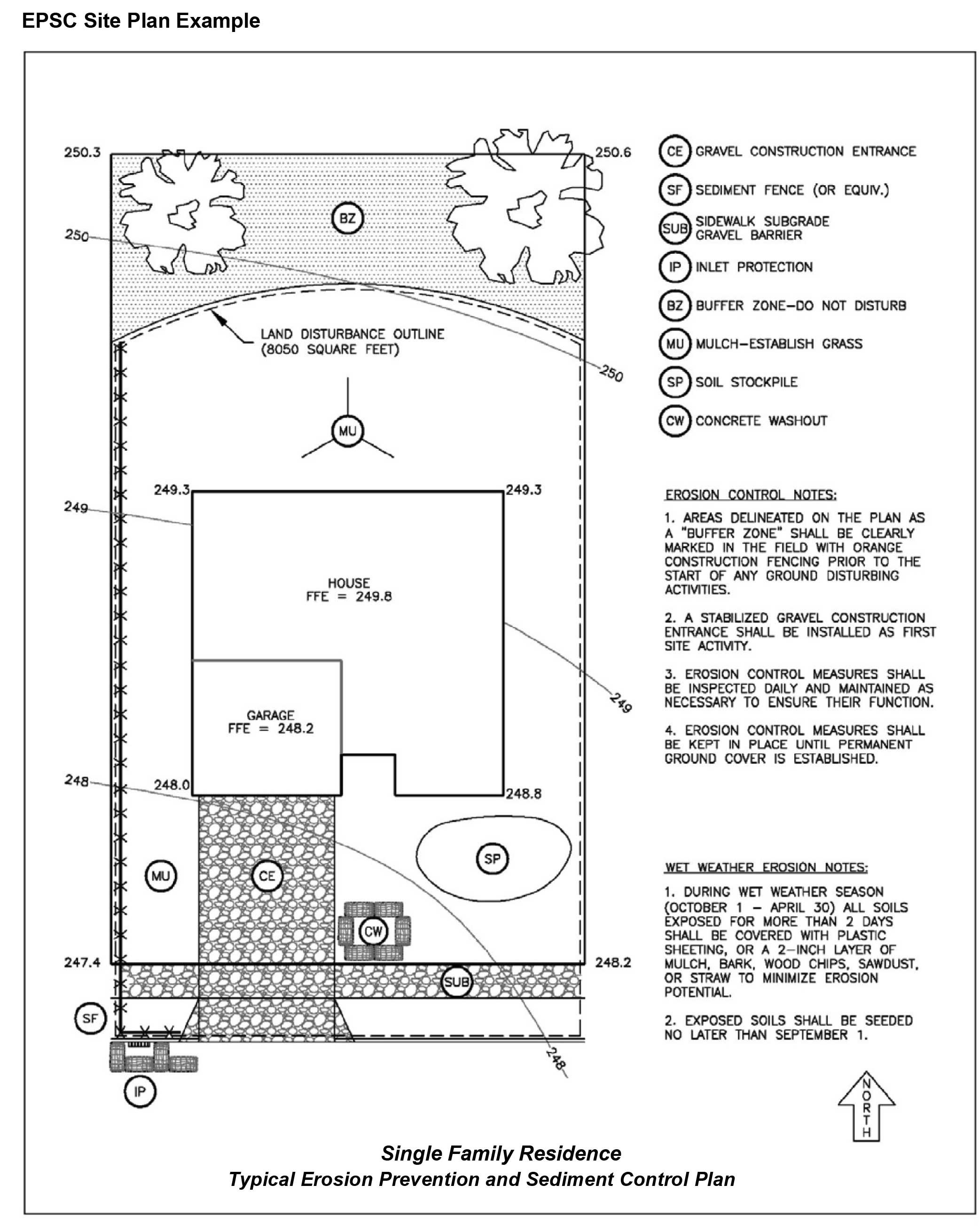
Example Site Plan

A simple Example Site Plan and basic design tips for residential construction.

Standard permit conditions:

  1. Prior to any ground disturbing activity on the site, Erosion Prevention and Sediment Control (EPSC) measures are required to be in place. An initial inspection by County staff is required at the time of the footing/foundation inspection or prior to any clearing or grading taking place. EPSC measures should be in place prior to the inspector arriving. To schedule your inspection, use the online inspection request system https://www.clackamas.us/building/inspectioncodes or call 503-742-4400.
  2. EPSC measures must be constructed in conjunction with, and prior to, all clearing and grading activities and in a manner as to ensure that sediment and sediment-laden waters do not enter the drainage system, roadways, or violate applicable water quality standards.
  3. EPSC measures shown on the plans are minimum requirements for anticipated site conditions. During the construction period, the EPSC measures shall be upgraded as needed for unexpected storm events and ensure that sediment and sediment-laden water does not leave the site.
  4. EPSC measures shall be inspected daily by the permit holder and be maintained as necessary to ensure their function.
  5. Stabilized gravel construction entrances shall be installed at the beginning of construction and maintained for the duration of the project. Additional measures may be required to ensure that all paved areas are kept clean for the duration of the project.
  6. EPSC measures shall be kept in place until permanent ground cover is established.
  7. All exposed soil must be permanently stabilized against wind and water erosion before the EPSC permit can be closed. Once the site is stabilized, schedule a final inspection by calling the number listed above or Accela Citizen Access. Permanent soil stabilization includes landscaping, seeding, or covering exposed soil with a minimum 2-inch layer of bark, straw, compost, or wood chips.

Wet weather permit conditions:

  1. Wet weather erosion prevention measures will be in effect from October 1 through April 30.
  2. Soil exposed for more than 2 days shall be seeded, or covered with plastic sheeting, matting, or a 2- inch layer of mulch, bark, wood chips, compost, or straw to minimize erosion potential.
  3. Exposed soil shall be seeded no later than September 1 to allow time for proper germination and growth before the wet weather season.
  4. Dry season erosion control measures will vary by site, regardless, the final inspection requirements will apply.

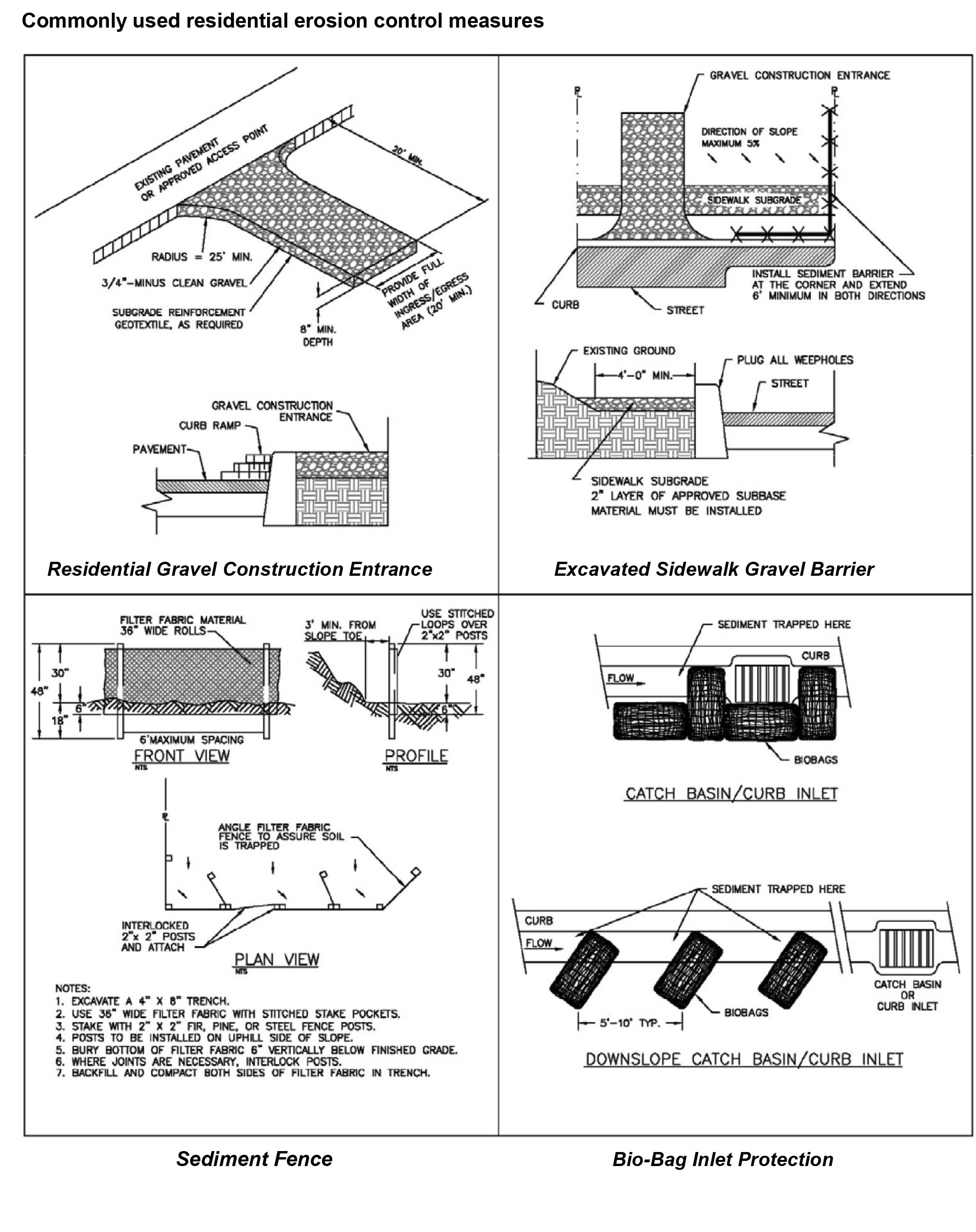
EPSC site plan example drawing Commonly used residential erosion control measures visual

Where can I get assistance?

We are here to help you. Staff are typically available to answer your questions by phone from 8:00 a.m. to 4:00 p.m. on Monday through Friday 503-742-4240 or in person at the Building Division located at 150 Beavercreek Rd. Oregon City, OR 97045 from 8:00 a.m. to 4:00 p.m. Monday

EPSC Planning and Design Manual

The Erosion Prevention and Sediment Control (EPSC) Planning and Design Manual provides approved methods, materials, and maintenance standards for construction sites.

Training

Training on erosion control installation and maintenance is available from private providers. Clackamas County does not approve or endorse specific training companies.

Sidebar Heading
Related Information
New Format?
Off

Erosion Control Permits in Clackamas County

When construction or development disturbs soil, it can cause erosion that harms nearby properties, streams, and rivers. Erosion control helps protect water quality and keep our communities healthy.

Depending on your project's location, your erosion control (EPSC) permit will be issued by one of several local agencies. The rules are the same countywide, but the permitting process and point of contact may differ.

Find Out Who Issues Your Permit

Not sure which erosion control district you live in? Put your address in the field below to return the contact information for your specific address.

Find my district

Sidebar Heading
Related Information
New Format?
Off