Assessment and Taxation

Assessment and Taxation

Where Your Tax Dollars Go

Property taxes support your local services
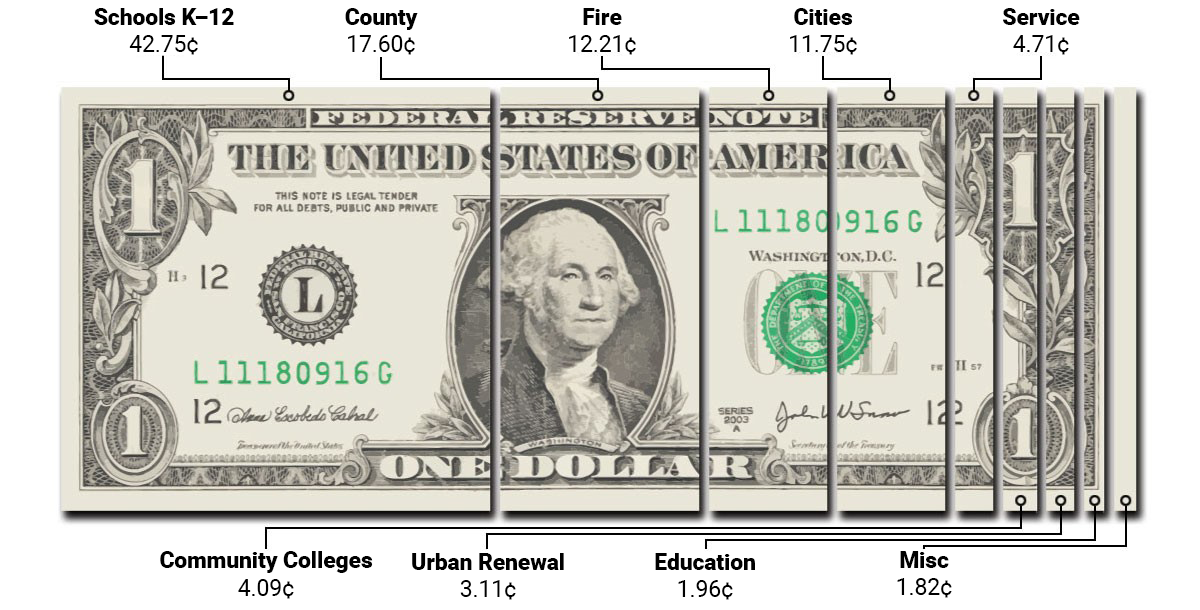
Property tax breakdown diagram

  • Schools K-12: 42.75¢
  • County: 17.60¢
  • Fire: 12.21¢
  • Cities: 11.75¢
  • Service: 4.75¢
  • Community Colleges: 4.09¢
  • Urban Renewal: 3.11¢
  • Education: 1.96¢
  • Miscellaneous: 1.82¢

How county tax dollars are spent

Diagram of how tax dollars are spent

  • Public Safety: 70.3%
  • General Government: 11.4%
  • Health, Housing & Human Services: 5.8%
  • Assessment & Taxation: 5.4%
  • Debt Services: 2.7%
  • Culture, Education, and Recreation: 2.6%
  • Economic Development: 1.8%

Clackamas County

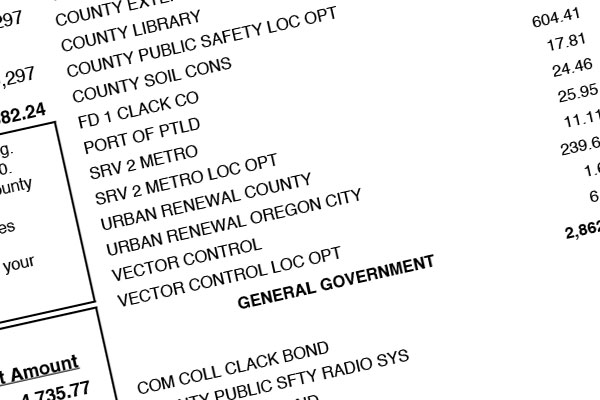
The elected Clackamas County Board of County Commissioners govern the County Offices and there are several different county levies dedicated to certain services as shown below:

  • County Public Safety 
    Preserves life, upholds the law, prevents crime, holds offenders accountable and promotes safety in Clackamas County.
  • Enhanced Law Enforcement 
    Provide enhanced law enforcement services by contract with the Clackamas County Sheriff. The district is also authorized to construct, maintain and operate appropriate service facilities to fulfill that purpose.
  • Library 
    The library district was organized under provisions of ORS Chapter 451 to provide financial support to the library service providers of Clackamas County in order to operate city libraries.
  • County Rural/City 
    The county general fund receives revenue from the permanent rates established under Measure 50 by service area. Incorporated Clackamas County consists of all city boundaries except the following: Barlow, Estacada, Johnson City and Rivergrove. Clackamas County Rural contains the rest of the county outside the incorporated areas.
  • County Emergency Radio Communication System

Colleges

There are 3 community colleges within the county. Clackamas Community College is wholly within our county; Mt Hood and Portland Community Colleges stretch across other counties.

Educational Service Districts (ESD)

There are 5 ESDs in Clackamas County that service K-12 school districts.

The purpose of ESDs is to develop, strengthen and maintain both formal and informal channels of communication with local school districts, the Oregon Department of Education and other external educational and governmental agencies. The ESD Board of Directors is also the boundary board for education districts, overseen by the Oregon Dept. of Education.

The Clackamas ESD serves teachers and students in 10 school districts in Clackamas County — a geographic area of 1,879 square miles. As one of Oregon's 19 ESDs, Clackamas ESD works to provide our county's school districts with a wide variety of educational programs and services, many of which are too costly or too limited in demand for a single location.

Service districts

Service districts are organized under ORS 451 and can be organized under varying ORS chapters and provide various services.

  • Clackamas County Service District No. 1 and Water Environment Services (WES) were organized to construct and operate sanitary sewer systems and to serve those unincorporated areas which drain into the lower Tualatin River and the Oswego Lake Basin within the county's boundaries.
  • Clackamas County Service District No. 5 constructs and operates facilities for lighting of streets and highways in a  designated area of Clackamas County.
  • Metro Service District (Metro) was formed in the 1950s under ORS 268 and serves more than 1.5 million people in Clackamas, Multnomah and Washington Counties. The District’s boundary encompasses Portland and 24 other cities from the Columbia River in the north to the bend of the Willamette River near Wilsonville, and from the foothills of the Coast Range near Forest Grove to the urban growth boundary in the east. Metro manages the urban growth boundary and provides region-wide planning and coordination to manage growth, infrastructure and development issues that cross jurisdictional boundaries. It protects farms and forests from urbanization, provides services that are regional in nature and manages 17,000 acres of parks, trails and natural areas. Metro runs the Oregon Zoo, Oregon Convention Center, Portland Expo Center and Portland's 5 Centers for the Arts. Metro oversees the region's solid waste system working with communities and industry partners to reduce waste in a cost effective manner.

Urban renewal

Clackamas County Development Agency was organized in December 1977 under the provisions of ORS Chapter 457 as the urban renewal of the county responsible for implementing public improvement programs in the vicinity of the Clackamas Town Center Shopping Mall and other industrial and recreations areas of the county.

The city urban renewal agencies are: Canby, Gladstone, Estacada, Happy Valley, Lake Oswego, Milwaukie, Molalla, Oregon City, Portland, Sandy and Wilsonville.

Water districts

Water districts provide wastewater collection and treatment and water quality enhancement services for Clackamas County communities.

Miscellaneous

  • Vector Control 
    Responsible for the prevention, control or eradication of public health vectors and vector habitats with the district and for control of predatory animals with the district. Also protects health and enhances livability through control of the rat and mosquito populations, and serves as a resource for addressing public health vector problems. Programs include rodent control, mosquito control and code enforcement, which enforces some specific county and city municipal codes.
  • TriMet Transportation 
    TriMet provides bus, light rail and commuter rail service in the Portland metropolitan area. Their transportation options connect people with their community, while easing traffic congestion and reducing air pollution — making our region a better place to live. TriMet currently does not levy any property tax in the three regional counties, Clackamas, Multnomah and Washington.
  • Clackamas County Extension and 4-H Service District 
    This district is not governed by Clackamas County but was organized under provisions of ORS Chapter 451 to provide financing to Oregon State University educational agricultural extension programs.
  • Clackamas County Soil and Water Conservation 
    Oregon's Soil and Water Conservation Districts provide technical assistance, educational outreach, and other conservation services to landowners, managers, and citizens. The district provides leadership in delivery of state water quality programs, watershed enhancement programs, and local conservation efforts that contribute to the Oregon Plan for Salmon and Watersheds. The districts coordinate and partner with state and federal natural resource agencies, private organizations and local governments.
New Format?
On

GASB 77 Tax Abatement Information

The tax expenditure information provided by the Clackamas County Department of Assessment & Taxation is a complete list of exempt properties in Clackamas County as certified on the tax roll. The data information can be downloaded for use by each governmental entity responsible for reporting.

Please refer to GASB 77 for specific disclosure requirements. Each governmental entity is responsible to determine which programs, from the data provided, qualify as abatement programs for their respective entity. The calculation of any associated abatement amounts are an estimate and solely the responsibility of entity management.

Clackamas County GASB 77 Data

Helpful Information

Information about the data provided

The data does not contain district information for bonds.

All data is applicable to the certified year noted.

Description of data
TermDescription
ParcelUnique property account number for county
TCATax Code Area number that identifies the unique mix of taxing districts for a specific property
District NameTaxing District
Exempt CodeClackamas County exemption type code
Exempt NameDescriptive name of exemption type
ORSOregon Revised Statute specifically for the exemption type indicated on each property
Property Class Type3 digit numeric identification of property class where the first number notes the property type, i.e. residential, commercial, etc. See "property class types" for more detail
Measure 5 Market ValueThe market value of the specified property used to test compression under Measure 5
CPRChange Property Ratio. CPRs are calculated annually and used to adjust the market value of new construction or other exception value before adding it to the Maximum Assessed Value as prescribed under Measure 50
District Tax RateTax rates are adjusted by urban renewal calculations

How to use the data provided

After downloading the data to an Excel Spreadsheet, set the filter function on the header row. Filter on the district name and then select the exemption name(s) to select the properties applicable to the required reporting by your governmental entity.

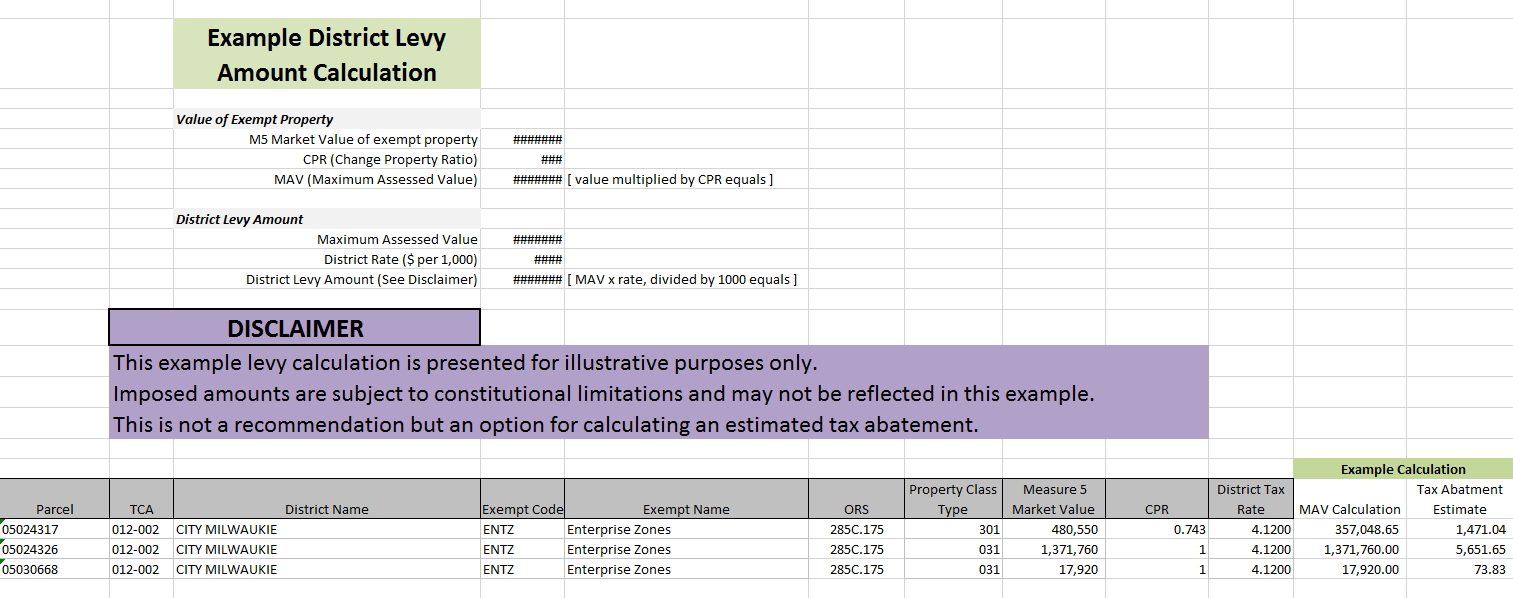
Illustrative calculation example

Example of calcuation

Change Property Ratio (CPR)

Clackamas County CPRs (Change Property Ratio) [PDF]

Property Class Characteristic Codes

CodeDescription
003Misc, Operating Assessed
014Misc, Res zone, Historical
015Misc, Res zone, Open Space
024Misc, Commercial zone, Historical
025Misc, Commercial zone, Open Space
035Misc, Industrial zone, Open Space
045Misc, Tract land, Open Space
081Misc, Rec, Improved, Summer Home Site
085Misc, Recreation, Open Space
087Misc, Recreation, Timeshare Condo
095Misc, Exempt, Open Space
100Residential land, vacant
101Residential land improved
102Residential condominium
151Res, EFU, Imp in a Water Dist
170Residential Vacant Non-Farm Variance
171Residential Improved Non-Farm Variance
200Commercial land, vacant
201Commercial land improved
300Industrial land, vacant
301Industrial land improved
303Industrial State appraised
400Tract Land, Vacant
401Tract Land Improved
470Tract Land Vacant Non-Farm Variance
471Tract Land Improved Non-Farm Variance
540Non EFU farmland vacant
541Non EFU farmland improved
550EFU farmland vacant
551EFU farmland improved
640Forestland vacant
641Forestland improved
660Small Tract Forestland Option Vacant
661Small Tract Forestland Option Improved
680Forest & Farm Land Vacant
681Forest & Farm Land Improved
700Multi-Family vacant
701Multi-Family Improved
707Manufactured Structure Park
781Specially Assessed Low Income Housing
800Recreational vacant
801Recreational improved

Exemption Code List

Exempt CodeExempt NameORS
CEMTRCemeteries307.150
CFUCComm. Fac. Under Const.307.330 to 340
CHHISTORICAL358.505
CHRTYCharitable Property307.130
CIPEZConstruction in Process (CIP) Enterprise Zone307.330 to 340
CITPRCities and Towns307.090
CTYPRCounty307.090
DAYCRDay Care307.145
ENTZEnterprise Zones285C.175
FARMHFarm Housing307.480
FEDGVFederal Government307.040, 307.050, 3.07.060
FIRDPFire District Property307.130
FPMEFood Processing - M&E307.455
FRATOFraternal Organizations307.134
HOAUTHousing Authority456.225
HONCLow Income Housing NP307.540 to 548
INVTYInventory307.400
METROMetro307.090
PARKPark Privately Owned307.115
PORTPPort307.120
RELGSReligious307.140
SCHOLSchools307.09
SENCESenior Service Centers307.147
STALBState Land Leased307.168
STAPRState Property307.090
VERTVertical Housing Development307.841 to 307.867
VETADVeteran Reservists on Active Duty307.286
WATRAWater Associations307.210
New Format?
On

Assessment & Tax Roll Summaries

SAL Tables-ORS 309.330

Tax District Certified Tax

Education

2025 2024 2023 2022 2021

General Government

2025 2024 2023 2022 2021

Urban Renewal Plans

County North Clackamas Revitalization

2025 2024 2023 2022 2021

City of Canby

2025 2024 2023 2022 2021

City of Estacada

2025 2024 2023 2022 2021

City of Gladstone

2025 2024 2023 2022 2021

City of Happy Valley

2025 2024 2023 2022 2021

City of Lake Oswego East End

2025 2024 2023 2022 2021

City of Lake Oswego Lake Grove

2025 2024 2023 2022 2021

City of Milwaukie

2025 2024 2023 2022 2021

City of Molalla

2025 2024 2023 2022 2021

City of Oregon City

2025 2024 2022 2021

City of Portland

2025 2024 2023 2022 2021

City of Portland Cully

2025 2024 2023

City of Portland 82nd Ave

2025

City of Portland Lloyd-Holliday

2025

City of Portland C Eastside

2025

City of Portland SPACC

2025

City of Portland Westside

2025

City of Portland East 205

2025

City of Sandy

2025 2024 2023 2022 2021

City of Tualatin Basalt Creek

20252024 2023 2022

City of Tualatin Core

2025 2024

City of West Linn

2025 2024

City of Wilsonville

                                2022 2021

City of Wilsonville Coffee Creek

2025 2024 2023 2022 2021

City of Wilsonville West Side

                     2023 2022 2021

City of Wilsonville Twist

2025 2024 2023

Summary of Property Tax

Statement of Taxes Levied

2025 2024 2023 2022 2021

Where Your Tax Dollar Goes

2025 2024 2023 2022 2021

Tax History

2025 2024 2023 2022 2021

Local School Levies

2025 2024 2023 2022 2021

Local Government Levies

2025 2024 2023 2022 2021

Special Taxes Levied

2025 2024 2023 2022 2021

Public Utilities

2025 2024 2023 2022 2021

Highest Tax Due Values in Clackamas County

2025 2024 2023 2022 2021

Tax District Rate Information

List of Taxing Districts by Name

2025 2024 2023 2022 2021

Tax District Rates

2025 2024 2023 2022 2021

Tax code rate detail

2025 2024 2023 2022 2021

Tax code rate totals

2025 2024 2023 2022 2021

Recap of Incorporated Areas

2025 2024 2023 2022 2021

Tax District Value Information

Value Summary

2025 2024 2023 2022 2021

Value History

2025 2024 2023 2022 2021

Assessed Value by Property Type

2025 2024 2023 2022 2021

Measure 5 Market Value by Property Type

2025 2024 2023 2022 2021

Market Value by Property Type

2025 2024 2023

District Ratio of Assessed Value to Measure 5 Value

2025 2024 2023 2022 2021

Commercial/Residential Property Values

2025 2024 2023 2022 2021

Changed Property Ratio History

2025 2024 2023 2022 2021

Farm and Forestland Soil Type Value Table

2025 2024 2023

Untitled Document
New Format?
On

Frequently Asked Questions

Here you will the find answers to some of our most commonly asked questions.

I have a new mortgage company. Will they pay my taxes this year?

Mortgage companies notify us by September 1st which accounts they expect to pay taxes on. Any changes between that time and Nov. 15 are not reflected in our records. If you have any questions regarding who is paying your property taxes, we suggest you contact your new mortgage company. Please remember, you are ultimately responsible for paying your taxes timely.

What are Forestland Fire Protection Fees?

The Oregon Department of Forestry protects nearly 16 million acres — mostly private lands — from wildfire. Forestland owners in the North Cascade Fire Protection District will see the fire protection assessment with a minimum cost of $20.00 ($1.7856 per acre) and the surcharge for improved properties $58.00. For more information, you may contact the Clackamas County district office in Molalla at 14995 S Hwy 211 in Molalla. Their phone number is 503-829-2216.

I've built a new house. When do I start paying property taxes?

The assessment date for all property is January 1. This means new construction is valued at the percent completed on January 1. If 50% complete, then a house is valued at half its market value, and the assessed value for tax purposes is adjusted to include this market addition using the Measure 50 rules. If construction on your house was started after January 1, then you will pay tax only on the land until the following year

What if I remodel or add a structure to my property?

The new improvements will be appraised at market value. The new taxable value is computed by adjusting the new additions market value with the Measure 50 rules. This gives new property a similar adjustment to other property that received the Measure 50 assessed value roll back.

Why is my purchase price different than the Assessor's market value?

The Assessor's office does not automatically adjust market value to the selling price of a property. We consider all sales that occur in a neighborhood to arrive at a market value. The Assessor also uses a complex recalculation and sales analysis program to annually update market values.

What will happen if real estate prices drop causing market values to fall below assessed values?

The real market value (RMV) on your tax statement represents the market value of the property as of January 1, each year. This is the estimate of value the property would have sold for on that date. It is important to understand that your property taxes are based on your assessed value, not market value. In most cases assessed values are significantly lower than market values. A decline in the market value does not automatically reduce your Measure 50 assessed value unless real market value falls below your maximum assessed value.

How is my Assessed Value calculated?

The assessed value (AV) on your tax statement is the value used to calculate your property taxes. For most property, the maximum assessed value was established in 1997 under Measure 50 by taking 90% of the 1995–96 market value and has continued to grow by 3% annually. If you have new construction, remodeling or additions to your property, the assessed value may increase more than the typical 3%. These are examples of exceptions to Measure 50 that allow the property's assessed value to grow more than the typical 3%. New construction, additions and remodeled properties do receive a Measure 50 benefit similar to existing property. The market value of the new construction is reduced by the ratio of the maximum assessed value to real market value of similar classes of property calculated county-wide. Once a new assessed value is established, it then continues to grow by the annual 3% increase required by Measure 50.

New Format?
On

Business Personal Property

If you’ve filed a return through eNoticesOnline, you will not receive a paper tax statement in the mail. Your tax statement will be available on the eNoticesOnline website, or you can follow the “Property Tax Statements” link below.

Filing and statements

eNotices logo

E-Filing Business Personal Property Taxes

Learn how to secure electronic access to your asset lists and tax statements, as well as the ability to file your returns electronically.

Property tax satement

Property Tax Statements

Search tax statements by year.

Frequently asked questions

Who files a personal property tax return?

  • Each individual, partnership, firm, or corporation that has taxable personal property must file a return by March 15 of each year.
  • If you were assessed the previous year, the county assessor, prior to Jan. 1 will mail a Confidential Personal Property Tax Return form to you. You must report property you own or had in your possession as of Jan. 1 at 1 a.m. If you do not receive a form from the assessor, you are still obligated to obtain and file a personal property tax return. There is a penalty for late filing. If you need help completing the form, contact your county assessor's office at 503-655-8671 extension 7612 or 4223, or dial direct at 503-742-4223.
  • If you sell your business, notify the county assessor to avoid future liability on the personal property.

What personal property is not taxable?

These items are exempt from property tax:

  • Intangible personal property. Money at interest, bonds, notes, shares of stock, business records, computer software, surveys and designs, and the materials on which the data are recorded (paper, tape, film, etc.) (ORS 307.020).
  • All items held exclusively for personal use. Household goods, furniture, clothing, tools, and equipment used exclusively for personal use in and around your home (ORS 307.190).
  • Farm animals. Livestock, poultry, fur-bearing animals, and bees (ORS 307.394).
  • Inventories. Items of tangible personal property which are or will be sold in the ordinary course of business (materials, containers, goods in process, and finished goods) (ORS 307.400).
  • Farm machinery and equipment (ORS 307.394).
  • Licensed vehicles other than fixed load/mobile equipment (ORS 801.285).

What if I file late?

The penalty is 5% of the tax owed if the return is filed after March 15, but on or before June 1. The penalty increases to 25% of the tax owed if the return is filed after June 1st, but on or before Aug. 1. After Aug. 1, the penalty is 50% of the tax owed (ORS 308.296).

What happens after the return is filed with the county assessor?

Your return will assist in the valuation of your personal property. In some cases an appraiser may inspect your property. Your return will remain a confidential record at all times. After Oct. 25, you will receive a tax statement showing the value of your personal property and the amount of tax due.

Contact

Questions? Contact our office at 503-655-8671 and ask for assistance with Business Personal Property.

Download an Information Circular about Business Personal Property Tax or a Personal Property Return from the State.

New Format?
On

Selling, Moving or Demolishing a Manufactured Home

Ownership transfers

Ownership Transfers are processed by the State Department of Consumer and Business Services Building Codes Division (BCD) or through a title company. The new process changes the ownership and location of a home in the State records. Simply signing off on an ownership document or sales agreement does not transfer ownership.

Records in the Assessor's office will be updated only after we receive notice from BCD that a transfer has been completed. Until the transfer is complete, our records will show the selling party as responsible for all property taxes.

Selling a manufactured home

To complete the process, you will need to do the following:

  1. Pay all property taxes, interest and fees due, as well as an estimated tax for the current fiscal year at the time of the transfer. All tax payments must be secured with certified funds, cash or cashier's check — no personal checks will be accepted for this process.
  2. Fill out a Manufactured Home Ownership Document Application for New and Used Homes (PDF from the Oregon Building Codes Division). The Assessor's Office will confirm that the taxes are paid in full and issue a tax certification. There is a $25 fee to process this form, which can be paid with cash or check. Bring or mail the form with your payment to our office at 150 Beavercreek Road in Oregon City, OR 97045. The form will be returned to you and must accompany any forms submitted to BCD.
  3. Provide the current DMV title or BCD ownership document signed off by the seller(s) and any lien holder(s).
  4. Send all forms with payment of $55 for the transfer fee to the address shown on the BCD forms.

You may call us at 503-655-8671 for more information or contact BCD at 503-378-4530 or 503-373-1249 or on their website.

Moving a manufactured home

  1. Secure a placement permit from your local Planning Department to be sure that the manufactured structure may be sited at the new location.
  2. To obtain a trip permit for a home moving out of Clackamas County, all taxes for the current fiscal year must be paid. You will need to complete and supply our office with the Manufactured Home Ownership Document Application for New and Used Homes (PDF from the Oregon Building Codes Division). You will need a county Tax Certification form for the county where the home is moving from and obtain a form for the county the home is moving to. Clackamas County charges a $25 fee for this form.
  3. Send the Manufactured Home Ownership Document Application for New and Used Homes form and county Tax Certification, along with a payment for the $55 transaction fee and trip permit fee (each section requires a $5 trip permit), payable to Oregon Department of Building codes, to the address listed on the BCD form.
  4. In October, you will receive a tax bill from the county where the manufactured home was located as of January 1 that year.

Exempting a manufactured home from ownership document

Your DMV title or Ownership Document may be eligible for the exemption process if the ownership of your land and manufactured home are the same. This exemption means that the structure is recorded as part of the land account and is considered real property for all purposes. For more details on how to complete this process, please contact us at 503-655-8671 or BCD at 503-378-4530 or 503-373-1249. You may also contact any Title Insurance company.

Demolishing a manufactured home

  1. Pay all property taxes, interest and fees currently due.
  2. File a Manufactured Home Ownership Document Application for New and Used Homes (PDF from the Oregon Building Codes Division) form with the Assessor's office (there is no processing fee) and submit the current title or ownership document.
  3. One of our appraisers will verify the home no longer exists for the applicable tax year. We will notify BCD that the home has been demolished.
New Format?
On

Property Tax Deferral for Disabled and Senior Citizens

State programs may allow you to delay paying property taxes on your residence.

You may qualify for the following deferrals if you are:

Disabled Citizens' Deferral

  • disabled
  • receiving Social Security disability benefits by Dec. 31 the year before you file
  • a homeowner in Clackamas County

Senior Citizens' Deferral

  • at least 62 years old by April 15 the year you file
  • a homeowner in Clackamas County

Additional requirements

Net worth

Your net worth limit is $500,000.

  • Net worth is the total of the current market value of all of your assets minus any debts. It does not include the value of the home for which you're claiming property tax deferral, the cash value of your life insurance policies or tangible personal property (vehicles, furniture, appliances, clothing, etc.) that you own.
  • Assets include:
    • Real property (other than the property for deferral)
    • Cash
    • Checking and savings accounts
    • Bonds

Income criteria

For 2026, annual household income during 2025 cannot exceed $70,000. Household income includes the income of all persons living in the home with you.

Home occupancy

You must have both owned and lived on the property for at least the last five full years ending April 15. If you lived away from the property due to medical reasons, you must attach a medical statement on letterhead from your healthcare provider stating that you are required to be away for health-related reasons.

Homeowner's insurance

You must show proof of homeowner's insurance that covers fire and other casualties.

Real Market Value

The real market value (RMV) of your home cannot be more than 100% of the county median RMV, but there are graduated allowances based on additional years of occupancy.

Interest

Deferral accounts accrue interest at the rate of 6% yearly. Interest continues to accrue each year on the balance of deferred tax amounts paid by the Department of Revenue.

Re-certification

To remain in the program, you must "re-certify" every two years. This means you must re-apply for the program every other year and meet all of the qualifications. If you do not re-certify or qualify, the state will not pay your property taxes.

For either deferral program, you must have a recorded deed to the property or be buying the property under a recorded sales contract. Certain trust or trustee arrangements qualify for deferral. You would not be eligible for deferral if you have a life estate interest in the property.

Additional information

Reverse mortgages

House Bill 2587 (2019) allows homes with certain reverse mortgages to qualify for the Senior and Disabled Deferral Program.

You may qualify for deferral if you entered into a reverse mortgage between July 1, 2011, and December 31, 2016, and have equity in your home of at least 40% as of the date of your deferral application. This does not enable retroactive deferral payments for prior tax years but enables deferral to pay the taxes to the county going forward for homes that qualify.

The State records a lien on your property

  • The deferred taxes paid by the state become a first lien on your property, except for the liens of mortgages or trust deeds that were recorded first.
  • The lien amount is an estimate of future taxes to be paid and interest to be charged, based on life expectancy tables.
  • When the Oregon Department of Revenue has approved your application, you must tell your mortgage holder that the state will be paying your taxes.

Paying the deferred taxes

The deferred taxes plus interest have to be paid when any of the following occurs:

  • The taxpayer getting the deferral passes away leaving no surviving spouse
  • You sell the property or in some way change the ownership
  • You cease to permanently live on the property

How to file

You need to file an application with our office between Jan. 1 and April 15 to defer the taxes due the following Nov. 15.

Income verification is required when you file.

If you have questions, or wish to file, you can contact our office at 503-655-8671 and ask for assistance with the Senior Tax Deferral Clerk.

Program Deadlines and Qualifications

New Format?
On

Measures 5 and 50

Measure 5 tax limitation

The Oregon Constitution sets limits on the amount of property taxes that can be collected from each property tax account. These limits are often called the "Measure 5 limits."

To calculate these limits, taxes are divided into categories described in the constitution. The categories are:

  • Education: $5 per $1000 of RMV
  • General government: $10 per $1000 of RMV

Please note that these limits are based on the real market value (RMV) of the property, not the "taxable assessed value."

Some taxes, usually for general obligation bonds, are not subject to limitation.

If taxes in either category exceed the limit for that property, the taxes are reduced or "compressed" until the limit is reached.

Local option taxes are compressed first. If the local option tax is compressed to zero, and the limit still hasn't been reached, the other taxes in the category are proportionally reduced.

Measure 50 value limitation

Measure 50 rolled back the 1997–98 assessed (taxable) value of each property to 90% of its 1995–96 value. This is known as Maximum Assessed Value (MAV). Adjustments to MAV are made for items such as new construction.

Key facts:

  • Limits future growth on maximum assessed value to 3% annually, unless it exceeds the real market value.
  • Taxes are based on the lower of real market value (RMV) or maximum assessed value (MAV), which is known as assessed value (AV).
  • Exceptions to the 3% cap are for items such as new construction, remodeling, new subdivisions, and rezoning which may increase assessed value and taxes more than 3%.
  • AV can also increase more than 3% when Real Market Value is less than Maximum Assessed Value and market values are increasing.
  • Established permanent tax rates for all local districts with existing tax bases and serial levies.
  • Allows voters to approve new short-term local option levies to fund additional services or approve bond measures for capital improvements. These are outside the permanent rate limits and need to be approved at a general election or an election with at least a 50% turnout (double majority).

Helpful videos

Video courtesy of Washington County

How to appeal your property value

If you disagree with the value of your property as shown on your tax statement, you may file an appeal with the Property Value Appeal Board (PVAB). You can get petition forms and information from the County Clerk by calling 503-655-8662.

A reduction in RMV will not mean a reduction in taxes unless the RMV is reduced below the AV — except in situations such as new construction and remodeling, if RMV is lowered then AV is reduced and taxes are decreased.

Note: Some properties may experience a small refund, particularly where there are school local option levies, when RMV approaches AV due to the Measure 5 tax rate limits.

New Format?
On

Property Value Appeals

Contact the Assessor’s office at 503-655-8671 if you have questions regarding your property value. If you feel the market value shown on your tax statement is too high, we encourage you to file an appeal with the Property Value Appeal Board (PVAB).

  • The deadline to file an appeal is December 31 — or the first working day in January, if December 31 falls on a weekend.
  • Appeals to the Property Value Appeal Board (PVAB) must be filed after receipt of your tax bill.
  • Contact the Clackamas County Clerk’s office at 503-655-8662 for filing information, specific petition guidelines and to see a petition filing checklist for filing your appeal.
  • Appeals are for the current tax year only.

If you miss the above deadline, or you disagree with a prior year's value, you may file an appeal with the Magistrate Division of the Oregon Tax Court. Appeal forms may be obtained by calling the Oregon Tax Court, Magistrate Division at 503-986-5650. Certain standards must be met to have appeals to the magistrate heard. All appeal forms are available in the Assessor's Office or you can download an Information Circular (PDF from the Oregon Department of Revenue) about the appeals process.

New Format?
On

Property Tax Bill Payment Options

Ways to Pay

The Clackamas County Assessor’s Office strives to make services inclusive. If you encounter accessibility barriers, please contact us at 503-655-8671 or propertytaxinfo@clackamas.us. We will do our best to respond to your inquiries within two business days. 

Mail icon

By mail

Clackamas County Assessor & Tax Collector
150 Beavercreek Road
Room #135
Oregon City, OR 97045

Only send a check or money order, do not mail cash. Please make your check payable to Clackamas County Tax. Your canceled check is proof of payment.

Mail your payment in the windowed envelope provided in your tax statement.

Be sure to mail your payment early enough to be postmarked on or before Nov. 15. According to Oregon law, if the postmark is after the payment due date, discounts are not allowed and interest will accrue on the past due portion. If the due date falls on a weekend or a legal holiday, the due date is extended through the next business day.

Online icon

Online

Pay your property taxes online via credit, debit or e-check online.

Convenience fees

You will be charged a convenience fee by US Bank, our online payment service provider.

  • E-check: $3
  • Visa, MasterCard, American Express and Discover credit card: 2.49%
  • VISA debit card: $3.95
  • Mastercard debit card: 2.49%
Bill Pay

Bill Pay

Pay your property taxes using your financial institutions bill payment service.

Important notice for bill payment service users: Use of electronic bill pay services offered by financial institutions is a convenience provided by your bank and is not affiliated with or controlled by the Clackamas County Assessment and Taxation Office. Payments initiated through these services may take several business days to process and are not considered received until actually delivered and posted by the County. Taxpayers are responsible for ensuring timely payment. Loss of discount and / or penalties or interest may apply to late payments regardless of the payment method used.

In person icon

In person

150 Beavercreek Road, Room #135, Oregon City

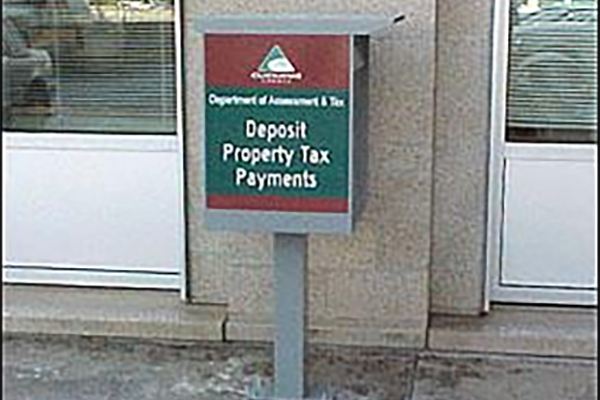
Our payment drop box is located at the front of our building.

Drop box near front door

Property tax payment drop box


Early and Late Payments

Discounts and installments

If you pay your bill early, you may qualify for a discount.

  • Full payment by Nov. 15:
    3% discount on the current year
  • 2/3 payment by Nov. 15:
    2% discount on the current year
    Pay the remainder by May 15.
  • 1/3 payments by Nov. 15: 
    0% discount on the current year
    Next 1/3 payment by Feb. 15.
    Pay the remainder by May 15.

Interest on late payments

Interest will be charged on any payment made after the installment due date for the schedule you choose. The rate of interest is determined by Oregon statute, which is 16% annually or 1.333% monthly until paid. If property taxes are not paid on time, interest accrues on the 16th of each month.

Payments made with electronic bill pay services must be received in our office by the due date. Please request your payment in advance with your bill pay provider.

Payments made with checks that are returned by the bank are not eligible for any discount.

Delinquent taxes and lien dates

Real property tax is delinquent if not paid by May 15. Foreclosure proceedings on real property begin when taxes have been delinquent for 3 years. Real property tax accounts with an unpaid balance for any tax year marked with an (*) on the front of your tax statement are subject to foreclosure if not paid on or before May 15. Property tax payments must be credited to the earliest year that taxes are due. For example, if you owe taxes for 2020, 2021, 2022 and 2023, any payment made will be first applied to 2020 and so forth.

Learn more about foreclosures.

Prepayment of property taxes

Unless authorized by law, no prepayments of property taxes that have not been certified by a taxing district shall be collected or accepted (OAR 150-311-0260). Examples of law allowing prepayment of taxes include recording a subdivision, creating a condominium or moving a manufactured home.

New Format?
On